When the burial party reached the top of the hill, they found George Armstrong Custer stripped naked except for his socks, his body propped against fallen soldiers as if he were merely sleeping. But the peaceful appearance was deceiving. His chest and head had been pierced by bullets. His brother Tom lay beside him, gutted, with his scalp torn away.
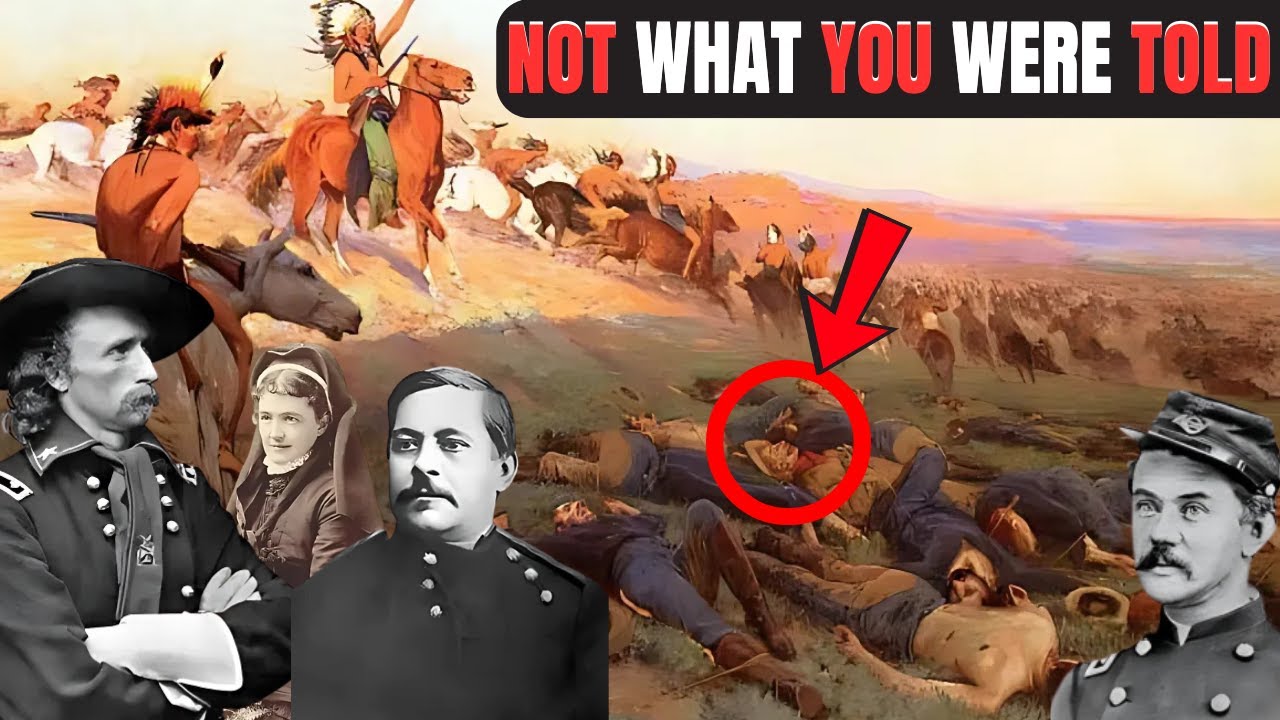
The army told the world that Custer died bravely, untouched by the horrors around him. That was a lie. They lied to his widow. They lied to the public.
The mutilations on the battlefield were far more extensive than anyone was allowed to know, and the full truth would be deliberately hidden for years. After the Battle of the Little Bighorn in June 1876, the victorious Lakota and Cheyenne warriors began looting their fallen enemies. Weapons, jewelry, uniforms, badges, and horses were all taken as spoils of war. Lakota warrior Brave Bear later recalled the fussing and quarreling over captured horses and guns, with warriors excitedly comparing their gains, one announcing he got tobacco, another coffee, another a good gun.
The process was brutal for the dead. Nearly every soldier was stripped of clothing and left exposed under the blazing Montana sun. In some cases, feet were cut off to remove boots more easily. Taking scalps was customary for the Lakota and Cheyenne, and this battlefield was no exception.
For hours, warriors claimed scalps from the dead as trophies, and women joined in the desecration as well. Cheyenne women later said they had driven awls into Custer’s ears. Years afterward, it came to light that someone had forced an arrow into a degrading place on Custer’s body, a detail the army concealed to protect his widow’s peace of mind. Lakota warrior Ironhawk recalled that some soldiers pretending to be dead were caught when women combed through the battlefield.
He described seeing two elderly women strip a man and begin cutting him apart, only for the soldier to leap up and fight them off. They quickly killed him, though Ironhawk admitted he found the sight of a naked man battling two old women strangely comical. Not everyone approved of what happened. It is alleged that Sitting Bull himself was troubled.
His visions had promised victory but warned of a curse if the dead were disturbed. Whether he truly opposed the mutilations is uncertain, since accounts of his words came years later, and he may have been distancing himself from acts condemned by outsiders. The fight was not yet over. Much of the Seventh Cavalry survived under Major Marcus Reno and Captain Frederick Benteen, fortified on what became known as Reno Hill.
Sitting Bull’s warriors harassed them through the night of June 25 and throughout June 26, finally breaking off on the morning of June 27 when scouts reported US reinforcements approaching. Reno and Benteen had been too engaged in their desperate defense to know what had happened to Custer. It was General Alfred Terry’s and Colonel John Gibbon’s forces that uncovered the scale of the catastrophe. Scouts first stumbled upon bloodied uniforms of US officers abandoned in an empty camp, loot left behind when Sitting Bull’s warriors withdrew.
Soon after, another scout delivered worse news. He reported counting 197 dead bodies lying in the hills. When asked if they were white men, he replied that they were. Terry and Gibbon immediately realized disaster had struck, fearing the entire Seventh Cavalry had been destroyed.
Their scouts soon located Reno and Benteen’s survivors, battered but alive. Both officers had assumed Custer had left them to chase glory. Instead, they learned of his fate. Benteen and part of his men were sent to locate Custer, and the scene they discovered was horrific.
The corpses of their comrades lay rotting after two days in the summer heat. They first came upon the bodies of Company L, led by Custer’s brother-in-law Lieutenant James Calhoun, still arranged in the defensive line where they had fallen at Calhoun Hill. Elsewhere, the dead were scattered, either killed in panic or moved after death. Another cluster of bodies lay on the slope that became known as Last Stand Hill.
Private Jacob Adams was the first to spot the fallen commander. He called Captain Benteen, who confirmed the identity, exclaiming, “By God, that’s him. ” Custer’s body was found near the top of the hill, just twenty feet from his brother Tom. Like the rest, he had been stripped naked, but unlike Tom, he had not been scalped.
Custer’s body appeared to be propped against fellow soldiers, his expression strangely peaceful, almost like sleep. Lieutenant James Bradley later wrote that about two hundred more bodies from Custer’s command were scattered between the hills and the river by Sitting Bull’s abandoned camp. In a letter, Bradley reassured the public that the fallen had not been badly treated and that mutilations were minimal. This was false.
Private Charles Windolf later admitted that Bradley’s words were intended to spare grieving families. In truth, the mutilations were shocking, with some bodies mutilated beyond description. Isaiah Dorman, the Black scout, had been so badly defiled that a kettle of his blood was left beside him as an insult. Most soldiers had been scalped, riddled with arrows, or struck with axes and war clubs after death.
Custer’s body officially showed only two gunshot wounds, one to the chest and one to the head, either of which could have been fatal, along with a knife wound in his thigh. But the more degrading details, such as the arrow violation, were deliberately concealed from the record to protect his widow Elizabeth, known as Libby. Tom Custer fared even worse. He had been scalped, his skull crushed, and his body disemboweled.
He could only be identified by a tattoo on his arm. After two days in the summer heat, the bodies were already decomposing, and the smell was unbearable. Colonel Gibbon admitted the scene was overwhelming, and survivors never forgot it. Some later insisted that everyone on Last Stand Hill had been dead when reinforcements arrived.
But Private Adams recalled something different. Among the corpses, he and others heard a faint noise. It came from a survivor, a horse. It was Comanche, a gelding belonging to Captain Miles Keogh, lying wounded but alive beside his dead rider.
Comanche had been struck by multiple bullets and arrows, and had endured days without care or water, yet had remained near Keogh’s body. Soldiers quickly tended to him. Though other horses survived the battle, Comanche’s ordeal and his solitary presence on Last Stand Hill made him a symbol. He recovered, became the Seventh Cavalry’s mascot, and lived until 1891, when he was honored with a full military funeral.
On June 27, soldiers counted and tried to identify the dead. Many could not be named with certainty. Nineteen bodies were never recovered. Over the years, remains continued to be found in the hills, suggesting that some soldiers fled the hill only to be hunted down later.
The following morning, June 28, the burials began. Benteen counted 208 dead, while Bradley counted 206. Time was short and danger lingered. Fearing renewed attack, the soldiers dug shallow mass graves or buried men where they fell.
Custer and Tom were laid side by side in a makeshift grave at the base of the hill, wrapped in canvas, with stones placed to deter scavengers. Who dug the grave remains debated, with several men later claiming the honor. By evening the burials were complete. General Terry was eager to withdraw.
Fifty wounded men needed urgent care, and word of the disaster had to reach command. The column marched toward the Big Horn River, where the steamer Far West awaited. Along the way, medics treated the injured as best they could, amputating limbs when necessary, though some still died on route. For the survivors, the psychological toll was severe.
Major Reno drowned his pain in alcohol, purchasing eleven gallons of whiskey within weeks of returning. Captain Benteen also turned to drink, eventually quarreling with Captain Thomas Weir, who accused him of abandoning Custer. Benteen challenged Weir to a duel, which Weir declined. Racked with guilt, Weir died later that year in his New York hotel room.
The Far West sped up the Missouri River with thirty-eight wounded and the devastating news. In under three days, it traveled 710 miles back to Fort Abraham Lincoln, setting speed records. At dawn on July 6, Libby Custer awoke to the sound of the ship’s arrival. Hours later, officers delivered the news to her and her sister-in-law, Maggie.
Both women collapsed in grief. Libby, married to George for twelve years, had been his childhood sweetheart. The officers remembered the moment as unbearable, with the women’s sobs and tears beyond comfort. Yet Libby quickly turned to duty, accompanying the officers to console the twenty-six other widows at the fort.
For the rest of her life, she defended her husband’s legacy, blaming Reno and Benteen for the disaster until her death in 1933. The public first learned of the defeat on July 7, only three days after celebrating America’s centennial. The shocking news dominated the press, sparking debate over blame: Custer’s recklessness, Reno and Benteen’s failures, or both. The nation was stunned, mourning one of the gravest defeats ever suffered by the US Army at the hands of native warriors.
The tragedy is not only that hundreds of men died that day, but that their deaths were quickly recast into legend, their suffering softened to spare families and preserve reputations. The uncomfortable question remains whether Custer was remembered as a hero or manufactured into one, with the truth of one of America’s greatest battlefield defeats deliberately buried beneath carefully crafted lies.