On the night of May 11, 1969, a six-man American reconnaissance team northeast of Quan Loi base camp found itself surrounded by roughly 30 enemy soldiers closing in from every direction. Rain had driven off the gunships meant to support them, the radio was fading, and reinforcements were not coming. Team leader Sergeant Orman Crabtree made the only decision left: he called artillery fire down onto his own position. The men were part of the long-range reconnaissance patrols, or LRRPs, small teams that operated across Vietnam in groups of six.
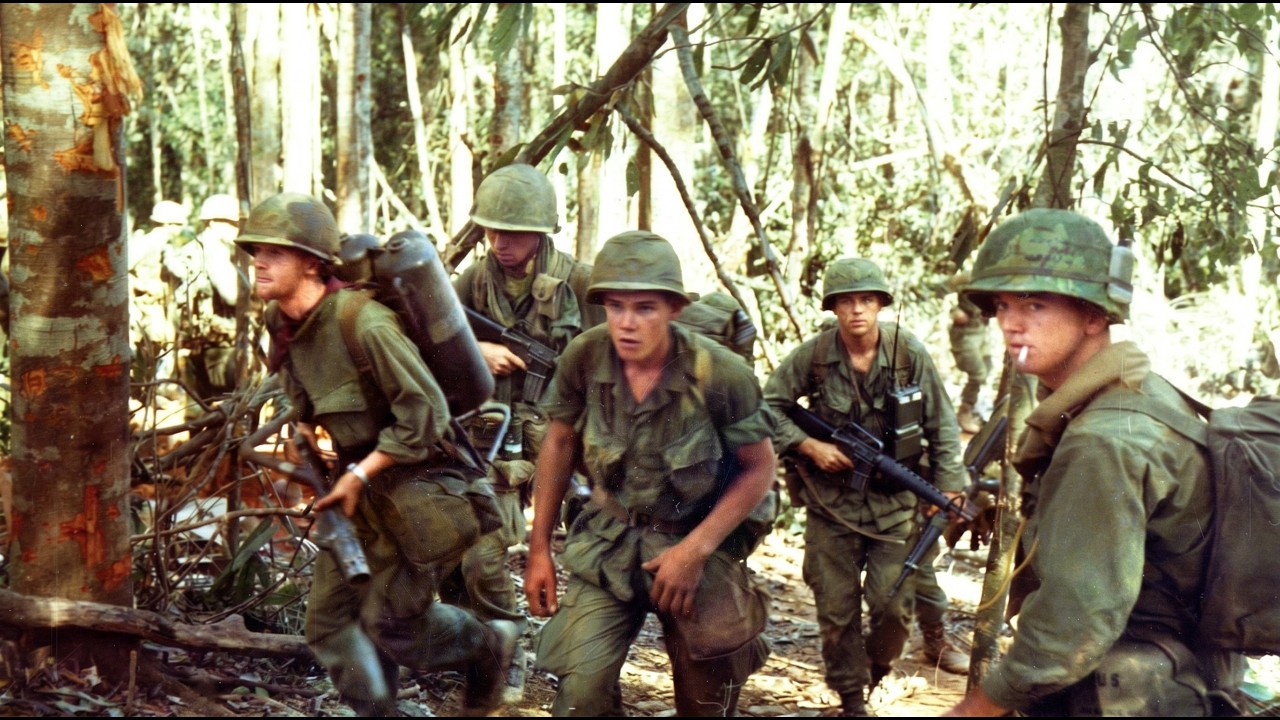
The patrols reported a striking ratio of roughly 400 enemy killed for every American lost, though the wilderness they worked in made survival brutally difficult. Between 60 and 70 percent of South Vietnam was raw jungle and mountain border zones, terrain where large units could not move without being detected. The enemy monitored radios, counted helicopters, and chose when to fight. These small teams carried CAR-15 carbines, sawed-off shotguns, and Claymore mines.
Their real lifeline was the AN/PRC-25 radio, their connection to artillery, gunships, and extraction. The enemy understood this and made the radio operator a priority target. The survival rate of these teams was studied in 1969 by the US Naval Institute. The research found a soldier’s odds of surviving were roughly twice as good in a small LRRP team as inside a full battalion, and each man inflicted about six times the enemy casualties.
Earlier in 1969, another team from the same company had faced similar circumstances. On February 22, Specialist 4 Robert Law and five teammates from Company I, 75th Rangers, First Infantry Division, were engaged by Viet Cong forces. When an enemy grenade landed in the middle of the team, Law threw his body on top of it, saving the other five men. He was posthumously awarded the Medal of Honor.
Three months later, Crabtree’s team faced the same brutal arithmetic. With roughly 30 enemy soldiers surrounding them and the light failing, Crabtree called artillery in at 50 meters, then walked it closer to 25 meters. The margin for error was a single eight-digit grid coordinate. A downpour then grounded the gunships, leaving the six men alone through the night as shells hammered the earth around them.
At dawn, Crabtree counted 10 enemy soldiers closing in. He set an ambush, and the opening blast dropped four of them. He then led a flanking move and crawled forward alone, reaching the first enemy position and destroying it with grenades. A machine gun bunker opened up from a second position, and Crabtree crawled toward it through the mud, getting close enough to put grenades through the aperture.
The bunker went quiet, and all six Americans walked out. Crabtree received the Distinguished Service Cross, announced in General Orders number 4343, dated December 6, 1969. In 1996, he was inducted into the Ranger Hall of Fame. Other units had similar experiences that year.
In July, an 11-man Ranger camp from G Company, 75th Infantry, Americal Division, took a company-sized North Vietnamese sapper assault at Landing Zone Baldy. The camp’s pet dog, a mutt named Crash, alerted them before the sappers reached the wire. By dawn, dozens of enemy bodies lay inside the perimeter, and the camp held. The North Vietnamese adapted to the threat over time.
By 1967, they had fielded dedicated counter-reconnaissance teams with tracking dogs, and they placed bounties on LRP teams worth between a thousand and $2,500 in a country where a laborer earned about 85 cents a day. Their standard response to a compromised team was to rush enough men forward to pin and swamp the six Americans before air power could arrive. The doctrine had its failures. The source transcript describes the November 1969 case of Sergeant Craig Jorgenson’s five-man H Company team from the First Cavalry Division, which was hit after being told no quick reaction force was available.
Two men were killed instantly and a third wounded before Jorgenson and his team leader fought back-to-back until rescue came. Five hundred LRP soldiers were killed in Vietnam. Company I buried 29 of its own. In 1974, the colors of the 75th Infantry passed to the newly formed 1st and 2nd Ranger Battalions, leading to today’s 75th Ranger Regiment.
Staff Sergeant Robert Pruden, who threw his body over his men at Quang Nai on November 29, 1969, was inducted into the first class of the Ranger Hall of Fame, and the regiment still runs an annual competition in his name. Crabtree’s actions were not a desperate gamble but doctrine pushed to its outer edge. Instead of holding the enemy at arm’s length, he used artillery to kill them.
At dawn, he ambushed them, and when the ambush left the job unfinished, he crawled forward and finished it himself.