Dendrochronology—tree-ring dating—has systematically dismantled the most beloved origin stories attached to America’s colonial architecture, and the corrections almost always run in the same direction: the buildings are younger than their plaques claim. A famous ancestor steps off a ship, two or three generations pass, somebody in that family builds in brick or stone, and then the ancestor’s name walks backward up the family tree and settles on the structure. Everyone repeats the date. Somebody prints it.
Somebody bolts it to the wall. The method itself rests on one principle: a tree lays down one ring per year, wide in good years and narrow in hard ones, and every tree in a region records the same sequence of fat and thin. Match a beam against a master sequence built from thousands of dated samples, and you get a calendar year for every ring—and, if the outer surface survives, the season the tree came down. Colonial builders worked green timber, so construction usually followed felling within 12 to 18 months.
The founder of the field was Andrew Ellicott Douglass, an astronomer chasing sunspot cycles rather than house dates. In 1929, at Whipple Ruin in Arizona, a charred roof timber bridged his two sequences and put absolute dates on roughly 40 archaeological sites across the Southwest. That same laboratory, decades later, was pointed at colonial buildings from the East Coast. In Virginia, Adam Thoroughgood seemed an ideal founder: an indentured servant who bought land in 1626, married into money, sat three times in the House of Burgesses, and patented more than 5,000 acres by 1635.
The building on his land was dated to 1719. Thoroughgood died in 1640—79 years before the trees in its roof were still growing. A 2005 report for the Colonial Williamsburg Foundation ruled out construction before about 1740, and clapboard samples pushed it past 1716. The 1972 nomination had put the wrong date into a federal document; the correction came 36 years later, in 2008, with unusually blunt language leaving the builder field blank.
Argal Thoroughgood II, a descendant several generations down, is thought to have started the work, and his widow Susanna likely finished it. The same pattern repeated across Massachusetts. Between 2001 and 2009, Oxford Laboratory tested the folk dates across the eastern part of the state. With one exception, not a stick of the first generation of Massachusetts Bay is standing.
The Coffin House in Newbury was dated to about 1654 based on a family history written in 1845; the trees say it is 24 years younger. The Pierce House in Dorchester came back at 1682 instead of 1650. The Whipple House in Ipswich, long given as 1638, tested at 1677. The John Balch House in Beverly, promoted as the oldest wood-frame dwelling in the nation and built in 1636 by John Balch, was felled across 1677–1679—John Balch had been dead 30 years.
His son Benjamin built it, and his grandson extended it in 1721. Where a house had a document behind its date, the wood generally agreed. Where it had only a story, the wood moved it later. The archives came out of this fine.
The storytellers did not. The Fairbanks House in Dedham is the famous exception. Jonathan Fairbanks received his lot and was accepted as a townsman in March 1637. The main structural timber for half the house came from a tree felled that same year; other members date to 1638, 1640, and 1641.
Document and wood agree almost exactly. It is nearly the only time in this subject that they do. He built a plain oak frame with five windows, three hearths, and a ceiling just six feet high. After he died in 1668, neighbors walked through his rooms and valued the estate: woolen clothing, a master bed and a trundle bed beneath it, four spinning wheels, two pairs of spectacles, and fifteen books—a library for a farming family.
In Virginia, the building now called Bacon’s Castle was known for its first two generations of occupants as Allen’s Brick House. Arthur Allen patented 200 acres in 1649 and was dead by 1669. The house was standing by September 1676, when about 70 of Nathaniel Bacon’s followers seized it and held it for 14 weeks. Nathaniel Bacon never lived there, and there is no evidence he ever set foot in it.
The name did not appear in records until 1823, long after everyone who remembered the rebellion was gone. In 1673, Allen’s son bought seven enslaved men—Simon, Mingo, Kamscy, Tony, Steven, Matthew, and Emanuel—who were inside those walls when the rebels came through the door; Simon and Emanuel remained enslaved on that ground until they died around 1700. Allen’s son later cleared the wreckage of the occupation into a pit and planted a formal garden over it. In St.
Augustine, Florida, a dentist named Charles Carver bought a coquina building in 1884. Tourists knocked so often that he could not practice dentistry, so he started charging them at the door. From 1884 to 1898, he advertised the place as the oldest dwelling in the United States, raised in 1565 by Franciscan monks. The site has been occupied since about 1650, and at least two wooden houses preceded the masonry one, which went up sometime between 1723 and 1727.
The society’s business manager, William Harris, drew a quarter of admissions money as commission and wrote a 1918 brochure repeating the false claim. A guidebook writer, Charles Reynolds, published a 31-page examination in 1921 showing no Franciscans were in Florida in 1565, and the society declined his offer of a joint investigating committee. When a board member named Edward Lawson published his own documented study of the fabricated history in 1957, the board voted 44–2 to expel him—the motion argued by Albert Manucy, the same man who would later do the honest scholarship establishing the building’s real date. At Acoma Pueblo in New Mexico, the results run the other way.
The mesa has been inhabited since at least 1200, with ceramic evidence suggesting people moved up onto it between 1150 and 1200. But Spanish forces under Juan de Oñate destroyed the pueblo in 1599, and the tree rings date the rebuilding: every original room in one housing block dates to 1646, with the third-level roofs arriving in the early 1650s. Society of Architectural Historians research reached the same conclusion independently. The community is centuries older than every European claim in this story; the wood in the roofs is not.
A building is not a lineage. Fabric is one thing and continuity is another. Wood rots and gets replaced, and the replacing is what a living settlement does. Every false claim in this subject ran aground on exactly that difference.
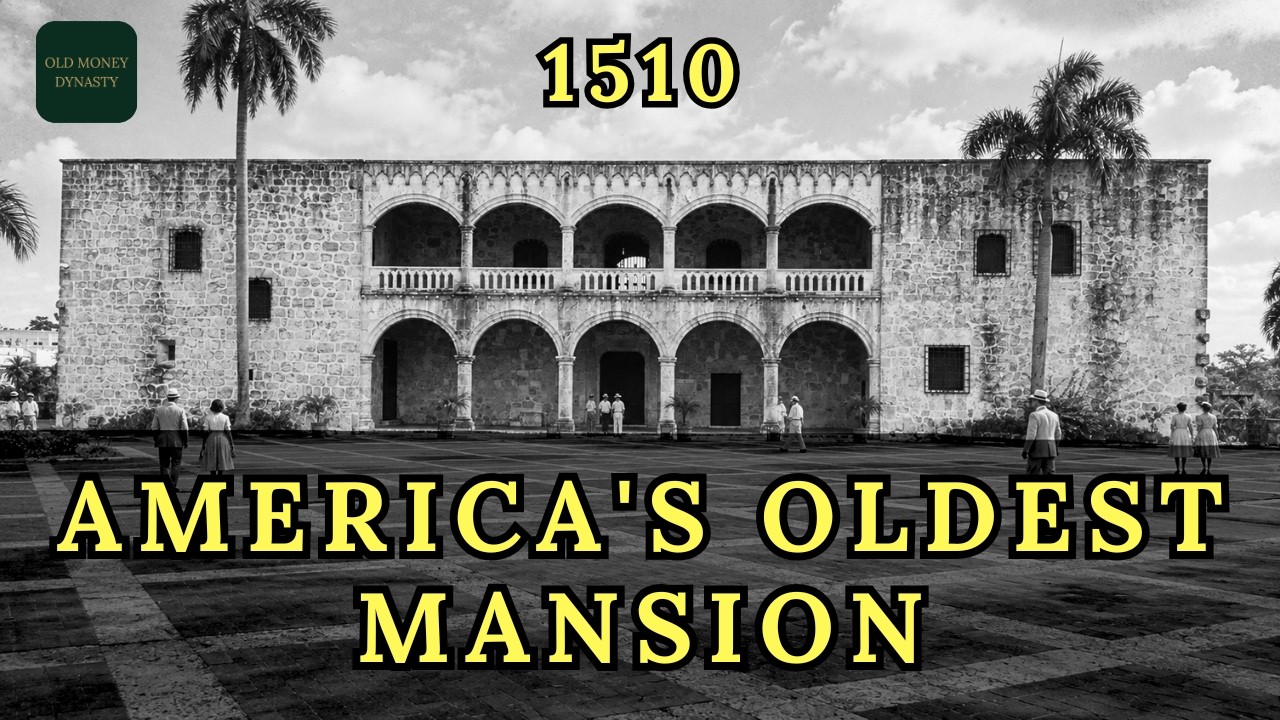
The people at Acoma are far older than the timber. The oldest European great house standing in the Americas is the Alcázar de Colón in Santo Domingo, built between about 1510 and 1514 for Diego Colón, the son of Christopher Columbus, and his wife María de Toledo. No building contract survives, and every date attached to it is traditional rather than documented. María lived in the palace roughly twice as long as her husband did.
By 1776 the authorities were describing a ruin; by 1786 the animals had moved in. Restoration ran from 1955 to 1957, so the walls are genuinely early 16th century while every roof, floor, ceiling, and door is younger than the Second World War. The furniture was bought in Spain and nearly none of it belonged to Diego Colón. It stands in the Caribbean—on this continent but not in the part of it that does the claiming.
The dates themselves survive only with qualifiers: in the Americas, in English North America, verified by tree rings. Take the qualifier away from any of them, and the sentence becomes false at once. That is not a weakness in the record.
That is the record being exact.