Around the year 1000, on the floodplain east of present-day St. Louis, people began moving earth at a scale that seems impossible considering the tools they had. There were no powered excavators, no dump trucks, and no draft animals hauling wagon loads of soil. The main transport system was people carrying baskets.
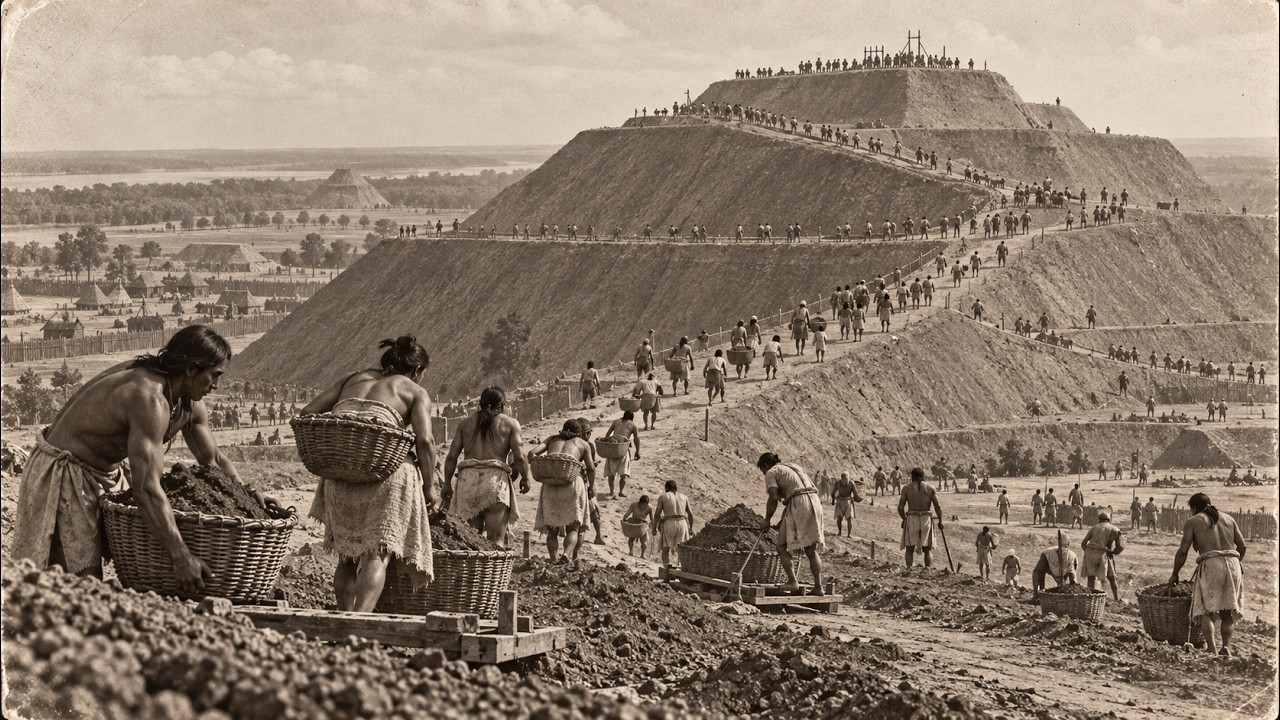
Yet Monks Mound at Cahokia would rise roughly 100 feet, cover about six hectares, and take shape through approximately 14 major construction stages. The height, however, is not the real mystery. The harder question is how a city organized enough soil, labor, planning, and repetition to build a mountain of earth and keep it standing. Monks Mound is not a natural hill that people decorated.
Archaeology shows it was constructed. Covered in grass today, it looks like a landscape feature, but it is architecture made out of earth. The answer begins with Cahokia itself. This was not a small village with one oversized pile of dirt beside it.
At its peak, between about 1050 and 1150, Cahokia was the largest pre-Columbian settlement north of Mexico. UNESCO estimates the central city may have held roughly 10,000 to 20,000 people. The larger settlement covered more than 1,600 hectares and once included around 120 mounds. Monks Mound was not an isolated miracle.
It was the biggest object inside a landscape already being deliberately shaped. Plazas were cleared and maintained. Mounds were raised in different forms. Houses were organized into neighborhoods.
A massive timber palisade later enclosed part of the central precinct. Large circles of wooden posts marked solar positions. The mound rises in four main terraces. Archaeological work indicates it was built in about 14 stages rather than all at once.
Nobody woke up one morning and ordered a 100-foot mound. The mound grew over generations. One construction episode created a platform. Later work enlarged it.
More earth changed its footprint and height. Surfaces were rebuilt and slopes extended. That staging turned an unimaginable single task into a sequence of enormous but manageable projects. It also created a technical problem.
Earth is not stone. Pile enough loose soil in one place and gravity tries to flatten it. Rain finds weak layers, water seeps into the fill, slopes erode, and different soils settle at different rates. The builders of Monks Mound were not simply moving soil; they were managing soil.
Archaeologists have found different kinds of fill used in mound construction, and the sequence of those layers matters. Some materials drain differently, some compact differently, and some are better for building stable surfaces. The people who built this city left no written construction specification. What survives is physical evidence: soil layers, borrow pits, post holes, rebuilt surfaces, building remains, mound shapes, artifacts, and the spatial organization of the site.
The ground shows clearly that the material had to come from somewhere. Around Cahokia are borrow pits, places where soil was removed for construction. A National Register record describes nine such pits, including one that covered about 17 acres. The same record explicitly describes baskets of earth being taken from these pits for mound construction.
A truck can haul several tons in one trip. A human carrier cannot. The load has to be small enough to lift, carry, and dump repeatedly. The project depended on thousands upon thousands of short cycles: dig, load, lift, walk, climb, dump, return, do it again.
Because the mound gets higher as work progresses, the final loads are harder than the first ones. Early in construction, a carrier may walk across relatively level ground. Later, the destination is above the floodplain. Every vertical foot of mound adds vertical work.
The Cahokians did not have powered machinery, but they had technology. A basket is technology. A digging tool is technology. A planned borrow pit is infrastructure.
A labor system that coordinates people and material is a technology of organization. The mistake is to imagine that if there is no engine, there is no engineering. Cahokia sat near the Mississippi in an extremely productive environment. The river floodplain, nearby uplands, wetlands, forests, and agricultural land supported a large population.
Food production, especially maize agriculture, helped sustain people who were not spending every hour finding their next meal. We do not know the exact labor schedules. But a large settlement creates possibilities: mobilizing groups, feeding work parties, maintaining specialists, coordinating building seasons, and turning social authority into physical work. Monumental architecture is always partly a labor story.
The structure stood at the center of a major urban place. Its summit supported buildings. The terraces created elevated platforms where height itself would have changed visibility, access, and status. Earth became hierarchy made visible.
The main plaza south of Monks Mound was enormous. Its open space did not appear by accident. Maintaining a large plaza means clearing vegetation, managing drainage, and keeping an area open in the middle of a dense settlement. The mound and plaza worked together.
The timber palisade around the central precinct makes the labor question even harder to ignore. Archaeologists estimate that one version required on the order of 15,000 logs, and the palisade was rebuilt more than once. A tree had to be selected, cut with stone tools, trimmed, and moved. A post hole had to be dug.
The log had to be raised. Thousands of those operations had to create a continuous wall. The basket is where the scale becomes human. A carrier bends down at the borrow pit.
Someone fills the container with earth. The load has to be heavy enough to make each trip worthwhile, but light enough to carry repeatedly. The carrier walks toward the mound, the path rises, the soil is dumped, and the carrier turns around and walks back empty. Every load creates a return trip that doubles the movement without doubling the mound.
Because this is earth, not standardized bricks, the material has to be spread and shaped after delivery. Someone has to distribute the fill, control the slope, keep the traffic route from becoming a mudslide after rain, and decide where the next loads go. Even without a written foreman’s notebook, the finished geometry shows there was sequencing. A mound cannot acquire four broad terraces by random dumping.
The construction site was occupied architecture. At some stages, buildings on the summit or terraces had to be removed, rebuilt, or worked around as the mound changed. Water is the quiet enemy of every earthwork. A hard rain hitting exposed fill can cut channels down a slope.
Saturated material can slump. Water trapped inside a mound can create internal weakness. Freeze and thaw can move surface material. Monks Mound has experienced erosion and slumping in modern times.
The original builders did not have modern geotechnical instruments, but they had observation. If one soil behaved badly, people could see it. If a slope washed, they could repeat the method. Construction knowledge does not need to be written to become sophisticated.
South and west of the central mound, archaeologists found circles of large timber posts known as Woodhenge. The post circles changed over time, meaning they were not one accidental ring of trees. They were built, altered, and rebuilt. Some alignments correspond with solar events such as the solstices, suggesting the posts helped mark time and organize ceremonial life.
The central city was a traffic system. If every carrier walks the same narrow route to the mound, the path becomes crowded. If rain turns the route to mud, production falls. If excavated material is taken from the wrong place, the borrow pit can interfere with settlement or drainage.
The finished mound cannot answer every one of those questions, but it proves that workable answers existed. The largest recorded borrow pit at Cahokia covered about 17 acres. That is landscape-scale extraction. Archaeologists studying mound fill have found that earthworks can contain intentionally varied soils rather than one homogeneous pile.
Different textures and colors can mark construction episodes. Some fills compact well, some drain differently, and some may have had visual or symbolic significance. The mound’s terraces are important. A 100-foot cone would be a different engineering object.
Monks Mound spreads its mass through broad platforms. Terraces interrupt the slope, create usable horizontal surfaces, reduce the amount of steep continuous face exposed to runoff, and organize access and visibility. No earthen structure stays perfect for nine centuries without change. Erosion has altered the surface, modern repairs have been necessary, and trees and later land use changed drainage.
Parts have slumped. The form seen today is not a pristine construction-day photograph turned into grass. But enough of the mass and geometry remained for archaeologists to reconstruct a long building sequence. Earth was locally available, workable with existing tools, and capable of producing platforms much larger than any timber building of the same period.
The trade-off was labor. Earth is cheap until you have to move it. Cahokia solved that cost with people and time. Because construction happened in stages, the city did not need to mobilize the full effort at once.
A later generation could add to what an earlier generation had already made. The first workers created height. The next workers inherited that height. The structure stored work.
Every trip belonged to an individual body. Shoulders fatigue, hands blister, heat matters, cold matters, the slope matters, food matters, and rest matters. Organization works by arranging those limits: rotate crews, distribute tasks, time work, feed people, and use more carriers rather than demanding impossible loads. Cahokia forces a rethink of what counts as a city in American history.
A lot of people learn a national story that begins with European colonies. That timeline makes places like Cahokia feel like a preface. They were not a preface to the people who lived there. Cahokia was a city in its own time, with a population comparable to many European cities.
Objects found at the site show participation in exchange networks extending far beyond the immediate Mississippi Valley. Food had to arrive, materials moved, people traveled, ideas circulated, ceremonies brought communities together, and power was organized. That is the hidden infrastructure behind a 100-foot mound. The visible material is dirt.
The invisible material is coordination. Monks Mound belongs in the same category as Stonehenge and the pyramids. The individual basket is ordinary. The accumulated result is not.
The nearby borrow pits are as much part of the monument as the mound itself. One is positive space, the other is negative space. The construction reshapes both. Soil remembers disturbance.
A post rots away but the stain of its hole may remain. A house disappears but its floor pattern can survive. A basket is gone but the source pit and fill layer remain. A palisade falls but thousands of post holes trace the wall.
Early European observers did not fully understand what they were seeing. Later farming and development damaged or erased parts of the site. Mounds were leveled. Roads and buildings crossed the ancient landscape.
Monks Mound survived partly because it was simply too large to ignore. The builders were Native American people of the Mississippian cultural world. Their descendants did not vanish from the continent. The real work is understanding the social and technical system that made such construction normal enough to repeat.
Cahokia had many mounds. The central mound was the giant, but smaller structures performed different roles. Some supported buildings, some were associated with burials. That variety tells us mound building was not one trick used once.
It was a construction tradition. Monks Mound is extraordinary in scale, but it grew from an established vocabulary of earth architecture. The 14 stages matter again. The largest structure was not just larger than the others.
It was a project that kept attracting more investment, more labor, more soil, more rebuilding, and more meaning. Construction histories always have a final unrecorded moment. The last load goes up. The last surface is shaped.
A building stands on the finished platform. Nobody on that day knows the mound has reached the form future archaeologists will call final. The decline of Cahokia came later. By the 13th and 14th centuries, population had fallen and the great urban concentration dispersed.
Scholars have debated the reasons for decades: environmental stress, political instability, social change, climate pressures, conflict, resource demands, or some combination. There is no single simple explanation that the evidence has settled beyond dispute. People did not disappear in one dramatic night. Urban systems change, families move, power shifts, and networks reorganize.
The mound remains after the city around it changes. The modern landscape removes exactly the thing that made construction possible: thousands of people living in a dense, organized community. So the mound can look like the achievement of a small population using brute persistence. It was the product of a city.
A city can turn time into architecture. Each person only has to carry one load at a time. The city makes sure there is another person behind them, another work period after that, another stage after that, and a reason for the effort to continue. Cahokia concentrated people.
The output was slower per worker, but the project did not require a single giant power source. It required organization that could persist. A machine does not need to believe in the project. People do.
When an earthwork survives for nearly a thousand years, part of what survives is evidence that a social system once held together long enough to create it. The shape is political archaeology, labor archaeology, and engineering archaeology. After European arrival, Cahokia had already built. It had already organized.
It had already altered the landscape with monumental public works. The tools were different. The principle was familiar: decide where the material needs to go, create a repeatable way to move it, control the shape, maintain the work, and keep doing it until the landscape has changed. A single person can carry a basket.
A single person cannot create Monks Mound. The work only becomes possible when knowledge survives from one crew to another, when a city feeds labor, when routes remain organized, and when later builders inherit earlier stages. Monks Mound rises about 30 meters, roughly 100 feet. From the top, you are standing on transported earth.
Below your feet are multiple construction episodes laid one over another. The mound is a stack of decisions. Somewhere around it are the lowered places where that earth came from. The baskets are gone.
The carrying paths have changed. The workers’ names were never written into a payroll ledger for us to recover, but the volume of their movement is still visible. A machine leaves tracks. Cahokia left a hill.
The scale tells us what the real machinery was: a city large enough to organize work, a construction tradition mature enough to shape earth deliberately, a landscape productive enough to support thousands of people, a political and ceremonial system strong enough to make monumental building matter, and generation after generation willing to carry the next basket. That is how Cahokia raised a 100-foot mountain of earth, not in one impossible lift, but one human load at a time.