On October 19, 1781, thousands of British and German troops marched out of their fortifications near the small tobacco port of Yorktown, Virginia, in full military dress. Drums beat and flags flew as they prepared to lay down their arms before a combined American and French force that most observers, just six years earlier, would have said had no real chance of pulling off such a feat. One detail of that day is rarely recalled: the British commander, Lord Cornwallis, was not present. Claiming illness, he sent a subordinate to surrender his sword on his behalf.
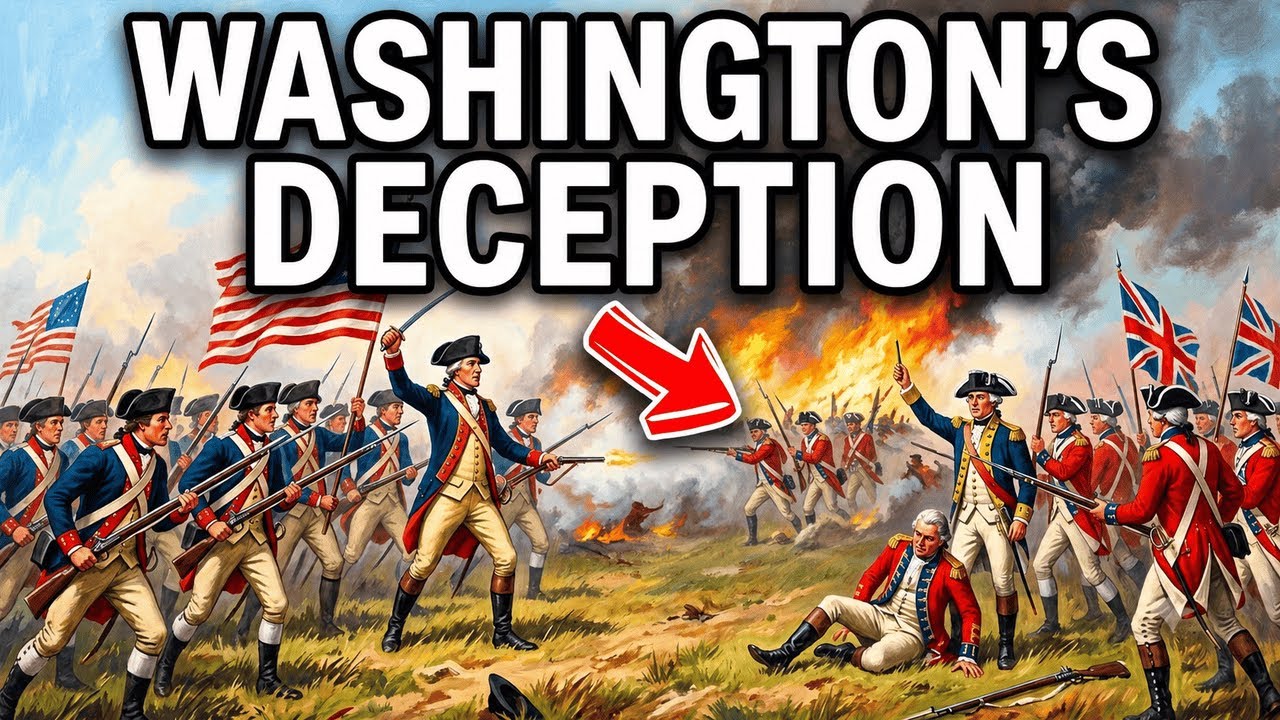
George Washington, the American commander, refused to accept the sword from anyone other than an officer of equal rank, forcing the British deputy to hand it to Washington’s own second-in-command in a subtle insult that both sides fully understood. Yorktown effectively ended the war, even though the formal peace treaty would not be signed for another two years. It was the moment London finally conceded that the war against the American colonies could not be won. What is striking is how much of that outcome depended on a chain of decisions, deceptions, and a single naval battle that most people have never heard of—all converging within a matter of weeks.
Most of the Revolution’s early fighting took place in the North, in places like Massachusetts, New York, Pennsylvania, and New Jersey. By 1780, the British had changed their strategy. After years of stalemate, London shifted its focus to the southern colonies, betting that large numbers of Loyalists would rally to the Crown once British forces gave them the chance. For a time, that strategy appeared to work.
British troops captured Savannah and then Charleston, inflicting the worst single American defeat of the entire war. With a whole garrison surrendered, Cornwallis pushed inland, chasing an American army that was rebuilding its ranks across the Carolinas. But the southern campaign never delivered the decisive blow the British needed. American forces under commanders like Nathanael Greene refused to fight the kind of pitched battle the British army was built to win.
Instead, they waged an exhausting campaign of retreats, skirmishes, and costly partial victories that wore down Cornwallis’s army without destroying it. Greene was said to have described it as fighting, getting beaten, rising again, and fighting once more—and that pattern repeated across the Carolinas in 1780 and 1781. By the summer of 1781, a frustrated Cornwallis made a decision that, in hindsight, turned the course of the entire war. He marched his army north into Virginia, hoping to cut supply lines supporting the southern American war effort and to link up with British forces there.
On paper, it looked like a logical strategic move. What Cornwallis did not fully grasp was where that decision would lead: he was heading onto a narrow peninsula, pressed against a river, in a position that could only be defended if the Royal Navy guaranteed safe resupply and the possibility of evacuation by sea. That guarantee was about to vanish. Washington spent years waiting for exactly this kind of opportunity.
When word reached him that a French fleet under Admiral François Joseph Paul de Grasse was sailing to the Chesapeake carrying troops and, crucially, warships, he saw a chance that might never come again. If the French fleet could control the waters around Yorktown, even temporarily, Cornwallis’s escape route by sea would be cut off entirely, and his army, however strong on land, would be trapped on a peninsula with no way out. The problem was distance. Washington’s main army was positioned around New York, watching the British garrison under General Henry Clinton.
Moving that army, along with a large French force under General Rochambeau, hundreds of miles south to Virginia in time to trap Cornwallis before he could reinforce his position or escape overland was a massive logistical gamble. It had to be done without Clinton realizing what Washington was actually doing. If Clinton discovered the plan early, he could either reinforce Cornwallis or attack New York while Washington’s army was scattered on a long march south. What followed became one of the most successful deception operations of the war.
Washington deliberately built dummy camps near New York, designed to look from a distance, and through Loyalist informants, like preparations for an assault on the city itself. Some accounts describe camps with more tents than soldiers to fill them, bakeries built to look as though they were supplying a force far larger than the real one, and messengers deliberately allowed to fall into British hands, suggesting that an attack on New York was imminent. Clinton, watching all of it, remained convinced for critical weeks that Washington’s real target was New York—until it was far too late to do anything meaningful about Yorktown. While that illusion held, the combined American and French army marched south at a pace that surprised even some of Washington’s own officers, covering enormous distances in a matter of weeks, passing through Philadelphia and arriving in Virginia.
Meanwhile, at sea, the part of the plan that no one could fully control was unfolding. In early September 1781, de Grasse’s French fleet clashed with the British fleet under Admiral Thomas Graves in what is now known as the Battle of the Chesapeake, fought at the mouth of the bay. It was not a battle of overwhelming destruction. Casualties and ship losses on both sides were relatively modest by the standards of the era’s great naval engagements.
But tactically, de Grasse outmaneuvered Graves. After several days of positioning and limited combat, the British fleet withdrew to New York for repairs and reinforcements, leaving de Grasse in control of the waters around the Chesapeake. That largely forgotten naval battle may have been one of the most important engagements of the entire war. With the British fleet gone, Cornwallis’s escape route by sea was cut.
He was already trapped, whether he fully realized it or not. By late September 1781, the combined American and French force of roughly 17,000 to 19,000 troops, split between Continental soldiers, militia, and French regulars, had reached the outskirts of Yorktown and begun the methodical, unglamorous work of a formal siege. This was not the kind of dramatic field battle that dominates popular memory of the Revolution. A late-eighteenth-century siege was, in large part, an engineering problem.
Troops dug a series of trenches known as parallel approaches, gradually moving closer to the enemy fortifications, protecting advancing soldiers and bringing artillery ever nearer until it could bombard the defenders directly. The first parallel was completed in early October, a few hundred meters from the British lines. Heavy artillery, including cannons supplied by the French, whose expertise in siege warfare was far ahead of anything the American army had previously used, began a relentless bombardment of the British positions. Cornwallis’s defenses at Yorktown consisted of earthworks and several smaller outlying positions called redoubts, designed to protect the main lines from direct assault.
Soldiers who took part in the siege described life inside those defenses during the bombardment as increasingly desperate: continuous artillery fire day and night, dwindling supplies, and a rising number of dead and wounded with limited ability to treat or bury them. Some British accounts describe throwing dead horses and even casualties into the river simply to manage the volume that a besieged, immobile position could not handle. By early October, the American and French forces had advanced a second parallel closer to the British defenses, but two specific fortified positions stood in the way of completing it: Redoubts 9 and 10. These small but heavily fortified earthworks on the British right flank had to be taken before the second parallel could be finished and the siege tightened.
Taking them required exactly the kind of direct, dangerous infantry assault that the siege had mostly avoided until that moment. On the night of October 14, 1781, Washington ordered simultaneous attacks on both redoubts. The French would take Redoubt 9, while American forces would take Redoubt 10. Leading the American attack on Redoubt 10 was a young artillery officer who had spent most of the war pressing Washington hard for this kind of combat command.
Alexander Hamilton, then serving as one of Washington’s aides, had long lobbied for a field command, and Washington finally gave him one for this specific assault. The attack was ordered with unloaded muskets and bayonets only, in darkness, specifically to preserve the element of surprise and prevent an accidental shot from alerting the defenders before the assault force could get close enough to overwhelm the position. It was a brutal, high-risk tactic that depended entirely on speed, discipline, and darkness. Hamilton’s men rushed the redoubt’s defenses, fought through the obstacles in front of the position, and overpowered roughly seventy defenders inside in a short, violent, close-quarters fight.
The redoubt fell within minutes. The French attack on Redoubt 9, happening simultaneously, met stiffer resistance and took a little longer, but it also succeeded. By the end of that night, both key positions were in American and French hands, and the second parallel could finally be completed, bringing the allied artillery close enough to make the British position inside Yorktown practically indefensible. Cornwallis, watching his defensive perimeter collapse, made one final desperate gamble.
On the night of October 16, he attempted to evacuate his army across the York River to Gloucester Point on the opposite shore, hoping to escape overland and leave his sick and wounded behind. But a violent storm scattered the boats midstream, forcing the operation to be abandoned, and the troops who had already crossed had to return. That was, in a sense, the last option available to Cornwallis, and the weather took it from him. By October 17, with his artillery largely silenced, his defenses shattered, his escape routes cut off by land and sea, and his army increasingly exhausted and sick, Cornwallis asked for surrender terms.
The formal surrender took place on October 19, 1781, in a ceremony whose symbolic weight both sides fully understood. Cornwallis did not appear in person, citing illness, and sent his deputy, General Charles O’Hara, to surrender on his behalf. When O’Hara tried to present Cornwallis’s sword to the senior French commander present, Rochambeau refused, indicating that surrender must be offered to the American commander, Washington, since this was at heart an American war of independence fought with French assistance. When O’Hara then tried to present the sword directly to Washington, Washington in turn refused to accept surrender from anyone other than Cornwallis’s equal in rank, and directed O’Hara instead to his deputy, General Benjamin Lincoln—the very American general who had been forced to surrender Charleston to the British the previous year, making the moment a sharp, almost poetic reversal.
According to a long-standing tradition, the British band played a tune called “The World Turned Upside Down” as the defeated army marched out to surrender. An empire that, a decade earlier, had possessed the most powerful military and naval force on earth had just watched an entire field army march out and lay down its weapons at a former tobacco port in Virginia. Roughly 7,000 British and German soldiers surrendered at Yorktown, along with large quantities of artillery, muskets, and supplies. It was not the largest single loss of the war in absolute numbers—the fall of Charleston the previous year had cost the British more prisoners—but Yorktown’s impact had nothing to do with numbers.
It was about what the loss represented at that precise moment to the people in London who had to decide whether continuing the war was worth it. News of the surrender took weeks to cross the Atlantic, reaching London in late November 1781. By most accounts of those present, the British government’s reaction was closer to genuine shock than mere disappointment. Prime Minister Lord North is said to have reacted as if struck by a bullet, repeating over and over a phrase to the effect that it was all over.
That reaction was not only about Yorktown itself. It was about what Yorktown meant after six years of an increasingly costly and unpopular war. Britain had lost an entire army at Saratoga in 1777, an event that had directly convinced France to enter the war on the American side. Now, four years later, a second full British field army had marched out and surrendered on American soil, this time with the French navy playing the decisive role in sealing the encirclement.
With war debts mounting, public support at home fading, and Britain fighting France and Spain simultaneously on other fronts around the world, Yorktown was the moment when Parliament’s political will to continue the war finally collapsed. Within months, Lord North’s ministry, the government that had overseen nearly the entire war, fell from power. A new government took office with an explicit mandate to seek peace rather than continue the war. To be precise, fighting did not stop everywhere overnight, and scattered military operations continued on various fronts even after Yorktown.
But large-scale British offensive operations in North America effectively ended with that surrender. For every practical purpose that mattered to the soldiers and diplomats who lived through it, the war ended at Yorktown. The formal legal end came only with the Treaty of Paris, signed in September 1783, which explicitly recognized American independence. But what makes Yorktown stand out today is not simply the American victory.
It is how many interlocking events had to come together to achieve it. The French fleet had to arrive at exactly the right moment and defeat the British fleet in a battle most people have never heard of. Washington had to gamble on an elaborate deception sophisticated enough to keep an entire British garrison in New York convinced of an imminent attack that never came. The army had to march hundreds of miles in weeks rather than months.
A young officer who had spent years begging for a combat command had to lead a bayonet charge in pitch darkness and succeed. And on one specific night, a violent storm had to be strong enough to destroy a final desperate attempt to escape across the river. If any of those elements had failed, if the fleet had arrived late, if the deception had been uncovered, if the redoubt assault had stumbled, or if the weather had calmed on the night of the crossing attempt, Cornwallis might have escaped, received supplies and reinforcements, and the war might have dragged on for years longer. But it did not.
It ended, practically, on a Virginia peninsula, with an army marching to the beat of drums to lay down the weapons of an empire that, six years earlier, no one would have believed capable of losing this fight.