Between 1870 and 1914, more than a hundred American heiresses married into the British aristocracy, trading vast fortunes for ancient titles in a transatlantic arrangement that saved crumbling estates while often consuming the women who paid for them. These brides came to be known as dollar princesses, though the label only arrived in 1907 with a Viennese operetta. The prototype appeared decades earlier, and by 1915 one marriage directory counted 454 American women wedded into European noble families. The market was driven by two hungers facing each other across the ocean.
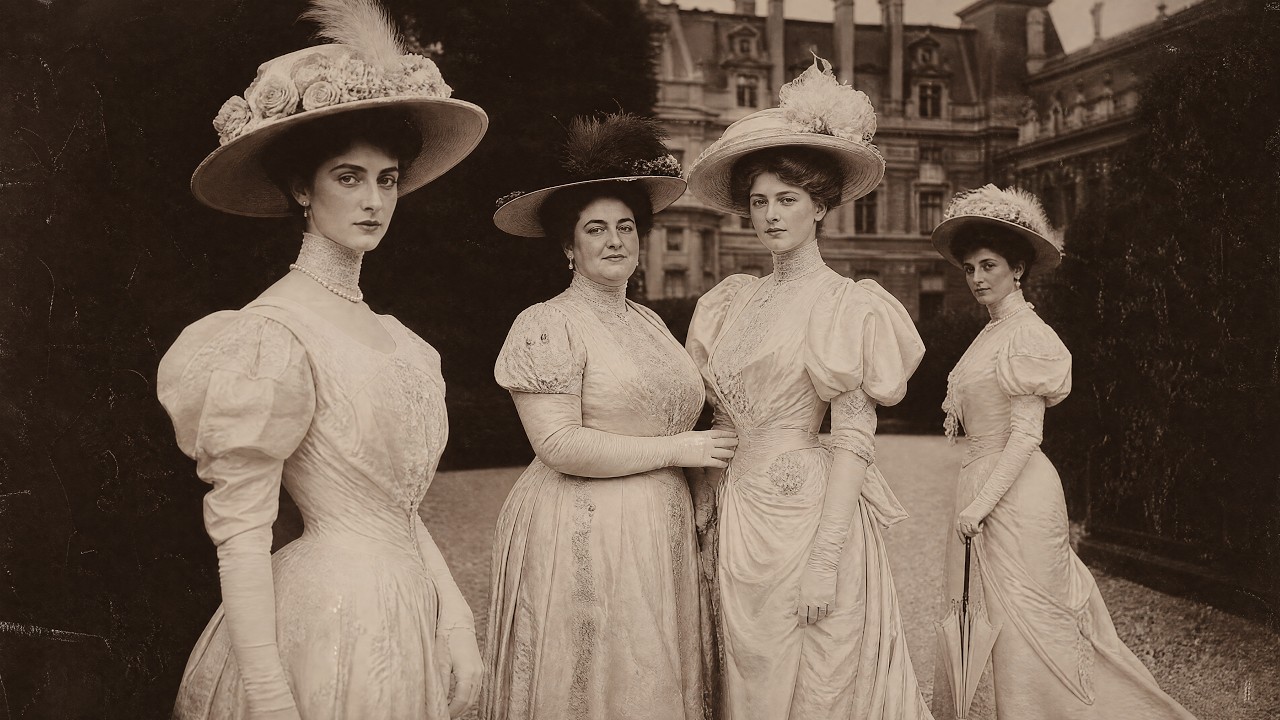
American fortunes, built on railroads, mines, and Manhattan land, could not buy social rank in New York, where old families guarded their drawing rooms. Across the Atlantic, British nobles with centuries-old titles were watching their landed incomes collapse under cheap American grain imports. Mothers on both sides brokered the matches openly, settlements were drawn by lawyers, and newspapers reported dowries like market prices. May Goelet was the richest young heiress in New York and could have married almost any prince in Europe.
In 1903 she chose Henry, the 8th Duke of Roxburghe, a quiet Scottish soldier, and brought her inheritance, roughly $28 million, to Floors Castle in the Scottish borders. The marriage was considered one of the happiest transatlantic matches of the era. But for ten years, in a castle without electricity, she waited for an heir in what observers described as a life narrowed to needlework, salmon fishing, and bridge. The divorce and the heir finally arrived in 1913, with King George V as godfather.
A far darker bargain was struck by Mary Leiter of Chicago. She fell in love with George Curzon, a brilliant but poor politician, and waited three years for him to propose. His biographer concluded from their private letters that Curzon did not love Mary deeply when he married her, but saw her as a prize whose dowry could fund his ambitions. Mary’s father, Levi Leiter, had built his fortune buying up Chicago land after the great fire.
Her money took the couple to India, where Curzon served as Viceroy and Mary became the first lady of an empire. In 1903 she wore a gown of cloth of gold covered with peacock feathers, each eye made from a beetle wing, to a state ball at Delhi. India wore her down. She suffered through pregnancies, the heat, the altitude, and ceremony that could not be refused.
In 1904 she nearly died at Walmer Castle from peritonitis and phlebitis, infections likely worsened by a clogged drain running beneath her bedroom window. Curzon wrote down every word she whispered while she believed she was dying. She told him she died happy, that he had been her only love, and begged not to be buried in the ground. She survived that crisis but never recovered, dying in London in July 1906 at age 36.
For years the love had run one way only. But by the end, Curzon could not bear anyone entering the room where she died until her coffin held his photograph in her hand. He built her a white marble memorial and lay beside her effigy for eternity, then remarried another American who understood she would never take Mary’s place. Anna Gould paid a different price.
The daughter of railroad baron Jay Gould was considered plain, mocked as a little monkey dressed as a princess, and in 1895 she married a beautiful French count named Boni de Castellane at a wedding costing $160,000. Society called it cash for a coronet. Over eleven years, Boni spent roughly $10 million of her inheritance on a pink marble palace copied from Versailles, a yacht, mistresses, and attempts to buy votes for parliament. Anna’s brother placed her under a trusteeship to stop the bleeding.
She divorced in 1906, then married Boni’s own cousin, who was his lifelong social rival. Anna survived to 86, outliving every man who had mocked or spent her. The pink palace was pulled down in 1969. The estate she chose to preserve, Lyndhurst on the Hudson, still stands as a museum.
Consuelo Yznaga opened the door for the others. Born to a Cuban American sugar family, she had charm rather than great wealth as her capital, and she played the banjo for the Prince of Wales’s bored circle. In 1875 she nursed a sick young lord, George Montagu, heir to the Duke of Manchester, back to health, and married him the next year. Her husband drank his way through her settlement, kept a music hall singer openly, and died bankrupt at 39 of cirrhosis.
She buried both her twin daughters, who died of tuberculosis at 15 and 20. Widowed and nearly broke, she still entertained kings, with friends reportedly carrying in food so her table could host a future monarch. She died in 1909. Her son, the 9th Duke of Manchester, repeated the pattern.
He married Helena Zimmerman, the only child of a Cincinnati industrialist worth some $10 million, in a quiet ceremony in 1900. Helena’s father, Eugene Zimmerman, protected his daughter by locking the fortune in a trust that gave the Duke nothing. The Duke still managed 66 bankruptcy petitions, and in 1935 he was jailed for nine months for lying to a pawnbroker about his dead mother’s jewels. The houses of his dukedom were sold one by one, becoming a school, a potato crisp factory, and an abbey.
Helena divorced him and died in 1971 as the Countess of Kintore, having outlasted him by decades. American historian and social observer Frank Work denounced the whole traffic in 1911, calling for an end to international marrying for titles and the privilege of paying so-called noblemen’s debts. He lost; the marriages went on. The women each got what they crossed the ocean to buy, but in every case the purchase cost an irreplaceable part of the buyer.
The houses they saved stand to this day, but the women are not remembered inside them. A tiara of 1,400 diamonds commissioned by Consuelo Yznaga, worn by both Manchester duchesses, now sits behind glass at the Victoria and Albert Museum, surrendered to the government in 2007 against a tax bill. And at the head of it all stands Consuelo Vanderbilt, whose mother locked her in a room on her wedding morning in 1895 until she stopped refusing to marry a duke she did not love. Her father’s railroad fortune saved Blenheim Palace, which still stands.
She was consumed by the same machine as the women who chose willingly. The promise underneath every bargain was always the same: the house would outlive the woman who paid for it. It was the one promise in the whole trade that was kept to the letter.