The children of King Leopold II of Belgium were born into a world of palaces and ceremony, yet their father’s reign became defined by colonial brutality and domestic scandal. The dynasty he tried to strengthen fractured quietly instead. One heir died before reaching ten years old. One princess married into tragedy at Mayerling.
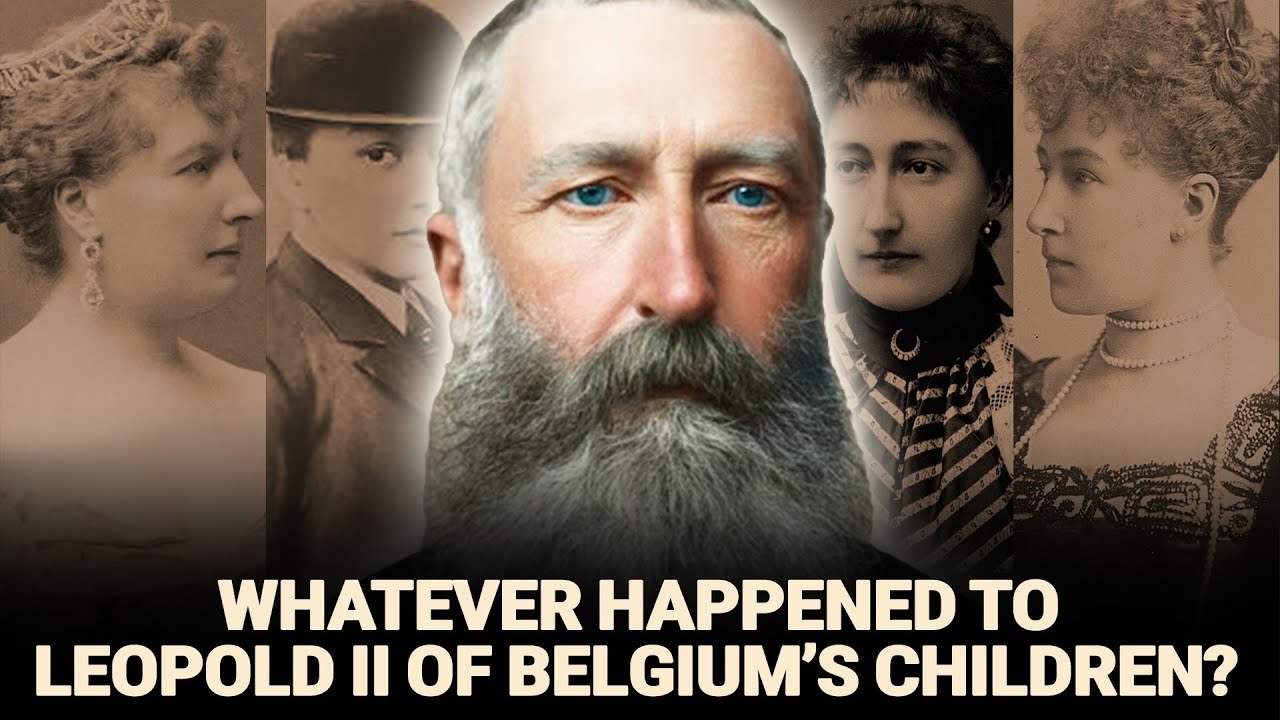
Another became a scandalous exile. And while one daughter remained loyal to her father to the very end, his secret sons grew up in the shadows, carrying his blood but never his crown. Leopold II came to the Belgian throne in 1865, but his personal life was shaped years earlier by the birth of his first daughter. Princess Louise Marie Amalie was born on February 18, 1858, at the Royal Palace of Brussels.
Her mother, Archduchess Marie Henriette of Austria, imposed a strict Catholic education and rigid court etiquette. Louise, however, showed an independent spirit early on, questioning authority and developing artistic interests that troubled her conventional parents. In 1875, at age 17, Louise married Prince Philip of Saxe-Coburg and Gotha, a distant cousin 12 years her senior. The marriage appeared to be a perfect dynastic union, but the couple proved deeply incompatible.
By the early 1890s, Louise had begun an affair with Count Géza Mattachich-Keglevich, a Croatian nobleman 22 years her junior who was serving in the Austrian army. The affair turned into a royal crisis in 1897, when Louise defied protocol by appearing publicly with Mattachich. Prince Philip, humiliated and pressured by both the Belgian and Austrian courts, demanded his wife’s confinement. Louise was declared mentally unstable and held in various institutions for nearly a decade.
Her movements were restricted and her correspondence monitored. In 1904, Louise escaped with Mattachich’s help and fled to France. The legal proceedings that followed exposed the harsh realities of royal marriage during a period of changing social values. In 1906, Louise obtained a divorce, becoming one of the first European princesses to legally end her marriage.
The victory came at enormous cost. She was stripped of her royal titles and privileges, cut off from family financial support, and effectively banished from Belgian society. Louise’s marriage had produced two children. Prince Leopold Clement died unmarried in 1916 during World War I.
Princess Dorothea later adopted children to continue the family line, though her descendants lived far from royal circles. Louise herself died in 1924 in Bodenbach, Germany, largely forgotten by the society that once celebrated her birth. Her life became a symbol of the collision between royal expectation and emerging ideas about individual freedom. Louise’s younger brother, Prince Leopold, was born on June 12, 1859, at the Château de Laeken.
As Duke of Brabant, he was heir presumptive to the Belgian throne. His education was designed for kingship, with courses in statecraft, military science, languages, and geography. Contemporary accounts describe him as a thoughtful child with a gentle temperament, unlike his more forceful father. In January 1869, tragedy struck with devastating suddenness.
While playing in the grounds of the Château de Laeken, nine-year-old Leopold fell into a pond. He was rescued quickly and initially seemed unharmed, but within days he developed pneumonia. Despite the attention of Belgium’s leading physicians, the prince died on January 20, 1869, just ten days after the accident. Leopold’s death severed the direct male line of succession and sent shockwaves through the kingdom.
His father was left without a male heir, which fundamentally changed his approach to family life. The succession eventually passed to Leopold II’s brother, Prince Philip, Count of Flanders, and his descendants. The tragedy also made Leopold II increasingly demanding when it came to arranging the marriages of his surviving daughters. Princess Stéphanie was born on May 21, 1864, at the Château de Laeken.
She was raised specifically for a grand dynastic marriage. Her education included French, German, English, and Hungarian, along with European history, court etiquette, music, and the arts. Unlike her older sister Louise, Stéphanie accepted her role as a diplomatic asset. In 1881, at age 17, Stéphanie married Crown Prince Rudolf of Austria-Hungary, heir to the Habsburg throne.
It was a diplomatic triumph for Belgium. The marriage, however, gradually revealed deep incompatibilities. Rudolf, brilliant but troubled, struggled with depression and increasingly turned to alcohol and extramarital affairs. On January 30, 1889, European society was shaken by the news from Mayerling, the Austrian imperial hunting lodge.
Crown Prince Rudolf was found dead alongside his young mistress, Baroness Mary Vetsera, in what appeared to be a murder-suicide. The official version claimed heart failure, but the truth gradually emerged despite Habsburg attempts to conceal it. For Stéphanie, then 24, Mayerling meant both personal tragedy and social catastrophe. The Habsburg court, desperate to minimize scandal, largely abandoned her.
In 1900, she married Count Elmer Lónyay de Nagy-Lónya, a Hungarian nobleman who had served as her children’s tutor. The marriage scandalized both the Habsburg and Belgian royal families, since Lónyay was considered socially inferior. The second marriage proved successful and enduring. The couple settled in Hungary, where Stéphanie began writing memoirs that provided insider perspectives on the Habsburg court.
She lived until 1945, witnessing two world wars and the total transformation of the political system she was born into. Her only child, Archduchess Elisabeth Marie, born in 1883, also had to navigate the scandal surrounding her father’s death and the collapse of the empire. Princess Clémentine, born on July 30, 1872, was the youngest of Leopold II’s legitimate children. Unlike her sisters, she became her father’s primary companion.
In the 1890s, she fell in love with Prince Victor Napoléon, heir to the Bonaparte imperial claims. Leopold II categorically refused to permit the marriage, viewing it as a connection to French republicanism and a threat to Belgian interests. For nearly two decades, Clémentine remained unmarried, caught between filial duty and personal desire. She chose patient loyalty rather than rebellion.
After Leopold II’s death in December 1909, she finally gained her freedom. She married Prince Victor Napoléon in November 1910, nearly 20 years after the couple first sought permission. The couple settled in France and had two children: Princess Marie Clotilde, born in 1912, and Prince Louis Napoléon, born in 1914. Prince Louis would eventually become the Bonapartist pretender to the French throne.
Clémentine devoted herself to charitable work, including organizing relief for Belgian refugees during World War I. She died in 1955, the longest-lived of Leopold II’s children. Leopold II also had two illegitimate sons with Caroline Lacroix, a young Frenchwoman who became his companion in his final years. Lucien Philippe Marie Antoine Durrieux was born on February 9, 1906, in Cambo-les-Bains, France.
His birth was kept discreet, and he was privately educated. Leopold II granted him the courtesy title Duke of Tervuren, which provided social standing without threatening the legitimate succession. Lucien inherited substantial financial resources after the king’s death in 1909. He married a Frenchwoman in 1930 and settled permanently in France.
The couple had no children, meaning his branch of the bloodline ended with him. He died in 1984 in Cambo-les-Bains, the same community where he was born. Philippe Durrieux was born on June 16, 1907, in Longpont-sur-Orge, south of Paris. He was the second son of Leopold II and Caroline Lacroix, born as international criticism of the king’s administration of the Congo Free State was reaching its peak.
Philippe suffered from respiratory ailments throughout his brief life, which limited his education and activities. Philippe died in 1914 at the age of six or seven, succumbing to the respiratory illness that had troubled him since childhood. Some elements of the European press used his death to attack Leopold II’s moral character, though such claims had no medical foundation. His death marked the end of the king’s bloodline through Caroline Lacroix, as no other children resulted from their relationship.
The fates of Leopold II’s children, legitimate and illegitimate, reveal a family torn between dynastic duty and a rapidly changing world. His legitimate children were often treated as instruments of policy. His illegitimate sons, by contrast, appear to have received more genuine affection, perhaps because those relationships were free from constitutional pressures. Leopold II was a man of deep contradictions, capable of tenderness toward his illegitimate sons while presiding over brutal colonial exploitation.
By the time Clémentine died in 1955, the world his children were born into had completely disappeared. The houses of Habsburg, Hohenzollern, Romanov, and Ottoman had fallen or been reduced to ceremonial roles. Each of his children had to find their own way to survive, with varying degrees of success, in a Europe that no longer belonged to them.