In March 1917, one of the most powerful monarchies in history collapsed in a matter of days, not years. The Romanov dynasty, which had ruled the largest contiguous empire on Earth for 300 years, ended so suddenly that Tsar Nicholas II recorded it in his diary like a minor inconvenience. Within months, a revolutionary who had been living in a rented apartment in Zurich just weeks earlier took control of Russia. His name was Vladimir Lenin.
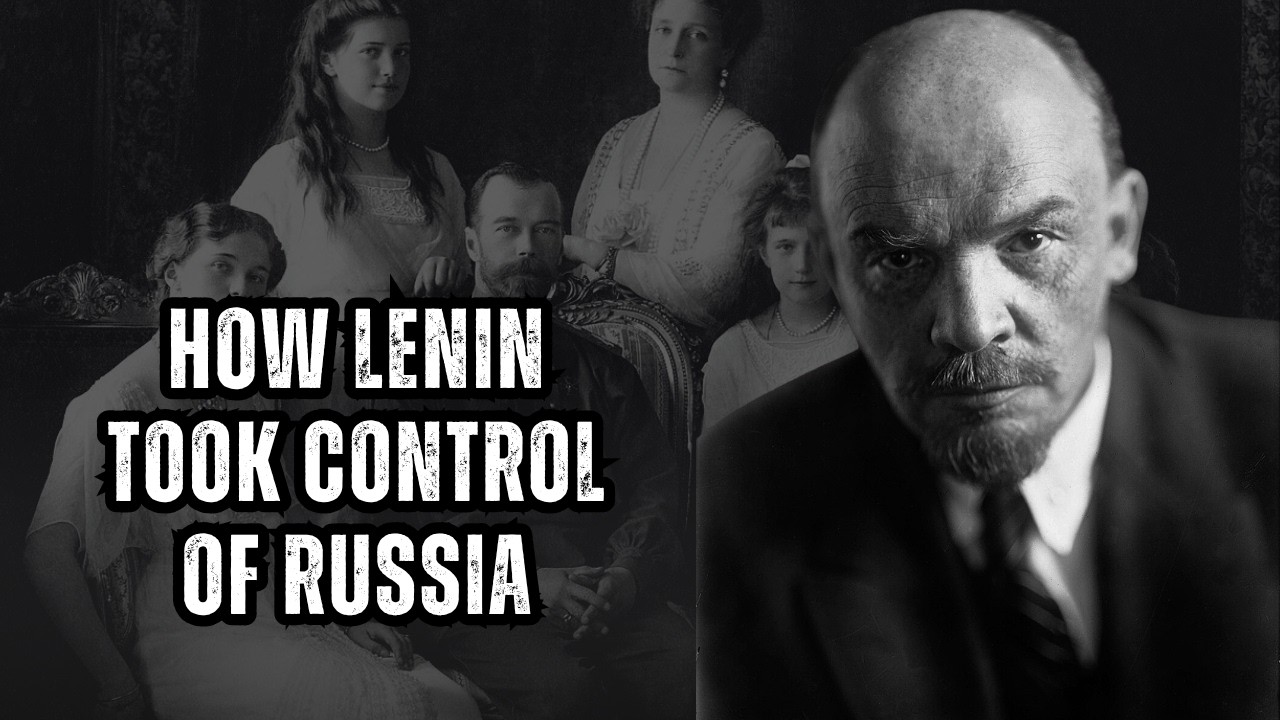
Most people misread what actually happened. Lenin did not defeat the Tsar. He did not march an army through the palace gates and force Nicholas off the throne. By the time Lenin arrived back in Russia, the Tsar was already gone.
What Lenin did was far more calculated: he walked into the ruins of a system that had been rotting from the inside for decades, identified where power was sitting unclaimed, and took it. On the surface, the Tsarist system looked unshakeable. In 1914, Russia was the most populous country in Europe, with 175 million people, nearly three times the population of Germany. The Russian army had 1.
3 million active soldiers and close to 5 million reservists. The Tsar commanded not just the military but everything: the government, the church, and the bureaucracy. Russia’s elected parliament, the Duma, existed largely at his pleasure. If its members disagreed with him too openly, he had the legal authority to dissolve it, and he used that authority.
The Orthodox Church reinforced the monarchy as divine. The secret police, the Okhrana, monitored, arrested, and exiled political opposition. Revolutionary leaders like Lenin had been pushed into Siberia or chased out of the country entirely. For most of the 19th century, that system worked.
Dissent was suppressed. The empire held. But the system was not powerful. It was rigid.
Powerful systems adapt under pressure. Rigid systems hold their shape right up until they break. The cracks in the Romanov empire had been forming long before the First World War. Eighty percent of Russia’s population were peasants.
They farmed land they could never truly own, fed a nobility that consumed without producing, and had almost no legal recourse when conditions worsened. In the cities, industrial workers lived in brutal conditions. Strikes were illegal. Organizing was illegal.
The gap between what workers produced and what they earned kept widening. Those tensions exploded once already in 1905, after Russia’s humiliating defeat in the Russo-Japanese War. A wave of strikes and protests swept across the empire. The monarchy survived that crisis by making concessions.
Nicholas issued the October Manifesto, which promised a constitution and a parliament. Then, once the crisis passed, he walked most of it back. Nicholas had shown the country two things in 1905: that the system could bend under pressure and that it had no intention of actually changing. That was not stability.
That was a system living on borrowed time. Then came the war. The First World War did not create the crisis. It exposed it.
Russia entered the war in August 1914 with enormous numbers and almost no capacity to support them. Within the first few weeks, the catastrophe was visible. At the Battle of Tannenberg in August 1914, the Russian army suffered around 30,000 killed or wounded, and nearly 100,000 soldiers were taken prisoner by the Germans in a single campaign. Russian officers had transmitted battle plans over open radio.
The two generals commanding the offensive despised each other and refused to coordinate. By the end of 1914 alone, Russia had lost more than 1 million men. By 1916, the army chief of staff was officially acknowledging more than 5. 3 million losses, killed, wounded, missing, or captured in roughly two years of fighting.
Back home, the war was dismantling what remained of the economy. The army requisitioned 2. 1 million horses between 1914 and 1917, stripping the primary agricultural labor force from a largely pre-industrial farming nation. Factories converted to military production.
By 1917, civilian manufacturing output had fallen to less than two-thirds of its pre-war level. Approximately 30 percent of Russia’s railway stock was unusable, cutting off food and coal shipments to the cities. In Petrograd, bread lines stretched around city blocks. A working woman in 1917 was spending an average of 40 hours a week just standing in food queues.
Food riots surged from around 20 incidents in 1915 to 288 by 1916. By October 1917, the Russian Minister of Food Procurement publicly acknowledged that grain reserves in the capital were down to less than a week’s supply. Some regiments near the northern front were already beginning to starve. In early March 1917, February by Russia’s old calendar, which is why it became known as the February Revolution, it finally broke.
Starving, exhausted, and furious, workers and soldiers in Petrograd took to the streets. Over the following week, more than a thousand people were killed in clashes with police and government troops. Then something shifted. The soldiers, the ones who were supposed to put the protesters down, started joining them instead.
That was the turning point: the moment the army stopped obeying. Nicholas II had been warned this was coming. His own generals told him. His own government officials told him.
By March 1917, even moderate members of the nobility and parliament were openly questioning whether the Tsar’s decisions were the result of stupidity or treason. On March 10th, Nicholas ordered the Duma dissolved. On March 12th, the high command of the Russian army told him he needed to abdicate. On March 15th, Nicholas II stepped down.
His younger brother, Grand Duke Michael, was offered the throne. He declined. Three hundred years of Romanov rule ended with nobody willing to pick it up. The Tsar was not overthrown by Lenin.
He was not defeated in battle by a revolutionary army. He was abandoned by his generals, by his government, by the institution that was supposed to be the foundation of his power. The system collapsed under its own weight. What replaced the Tsar was not stability.
A provisional government was formed, led initially by a liberal aristocrat named Prince George Lvov. It was a government of moderates, educated men who wanted reform, who believed in democracy, and who genuinely thought they could rebuild Russia into something resembling a constitutional state. The problem was that they also believed the war had to continue. Russia’s allies, Britain and France, were counting on Russian forces to keep pressure on Germany from the East.
The provisional government, trying to demonstrate legitimacy on the international stage, committed to honoring that obligation. The workers and soldiers who had just forced the Tsar off the throne did not want to keep fighting. They wanted peace. They wanted bread.
They wanted land. This created what historians call dual power. On one side sat the provisional government, officially in charge but dependent on the cooperation of the military and the public to function. On the other side sat the Soviets, the councils of workers, soldiers, and sailors that had emerged during the revolution with real grassroots authority and real popular support.
Two power structures, neither fully in charge, both suspicious of the other. Russia had not moved from crisis to stability. It had moved from one crisis to another. That gap, unresolved and contested, is exactly where Lenin was about to step.
Vladimir Lenin was born Vladimir Ilyich Ulyanov in April 1870. In 1887, when Lenin was 17, his older brother Alexander was arrested and hanged for plotting to assassinate Tsar Alexander III. That execution did not just radicalize the young Lenin; it gave his radicalism direction. He studied law, organized Marxist groups among factory workers, was arrested and jailed for a year, then exiled to Siberia for three more.
After Siberia, he left for Western Europe and spent the next decade and a half building revolutionary networks and writing political tracts that laid out his theory of how power could actually be taken. His core argument, developed in a 1902 pamphlet called What Is to Be Done, was this: revolution does not happen spontaneously. It requires a disciplined, professional revolutionary party that can guide the working class toward power. That idea, the vanguard party, became the foundation of the Bolsheviks.
When word reached Lenin in Zurich that the Tsar had abdicated, he needed to get back to Russia. Most routes were closed. Russia’s allies, Britain and France, would not grant him safe passage. That left one route: through Germany.
Germany’s military leadership saw the opportunity clearly. If Lenin could destabilize the provisional government and force Russia out of the war, Germany could concentrate its full strength on the Western Front. On April 9th, 1917, Lenin, along with his wife, Nadezhda Krupskaya, and approximately 30 other Russian exiles, boarded a train in Zurich. The Germans gave them passage through enemy territory in what became known as the sealed train.
It was not actually sealed. The seal was a legal arrangement. The carriage was given extraterritorial status, like a moving embassy, so Lenin could not be accused of collaborating with the enemy. A chalk line on the floor separated the Russian passengers from their German escorts.
As the train pulled out of Zurich station, a crowd of about 100 Russians gathered on the platform shouting “Spies and traitors. ” Lenin did not look back. He spent most of the journey in his own compartment, drafting the political program he intended to present the moment he arrived. Eight days after leaving Zurich, on April 16th, 1917, the train pulled into Finland Station in Petrograd.
He was greeted by sailors from the Kronstadt naval base, workers from the Petrograd militia, and Red Guards. One eyewitness, a veteran revolutionary named Feodosia Drabkina, later said, “Just think, in the course of only a few days, Russia had made the transition from the most brutal and cruel arbitrary rule to the freest country in the world. ” Lenin climbed onto an armored car and addressed the crowd. He announced the beginning of a worldwide socialist revolution.
Then he set to work. The popular version of what followed is that Lenin arrived, the workers rallied, and the Bolsheviks swept into power on a wave of popular energy. The reality was more deliberate. What Lenin did between April and November 1917 was methodical, layered, and in some ways ruthless.
When Lenin issued his April Theses, the political program he drafted on the train, it was a direct rejection of everything the Provisional Government stood for. No support for the war. No cooperation with the liberal reformers. Power to the Soviets.
His three-word slogan cut through the noise of a country drowning in it: peace, land, bread. Not ideology, not theory. The three things ordinary Russians actually needed. Soldiers wanted peace.
Peasants wanted land. Workers wanted food. The Provisional Government was still talking about continuing the war and holding elections at some point in the future. It offered process.
Lenin offered answers. At the same time, Bolshevik membership grew from around 24,000 in February 1917 to 200,000 by September. It was a systematic recruitment effort targeting workers, soldiers, and sailors, the exact groups who controlled physical access to the cities, the railways, and the weapons. The Provisional Government also handed Lenin several gifts.
In July 1917, the July Days Uprising was suppressed. Lenin fled to Finland in disguise, and Kerensky’s government labeled him a German agent. It looked like a setback. Then in August, General Lavr Kornilov marched troops on Petrograd in what appeared to be a coup attempt against the provisional government itself.
Kerensky turned to the Bolsheviks for help, effectively arming the very group he had accused of treason a month earlier. Kornilov’s coup failed, but the damage to the provisional government was permanent. It had demonstrated that it could not survive without the people who wanted to destroy it. By October 1917, the Bolsheviks held majorities in the key Soviets in both Petrograd and Moscow.
Leon Trotsky, chairman of the Petrograd Soviet, was put in charge of organizing the insurrection. The Bolsheviks created a revolutionary military committee specifically to coordinate the takeover. Lenin, hiding in Petrograd, pushed the Central Committee to move faster. On the evening of November 6th, he wrote to party leadership with one message: to delay would be fatal.
He wanted the government arrested that night, before the Congress of Soviets convened the next morning, before anyone could debate or organize a response. The Central Committee agreed. They moved that evening. On the night of November 6th and 7th, 1917, October 24th and 25th by the old Russian calendar, the Bolsheviks moved.
Red Guards and revolutionary soldiers took control of key government buildings, bridges, telegraph offices, and train stations across Petrograd. The assault on the Winter Palace, the seat of the provisional government, met almost no resistance. Kerensky had already fled the city. The initial assault on Petrograd happened largely without casualties.
The next morning, Lenin addressed the second All-Russian Congress of Soviets and declared that state power had passed to the Soviets. The 300-year Romanov dynasty was already gone. The eight-month provisional government was gone. Russia now had a Bolshevik government.
Within weeks, Lenin’s government began to deliver on the three-word promise that had brought them to power. They announced peace negotiations with Germany, the war Russia was still fighting. They issued decrees on land, transferring ownership from the nobility to local peasant committees. They moved to nationalize major industry and banks.
The peace came at a cost. The Treaty of Brest-Litovsk, signed in March 1918, required Russia to surrender approximately 1 million square miles of territory to Germany: Ukraine, the Baltic states, parts of the Caucasus. It was an enormous concession. Lenin accepted it without hesitation.
He had made a calculation. Peace now, regardless of the terms, was what kept the Bolsheviks in power. The civil war that followed, the Red Army against the loosely allied White forces, backed at various points by British, French, and American troops, lasted until 1922. It was brutal.
But by the time it ended, Lenin’s government had survived. In December 1922, the Soviet Union was formally established. The former exile from Zurich was now head of a new superstate that would shape the rest of the 20th century. On July 17th, 1918, Tsar Nicholas II, his wife Alexandra, their five children, their physician, and several servants were taken to the basement of a house in Yekaterinburg and shot.
Three hundred years of Romanov rule, an empire that had stretched across 11 time zones, ended in a basement. This story is usually told as a story of revolution. It is more accurately a story of structural failure. An empire that had not adapted.
A monarchy that suppressed opposition instead of absorbing it. A war that broke the systems holding everything together. Lenin did not create that failure. He read it.
He understood that the question of 1917 was not whether Russia’s existing order would collapse, but who would control what came next. He organized for that moment while most people were still hoping it would not arrive. None of that makes what followed justifiable. The civil war.
The repression. The Red Terror. The dissolution of the Constituent Assembly elections, the only free democratic vote Russia had ever held, in which the Bolsheviks came in second place, and which Lenin shut down anyway. Lenin succeeded because the old system had already lost the one thing no amount of military force or secret police can manufacture once it is gone: belief.
Revolutions do not begin when leaders are attacked. They begin when people stop believing the system deserves to survive.