In the spring of 1944, on a Hawaiian training ground, American infantrymen drilled in two short Japanese phrases: one ordering a man to raise his hands, the other offering food and water if he came out. Nobody training on that grass knew the name of the island where they would eventually say them. The island was Saipan, roughly a dozen miles long and five and a half across at its widest point. Most of the flat ground was covered in sugarcane, with a mountain through the middle and a barrier reef running the length of the western shore.
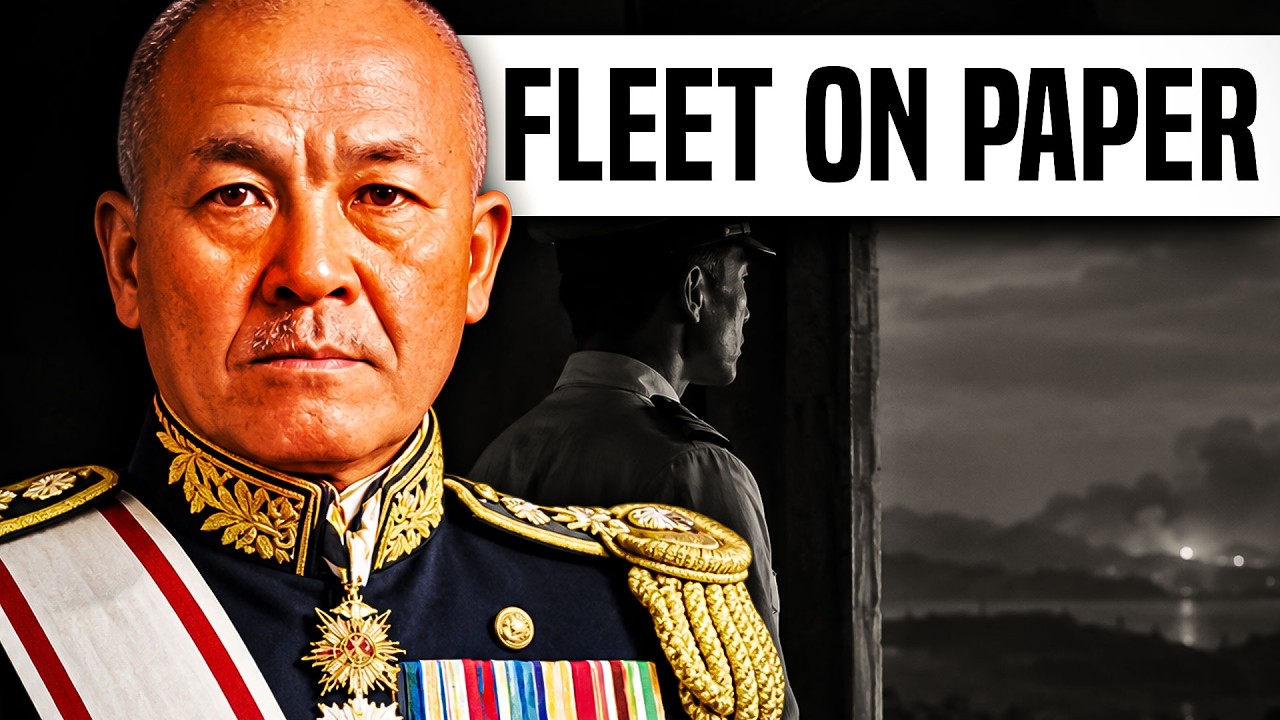
On the evening of June 14, a paper went out from naval headquarters on the island over the signature of Vice Admiral Chuichi Nagumo, the commander who had led Japan’s carriers at Pearl Harbor and Midway. Nagumo’s orders told the garrison that the Marianas were the first line of defense of the homeland and that an American landing was a certainty that month or the next. But down on the western shore, forward units were better informed than the admiral. They watched small craft working along the outer edge of the reef in failing light, setting floats to mark a boat lane.
A marker float is not something an enemy puts in the water weeks ahead. It is something he puts in the water the night before. The gap is worth holding onto, because Nagumo was no fool. He had commanded fleets at sea while most of the men drafting his orders in 1944 were still lieutenants.
What he had on June 14 was a headquarters, a staff, and a title covering the Marianas, the Bonins, and the Palaus — and almost nothing to put in the water. The Marine Corps history of the battle, assembled afterward by men who went over the island with translators and captured files, puts it plainly: his Central Pacific Fleet was an administrative command that never got past the paper stage. This was not a secret from the men who had to hold the place. Through the spring, the chief of staff of the 31st Army, the army command for the whole area, kept writing to the chief of staff of Nagumo’s fleet about the same thing.
And the thing was never troops. It was cement — along with steel reinforcement, barbed wire, and lumber. None of it could be had on those islands, and all of it had to come by sea. Without it, he wrote, it did not matter how many soldiers they had, because there was nothing for them to do but sit around with their arms folded.
The afternoon of June 14 had been the worst of it so far. Swimmers had come in over the reef in daylight, small dark shapes in front of the beaches, near enough to be shot at the whole way in. They were taking soundings, checking the lagoon’s depth and the state of the coral, hunting for obstacles that turned out not to exist. Two were killed and seven were hurt.
Out in the cane, warships had been putting phosphorus into every field that had not yet burned. By evening, smoke lay along the coastal flat in sheets, and the western half of the island smelled of scorched sugar and high explosive at the same time. When the heavy ships pulled back for the night, destroyers stayed behind and shot at the island until morning, so nobody ashore got an hour to repair anything. Rewind to first light that morning.
The fast battleships had been shelling since June 13 from beyond 10,000 yards, held well off the shelf by the chance of mines. Their crews were trained to fight other ships and had spent almost no time on the patient work of knocking down a bunker one correction at a time. They hit the sugar mill at Charan Konoa, a tall, obvious building with a smokestack, over and over. The Japanese were not in it.
On the morning of June 14, the old battleships came in behind the minesweepers, ships that had practiced this exact job on a target range in Hawaii a month before, and the shooting changed character. It went slower and nearer and began to find things. What it found was an island that could not shoot back properly. When it was all over, American ordnance men counted 89 coastal and dual-purpose guns on Saipan, and only 32 of them were emplaced and ready to fire.
The others sat in depots, lay in the open beside pits that had been started and never finished, or were still chained to the flatcars of the narrow-gauge railway that ran around the coast. Not one battery position on the whole island stood complete. What did work, and did terrible damage on June 15, was the field artillery dug in on the first high ground behind the beaches, firing from reverse slopes on sand its gunners had ranged at leisure. Three days before that, the air had gone.
On the afternoon of June 11, with his carriers still 200 miles out to the east, Admiral Marc Mitscher sent in a fighter sweep of 225 aircraft. Every previous American carrier strike in that part of the ocean had come at first light, and Mitscher had asked permission to break the habit for exactly that reason. It arrived in the middle of the afternoon, the wrong part of the day to be watching for it. By dark, the fields were burning.
Most of the aircraft that had gone up were down. The sky over the group belonged to somebody else and stayed that way. A tank sergeant named Tokuzo Matsuya, whose diary came off the island later, wrote that they had watched the whole thing and could do nothing else about it. Two days on, after the naval guns started, he added the line that gives the situation away: “If only we had a hundred planes or so.
”
He did not have a hundred planes or so, and the reason lay 3,000 miles south. Most of the air units based in the Marianas had been pulled out in the back half of May to support the defense of Biak off the north coast of New Guinea, where General Douglas MacArthur had come ashore on May 27. They flew to fields that were being bombed, and they lost aircraft to accidents and crews to sickness about as fast as they lost them to the Americans. A week into June, Tokyo worked out what had been done and ordered them back.
Very few reached even the Palaus. As far as anyone has since established, not one of them got back to the Marianas. Small ground attachments of several air groups were still sitting on Saipan when the Marines landed, servicing nothing, waiting on aircraft that were coming from nowhere. On Tinian, six miles off, an unnamed sergeant wrote in his diary that the whole sky belonged to the enemy and there was nothing left but to go underground.
“Now begins our cave life. ”
The infantry had gone the same way a week before, and more directly. At the end of May, a group of ten ships sailed from the Tokyo area carrying the bulk of Lieutenant General Yoshitsugu Saito’s 43rd Division to Saipan, with a torpedo boat and three submarine chasers around them. Waiting on the route was an American submarine pack of three boats under Captain Leon Blair, working as a team, one on each flank and one trailing behind.
They found the ships on June 4 and stayed with them for two days. What happened over those two days was not a battle. It was a slow, methodical taking apart. One boat would attack, take a heavy depth charge working and slide off, and the other two would hold contact and set up the next run.
Five of the seven ships carrying the division went to the bottom. The men in the water were picked up by whatever was still afloat, and those holes carried them on to Saipan and put them ashore. The better part of a division came off those decks in the first week of June, soaked and empty-handed. Rifles, machine guns, mortars, and unit papers had all gone down with the ships, and in a good many cases, so had the officers who knew who these men were.
One regiment lost most of its strength on the water. Other men on the island had never been meant for the place at all. Troops bound for Yap came out of the sea after their own ships went down, and the rescuers carried them here because here was where the rescuers were headed. Survivors of units routed to the Peleus turned up on the same principle.
Several thousand more were passing through to other garrisons when the blow fell and got caught. On top of that, the Japanese had renamed and renumbered their army units across the whole area in May, folding old expeditionary forces into independent battalions and mixed brigades. The soldiers went on calling themselves by the old names because nobody had ever explained the new ones. Saipan’s own headquarters could not say with confidence how many men it held or what to call them.
Even the dates are not clean. American accounts disagree over whether the first ship of that group went down on June 4 or June 5, and the Japanese side was written up afterward from survivors who had been in the sea and had no reason to be precise about the hour. The same problem runs back to the winter. When a troopship carrying most of a regiment bound for the Marianas burned and sank east of Formosa at the end of February, the American submarine that did it never reported the attack because she did not come home from that patrol.
Both navies had to build the night back up out of the wreckage of the other one’s paperwork. There was a further piece of arithmetic nobody in Tokyo seems to have looked at squarely. The building plan for the defenses of Saipan ran to completion in about November of 1944. A paper of May 20, less than a month before the landing, admitted the work was behind and promised the field positions would be done in the first ten days of June, with permanent ones to follow.
The Americans came on June 15. Nor was there any way to move what did exist, because the garrison had no horses and nothing built for cross-country movement, just rear-drive trucks made for roads. That is why so many guns ended up abandoned where they stood the moment the line moved. Now go back to that ground in Hawaii, because there was something else laid out on it.
At the end of its training, the 2nd Marine Division had carried out a walk-through rehearsal on dry land. Engineers laid out the phase lines for the entire landing on the ground to scale, with the beaches staked and the water in front of them marked off. Then the whole of it walked across on the real clock in the real scheme of maneuver. As its commanding general put it afterward, no more than a handful of commanders and staff officers among those thousands knew what island they had just crossed.
They walked over a full-size copy of the place before anyone told them its name. Which runs back to March 4 and to what the promise had amounted to. That was the day the Central Pacific Area Fleet came into being, with Nagumo at its head and a charter covering the Marianas, the Bonins, and the Palaus. On paper, he was supreme commander in the sector, army and navy both.
The 31st Army headquarters objected to taking orders from a naval officer, an old quarrel rather than a new one. By the middle of March, Nagumo and Lieutenant General Hideyoshi Obata had settled it in the one way open to them: each gave his word not to exercise full authority over the other. The islands were then handled one at a time, each under whichever officer happened to be senior on it. Unified command of the Central Pacific lasted about a fortnight and was dissolved by agreement between the two officers who held it.
Three days before it was created, that burning troopship had gone down east of Formosa with most of an infantry regiment aboard, bound for the Marianas. About half of them died in the water. It was the first delivery of the new command, and it arrived before the command did. That leaves first light on June 14 and what was standing on the island when the old battleships opened at half past five in the morning.
The heavy pieces were there. Mortars of 200 mm, coastal guns up to five inches, searchlights by the dozen, anti-aircraft weapons in quantity. Some sat in naval depots under cover. Some lay in cosmoline grease in the open, out in the cane beside pits dug to about half their depth.
The rest were chained down on railway flatcars where they had been set when they came off the ships, strung out along the narrow-gauge track. They sat through the bombardment on June 14 and through June 15 while the first wave crossed the reef. And they were sitting there still in July when American ordnance men walked the island counting what they had captured — and found the grease unbroken on them, never fired, where Tokyo had set them down.