Last spring, an Egyptian archaeological team working in the Abydos necropolis discovered something that had eluded over a century of systematic excavation at one of the most intensely studied sacred sites in Egypt. They uncovered a royal tomb complex containing multiple burial chambers, intact funerary goods, and human remains belonging to individuals whose inscriptions and biological analysis revealed a ruling family from a period of Egyptian history so poorly documented that scholars had debated for generations whether it even constituted a coherent dynasty. The find did more than fill a gap in the historical record. It reopened an entire chapter of ancient Egyptian history by placing a previously unknown royal family firmly within the sacred landscape where Egyptian kingship was legitimized for three thousand years.
Abydos sits on the west bank of the Nile in Upper Egypt, roughly 500 kilometers south of Cairo, at the edge of the desert where the green strip of the floodplain gives way to limestone cliffs. It was one of the most sacred sites in ancient Egypt throughout the civilization’s history, a period spanning more than three thousand years from the earliest historical rulers to the end of the Ptolemaic era. The site was associated with Osiris, the god of the dead and rebirth, and Egyptian tradition identified it as the burial place of Osiris himself, or at least of the god’s head, which religious geography distributed across multiple sacred locations. The connection to Osiris made Abydos a destination for pilgrimage, veneration, and royal investment from the earliest historical times.
To be buried here, or to be associated with the site in the funerary record, carried a weight of sacred legitimacy that no other location in Egypt could fully replicate. The earliest royal tombs in Egyptian history are found at Abydos. The rulers of the First and Second Dynasties, the kings who established the unified Egyptian state and developed the administrative and symbolic infrastructure of pharaonic civilization around 3100 BC, built their tombs here in a royal cemetery that modern archaeologists call Umm el-Qa’ab. Those early royal tombs were excavated and re-excavated from the late nineteenth century onward, producing essential evidence for the earliest phases of Egyptian chronology and sparking debates about the identities and sequences of early rulers that continue in scholarship today.
But the site never stopped being important to Egyptian kingship after the first dynasties moved their main royal cemetery elsewhere. Throughout the Old, Middle, and New Kingdoms, pharaohs built memorial temples at Abydos, commissioned symbolic tombs called cenotaphs to participate in the sacred geography of Osiris’s burial place, and ensured their presence at the site through architectural and devotional investments that left a material record spanning the entire dynastic period. The temple of Seti I at Abydos, built in the thirteenth century BC and containing some of the finest painted reliefs to survive from ancient Egypt, also holds the famous Abydos King List. That list was both a religious document honoring previous kings who received veneration alongside Osiris and a political document defining which rulers counted as legitimate ancestors of the current pharaoh.
The significance of the recent discovery is therefore not simply that a royal burial was found at Abydos. It is that the family buried there claimed full membership in the royal tradition that this site embodied for centuries. The period in question is the First Intermediate Period, dating roughly from 2200 to 2000 BC. This era followed the collapse of the Old Kingdom and its pyramid-building culture, and preceded the reunification of Egypt under the kings of the Middle Kingdom.
It is among the most poorly documented and least understood periods of Egyptian history, largely because political fragmentation produced rulers with fewer resources and shorter reigns who left behind less archaeological and textual evidence than the kings of stronger centralized eras. The First Intermediate Period is traditionally assigned to Dynasties Seven through Eleven according to the framework derived from the ancient historian Manetho. Dynasties Seven and Eight represented a continuation of the Old Kingdom royal line at Memphis under deteriorating conditions. Dynasties Nine and Ten represented a rival power based in Herakleopolis in Middle Egypt.
Dynasty Eleven, based at Thebes in Upper Egypt, eventually reunited the country and began the Middle Kingdom. Within this framework, some rulers are attested by archaeology or inscriptions, and their place in the dynastic sequence is clear. But there are long stretches of the era where the record is so thin that Egyptologists cannot confidently identify the years, rulers, or political geography involved. The tomb complex discovered at Abydos falls within one of those poorly documented stretches.
The inscriptions found in the complex identify individuals bearing royal titles, royal epithets, and the iconographic markers of Egyptian kingship during the transition from the late Old Kingdom into the early First Intermediate Period. However, these names do not match with certainty any ruler previously known to scholarship from this period. The excavation team is dealing with a royal family that may represent either an entirely unknown secondary dynasty operating within the political landscape of the First Intermediate Period, or a dynasty so poorly attested that it was only inferred from scattered evidence, with its physical burial record completely unknown until now. Both possibilities represent a significant discovery.
Together, they constitute one of the most important additions to the royal chronology of Egypt in generations. The physical scope and content of the tomb complex itself is the most striking dimension of the find, because it is not a single royal burial of the kind that surfaces regularly in Egyptian archaeology, but a multi-chamber complex containing remains and funerary goods belonging to multiple generations of what appears to be one ruling family. The complex was initially identified through ground-penetrating radar survey of an area of the Abydos necropolis that had previously been surveyed but not deeply or systematically excavated. The radar data showed structural anomalies at depths consistent with funerary architecture of the late Old Kingdom and early First Intermediate Period.
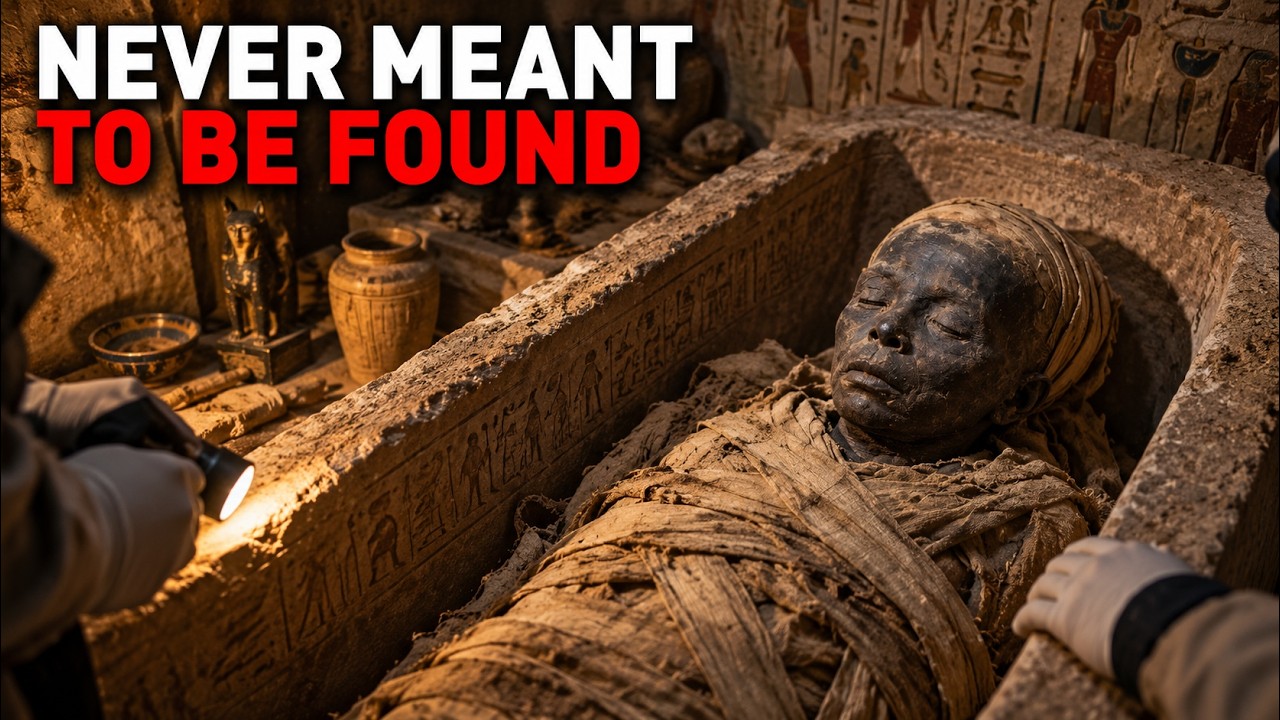
Test excavations confirmed that the survey had revealed a massive underground structure, not geological variation or the remains of previously known and partially excavated tombs. Systematic excavation revealed a complex of at least seven connected underground chambers, each containing an individual burial in varying states of preservation. The funerary goods ranged from pottery vessels and stone tools to jewelry and administrative items bearing hieroglyphic inscriptions. Several chambers contained wooden objects that had largely decayed, but whose shapes could be reconstructed from decomposition patterns and surviving metal fittings and inlays.
The burials themselves represent individuals of both sexes and various ages at death, consistent with a family burial complex spanning multiple generations rather than a group buried at once or a set of unrelated high-status individuals. Skeletal analysis identified probable biological relationships among several individuals based on morphological similarities, with ancient DNA analysis underway and expected to provide much more definitive evidence of family relationships. The burial of children among the occupants of the complex is historically significant. Children of royal status with accompanying funerary goods are strong evidence that the individuals buried here saw themselves, and were seen by those who buried them, as constituting a royal dynasty rather than merely an elite family.
The investment in elaborate burials for children who had not lived long enough to accumulate adult achievements reflects hereditary royal status conferred on family members regardless of individual accomplishment. The inscriptions found in the complex are the most historically significant part of the discovery. They provide the identifications, titles, and royal claims that transform an unusual elite burial complex into evidence of a previously unknown or poorly documented ruling dynasty. Stelae, upright stone slabs bearing biographical and dedicatory texts of the type common in elite Egyptian burials, were associated with at least four of the seven burial chambers.
Hieroglyphic texts on fragments of wooden coffins, pottery vessels, and small administrative objects including seal impressions and labels added further evidence. The quality and extent of the epigraphic record is much better than one might expect from a dynasty operating during the political and economic contraction of the First Intermediate Period. This suggests either that the family was wealthier and more powerful in its local or regional context than general conditions of the period might indicate, or that the complex was built and furnished during the transition between the late Old Kingdom and the early First Intermediate Period, when resources for elite funerary investment were declining but had not yet reached their lowest point. The royal titles in the inscriptions are the element that makes identification as a royal family certain rather than as merely a prominent elite family.
Several adult males buried in the complex bear the Horus name, the oldest and most essential of Egyptian royal titles, and one inscription contains the full five-fold royal titulary developed by Dynasty Five. The presence of the complete royal titulary in an official inscription is not something that can be attributed to an ambitious non-royal official exaggerating his status. It is a formal claim to kingship, supported by the burial context, the location within the royal Abydos necropolis, and the quality and content of the accompanying funerary goods. The personal names preserved in the inscriptions follow naming traditions documented for rulers of the late Old Kingdom and early First Intermediate Period, and at least one name appears to represent a royal name never before documented.
This previously unattested royal name is the most striking element of the epigraphic evidence, because it proves beyond doubt that at least one of the individuals buried in the complex was a ruler whose existence was entirely unknown to Egyptology before this discovery. Biological analysis of the human remains adds dimensions to the historical picture that epigraphic evidence alone cannot provide. Preservation varies significantly across the seven burial chambers, reflecting both differences in original burial practices and differences in micro-environmental conditions within different parts of the complex over more than three thousand years. Age-at-death estimates for adults range from early-to-mid adulthood up to apparent advanced age for one individual, a pattern consistent with a multi-generational family interpretation and inconsistent with a scenario involving a mass burial of people who died together in a single event.
Evidence of health and life experience recorded in the skeletal remains is one of the most unexpected dimensions of the biological analysis. Several adults show skeletal markers consistent with strenuous physical activity during their lives, which is not typically expected from royal individuals whose social status would usually separate them from manual labor. The research team is appropriately cautious about these markers, working to contextualize them within what is known about the physical demands of royal life during the First Intermediate Period before drawing interpretive conclusions. The ongoing ancient DNA analysis represents the biological evidence with the greatest potential to change historical interpretation of the complex.
If the genetic material in these remains falls within the range that allows accurate analysis, the DNA data will provide conclusive evidence of biological relationships among the individuals buried in the complex, and possibly evidence about the broader genetic origins of the family that could shed light on their geographic and ethnic roots within the complex demographic landscape of First Intermediate Period Egypt. The historical implications of the discovery extend far beyond identifying previously unknown rulers to raising questions about how and why this family disappeared entirely from Egyptian historical records. The Abydos King List in the temple of Seti I is one of the most important documents in the chronology of Egyptian kings, but it was never a neutral historical record. It is a carefully selected collection of rulers that Dynasty Nineteen considered legitimate ancestors worthy of inclusion in a list whose primary purpose was religious and political rather than comprehensive historical documentation.
The First Intermediate Period entries in the list are notably sparse and selective, reflecting both the genuine difficulty of documenting a period of political fragmentation and the tendency of later unified kingdoms to downplay the historical significance of periods when Egypt was not unified under a single legitimate ruler. A secondary dynasty that ruled during the First Intermediate Period would have had no political incentive for any later strong unified system to carefully preserve its memory. The family may not have been actively suppressed as the Amarna rulers were, but simply deemed irrelevant to the official narratives built by the later system to legitimize its own authority. The fact that they buried themselves at Abydos, in the sacred site where the legitimacy of Egyptian kingship was concentrated in the historical landscape, tells us much about how they understood their own claims to royal status.
Burial at Abydos was not available to anyone with wealth and power. It was a declaration of royal legitimacy, a claim to be counted among the legitimate rulers of Egypt belonging to the sacred landscape of Osiris’s burial place. Whatever their political power and territorial reach, and the evidence suggests both were limited, they considered themselves true pharaohs, not merely powerful provincial notables who adopted royal symbols without the implied claim to legitimate royal identity. The discovery also sheds light on the broader political and social dynamics of the First Intermediate Period in ways that scattered available evidence had left unclear.
The First Intermediate Period has been described in Egyptological literature in terms ranging from catastrophic collapse to managed decentralization, with different scholars weighing available evidence differently to present quite divergent pictures of what Egyptian society and political life looked like during this transitional period between the Old and Middle Kingdoms. The investment in a multi-generational royal tomb complex at Abydos, even during a period of political and economic difficulty, suggests that the cultural and symbolic infrastructure of Egyptian kingship remained intact and important enough for this family to allocate significant resources to its preservation and expression in the funerary sphere. The quality of the funerary goods, while not matching the opulence of the great royal burials of the Old Kingdom, represents substantial investment rather than the modest funerary equipment one might expect from a family operating under severe economic constraints. The geographic location of this family within the political landscape of the First Intermediate Period is one of the questions raised by the discovery.
Abydos is in Upper Egypt, in the same general region that would eventually produce the rulers of Dynasty Eleven at Thebes who reunified the country. Whether this family was a precursor, a rival, or a subordinate ally of the Theban rulers who came after them is a question the epigraphic evidence from the complex only partially addresses, and it will require ongoing historical contextual analysis to fully explore. The discovery also illustrates how major archaeological finds happen in the twenty-first century in ways that differ fundamentally from the discoveries of the past century that shaped popular imagination about what Egyptian archaeology looks like. The tomb complex was not found through the romantic excavation seen in famous discovery stories, but through the systematic use of non-invasive survey techniques at a site that had already been excavated for over a century.
Without the ground-penetrating radar survey, the complex might have remained undiscovered for decades despite being located within one of the most intensely excavated archaeological sites in the world. The multidisciplinary team assembled for this discovery and analysis reflects the shift in archaeological practice toward integrating experts who were not primary participants in earlier generations of Egyptian fieldwork. Physical anthropologists, ancient DNA specialists, materials scientists analyzing pigment composition and ceramic fabric, experts in ancient textiles and woodworking techniques, epigraphers, and art historians all contributed to analyzing a discovery that earlier archaeological practices might have treated primarily through the lens of inscriptions and art history alone. The Egyptian archaeological mission that led the discovery represents the continued development of Egyptian-led archaeology at major Egyptian sites, a shift from the patterns of the nineteenth and early twentieth centuries when major discoveries were often made by European and North American expeditions.
Egyptian archaeological expertise, institutional infrastructure, and methodological development have grown significantly in recent decades, and discoveries of this scale made by Egyptian teams at Egyptian sites are now the norm rather than the exception in current Egyptian archaeology. An honest report of the discovery’s significance requires acknowledging what has not yet been resolved as much as what has been proven, because the gap between what the evidence currently shows and what it will eventually show when analysis is complete is itself part of the historical picture. The territorial extent of this family’s political control has not been confirmed by the tomb complex evidence and may never be fully established. Tomb complexes tell us how rulers chose to present themselves and what resources they devoted to funerary investments, but they do not directly document the geographic boundaries of political control, the administrative scope of the family’s institutions, or the specific relationships between this family and other regional powers operating in Egypt during the same period.
The duration of the dynasty has not yet been determined with the chronological precision the question deserves. Radiocarbon dating of organic materials recovered from the complex is currently underway and will provide secure dates for the burials that will place them within the chronology of the First Intermediate Period with greater accuracy than stylistic and comparative evidence alone can provide. The question of how the family came to an end, whether through military defeat by a rival, absorption into a larger political entity, alliance or intermarriage, or even the biological extinction of the royal line, is not answered by current evidence and may remain uncertain given the scarcity of textual evidence about the internal politics of the First Intermediate Period. Abydos has long produced discoveries that rewrite Egyptian history through more than a century of systematic archaeological research, and the discovery of this royal tomb complex and the family it represents is the most significant addition to that record in modern memory.
The family found in this complex made their declaration of belonging to the legitimate line of Egyptian kings. They equipped their burials with the markers of royal legitimacy. They used the full royal titulary. They buried their dead in the sacred site of Osiris.
Then they disappeared from the historical record so completely that three thousand years of research passed before anyone found the physical evidence of their existence. They are no longer entirely unknown. The inscriptions tell us their names. Biological analysis reveals their relationships to one another and aspects of their lives.
Ancient DNA analysis will tell us more. Ongoing study of associated materials will continue to add detail to the picture for years to come. The family that history forgot is now returning to memory, one analyzed inscription and one biological sample at a time. History forgot this family.
But the land of Abydos did not. What is being extracted from that ground is proof that the history of ancient Egypt is larger and more complex, and more crowded with rulers and dynasties and political realities, than the surviving textual records could preserve. This discovery does not fully close the gap. Gaps like this are rarely closed by a single excavation season.
What has been filled is the physical, three-dimensional, biologically real existence of a king and his family who built their tombs in the most sacred site in Egypt and waited in the limestone for three thousand years for someone to learn their names. We know their names now. The full account of who they were, what they ruled, and why history forgot them will take years of continued research to write. But the evidence of their existence, their significance, and their humanity is no longer in doubt.
The dynasty that history forgot has been found, and what comes next is the work of understanding what their discovery means for the history that forgot them.