When George Raft flipped a coin between his knuckles on the set of Scarface in 1931, the gesture became an instant trademark that followed him for the rest of his life. The tiny flip looked casual, but for the former dancer turned actor, it was a distillation of everything he had learned in New York’s Hell’s Kitchen and its illegal speak-easies: how to make silence talk and stillness seem dangerous. George Raft was born in 1901 or possibly 1895 in Manhattan’s Hell’s Kitchen, where birth dates were flexible both in old Hollywood and in the hardscrabble neighborhood long before he ever set foot on a studio lot. His German immigrant parents worked the carnival circuit, and his mother taught him dance steps before he could read.
By 12, he had quit school, and by 13, he was on his own, working electrician’s helper jobs, boxing under the name “Ducks Rooft,” and even trying minor league baseball. None of it stuck until he realized he could get paid for dancing. By the late teens, Raft was dancing in Manhattan amusement parks and taxi dance halls during the roaring 20s. He landed in the orbit of Texas Guinan, the legendary nightclub queen whose speak-easies catered to the rich and reckless while the vice squad circled outside.
She put him in her stage act and pushed him toward a Charleston competition that drew the attention of talent scouts. Raft took it from there, making his way to Broadway in shows like The City Chap and Padlocks of 1927. His nights among bootleggers and mob figures were not incidental to his education. His New York circle included Onie Madden and, a little later, Benjamin “Bugsy” Siegel.
These were informal connections built on proximity and loyalty, the natural result of a hungry young man working in clubs where the patrons financed the room. He learned to be genial with everyone and in debt to no one. Raft married Grace Mulrooney in 1923, but the marriage soured quickly. She refused him a divorce, leaving him legally bound for the next four decades.
He kept her on a stipend and spoke of her without bitterness, but he could never marry the women he loved. Hollywood came calling in 1931 with Quick Millions, where he played a heavy opposite Spencer Tracy. He stole his shots with a dancer’s economy, standing like he had seen everything and walking like he owned the next ten seconds. It was his first gangster role, and the formula clicked.
That same year he appeared in Taxi, and then came Scarface. On the soundstage in September 1931, director Howard Hawks was blocking a scene he felt was too quiet. Paul Muni held the center of the frame, but the lieutenant beside him, a character named Guino Ronaldo, looked underwritten. Hawks told Raft to do something with his hands.
Raft took out a coin and began flipping it from knuckle to knuckle. The set went silent. The coin transformed a secondary hood into a figure with a private ritual, a man who measures risk by feel. Scarface landed in 1932 with bruising force, and Raft walked out with a brand.
Paramount signed him and began building vehicles around his silhouette. Young men copied his white tie against a dark shirt and his low hat brim. He never tried to out-talk James Cagney, but he did not need to. He looked the part more than anyone else, and he had the street credentials to back it up.
Raft’s career took off with Mae West’s first Hollywood vehicle, Night After Night, where he played her suave gangster boyfriend. It was his first leading man role, and the two began what was technically an affair. He later had a relationship with Tallulah Bankhead, which ended badly after he gave her gonorrhea, as she detailed in her own autobiography. He also had an affair with showgirl Hilda Ferguson, who died in 1933 after they had separated.
In 1934, he starred in Bolero as a Latin dance instructor opposite Carole Lombard, and their on-screen tango was so sensuous that audiences left the theater speaking Spanish to their sweethearts. Off-screen, the affair was widely reported. Lombard later said that George was the greatest lover she ever had, and she would not be the last to make that claim. By the mid-1930s, Raft’s celebrity was rising.
Co-star Spencer Tracy said he had never met a tougher man off-screen. Columnist Hedda Hopper noted in 1937 that Raft had made millions but had not kept them, due to a fondness for gambling and a loyalty to helping old friends. He tipped his winnings to buddies like Bugsy Siegel and watched money vanish on dice tables. He had at one time been, at the very least, a wheelman for Siegel.
In 1938, he was interviewed by the FBI about two Jewish gangsters, Lewis Buchalter and Jacob Shapiro, leading figures in Murder Incorporated. It later emerged that it was Owney Madden who had quietly financed Raft’s early Hollywood gamble, thinking it would be great to have one of their own on the big screen. Madden was an Irish-American gangster nicknamed “the Killer” and one of the major bootleggers of the Prohibition era. He ran the Cotton Club, the notorious illegal venue where legendary Black performers entertained a strictly white-only audience during the Jim Crow era.
Off-camera, Raft’s personal life remained tabloid material. He fell deeply in love with Norma Shearer, the epitome of MGM refinement. The pairing seemed unlikely to most observers, but the chemistry was genuine. They saw each other almost daily through much of 1939 and 1940.
Raft remained legally bound to Grace, however, and Shearer, worried about her children’s welfare, ended the affair, calling the decision “sad, but necessary. ” Despite the breakup, both spoke kindly of one another in later years. Next came a well-publicized affair with Betty Grable. By this time, any prior gallantry had dried up, and he was abusive toward her.
Still, Grable was under his spell. “I would have married George Raft a week after I met him, I was so desperately, so deeply in love with him,” she later said. “But when I wait two and a half years, there doesn’t seem to be any future in a romance with a married man. ”
By this time Raft was earning $200,000 a year, making him the third highest-paid actor in America behind Warner Baxter and Gary Cooper.
Paramount built pictures around him. He headlined Souls at Sea with Cooper, co-starred with William Holden and a then relatively unknown Humphrey Bogart in Invisible Stripes, and shared the screen with James Cagney in Each Dawn I Die. The volatility of his temper was on full display during the making of 1941’s Manpower. The main antagonism was between Raft and Edward G.
Robinson, and the trouble began when Raft berated Robinson over a line of dialogue. A week later, the pair exchanged blows while a Life magazine staff photographer was on set, capturing an image that stunned movie lovers when it was published. Raft was jealous of Robinson’s star billing, feeling he ought to have topped the marquee. He was also infatuated with Marlene Dietrich and believed she was sleeping with Robinson.
He even declined to slap Dietrich in a scene, saying, “I respect women,” until both Walsh and Dietrich convinced him it was necessary. The irony is that Robinson was only cast after Raft refused to work with Humphrey Bogart, whom he openly disliked due to Bogart’s politics. Robinson later said Raft was “touchy, difficult, and thoroughly impossible to play with. ” When James Cagney became president of the Screen Actors Guild and battled the mob’s influence in Hollywood, Cagney later insisted he owed his life to Raft.
Rumor had it a mob hitman was about to kill Cagney with a falling light, and Raft intervened to have the hit quietly called off. Raft famously made two career decisions that altered the course of Hollywood history. In 1941, Warner Bros acquired the rights to High Sierra, and director Raoul Walsh thought Raft was perfect for the lead. But Raft refused to play a crook who goes to the chair.
When Walsh explained he had to die in the script, Raft reportedly barked back, “I’m not going to die. ” He told Jack Warner to shove it. Bogart accepted the part, and High Sierra became his breakthrough role. Barely had that decision sunk in when the studio lined up another project: The Maltese Falcon.
Raft’s contract said he should be cast as Sam Spade, but he fumbled the opportunity. He wrote an explosive letter to Jack Warner four days before filming, insisting the Maltese Falcon was not an important picture and that he had no obligation to make any film that wasn’t important. Warner shrugged and replaced Raft with Bogart once more. That film became another smash.
A bitter Raft never got over living in the shadow of Bogart for the rest of his career. Despite these blows, Raft worked steadily through the 1940s. In 1942, he persuaded Warner Bros to let him star in Universal’s Broadway, a film largely based on his own early dancer days, but the studio suspended him for eight months before granting the loan-out, and Raft had to pay $27,500 of his own money. The film was self-referential nostalgia, but it was not a hit.
The mythology around Raft’s decline included a claim that he turned down Casablanca, but in truth, Jack Warner and Hal Wallis had already settled on Bogart for that part. In reality, Raft could well have been offered the role had his track record with the studio been less volatile. He was also offered the lead in Billy Wilder’s Double Indemnity and passed, telling Wilder he would reconsider if the film were reworked as a comedy. Wilder flatly rejected the idea, and Fred MacMurray gave cinema one of its most famous noir performances.
Raft’s mob associations brought him trouble throughout the 1940s. In 1947, his childhood friend and benefactor Bugsy Siegel was murdered in what was most likely a mob hit, and Raft’s murky connections made the headlines. The 1950s found him drifting through the film industry on old star power, settling into gangster roles in B-movies and supporting parts. He was offered a stake in Siegel’s Flamingo Hotel after the murder, with the plan that he would become entertainment director, but he was denied a gaming license due to his organized crime connections.
Three years later he obtained one on appeal. He went into business in Havana with mob boss Santo Trafficante Jr, opening the Capri Casino, where he minded craps tables for most of the decade. In January 1959, Fidel Castro’s troops arrived in Havana, and Raft was in the Capri the night the revolutionaries arrived. Castro closed all of Cuba’s casinos, and Raft fled back to the US by boat.
In 1959, Raft made one of his most visible late-career appearances in Billy Wilder’s comedy Some Like It Hot, playing Chicago mob boss Spats Colombo. In one scene, he glares at a hood flipping a coin and growls, “Where did you pick up that cheap trick? ” It was a knowing parody of the trademark that had made him famous, and one of his last major appearances in a Hollywood classic. Age was closing in on Raft.
In 1965, he was convicted on tax evasion charges and fined $2,500. The next year, he testified before a New York grand jury about his organized crime connections. The last chapter was set in London, where Raft became the frontman for mobsters Angelo Bruno and Meyer Lansky’s newest venture, the Colony Sports Club, an upscale gambling hall on Piccadilly. But the British government had very little tolerance for American organized crime operations.
After returning to the US for vacation in 1967, Raft was denied re-entry to Britain entirely, officially banned as an undesirable mob frontman. George Raft spent his last years quietly back in Los Angeles, a shadow of the figure who once prowled studio lots and speak-easy wings. He picked up TV roles and B-movie parts, and even briefly became the face of Alka-Seltzer. His mob connections had dried up, and the money ran out.
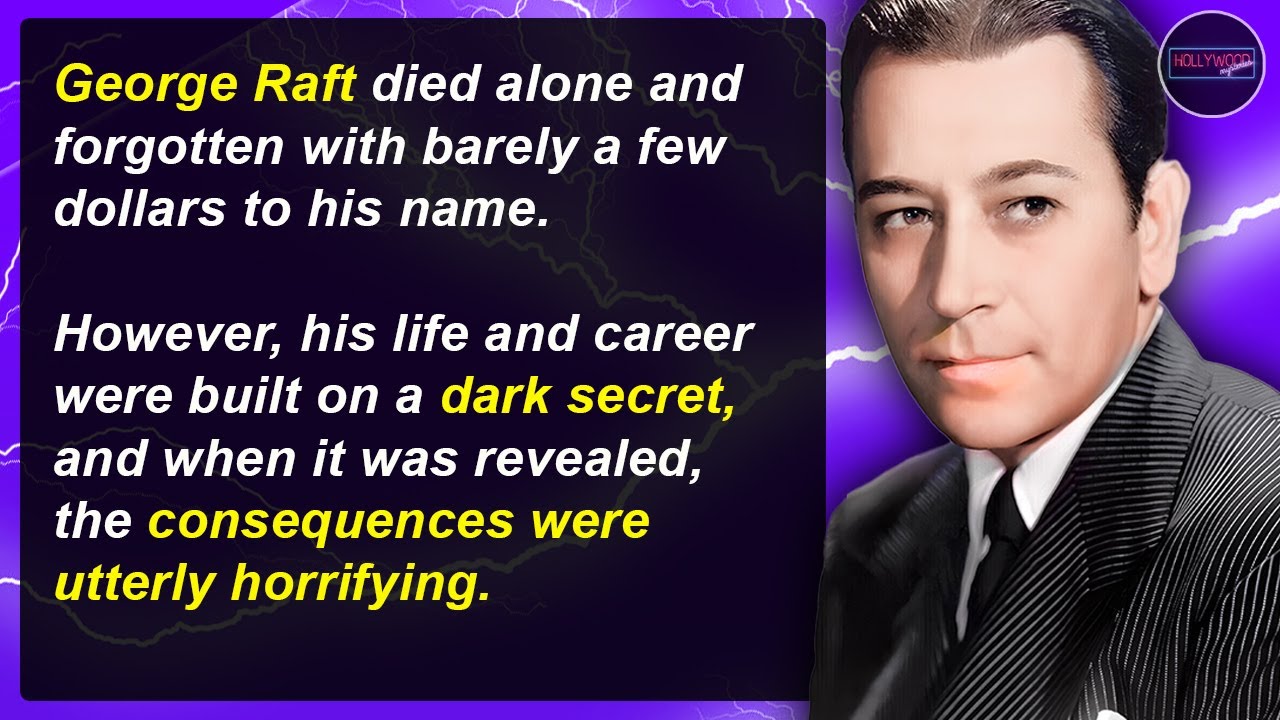
By the end of the 1970s, he was broke, living off $800 a month from social security and a pension. He battled emphysema. In November 1980, at age 79, he passed away alone with little money and less fanfare, an almost forgotten figure. He left behind a $10,000 life insurance policy and a battered wardrobe containing some finely tailored but ancient gangster suits, which a dealer later sold for a few hundred dollars.
There was no will, no grand funeral, only the unceremonious closure of a checkered life. For those who remember, George Raft remains one of Hollywood’s original tough guys, complicated and unforgettable in the mystery of his life.