When Thomas “Stonewall” Jackson lay dying on a serene Sunday in rural Virginia, roughly 27 miles from the bloody battlefield of Chancellorsville, the man who had terrorized Union forces for two years was momentarily peaceful. His final words were a poignant farewell, but the hours before had been far more characteristic of the man his own troops and enemies knew—sharp, concise orders that brooked no argument. Those around him had witnessed the delirium of a commander who had become the Confederacy’s most feared field officer. His battlefield mantra was simple and brutal: unsheathe your blade and discard the scabbard.
Use the bayonet. Slay them all. Even in the parlors of Richmond, rumors swirled about Jackson’s unique ruthlessness. One observer noted that he cared not how many perished, only that he triumphed.
Yet only his wife knew the softer side of a man grounded in solitude and self-doubt. To the broader world, “Old Jack” embodied utter chaos on the battlefield—a primal warrior who showed no mercy to a foe. His death in May 1863 sent shockwaves through the Confederacy. Robert E.
Lee was so shaken he refused to discuss it, and Jefferson Davis admitted he could barely think. One young Virginia girl wrote that it was the first time she realized God might allow the South’s defeat. Jackson’s towering reputation was forged in just two to three years, a period consumed almost entirely by battles and strategies. In a single nine-month span, he fought in some 14 major engagements, often being the decisive factor.
His rise surprised everyone. At the war’s outset, journalists dismissed him as proof the Confederacy lacked military talent, and observers noted that if he was capable, he had hidden it well. Nothing in his early history suggested what he would become. Unlike the aristocratic Virginia commanders who surrounded Lee, Jackson was a rugged son of the Piedmont, raised in impoverished circumstances.
Everything he achieved was largely self-made, deliberately so. He was intentionally a self-forged man, driven to excel yet reserved and keenly aware of the privileges he lacked. His evangelical faith was a potent blend, perhaps echoing stern ancestral roots in Ireland. Perseverance carried him through West Point, where he was an unremarkable student who turned relentless study into adequate grades.
The experience cemented an obsessive commitment to military protocol and details. During the Mexican War, he fretted that enemy fire would not be fierce enough for him to prove himself. He was a man without moderation, even shunning whiskey because he enjoyed its taste too much. From 1851 to 1861, he taught natural philosophy and artillery tactics at the Virginia Military Institute in Lexington, Virginia.
He was an uninspired instructor, often mocked by cadets, and a day’s lesson was typically memorized verbatim the night before. Any student question usually prompted Jackson to repeat the entire lecture word for word. It is astonishing that such a rigid man would later be hailed as a master of innovation and unpredictable strategy. On July 21, 1861, at the First Battle of Bull Run, he earned the most iconic nickname in American military history.
“There stands Jackson like a stone wall,” shouted General Barnard Bee, rallying his troops. Bee perished that day, but the South secured a resounding victory. Jackson was sent to the Shenandoah Valley, where he managed with barely a third of the troops his opponents could muster to outmaneuver and outfight anything the Federals sent against him in a three-month campaign. Only Jackson seemed unsurprised by these outcomes.
Steeped in the doctrine of predestination, he viewed all events as expressions of God’s will. Defeats were his fault, a divine rebuke; victories were God’s alone. As the war progressed, Jackson increasingly saw the conflict as a holy crusade. Yankees were sinners, and fighting them was a sacred obligation.
This mindset explained his harsh treatment of his own men, who were God’s instruments expected to endure hardship, hunger, grueling marches, and instant death if commanded. A fellow general observed that Jackson placed no value on human life when he had a goal to achieve. “Did Jackson’s men love him? ” the same officer asked rhetorically.
“That was nonsense. They feared him and followed him to the death. ” Contemporaries called him either a genius or slightly unhinged. Jackson kept his plans secret to the confusion of his subordinates, and his sudden marches and baffling orders became legendary.
Dispatches from headquarters were sometimes addressed simply to “General T. J. Jackson, somewhere. ”
Jackson believed there was method to the madness.
“Mystery, mystery, mystery is the key to success,” he once said. His wife recalled him saying that only one style of warfare was acceptable against the Federals: blind, furious, wild. He never hesitated to attack, never doubted himself, always pressing forward. This made him the perfect lieutenant for Robert E.
Lee, though many believed he lacked Lee’s refined sense of balance and would have been a poor commander-in-chief. By June 1862, Lee and Jackson had begun their renowned partnership. The Army of Northern Virginia, with Jackson as a core commander, defeated General McDowell on the peninsula, crushed General Pope at Second Bull Run, seized Harper’s Ferry, severely mauled McDowell again at Antietam, and obliterated over 12,000 troops under General Ambrose Burnside on the heights above Fredericksburg. Jackson’s fame, amplified by an adoring Southern press, was at its peak.
In the spring of 1863, President Lincoln turned to General “Fighting Joe” Hooker to steady the Federal cause. At Chancellorsville in late April 1863, Hooker vowed to trap Lee. Instead, after three days of brutal combat, he confessed he had had enough and almost wished he had never been born. The chief architect of this despair was Stonewall Jackson.
Hooker had secretly crossed 134,000 men over the Rappahannock River to the Confederate rear. Lee split his 62,000 troops, leaving a defensive screen at the front while redirecting the rest toward Hooker. At a remote crossroads called Chancellorsville, Hooker took a defensive stance, inviting Lee to attack. Lee assessed Hooker and saw weakness.
Despite the disparity in numbers, he urgently asked Jackson, “How do we get at those people? ”
The answer came from scouts: Hooker’s right flank was exposed, unanchored by terrain or fortifications. When Jackson proposed to march his entire corps of 28,000 men around the flank, Lee asked what he would leave behind. Jackson would leave Lee with only 14,000 to face Hooker’s 50,000.
The exchange ended with Lee’s simple, “Well, go on. ”
At 7:30 that morning, Jackson began a 12-mile trek through the tangled wilderness. Around midday, a scout led him to a rise where 11,000 men of the Union 11th Corps lounged in a clearing, rifles stacked, listening to regimental bands. Stonewall studied the scene for five silent minutes.
For a soldier, this was nirvana. With only two hours until sunset, Jackson ordered his brigades to advance through the scrub woods. Some junior officers had reported strange noises, but generals dismissed the reports. At 5:45 p.
m. , the Federals heard a sudden surge of rustling followed by a flood of wildlife—quail, rabbits, foxes, deer, even a bear. Right behind came 21,000 Confederate soldiers who delivered a devastating volley. Within minutes, at least half the 11th Corps dissolved into a panicked mob.
To Jackson, the moonlit night only offered more chances to press the attack. Around 9:00, he chose to scout ahead of his men to find a way to exploit the advantage in the dark. His party stumbled across Confederate lines. A shot rang out, then a volley.
In seconds, ten of the nineteen men with Jackson were struck, including Jackson himself. He was hit twice in the left arm and once in the right hand. His horse bolted through the underbrush, and a branch struck the general in the face. His staff found him dazed and in pain.
“My arm is broken,” he said. He was carried from his horse, which fled toward the enemy. Federals were nearby, and cannons were spraying the trail. A crude stretcher was assembled, but twice in the darkness bearers stumbled, dropping Jackson onto his injured shoulder and likely rupturing an artery.
He was alert enough to issue a final order to General Pender: “You must hold your ground, sir. ” At a field hospital, surgeons amputated his arm. Initially, hopes for survival were high. Lee was confident Jackson would return, admitting he had never prayed so fervently for any single blessing.
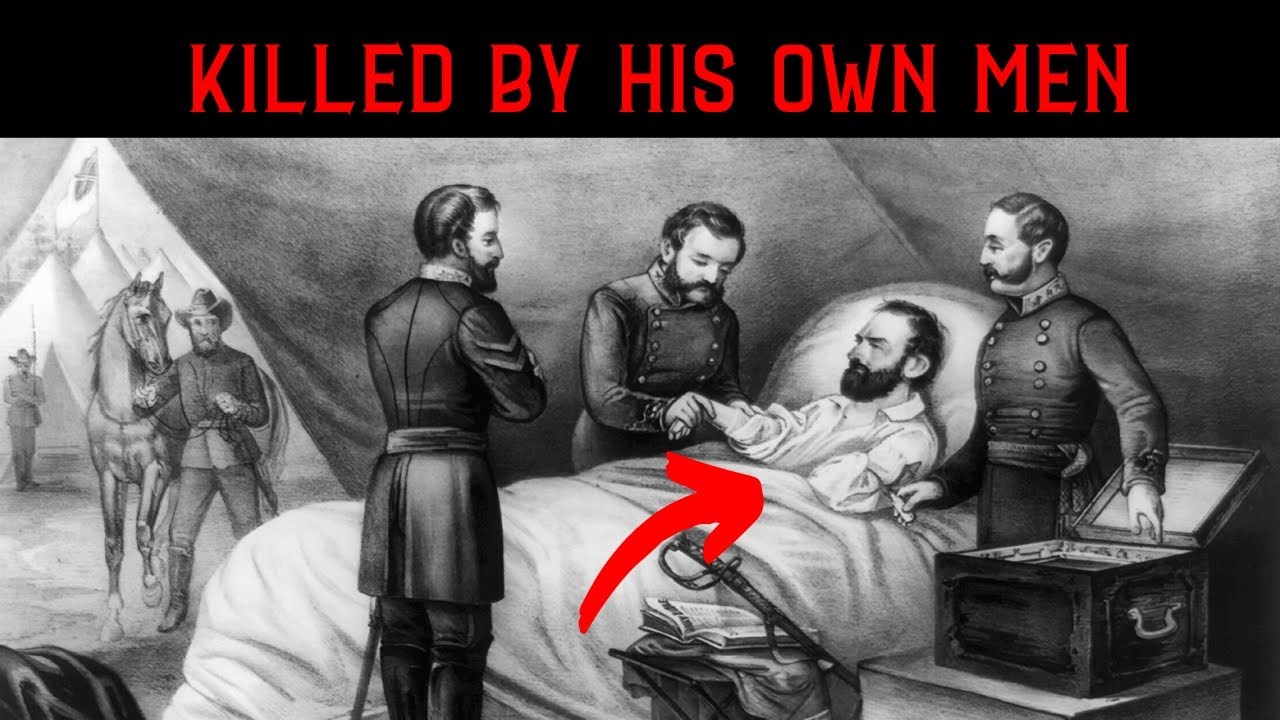
A grueling 27-mile, 14-hour ambulance journey brought Jackson to Guinea Station. His wife and infant daughter arrived three days later. Despite an optimistic prognosis, Anna Jackson’s heart sank when she saw him. He looked like a dying man.
Jackson lingered for three more days, at first lucid and thankful for his wounds, which he saw as part of a divine plan. He received Lee’s congratulations and the famous remark that while Jackson had lost his left arm, Lee had lost his right. On May 7th, signs of pneumonia appeared. By May 9th, it was clear he would not survive.
Anna asked if he was ready to meet God. “My wish is fulfilled,” he said. “I have always desired to die on Sunday. ” At 3:15 p.
m. on May 10, 1863, he crossed the river. When Federals learned of his death, they took grim satisfaction, perhaps a solace for their 17,000 casualties. Jackson’s body was taken to Richmond for a grand ceremonial lying in state, then to Lexington, where he was buried in a cemetery overlooking the town.
His discarded left arm was retrieved by his chaplain and buried in a family plot near Chancellorsville. Few visit the site today; the field hospital’s location is now a median on a busy county highway, with no markers or signs. For General Lee, Jackson’s death was catastrophic. He never again divided his army as he had at Chancellorsville, never again attempted such an audacious flanking maneuver, and never trusted another as he had Stonewall.
Pickett’s charge at Gettysburg, a blunt assault, reflected the kind of warfare Jackson’s absence made necessary. It was a strategy that favored the more populous North and ultimately doomed the Confederacy. Jackson left an estate worth $22,000, which vanished by 1864. His image appeared on the Confederate $500 bill, worthless by 1864.
Anna lived until 1915, serving as president of the United Daughters of the Confederacy. Jackson’s sister, a staunch Unionist who had disowned her brother, was made an honorary member of the Grand Army of the Republic. Little Sorrel, Jackson’s horse, was recovered and lived to 36, outlasting Jackson’s 39 years.