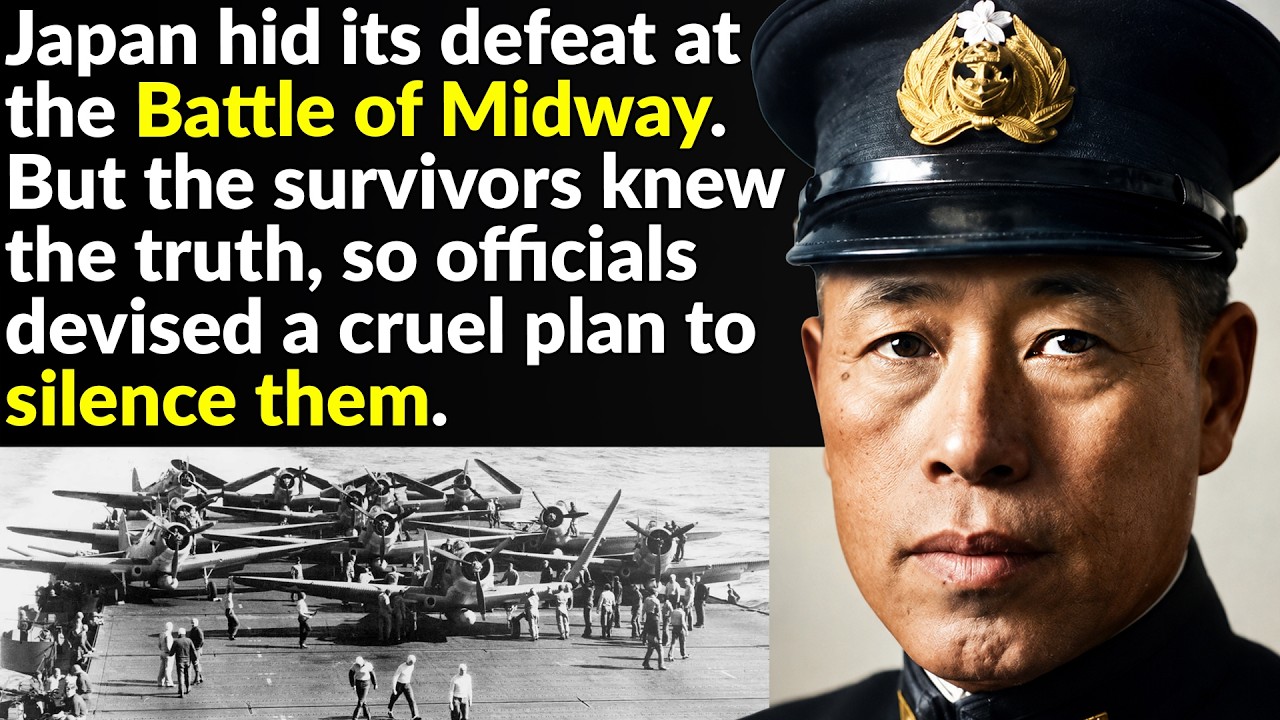
Japan had a secret to protect, and they were willing to do almost anything to keep it. They had lost the Battle of Midway, a devastating blow in the Pacific War, and they could not let the world know. The greatest threat to that secret was the survivors of the battle itself, the men who had seen the defeat with their own eyes. To silence them, the Japanese came up with a plan so cruel it defies imagination.
Everyone knows the story of Pearl Harbor, the surprise attack that dragged the United States into World War II. But the Battle of Midway, fought just six months later, was just as dramatic, a desperate American attempt to hold their ground in the volatile Pacific and to seek revenge for the lives lost in Hawaii. The Midway Islands had been claimed for the United States back in 1859 by Captain N. C.
Brooks. For decades, America saw little value in the atoll, a tiny strip of land covering just over six square kilometers. But when air travel became common, the islands, named because they sat roughly halfway between North America and Asia, suddenly became an asset worth defending. In 1940, the U.
S. Navy began building submarine bases, air traffic facilities, radio stations, and a power plant on the island. It was impossible to keep that kind of activity secret for long. Soon, the Japanese took notice.
On December 7th and 8th, 1941, just twelve hours after the attack on Pearl Harbor, Japan struck the hangar and the power plant on Midway. The island was now on the front line of a global war. In 1942, Japan had ambitious plans to expand the war across the Pacific. They set their sights on British Hong Kong, the Philippines, Singapore, British Malaysia, and the Dutch East Indies.
In April, American forces launched a daring raid on Tokyo and other Japanese cities, a shock that made the Japanese leadership realize just how formidable their enemy truly was. The presence of American power in the Pacific posed a serious threat to Japan’s defenses. At first, the Japanese seriously considered hitting Pearl Harbor again, hoping a second devastating blow would force the United States to pull back and defend its own shores. But instead, they came up with a different plan.
Admiral Yamamoto, the mastermind behind Pearl Harbor, chose the Midway Atoll as the site of his next move. The tiny islands held little strategic value for Japan, but Yamamoto understood they were vital to the Americans as a refueling point for their submarines. He wanted to act fast. He had already destroyed the USS Yorktown in the Battle of the Coral Sea, or so he believed.
That victory meant the Americans had only two carriers left for defense, the USS Enterprise and the USS Hornet. On paper, the United States looked vulnerable, and Yamamoto planned to take full advantage. But there were things Yamamoto did not know. The Yorktown had been hit hard and needed repairs, but the Americans worked around the clock and made her seaworthy again in just seventy-two hours.
It was a remarkable feat of engineering and determination. The Yorktown was ready to fight. America was not as vulnerable as Yamamoto assumed. He made another mistake as well.
Because of American losses in the region, Yamamoto believed morale on the U. S. side was low. He underestimated the American desire to succeed.
Morale was not low. American fighters were hungry, angry, and ready to take on whatever Japan had in store. Yamamoto’s plan was to lure the American carriers into a trap at Midway. He sent a small force under Chuichi Nagumo to strike first, while he held a much larger fighting force several hundred miles behind, ready to crush any American response.
It was a sound strategy, but Yamamoto had not counted on the American code breakers. The code breakers had noticed the Japanese referring to a location by the code name AF. They suspected it meant Midway, but they weren’t certain. So they sent out an uncoded message claiming that Midway’s water purification system had broken down.
The Japanese took the bait and relayed the information, replacing the location with AF. Soon afterward, American intelligence intercepted another Japanese message stating that AF was short on fresh water. That confirmed it. AF meant Midway.
Now the Americans had a vague but critical picture of what was coming. They knew what to expect, and Yamamoto had no idea they knew anything at all. Admiral Chester Nimitz sent three carriers to a position northeast of Midway: the Enterprise, the Hornet, and the Yorktown. The Japanese had no idea the Yorktown was still afloat.
By June 4th, the U. S. Navy had assembled a formidable defense. They had four squadrons of seaplanes totaling thirty-one aircraft, six new Grumman TBF Avengers, another sixty-four planes from the Marine Corps, and an additional one hundred and twenty-two from the U.
S. Army Air Forces. The United States was far more prepared than Japan could ever have imagined. At 4:30 in the morning on June 4th, Nagumo launched his attack.
Major Floyd B. Parks led the American interception but suffered heavy losses. After the first exchange, only two of the American planes were still able to fly. But the American anti-aircraft fire was lethal.
They destroyed three Japanese aircraft and did significant damage to the rest. Then the United States benefited from a Japanese tactical error. Nagumo was faced with a choice: finish rearming his planes for a possible second strike, or launch an immediate attack on the American ships. He chose to wait.
Many historians believe this was his fatal mistake. Suddenly, the Americans had a huge advantage. The Enterprise, the Hornet, and the Yorktown were all converging on the area. The plan was to use two squadrons to make direct hits on the three Japanese carriers in the vicinity.
But now it was the Americans’ turn to make a devastating mistake. Due to a miscommunication, both U. S. squadrons attacked the same carrier, the Kaga.
The Kaga took a double strike that killed her captain and many of her senior officers. The Kaga was finished, but the other Japanese carriers remained untouched. Lieutenant Richard Halsey Best noticed the error while he and his wingmen still had time to pull out of their dives. They made a stunning change of plan, quickly redirecting their attack toward another Japanese ship, the Akagi.
They managed only one direct hit, but it was lethal. The explosion struck the aircraft on the upper hangar deck. The Japanese had armed and fueled those planes, and the result was a massive, raging fire. One survivor said there were bodies everywhere.
The Akagi was destroyed. But there was still one carrier left for the Americans to deal with. Lieutenant Max Leslie took off from the USS Yorktown in a VB3 dive bomber. His mission was to take down the Soryu.
His three hits ignited fuel and caused huge explosions that turned into a powerful, unstoppable inferno. Now all three Japanese carriers were ablaze. The flames became impossible to contain, and Nagumo was forced to abandon the Akagi in shame. Japan’s only surviving carrier was the Hiryu, and it could still inflict serious damage.
The Hiryu struck the USS Yorktown, severely damaging her. Once again, the Japanese thought they had crippled the American carrier. But the Americans, displaying their remarkable resilience, repaired the Yorktown again. The repairs were so quick and so effective that the Japanese assumed they were facing a different carrier when they encountered her again.
They hit her a second time, and this time the damage was severe. The Japanese celebrated what they believed was the destruction of two American carriers. Their confidence soared, and they felt they were close to victory. But they were wrong, and that false sense of security would prove costly.
In the latter part of the day on June 4th, a scout plane from the Yorktown made an incredible discovery. They located Japan’s last remaining carrier, the Hiryu. With that information, the USS Enterprise launched an attack. By the time the day was over, the Hiryu was in flames and eventually sank beneath the waves.
But the Battle of Midway was far from over. The sun set on that bloody day, plunging the area into darkness. Both sides used the time to plan their next moves. Just after 2:00 a.
m. on June 5th, Commander John Murphy, aboard the submarine Tambor west of Midway, saw several ships approaching. He had no way of knowing whether they were friendly forces or the enemy. That confusion was about to cost America dearly.
Commander Robert English received Murphy’s report about the approaching ships and became enraged because the report did not identify whether they were Japanese. As it turned out, they were the ships Yamamoto had sent, and they were on their way to attack Midway. But then something strange happened. The Japanese cruisers Mogami and Mikuma accidentally crashed into each other.
The collision left them crippled, sitting ducks in the open water. Murphy could now see that the approaching ships were Japanese, and he took his submarine down, both to hide and to launch an offensive strike. Unfortunately, his ambush failed. He slipped away from the area without landing a single hit.
The two slow-moving cruisers were still extremely vulnerable, but there was no American vessel there to take advantage. Murphy returned to port and had to face the music. His first sin was sending that vague report about the cruisers. His second was failing to be more aggressive in his attack.
The ships had been an easy target, and he had done no damage at all. Murphy’s punishment was a demotion. To fix the damage done by Murphy, the Americans launched strikes from both Midway and their carriers. They sank the Mikuma, and the Mogami suffered significant damage.
Two other destroyers were seriously damaged as well. Captain Richard E. Fleming was killed during this offensive, and he received a posthumous Medal of Honor for his service. But there was little time to mourn.
The Battle of Midway raged on. The USS Varayo was towing the heavily damaged Yorktown when the USS Hammann was struck by a Japanese torpedo. The entire ship broke into pieces and began to sink. To make matters worse, the Hammann’s own depth charges ignited in the chaos.
Eighty men lost their lives. The Yorktown had always managed to recover, but this time seemed impossible. The remaining crew abandoned ship. At around 7:00 a.
m. , the Yorktown turned over and slipped into the watery depths. After everything she had survived, after every repair and every desperate fight, the Yorktown was gone. In the following days, the United States sent more forces to deal with the Japanese.
They launched fighters from both the sea and from Midway. Faced with this lethal combined force, Japan had to slowly retreat. It looked like the Americans had won the Battle of Midway. But there were grim realities to face.
On the American side, the casualty list included the Yorktown and the Hammann. Three hundred and seven servicemen lost their lives, including Major General Clarence L. Tinker, commander of the 7th Air Force. For the Japanese, the toll was far more devastating.
The Battle of Midway cost them over three thousand lives. Two Japanese captains died as they went down with their ships. They also lost four aircraft carriers and countless aircraft, a blow from which their navy would never fully recover. Even though it was clear the Americans had come out on top, the news in Japan told a different story.
The Japanese government announced a great victory to their people. The true nature of the brutal loss remained a closely guarded secret. Only Emperor Hirohito and his highest officials knew the truth. But keeping that secret was going to be difficult.
When the casualties of the Battle of Midway arrived in Japan, it soon became clear that the Japanese had suffered a massive defeat. The wounded survivors were kept away from other patients at the hospital, isolated so they could not speak to anyone about what they had seen. And the healthy survivors had to be silenced as well. They were sent back to other battles across the Pacific, where most of them were killed in combat.
The Japanese leadership used the war itself as a way to bury the truth. Of course, the truth was still out there, but a lot of it was sitting at the bottom of the ocean. The waters around Midway are extremely deep, making it difficult to locate the destroyed vessels. In 1998, oceanographer Robert Ballard, the man who found the Titanic, used the help of American and Japanese veterans to locate the sunken Yorktown.
Remarkably, photographs showed a mostly intact ship resting on the seafloor. Ballard could not find any remains of the Japanese carriers. Many historians view the Battle of Midway as a significant turning point in World War II. It was the first major naval victory for the Allies against the Japanese, and it shifted the balance of power in the Pacific.
Historians have long speculated about what would have happened if Japan had won at Midway. They had plans to occupy Fiji and Samoa, and even to carry out offensives against Australia and Alaska. If that battle had ended differently, the world might look very different today.