In December 1937, a 60-year-old man named Abel Enukidze was executed by firing squad in the Soviet Union. He had spent nearly two decades building the revolution, served 17 years as the administrator of the Kremlin, and was the godfather of Stalin’s own wife. By most accounts, he was one of the kindest men in Soviet power—and that was precisely what destroyed him. A photograph taken in Moscow in 1931 shows Enukidze sitting beside Stalin, with the writer Maxim Gorky nearby.
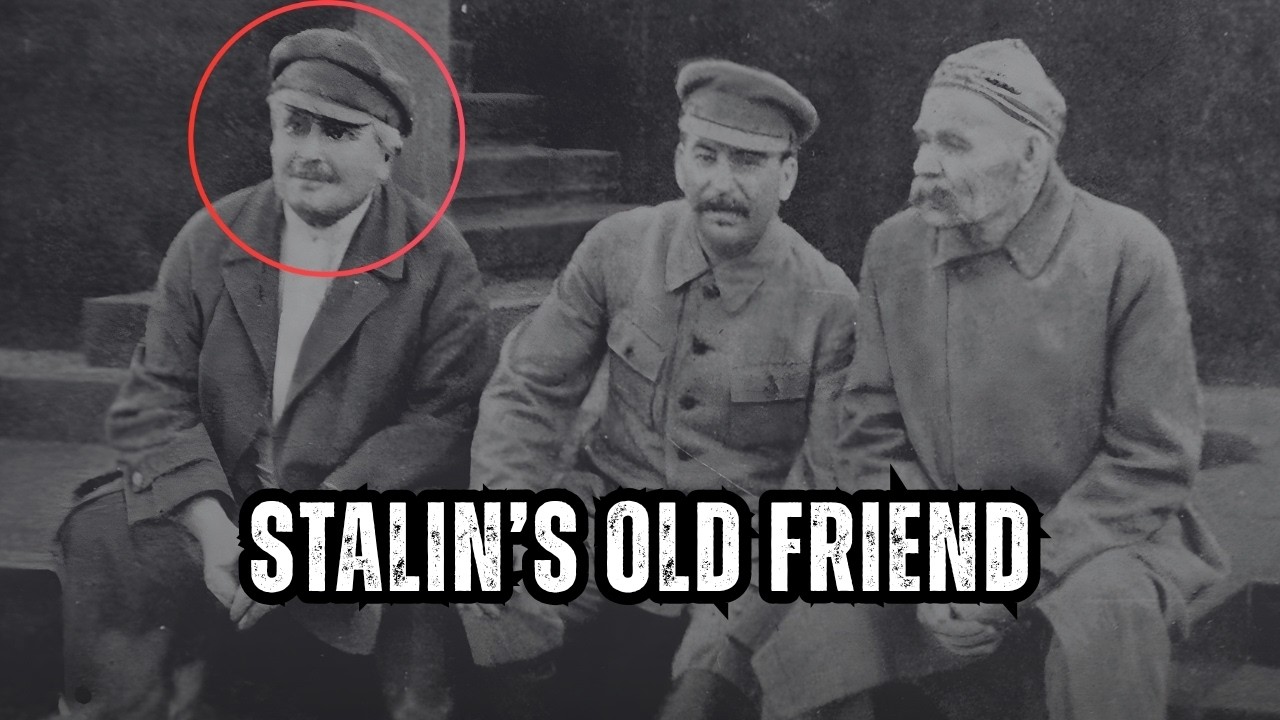
Most people have never heard of the third man in that image. Trotsky, who held virtually no one in Stalin’s orbit in any regard, described Enukidze as “no careerist and certainly not a scoundrel. ”
Born in 1877 to peasants in the Kutaisi province of Georgia, then part of the Russian Empire, Enukidze moved to Tiflis as a teenager to study. By 1896, still a teenager, he was committed to Marxist politics.
After graduating from technical college, he went to work on the Transcaucasian Railways—a position that mattered because railways moved workers, information, and contraband, including the printed revolutionary literature the Tsar feared most. In 1898, he formally joined the Russian Social Democratic Labor Party. A year later, he moved to Baku, the oil city on the Caspian, where he and fellow revolutionary Lado Ketskhoveli built the city’s first underground party organization. Hidden beneath the ground was a secret printing press used to produce and distribute revolutionary literature across the Caucasus.
The work was dangerous and unglamorous. Enukidze lived in cellars, moved at night, and was arrested seven times between 1902 and 1914. He escaped from the Tiflis Metekhi Castle prison in 1903. He was arrested again in 1907, 1908, 1910, and 1911, escaping every time.
In July 1914, his seventh arrest led to exile in Turukhansk, Siberia. By the end of 1916, the Tsarist authorities drafted him into the army. Then came February 1917. Enukidze was being transported to the front through Petrograd when the February Revolution broke out.
He arrived on the first day of the uprising and was immediately elected to the Executive Committee of the Soviets. He was in the room for the October armed uprising and sat on the Military Revolutionary Committee. After nearly two decades of arrests, imprisonment, and exile, he had earned his place in the revolution. After 1917, Enukidze’s role shifted from underground agitator to administrator.
In 1918, he was appointed secretary of the Executive Committee of the Soviets, which in practice meant he ran the Kremlin—who worked there, who had access, how the entire apparatus functioned. He held that post in various formal iterations from 1918 to 1935. From 1922 to 1934, he also chaired the boards of the Bolshoi Theater and the Moscow Art Theater. From 1925 to 1927, he oversaw the Soviet Academy of Sciences.
He used his position quietly and at personal risk to channel money to the families of old Bolsheviks who had been stripped of their livelihoods for opposing Stalin. In May 1934, the poet Osip Mandelstam was arrested after writing a poem mocking Stalin. His close friend, the poet Anna Akhmatova, went through Kremlin offices looking for anyone who would help. Every door closed, except one.
Enukidze received her. But in Stalinist Russia, kindness could get you killed. What really got you killed was memory. Enukidze had written a book, published in 1925 and revised in 1930, about the underground printing press operations in the Caucasus—the operation he had helped build, the one he had lived beside in a cellar for years.
The book told the truth. It credited Lado Ketskhoveli with his proper historical role. It accurately described what Enukidze himself had done. The problem was that it barely mentioned Stalin.
During those years in Baku, Stalin had been based in Tiflis, and his role in the operation had been minimal at best. But by the early 1930s, Stalin’s cult of personality was being constructed at industrial scale. History was being rewritten to place Stalin at the center of everything. Here was Enukidze, the man who had actually built the Baku press, refusing in print to give Stalin credit he hadn’t earned.
According to Trotsky, Enukidze complained privately about the pressure being applied. “I am doing everything he has asked me to do, but it is not enough for him. He wants me to admit that he is a genius. ”
On January 16, 1935, Enukidze published a public apology in Pravda.
He revised the historical record, stating that Ketskhoveli had been sent to Baku by Stalin and others. He handed Stalin the origin story Stalin wanted. It didn’t save him. Six months later, Lavrentiy Beria published a full report accusing Enukidze of having deliberately and with hostile intent falsified the record.
The public apology wasn’t enough. The recantation wasn’t enough. The fact that he had written the truth in the first place was now the crime. The formal pretext for Enukidze’s destruction came through Kremlin security.
In February 1935, following the assassination of Sergei Kirov in Leningrad, the NKVD began running security checks on everyone working in or near the Kremlin. Enukidze, as the man who had run Kremlin administration for 17 years, was the natural target. On March 21, the Politburo circulated a report accusing Enukidze of failing to exercise sufficient political vigilance. That summer, 110 Kremlin staff members were arrested in connection with investigations tied to him.
Two were sentenced to death. The rest went to prison. Then came the Central Committee Plenum. Enukidze didn’t know it was about him.
He had been sent to manage a mineral resort agency in the North Caucasus, a stark demotion from the Kremlin, but he returned to Moscow for what he believed was a routine party meeting. Nikolai Yezhov, the man who would soon oversee the bloodiest years of the purges, stood up and accused Enukidze of allowing potential assassins into the Kremlin and endangering Stalin’s life. Then Ordzhonikidze and Beria, both Georgians who had known Enukidze for years, stood up and attacked him for giving financial support to Stalin’s political enemies. Enukidze was expelled from the party, stripped of his posts, and sent to manage an automobile factory in Kharkiv.
In February 1937, he was arrested. What is known about what happened inside the interrogation room comes not from Stalinist records, but from Alexander Orlov, a Soviet defector who had been inside the system and wrote about it years later. According to Orlov, Enukidze told his interrogators what he believed was the real cause of everything that had happened to him. “My whole crime is that when he told me that he wanted to arrange a trial and shoot Kamenev and Zinoviev, I tried to dissuade him,” Enukidze said, as Orlov recorded it.
“‘So-so,’ I told him. ‘No doubt they hurt you, but they have already suffered enough for it. You have expelled them from the party. You keep them in prison.
Their children have nothing to eat. ‘ ‘So-so,’ I said, ‘they are old Bolsheviks like you and me. You will not shed the blood of the old Bolsheviks. Think what the whole world will say about us.
‘ He looked at me with such eyes as if I had killed his own father and said, ‘Remember, Avel, whoever is not with me is against me. ‘”
Not the printing press history. Not the Kremlin security failures. Not the money quietly passed to struggling families.
He had told Stalin to his face that executing his old comrades was wrong. Stalin didn’t forget. Avel Enukidze was tried in private on December 15, 1937. The charges were treason and espionage.
No public proceeding. No defense. No crowd. According to a Pravda report, he was executed on December 20.
He was 60 years old. In a regime where executions were typically kept quiet and people simply disappeared, Pravda ran a notice of his trial and death. That was unusual. It was deliberate.
Decades later, after Stalin was dead and Khrushchev had delivered his secret speech condemning the crimes of the Stalin era, Enukidze was posthumously rehabilitated. In 1977, 40 years after his execution, the Soviet Union issued a commemorative postage stamp with his portrait. They gave him a stamp. They had given him a bullet.
Enukidze was the first member of the Central Committee to be expelled from it. What followed was the Great Terror. The Congress where he’d been elected was later called the Executed Congress; almost everyone in that room died. Enukidze was the canary.
He had survived seven tsarist arrests. He had lived in a cellar with an underground printing press. He helped build the very revolution that would eventually destroy him. What finished him wasn’t weakness or betrayal or incompetence.
It was that when he looked at the man who held power over every person in the Soviet Union, he used the old Georgian nickname, Soso, and told him the truth. That was enough.