The Waffen-SS built a fearsome reputation during World War II. They were considered some of the most brutal and dangerous soldiers on the battlefield. Their ideological commitment to Nazism and their involvement in war crimes made them a unique threat.
When these soldiers attempted to surrender, they often faced a deadly risk. There were many documented cases where SS members were shot instead of being taken prisoner. This was especially common during fierce battles or after Allied troops discovered evidence of atrocities.
One notable example occurred during the Battle of the Bulge. After discovering the Malmedy Massacre, where SS troops killed unarmed American prisoners, many US soldiers refused to take SS men alive. The anger and desire for revenge were understandable given the circumstances.
However, shooting captured Waffen-SS soldiers was not the universal fate for all of them. Large numbers survived their surrender and entered Allied captivity. This raises an important question: why were so many of them spared and not executed on the spot?
The answer begins with understanding the nature of the Waffen-SS. They were the armed wing of the SS, created by Heinrich Heindrich Himmler to give him legitimacy and power. Over time, the group expanded dramatically, with around half a million men serving in its ranks.
The mindset of an SS soldier differed greatly from that of a regular German army soldier. The Waffen-SS were on an ideological crusade. They were the most radical Nazis, having been indoctrinated for years. Their loyalty was personal to Hitler, not to the German armed forces.
In contrast, the Wehrmacht consisted of men whose primary loyalty was to the army itself. This distinction mattered on the battlefield and in the treatment of prisoners.
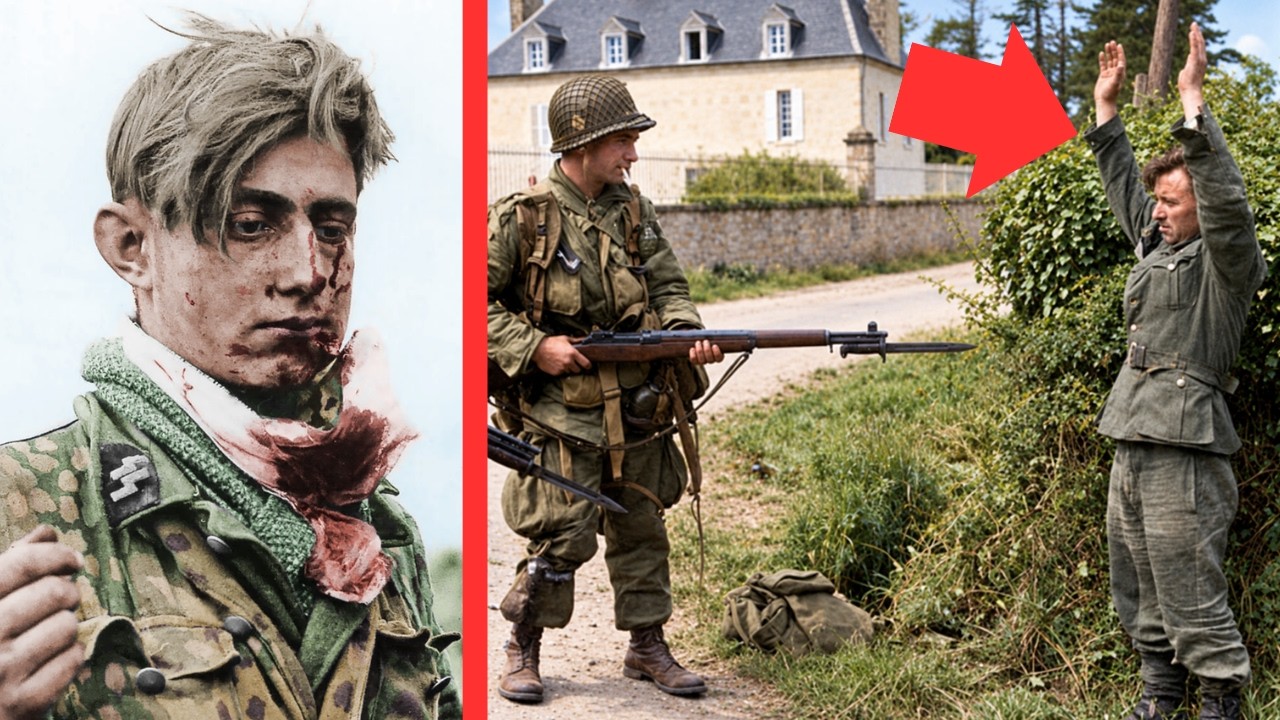
One of the most important reasons captured SS soldiers were not shot was the basic rule of war. A soldier who surrenders and stops resisting is entitled to protection as a prisoner of war. This rule applied to all soldiers, regardless of their unit or reputation.
Allied soldiers were officially expected to accept the surrender of Waffen-SS men just as they would any other German soldier. The process was straightforward: approach them, disarm them, and send them to the rear for processing and interrogation.
Another key factor was that being a member of the Waffen-SS did not automatically prove involvement in a specific war crime. While the group was certainly involved in atrocities, not every captured SS soldier personally committed a crime. Some were drivers, clerks, mechanics, medics, or ordinary infantrymen.
In the final stages of the war, large numbers of men from across occupied Europe were conscripted into the group. Some were forced to fight, while others were transferred into Waffen-SS formations. Finding SS insignia on a uniform did not precisely identify what that individual had done.
Suspected war criminals were investigated after capture rather than executed immediately. Any executions that did occur typically happened after extensive trials and through proper legal channels.
There was also a very practical reason for keeping SS prisoners alive: intelligence. Captured soldiers could provide valuable information about German defensive positions, unit strength, commanders, weapons, and upcoming operations. A single prisoner might possess one piece of golden information that could change everything.
Allowing prisoners to surrender also served a military purpose. Every German soldier convinced to lay down his arms meant one fewer enemy that Allied troops had to defeat in combat. This reduced the danger faced by Allied forces overall.

Maintaining military discipline was crucial as well. The Allies portrayed themselves as forces of good throughout the war. They relied on strict discipline to maintain this image. Individual soldiers were not officially allowed to decide who deserved life or death among prisoners.
Allowing soldiers to execute prisoners based on their unit, uniform, or reputation would undermine the chain of command. It would also encourage retaliatory actions. The official expectation was simple: disarm the prisoners, secure them, and send them to the rear lines.
What happened after that was a matter for military authorities to handle. Some Waffen-SS men faced further investigation and scrutiny. Allied authorities tried to identify individuals suspected of involvement in massacres, concentration camps, and other crimes.
Investigators questioned prisoners about their units and military service. They then tried to link individual soldiers to specific war crimes and decided whether to pursue prosecution. Capturing them alive did not mean they escaped justice. It meant guilt could be proven through proper legal procedures and evidence.
This point was emphasized during the Nuremberg Trials. The SS was officially declared a criminal organization, meaning membership itself was a crime. However, this did not mean everyone who wore the Waffen-SS insignia was automatically sentenced to death.
Of course, not all SS prisoners were treated according to the rules. Fighting in Europe became incredibly brutal, especially in the final months of the war. Waffen-SS formations were linked to atrocities against civilians and Allied prisoners. News of these massacres spread quickly among Allied troops.
This led to retaliatory actions. There are documented incidents where SS soldiers were killed after surrendering and while already in captivity. However, these killings were not official Allied policy. Much of this was driven by emotions of revenge.

The fate of a captured SS soldier depended on many factors. Where he surrendered, which unit captured him, what had happened in the area previously, and whether military discipline was still intact all played a role.
A exhausted Allied soldier who had just discovered his comrades murdered by SS troops might react very differently than a military police officer receiving prisoners miles from the front. In the first case, shooting surrendering SS troops was highly likely. In the second, proper procedure would be followed.
By 1945, Germany was surrendering in massive numbers. Hundreds of thousands of German troops were giving themselves up to the Allies. Many wanted to surrender to the Western Allies rather than the Soviets. Waffen-SS soldiers were part of this massive collapse.
So why were Waffen-SS soldiers often spared? A soldier who surrenders is supposed to become a prisoner. Keeping prisoners alive encourages more surrenders, reduces unnecessary fighting, provides important intelligence, and maintains military discipline.
Most importantly, there was a distinction between membership in a criminal organization and committing war crimes. Simply being a member of the Waffen-SS was not enough to justify execution in post-war trials.
However, the group's record made its members highly suspect upon capture. They were also exposed to violent retaliation. Yet there was no official Allied policy to execute everyone wearing the SS uniform.
Despite their reputation and involvement in some of the worst crimes of World War II, many Waffen-SS soldiers survived the moment of capture. They entered Allied camps, and some eventually told their stories to the world after the war.