When Genghis Khan divided his empire, he passed over his four famous sons entirely. The lands he handed to them were not the crown of his domain—they were open grassland, deliberately placed far from the treasury and from one another. The beating heart of the world economy never went to them. Instead, the great Khan built a second structure of power, one loyal only to him and designed to hold his sons in check.
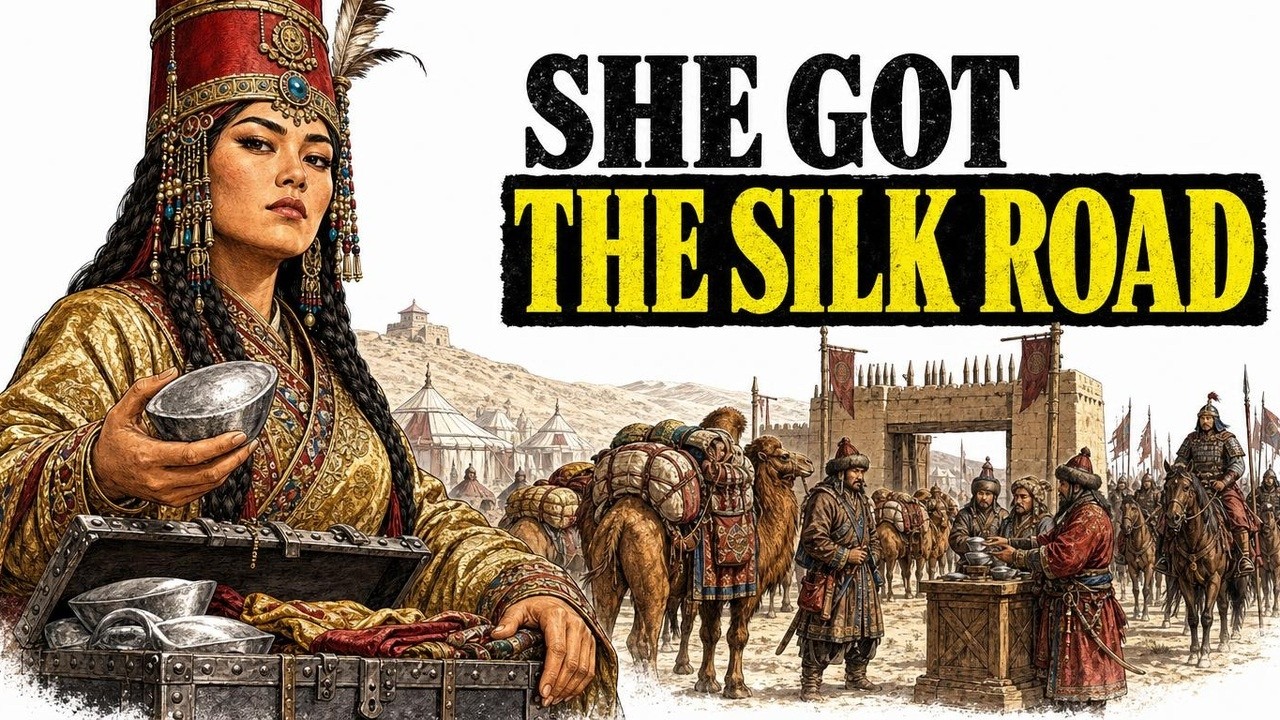
He gave the wealth, the roads, and the tolls to his daughters. This is not a polished legend. It is a strategy documented in The Secret History of the Mongols, a private record written in the Mongols’ own tongue shortly after the great Khan’s death. It does not describe a god but a man: his fears, his distrust of his children, and the shouting that filled his tent as his sons fought over land not yet conquered.
For centuries, this guarded book reached no full version outside Mongol hands until the 20th century. The document is damaged. At the exact moment the Khan begins assigning territories, a section has been carved away. The passage describing the inheritance of his daughters was deliberately removed.
Someone in a later generation decided certain truths were too dangerous to keep. The standard account of the Mongol Empire draws four clean lines: Jochi, Chagatai, Ögedei, and Tolui. Four sons, four grants of land, four uluses that became the four great khanates. It is a tidy story, and it is false.
The record shows a man who did not see the future in his sons—he saw the fault line most likely to swallow everything he had made. The sons were bound by blood and by loathing. Jochi’s grant lay far west in the steppe beyond the Aral Sea, land barely touched when the division was drawn. Chagatai took the middle ground in Central Asia, pastures heavy with horsemen but thin on cities.
These were encampments, not kingdoms, set as far from the treasury as the map allowed. The Khan’s design did not run through his sons at all. The division was rooted in a public crisis. In the great tent before assembled Mongol nobility, Genghis raised the question of succession.
He turned to Jochi, his eldest. Chagatai cut across him, raising a finger and declaring that Jochi was not their father’s son—calling him the bastard offspring of a Merkit. The accusation landed like a torch in dry grass. Everyone in the tent understood the roots.
Years before, when Genghis was still called Temüjin, his wife Börte had been seized by the Merkit tribe in a dawn raid. She was taken because there were not enough horses to carry everyone, held for months before Temüjin could gather allies to win her back. Not long after her return, she gave birth to Jochi. His very name carried the shadow of the question.
Chagatai had flung that question into the center of the state, declaring the succession illegitimate in public. Jochi lunged, catching his brother by the collar. The two stood chest to chest, ready to kill in front of their father. Two of the Khan’s oldest companions had to pull them apart by force.
Through it all, Genghis sat still, watching the machine he had built from broken tribes grind against its own gears. Only after the brothers were pried apart did an old adviser step forward. Kökö reminded them of the darkness their mother had lived through—the cold nights before Temüjin bound the tribes, the fatherless years when the family ate marmots and wild onions to survive. The room went quiet.
Then the Khan declared before them all that Jochi was his eldest son and no man was to speak of the matter again. An order does not erase a rumor. The paternity of Jochi was now a permanent crack in the foundation. Within a few years, Jochi drifted to the far western steppe and stopped answering his father’s summons.
He died there around 1227, months before Genghis himself. There were whispers the father had ordered the death—a rumor that alone shows how deep the fracture went. Each of the four sons carried a fatal flaw. Chagatai was the enforcer, rigid and unbending, a man who honored only Mongol law and looked with open contempt on the settled peoples the empire now ruled.
It was said he forbade the ritual slaughter of animals and washing in running water, striking at the daily practices of Muslim towns, punishing men for how they prepared a meal or entered a river. He was a mallet, useful for hammering down rebellion but incapable of winning a city’s loyalty. Ögedei, the third son, was in most respects the ablest—sharp, charming, politically fluent, open-handed with gold and grants. Genghis named him heir, the son the other three could tolerate.
But Ögedei drank without a floor. The Secret History records that Genghis appointed a steward with one duty: to shadow Ögedei and count the cups of wine he drank each day. Ögedei had the cups made larger so that fewer cups meant more wine, and the tally read low. He died drunk in December 1241 after a night of hunting and feasting, and his death pulled a Mongol army back from the gates of Europe.
Tolui, the youngest, was perhaps the finest battlefield mind of the four, a master of siege who cracked cities others called impossible. He took Merv in 1221, one of the largest cities on Earth in its day. But he carried the family thirst. The Persian historian Rashid al-Din records that Tolui drank himself to death in a ritual meant to draw an illness away from his brother Ögedei, dying in 1232.
These were the four names in the risk column. The Khan had built everything on discipline and cold efficiency, and he had raised four sons who embodied the reverse. He was not handing kingdoms to heirs. He was planning against them.
At the kurultai, the succession assembly, he did not ask who was strongest. He made the brothers accept Ögedei one by one out loud, and bound them to a written oath. He was building a cage out of language and shame, but he knew an oath holds only as long as the men who swore it want it to. The proof of the coming fracture is the document itself.
The author of The Secret History did not soften the fight in the tent, the insult, or the father sitting silent. This honesty makes the later silence deafening. If the author felt free to record two brothers nearly killing each other, whatever was written about the Khan’s daughters must have carried a danger greater still—great enough that a later hand took a blade to the page and cut it out. Genghis Khan’s real design was a second empire built inside the first.
Look at the map as a quartermaster would. The Mongol Empire ran like a firm. Its most valuable holdings were not its armies but its tollgates—the choke points where every trader had to pass under someone’s eye. Four territories mattered more than all the rest combined.
The first was the Uyghur country in the Tarim Basin, the oasis towns where the Silk Road funneled through scarce water. Whoever held the wells held the trade. The second was the land of the Öngüt, Nestorian Christians who guarded the passes south of the Gobi, the main door into northern China. The third was the land of the Oirat forest people, who held timber, furs, and hunting falcons.
The fourth was the ground of the Onggirat, Börte’s people, who held the pastures that grew the horses feeding the whole war machine. The Khan did not trust these pillars to his brawling sons. He handed them to his daughters through a cold and repeatable procedure historians call the disposable son-in-law. First, he gave a daughter to the king of one of these vital peoples, with the condition that the king set aside every other wife and raise the Khan’s daughter to principal queen, making her children the sole heirs.
Second, the son-in-law was granted the honor of leading his men in the vanguard of the next campaign—the most dangerous ground on the field—until the arithmetic did its work and he was killed. Third, his widow stayed and took direct hold of his kingdom, ruling it for her infant son. Her loyalty pointed back to her father. One daughter, Alaqai Beki, was married into the Öngüt, the keepers of the road into China.
When her husband was killed, the Öngüt nobility rose against her and murdered the heir. Alaqai fled for her life with her young daughter. Genghis did not burn the territory—it was worth more standing than in ashes. He executed the rebellion’s leaders, spared the ordinary families, and set Alaqai back on the seat alone as sole ruler.
She held that border for decades, and her own people came to call her the princess who governs the state. The richest prize of all, the Uyghur kingdom at the commercial heart of Central Asia, was bound to his daughter Altun. Betrothed to the iduqut, the king rode to war and did not return. Altun’s hand on the Uyghur seat made the most profitable stretch of territory in the empire a queen’s domain.
The caravans, the taxes, the travel papers—all were stamped by her clerks and counted into her treasury. There is a shadow across Altun’s story. Rashid al-Din records that she was later put to death, accused of poisoning the great Khan Ögedei. Whether the charge was true or invented, it shows that a daughter of Genghis was thought powerful enough to reach a reigning emperor, and the men of the next generation feared her enough to kill her over it.
The daughters carried a formal rank as the beki princesses, whose word held the authority of the throne. Their courts kept their own guards, scribes, and herds apart from any husband. Genghis took the steppe tradition of a wife managing the household economy and scaled it to the size of a continent. The tent became a treasury.
The wife became a governor. What looked like a marriage was a chain of command. The machine was nearly flawless, but it rested on a single pillar: the unquestioned authority of the man who built it. No son-in-law rode to the front and no daughter took a throne except by his word.
When Genghis Khan fell from a horse in the winter hunting wild asses, and a fever took hold in the summer heat of August 1227 on campaign against the Tangut kingdom, the men who gathered around his failing body were his sons, not his daughters. For most of a decade after his death, the largest connected land empire the world has ever seen was run by widows. Ögedei was not elected great Khan until the assembly of 1229. The empire did not steer itself.
During the gaps when no khan sat the throne, women held the seals, received the ambassadors, and signed the decrees. Altun fell first. She held the roads and the money, and the new regime wanted both. A charge of poison appeared—in some tellings, the target was Ögedei himself.
There was no trial worth the name. She was arrested and put to death. Her real offense was that she owned a piece of the world the male line had decided to take back. When Ögedei died in December 1241, his widow Töregene took the regency.
She had been a noble’s wife before that man was defeated and she was handed to Ögedei as a spoil of war. For five years, from 1241 to 1246, she was the most powerful person alive. She drove out her husband’s ministers, including the Kitan statesman Yelü Chucai whose arithmetic had first taught the Mongols to tax instead of only to burn. She sold the empire’s tax farms to the highest bidders and raised her own favorites, chief among them a merchant woman named Fatima.
Yet she held the vast realm together by sheer refusal to let go, maneuvering her son Güyük onto the throne at the assembly of 1246. She was not the most dangerous widow on the board. That distinction belonged to Sorghaghtani Beki, widow of Tolui. She had refused Ögedei’s offer to remarry her to his own son, choosing to keep her household and her four boys under her own hand.
She was a Nestorian Christian, sharp beyond the men around her. While other branches of the family burned through their strength in feuds and drinking, she built quietly. She lowered taxes in her late husband’s lands and won loyalty. She founded a college for Muslim scholars at Bukhara, gave money to mosques, Buddhist temples, and Christian churches, stitching a coalition out of faith that distrusted one another.
Above all, she raised her four sons to rule: Möngke, Kublai, Hulegu, and Ariq Böke. Rashid al-Din wrote that she towered above all the women of the world. A Syriac churchman of the same era, Bar Hebraeus, wrote that from her example, men might learn that a woman could be the equal of the wisest of them. While Töregene and Güyük held the throne, she waited.
Güyük reigned briefly and badly, a sick man and a drinker like his father. He moved west in 1248 with an army, possibly to make war on his cousin Batu. Sorghaghtani sent Batu a secret rider warning him. Güyük died on the road that year.
His widow, Oghul Qaimish, took up the regency, and by every account she preferred shamans to the labor of government while petitions piled unanswered at her door. That was the opening Sorghaghtani had been patient for. She bound herself to Batu and the Golden Horde and made her case plainly: the house of Ögedei was corrupt and steering the empire toward ruin. The throne was pulled from Ögedei’s descendants and given to her eldest son Möngke in 1251.
A plot was uncovered to overturn the election, and the purge was thorough. Oghul Qaimish was wrapped in felt and drowned in the manner reserved for royal blood whose blood was not to be spilled on open ground. Töregene’s counselor Fatima had already met a grim end under torture years before. Sorghaghtani’s sons became the masters of the world.
Möngke would be the last khan to rule the empire whole, dying on campaign in 1259. Hulegu took Persia and sacked Baghdad in 1258, ending the 500-year Abbasid caliphate. Kublai took China and raised the Yuan dynasty, moving the capital to Khanbaliq. Sorghaghtani never ruled in her own name.
She died in 1252, just as her first son took the supreme seat. She had set four sons on four thrones. The erasure came later. The Secret History was the founder’s own recorded voice granting the Uyghur kingdom—the heart of the Silk Road—to the line of his daughter Altun.
But that kingdom was now held by Kublai’s own line. In the plain words of the page, the reigning emperor sat on ground his ancestor had given to a woman’s line. The passage was a legal seed for every rival claim—a written justification for rebellion in the hand of the one man no Mongol could contradict. A scribe in Kublai’s new capital, copying the text, reached the passage assigning the daughters their inheritance.
He read the words and understood what they now were: a founders’ decree that made the ruling dynasty a usurper. He did not tear the page. He cut a neat, deliberate excision, removing the story of the daughter queens—Alaqai Beki, who held the road into China, and Altun, who held the Silk Road—cleanly out of the record. The offending leaf was gone.
The gap remains. It is not the work of time. Damp did not eat it. Worms did not carry it off.
It is the scar of a deliberate act, a political killing carried out with a copyist’s knife long after the queens themselves were in the ground. It is not the absence of evidence. It is evidence of an absence. The kingdoms of the daughters were not a legend.
They were the plan itself—a machine the men who came after could only dismantle by executing the queens, taking their lands, drowning the last regents, and then reaching back into the past with a blade to remove the women from the story for good.