In the summer of 2014, thousands of convention attendees in Dallas drank nearly 4,800 gallons of a single soft drink over one weekend—roughly 60,000 bottles of Bawls Guarana, the cobalt blue, bumpy glass bottle that had fueled late-night gamers for more than a decade. Eight years later, a national food magazine found the drink nearly impossible to buy in ordinary American stores. Even its creator believed its best years were behind it. The formula had not changed, the bottle had not changed, but the customers had moved on.
The story begins in 1994 in Vienna, Austria, where Hobart C. Buppert III, a Cornell University student in the School of Hotel Administration, noticed dancers in a nightclub paying about $10 a can for a thick, heavily caffeinated brew made from guarana, an Amazonian plant whose seeds carry roughly twice the caffeine of a coffee bean. Buppert could not tolerate coffee, and he saw a gap in the American market: no product offered a strong caffeine kick, a natural source, and a flavor people would choose to drink cold. He wrote a business plan for a guarana-based soft drink as his final-semester independent study in 1995.
In 1996, he borrowed $200,000, founded a company called Hobaroma in Miami Beach, Florida, and on November 14 of that year, the first product went on sale in South Beach. It carried three times the caffeine of a Coca-Cola Classic. The formula was created in a single session with a flavor laboratory in Indianapolis. The goal was to deliver a heavy dose of caffeine without tasting like medicine or coffee.
The result was described by a Baltimore Sun reviewer as a cream soda with a citrus edge. The caffeine came from guarana grown in Brazil, and the company made no health or performance claims—it presented the drink simply as a very strong soft drink. That formula would never change. Nearly 20 years later, the recipe and even the guarana suppliers remained the same as they had been in 1996.
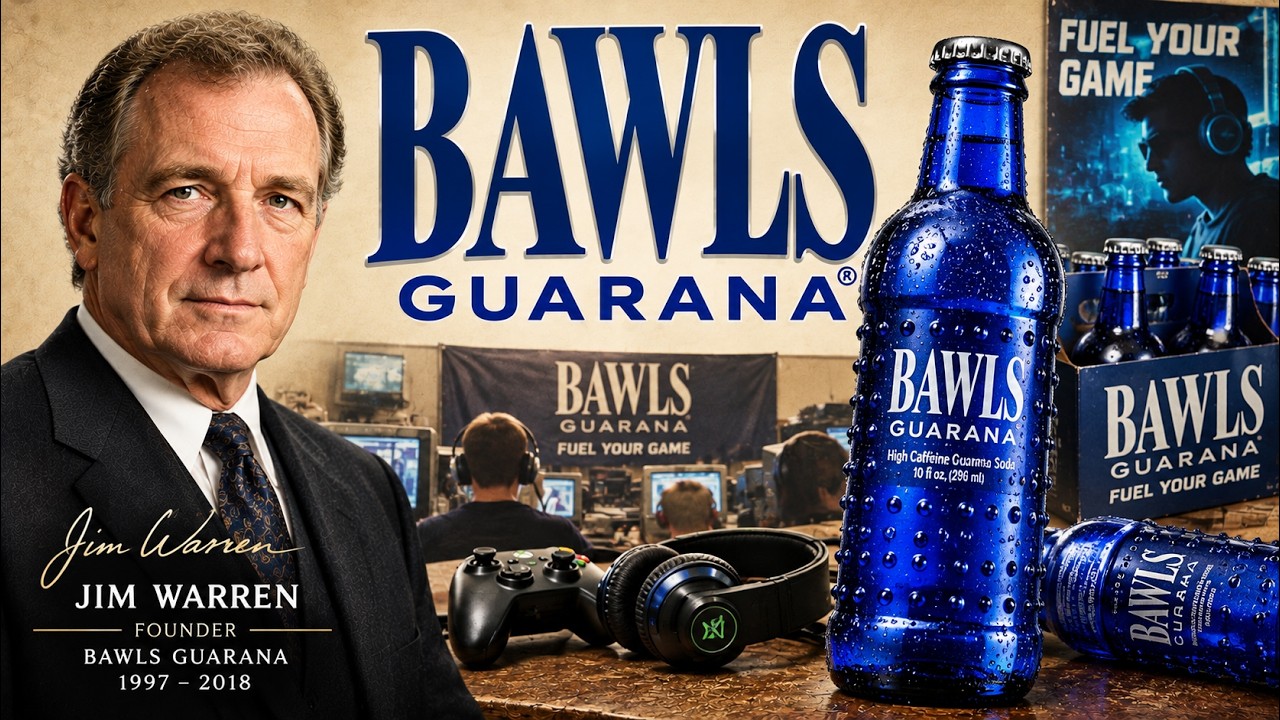
The bottle was equally distinctive: 10 ounces of cobalt blue glass covered in raised bumps. Buppert later explained the design as a picture of energy—small balls bouncing inside the bottle trying to punch their way out. By 2003, the glass came from Germany, the caps from Ecuador, and the guarana from Brazil, all meeting at a bottling plant in Hillside, New Jersey. The pricing was aggressive.
In 2002, a 12-ounce bottle sold for about $1 and carried 80 mg of caffeine, while Red Bull’s slim can often cost close to twice as much. The Bawls customer got more drink, more caffeine, and a glass bottle for less money. The market found the product on its own. In the mid-1990s, most Americans used slow dial-up internet, which made fast-action games like Quake nearly unplayable online.
Players solved the problem by hauling their computers into basements, garages, and hotel ballrooms for LAN parties—local area network gatherings where machines were wired directly together. In 1998, Blues News, an early computer gaming website, published a favorable review of Bawls. Traffic to the company’s website multiplied by roughly 30 times, and in some measures by more than 100. Word spread through forums, and event organizers began calling Miami asking the company to supply their events.
The company said yes, shipping cases to LAN parties in exchange for banners and a place on every table. In 2002 alone, Bawls sponsored 2,500 LAN parties across the country—nearly 50 events every week. That same year, it became the official soft drink of the Cyberathlete Professional League, one of the first organizations in the United States to run computer gaming as a professional sport. By 2002, gamers made up half of everyone who drank Bawls.
No other American soft drink could make that claim. The brand never ran a national television campaign and never hired a famous athlete. Its presence came from showing up where its drinkers already were. That year, CompUSA, one of the largest computer retail chains in the United States, began stocking Bawls in its stores, placing the blue bottles near the cash registers, a few steps from the graphics cards and joysticks.
The brand also entered a video game. In 2002, a cross-promotion with Vivendi Universal Games placed Bawls inside the science-fiction horror game Run Like Hell. The hero, wounded and running low on strength, finds a vending machine, buys a bottle, and his health returns. The drink worked as medicine inside a fictional world, and cases of Bawls carried advertising for the game in stores.
In 2006, the company answered a growing problem with a can. Glass was heavy, broke easily, and was banned in some venues. Bawls worked with Crown Beverage Packaging to solve an unusual problem: how to make smooth aluminum feel like the bumpy bottle. The solution was foaming ink, a low-gloss ink that swells when heated and leaves a raised textured surface—a first for aluminum beverage cans.
Early versions also used color-changing ink that showed whether the drink was cold. The 16-ounce can went where the bottle could not: to paintball tournaments where glass was prohibited, and to American troops stationed in Iraq and Afghanistan. Many of them had spent the previous decade at LAN parties, and some wrote home asking for the drink. The product line grew.
A sugar-free version called Guaranexx arrived in the early 2000s. In 2005, the company introduced caffeinated mints. In 2006, it partnered with 7-Eleven on a frozen version called Bawls Snowballs. Cherry arrived next, then a stronger formula called Xtra.
In 2008, the company introduced a root beer and named it G33K Beer, spelled with two threes in place of the letter E, the way gamers typed online. That year, the beverage trade publication BevNET named it energy drink of the year. The bottles also appeared in places the founder never paid to reach: on the shelves of The Big Bang Theory, in the comedy The Hangover, in the police parody Reno 911, and later in the offices of Silicon Valley. When a set designer needed a prop that said “a young man who lives on his computer,” the blue bottle did the work.
In November 2006, the company marked its 10th anniversary. The year before, Hobarama had shipped 20 million bottles of Bawls—roughly 55,000 bottles a day. Trade press held the company up as a model of survival in a crowded industry, still independent, still growing, and still led by the man who had written the business plan as a college assignment. But a new competitor had been on American shelves since April 2002.
Monster Energy, from Hansen Natural, came in a tall black 16-ounce can with three green claw marks. It sold for about the same price as a Red Bull but held twice as much liquid. It carried more caffeine per can than a bottle of Bawls. Monster did not target gamers.
It targeted almost everyone—motocross riders, skateboarders, rock bands, construction workers, and long-haul truckers—through gas stations and convenience stores across the country. Monster’s larger dose of caffeine and its broad marketing delivered the first real blow to Bawls’ share of the market beginning in 2002. Bawls had narrowed its focus to a single audience. It made sense at the time, but a niche has walls, and the same walls that protect a small brand also keep it small.
The second force came from gamers themselves. LAN parties existed because home internet was too slow for fast games. Then broadband arrived, dozens of times faster than dial-up. In November 2002, Microsoft launched Xbox Live.
In 2003, the Steam platform began delivering games over the internet. In November 2004, World of Warcraft arrived, and millions of people began playing together without ever sharing a room. The LAN party was becoming an occasion, not a habit. For Bawls, that change struck at the foundation.
The brand had been built on physical presence—cases on folding tables, bottles beside keyboards, banners on the walls of rented halls. When fewer people gathered in those rooms, fewer people saw the bottles. Meanwhile, the largest beverage companies finally noticed the gamer. In 2007, PepsiCo released Mountain Dew Game Fuel, a limited-edition citrus cherry drink promoted alongside Halo 3.
It was available nationwide, backed by Pepsi’s distribution network, and stocked in the same convenience stores where Monster already sat. And the one national retailer that had placed Bawls at the center of gaming culture was about to disappear. In December 2007, CompUSA announced it would close its remaining stores. By the spring of 2008, the aisles were empty.
For most soft drinks, losing one retailer is a minor setback. For Bawls, it meant losing one of the few national chains that had understood what the drink was for. The ordinary grocery store had never been a comfortable fit. In the mid-2000s, some chains, including the Midwestern supermarket company Meijer, hesitated to stock a product with that name.
The joke that made the brand impossible to forget also made it easy for buyers to refuse. Then the economy broke. In the fall of 2008, the American financial system came close to collapse, and credit tightened. In November 2009, the creditors of Hobarama, among them Fifth Third Bank, forced out the company’s chief executive—the man who had founded it.
Thirteen years after he borrowed $200,000 to launch a drink in South Beach, he no longer ran it. The brand was reorganized. By 2012, the company was stable enough to buy two smaller energy drink brands, Krunk and Strut and Rutt. Its offices moved from Miami Beach to Twinsburg, Ohio.
By 2014, a new chief executive, John Gunnerson, was in charge. The company kept doing the one thing it had always done well. It returned to QuakeCon in Dallas, where that summer the crowd drank nearly 4,800 gallons. It was a triumph, but it was also a closed room.
Outside that room, a new generation of gamers had grown up watching other people play on YouTube and on a streaming service called Twitch. A brand called G Fuel, sold largely as a powder to be mixed with water, built its business on those streamers. By the early 2020s, G Fuel had more than 100 times as many social media followers as Bawls. Rockstar and Game Fuel held the convenience store coolers.
By 2022, the brand had changed hands again, produced by a company called Solvi Acquisition. That spring, Bon Appetit reported that Bawls had become nearly impossible to find in stores. The founder himself acknowledged that the drink was in its twilight. No bankruptcy, no final run—just a quiet disappearance.
Bawls is still made. The drink never stopped being produced. As of 2025, the company’s website listed seven flavors in the 10-ounce bottle: Original, Zero, Cherry, Cherry Cola, Orange, Ginger, and Root Beer. Four of them also came in the 16-ounce can.
The bottle is still cobalt blue. It is still covered in bumps. The brand is now sold mostly online through specialty soda shops and in scattered stores that stock it for regular customers who asked. Those customers form a quiet community of their own.
Some are collectors. Others organize retro LAN parties where men in their 40s and 50s carry old computers into rented halls to play the games of their youth. The blue bottles return to the tables. The original still matters for a practical reason: it is a strong dose of caffeine that tastes like a soft drink, not like medicine or coffee.
It does exactly what it was designed to do—designed by a young man who could not drink coffee either. And then there is the name. For years, the company offered a noble explanation: that Bawls stood for the Brazilian American Wildlife Society, an organization meant to promote sustainable uses of the rainforest. The founder repeated that account to CNN in 2003.
But in 2004, his own college newspaper told a different story. While searching for a name as bold as Red Bull, a friend had joked that he should simply call it the obvious word. Years later, in an interview in the 2020s, the founder confirmed this was the real origin. There was never a wildlife society.
There was a joke among friends and a young man willing to put it on a bottle. That same boldness carried the brand into places no soft drink had gone before: into a video game as a source of healing, into computer stores beside the graphics cards, and in 2004 into the Fallout series itself, where Bawls replaced the franchise’s famous fictional soda Nuka-Cola. The fans did not approve. The story of Bawls is not the story of a brand destroyed by a bad formula or a careless owner.
It is the story of a product that fit one community so perfectly that it never learned to belong anywhere else. The big companies won by being everywhere. This drink had won by being in one place among one group of people at one moment in time. When that moment passed, the drink remained exactly what it had always been.
It was simply no longer where its customers were. Somewhere, that scene still happens. A cap twists off. The glass is cold and ribbed under the thumb.
And at 2:00 in the morning beside a bright screen, someone lifts a blue bottle and settles in for one more game.