Phyllis Jean Baylor was 26 years old in July 1972, a young mother living in Indianapolis with her three-year-old daughter, Jody. Everyone who knew her called her Jean. She and her husband Richard had married young and had been separated for about three months when she packed up her daughter for a routine weekend trip to see her parents in Bluffton, Indiana, about 100 miles northeast. On the evening of Friday, July 7th, 1972, Phyllis buckled Jody into a borrowed car and left Indianapolis shortly after 8:00.
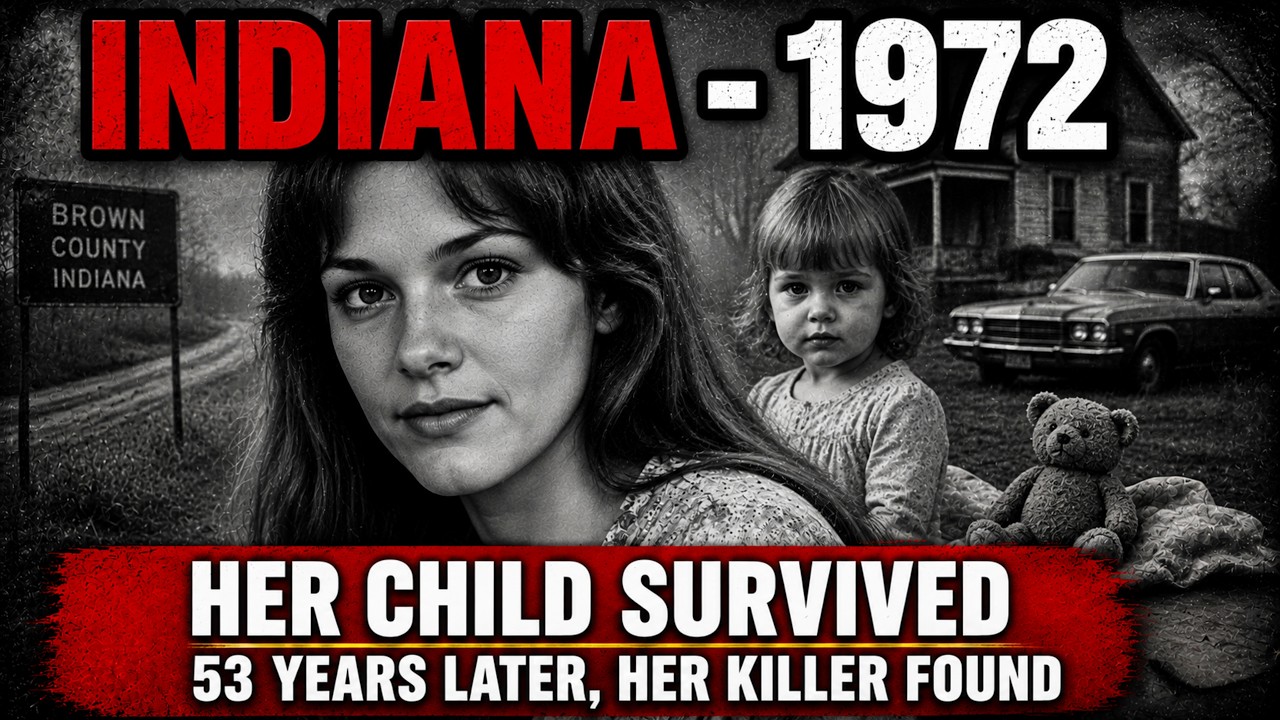
It was a drive she had made many times before. She never arrived. Her parents waited, then worried, and eventually called police to report both their daughter and granddaughter missing. The next morning, a stranger found her car abandoned on northbound Interstate 69 in Grant County with the hood raised, as if it had broken down.
About an hour later, another motorist driving along West Road in Allen County spotted something in a ditch. Phyllis was there, dead. Sitting in the grass beside her was three-year-old Jody, physically unharmed. An autopsy determined Phyllis had been shot and sexually assaulted.
Investigators believed she had been taken from the highway to the spot where she was found, nearly 20 miles away. Detectives collected clothing and physical evidence from the scene, including biological material, but in 1972 the tools to read that evidence did not exist. DNA testing would not become a practical investigative tool for law enforcement until the early 1990s. In the meantime, investigators focused on the person closest to the victim.
Richard Baylor, separated from his wife at the time, became an immediate person of interest. He had driven out to the highway himself and found her abandoned car before police reached him. His alibi held up, and investigators cleared him. Years later, a partial DNA profile developed from Phyllis’s clothing would further eliminate him as a suspect, but it was not strong enough to identify anyone else.
The case went cold. The evidence sat in storage in Allen County for decades while detectives retired and the file gathered dust, waiting for science to catch up. The man who killed Phyllis Baylor was Fred Allen Leineman. In 1972 he was 25 years old, born near Anderson, Indiana, not far from where Phyllis grew up.
By the time of the murder he was living in Grosse Pointe, Michigan. He had no known connection to Phyllis, no shared friends, no overlap that would have placed his name anywhere near the investigation. He was a stranger to her in every documented sense. Records showed Leineman had a significant criminal history prior to 1972, but nothing ever connected him to the Baylor case while he was alive.
He continued living in Michigan for 13 years after the murder, and then in 1985 his own life ended violently in Detroit. According to a May 1985 Detroit News clipping, two men named Clifford John Copley and Kevin Reese got into an argument with Leineman over property. They beat him with a baseball bat, threw him into a dumpster, and set it on fire while he was still alive. He died there, never having faced justice for Phyllis’s murder.
The break in the case came through a new unit within the Indiana State Police called a forensic investigative genetic genealogy team, or FIGG. In 2024, the state police laboratory developed a much stronger DNA profile from the evidence on Phyllis’s clothing, the same evidence that had sat in storage since 1972. Investigators took that profile to Identifinders International, a California-based forensic genealogy company founded by researcher Colleen Fitzpatrick, which specializes in tracing crime scene DNA through family trees. By early 2025, the genealogists and detectives had built out a family tree that led to a name that had never appeared in the Baylor file: Fred Allen Leineman.
Fitzpatrick said the case would never have been solved without forensic genetic genealogy. Confirming the name was not the same as closing the case. Investigators verified Leineman’s age, his birthplace, his residence in Michigan at the time of the murder, and his criminal history. They also confirmed what changed the entire shape of the story: Leineman had died in 1985, 40 years before anyone learned his name.
There would be no arrest, no trial, no interview. The Allen County Prosecutor’s Office reviewed the evidence and reached a clear conclusion: if Fred Leineman were alive today, he would be charged with the murder of Phyllis Baylor. That was as close to a verdict as the case would ever get. On April 16th, 2025, Indiana State Police made the case public.
Sergeant Wes Rohliter wrote that after years of questions, the family finally had answers about what happened. Richard Baylor was 79 when investigators reached him with Leineman’s name. He described a mix of emotions: totally relieved that the case was solved, but upset that the suspect had died. He said he wished Phyllis’s parents and sister had lived long enough to hear the news.
They had died still waiting. But Jody, the daughter found unharmed beside her mother’s body, lived long enough to finally know what happened. When Richard learned how Leineman had died, he called it the good side of the outcome, not because it replaced a trial, but because the man who took Phyllis never got to live a long, quiet, comfortable life after what he did.
There was no courtroom verdict, no sentencing, just a name and an answer, delivered 53 years after a young mother set out on an ordinary drive to see her parents.