During World War II, hundreds of thousands of women served in the armed forces of various nations. Some worked as nurses, drivers, radio operators, and even in artillery battalions, while others served close to the front lines. Within the Soviet Union, women became pilots, snipers, machine gunners, and medics. However, the reality of war was often terrifying for female soldiers if they fell into enemy hands.
Female fighters were sometimes executed after capture, particularly on the Eastern Front. Some were shot for being considered partisans or spies, while others were killed for being high-value targets, such as snipers. The German army executed female soldiers without mercy because it contradicted their beliefs that women should not be present on the battlefield. They viewed this as a backward policy of their enemies that needed to be eliminated quickly.
The fighting on the Eastern Front was especially brutal. When Germany launched Operation Barbarossa on June 22, 1941, it opened the Eastern Front and turned into a war of total extermination. The Nazi war against the communists quickly became devastatingly destructive. It was a battle to determine who was racially superior, and because of this, Soviet prisoners of war who fell into enemy hands had a very high mortality rate. Around 5.7 million Red Army personnel fell into German hands during World War II, and about 3 million of them died in German captivity. Starvation, exposure, disease, executions, and deliberate mistreatment all contributed to this.
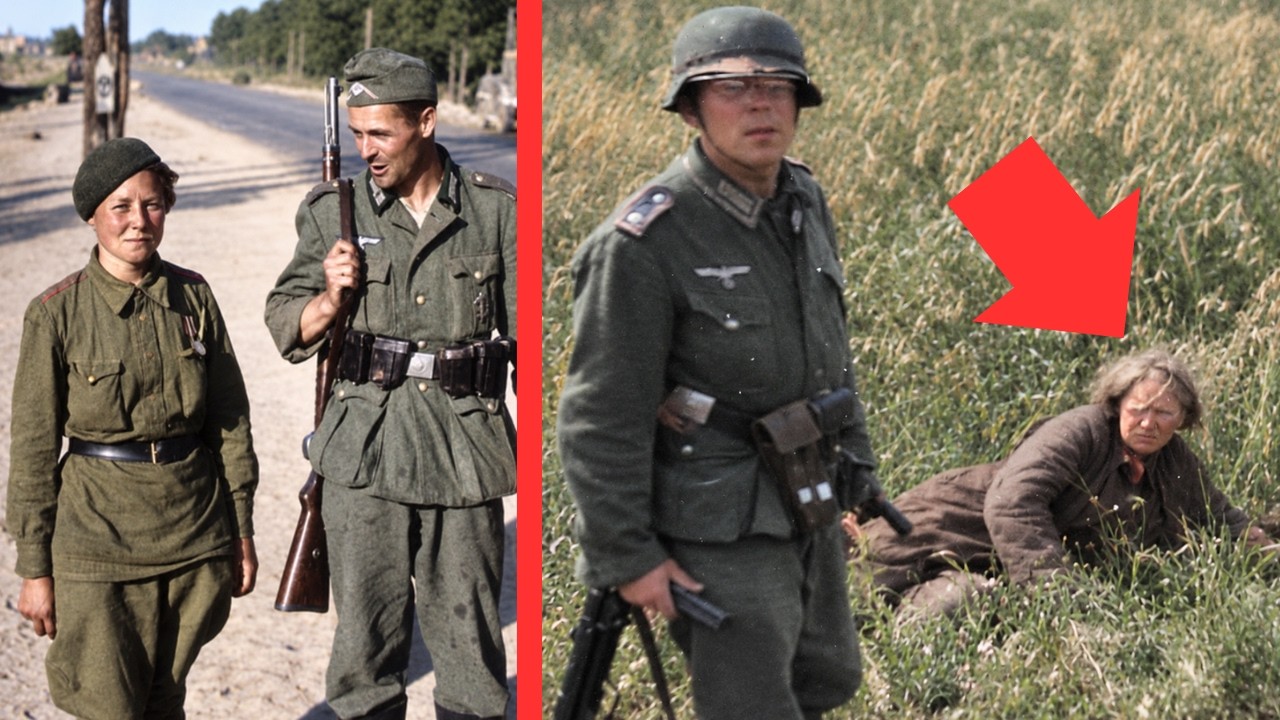
Soviet female personnel, if captured, often faced a similar fate, if they could even make it off the battlefield in the first place. The Soviets deployed around 800,000 women in their armed forces during World War II. Many served in support roles, but they also served in direct combat against German forces. They carried weapons and fired at the Germans, as well as waging guerrilla warfare behind enemy lines. One Soviet sniper, Lyudmila Pavlichenko, recorded a kill count of 309 enemies with her rifle.
German soldiers faced armed women in circumstances they never imagined. The Nazi ideology considered female fighters a backward policy within an ideology they wanted to completely eradicate. An armed Soviet woman was a sign that the Bolsheviks had turned the natural social order upside down. Consequently, many high-ranking German officers ordered the execution of Soviet female soldiers immediately upon capture. For the Germans, these women should have been wives and mothers at home. If a German soldier was killed by a female fighter, it would send a damaging message to the German people back home. The Germans claimed to be the master race, and if their elite troops were killed by an enemy woman, it would undermine the very essence of Nazi policy.
Officers within the German army issued instructions to their frontline troops on how to deal with female fighters if they were captured. They were to be dealt with according to Hitler's Commissar Order. This order stipulated that Soviet commissars and political soldiers should be executed immediately without trial. Soldiers were encouraged to execute women on the spot without any trial or chance to defend themselves. The Germans were told to exterminate them as if they were pests. Most were led to isolated areas where they would kneel, and a single German soldier would shoot them in the head with his pistol. Women were not executed by large firing squads, as that was considered a waste of ammunition. Instead, a single soldier would deliver one fatal shot.

Not many of these women made it to prisoner-of-war camps or concentration camps. Some were even publicly hanged for bearing arms against the German occupiers, their bodies strung up in trees in front of large crowds. These women were often accused of being partisans. Individual commanders issued their own instructions to their troops. The commander of the Fourth Army at the start of Operation Barbarossa, Günther von Kluge, told his soldiers: "Every woman found wearing a Soviet army uniform must be shot immediately."
The partisan threat was real for the Germans occupying hostile territory. Partisans were irregular fighters who used less formal warfare tactics, such as sabotage and demolition. Teenage girls were encouraged to take up arms and fight the Germans, but if captured, they were treated harshly. Zoya Kosmodemyanskaya was 18 years old when the Germans captured her. She was part of a Soviet combat group on a mission. Upon capture, she was severely beaten and tortured for information, but she refused to reveal anything. She attempted to escape and even shot at a guard. However, after being recaptured, she was stripped, severely beaten, and given 200 lashes, and her body was burned. On her way to execution, she was forced to wear a sign around her neck that read "house burner." She was not shot but hanged on the gallows. She stood defiantly before her enemies and was considered a hero for the Soviet cause.
The Germans were exceptionally brutal towards captured female enemies. They were considered extremely dangerous opponents. The Soviets used female snipers extensively, and they were said to be skilled killers when infiltrating the ruins of towns and cities. These women had incredible patience and were celebrated in Soviet propaganda. Any sniper could be dangerous, but upon capture, due to their superior marksmanship and accuracy, they often faced immense threats. Soldiers had seen their comrades, friends, and even commanders killed by a hidden sniper and would seek immediate revenge once a sniper was captured. Executing these women quickly was considered a necessity for the Germans.

They were Soviet fighters, women bearing arms, and a highly skilled enemy that was too dangerous to be allowed to live or be released. Around 2,500 female snipers fought against the Germans, and only about 500 survived the war. Together, they eliminated 11,000 enemies, including some senior officers and even generals.
Women were also killers in other ways. There was the 46th "Taman" Guards Night Bomber Aviation Regiment, known as the "Night Witches" for good reason. These female pilots flew 24,000 missions. Using outdated biplanes, they attacked German positions and dropped explosives on their enemies. They would fly at high altitudes, then cut their engines and silently glide into bombing range. They would drop their payloads, causing massive destruction and death, before restarting their engines and flying away. There were other groups of pilots, such as the 586th Fighter Aviation Regiment, which included three female regiments that flew over 4,000 sorties. A female officer also commanded the 125th Guards Bomber Aviation Regiment, and they dropped about 1,000 tons of bombs on Axis troops.
These pilots often risked certain death if captured. If their planes were shot down and they survived the landing, the Germans, if they captured a woman inside an aircraft, took no prisoners at all. However, it is important to note that the laws of war did not permit their execution. Being a female soldier did not negate their right to humane treatment after surrender. Once an enemy combatant had effectively surrendered and stopped fighting, shooting them was not allowed under the laws of war, even if they had killed German soldiers. Captured female soldiers were entitled to the same levels of protection but were often executed immediately.
At the same time, not every captured servicewoman was executed. There was no universal official practice where every German soldier automatically shot every female Red Army prisoner. Some women were captured and survived German captivity. They were sent through POW camps, prisons, concentration camps, or forced labor systems. Treatment varied greatly depending on the location, date, capturing unit, and their presumed military role.
In conclusion, female soldiers were shot during World War II for many reasons. A German unit that had suffered heavy losses might act out of revenge. In the eyes of the Germans, the presence of women on the battlefield undermined the social order, and they had to deal with it. These women were also considered extremely dangerous. Sadly, many female soldiers still lie in unmarked graves today, victims of the cruel German treatment they received immediately upon capture.