The man in the wheelchair was 99 years old. He had been in hospice for nine months, a detail that made his presence at the Atlanta church on that November morning almost unfathomable to the gathered press. Yet there he was, wheeled in to sit beneath the casket of the woman he had married 77 years earlier.
The image was seared into the national consciousness instantly: the former president, frail and silent, paying a final tribute to his wife. America looked at that photograph and decided it had the whole story. It was a story of endurance, of partnership, of a love that outlasted everything.
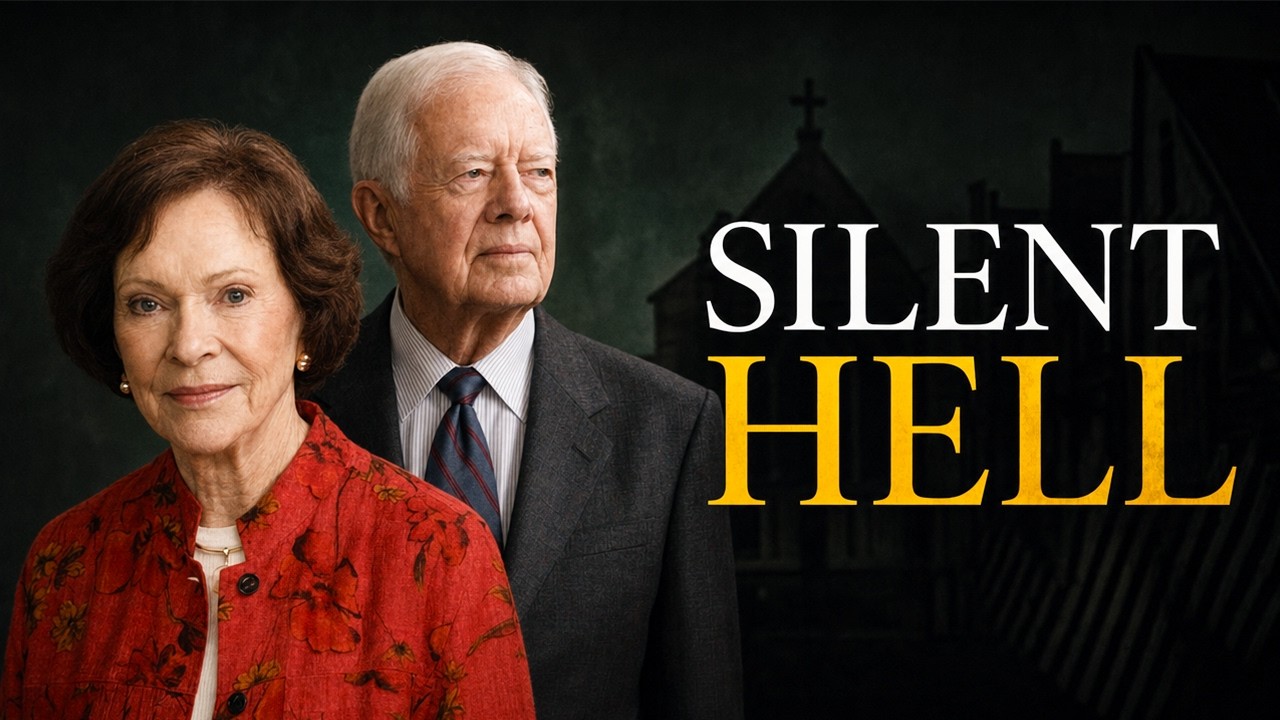 But the story America told itself was a myth, and the reality was far more complex, a 77-year silent war waged in the quiet spaces of a marriage that was never what it appeared to be from the outside.
The trouble did not begin in the White House, nor in the peanut warehouse, but in the summer of 1953, in a moment that would define the fault lines of their entire union. Rosalynn Carter stopped speaking to her husband. The silence was not a sulk; it was a weapon, the only one she had.
Jimmy Carter, a rising naval officer with a promising career under Admiral Hyman Rickover, had resigned his commission without consulting her. He had decided they were moving back to Plains, Georgia, to take over the family peanut business after his father’s death. He did not ask.
He told her. And in that single act, he had ripped her away from the life she had built, the life she loved, and the freedom she had discovered for the first time in her life. She called it the worst argument of their marriage, a confession she would not make in print for another 30 years.
That argument, and the silence that followed, is the key to understanding everything that came after.
To understand the depth of that betrayal, one must understand the woman before the marriage. Born Eleanor Rosalynn Smith in August 1927, she was a product of the Depression-era South, raised on a red-dirt farm just miles from where she would eventually die. Her father, Edgar, worked himself to death—driving a school bus, running a garage, and farming—three jobs that in Plains, Georgia, added up to almost nothing.
When Rosalynn was 13, her father was diagnosed with leukemia. He called his four children into his room to say goodbye, and he made them a promise: they would go to college. He died soon after.
Her mother, Allie, took in sewing and later a post office job, and Rosalynn, the eldest, became the surrogate parent. She cooked, she cleaned, she watched the younger children. She learned that grief was a luxury not to be indulged, that competence was the only currency a girl had, and that keeping her mouth shut while getting the job done was the only way to survive.
She learned to manage, and she learned to want out. Plains was not a home; it was a trap.
The escape came in the form of a photograph. Her best friend, Ruth Carter, had an older brother away at the Naval Academy. Rosalynn saw his picture in Ruth’s room and, by her own later admission, thought about it more than she should have.
When they met in July 1945, on a movie date in Plains, she was 17 and he was 20. He went home that night and told his mother he had met the girl he was going to marry. The timeline of their courtship is aggressive.
By Christmas, he proposed. She said no. This refusal is the most underreported fact in the entire marriage.
She was 18, and she had a competing obligation: a promise to a dying father to finish college. She chose her own path over him. It took a visit to Annapolis in February 1946 for him to ask again and for her to say yes.
From the very first negotiation of their lives, she made him ask twice. She set the terms.
They married on July 7, 1946. The following years were, by her own repeated account, the happiest of her life. It was a nomadic existence—Norfolk, Honolulu, New London, Schenectady—as he moved through the submarine service and into the nuclear program.
 Three sons were born in four different states, none of them in Georgia. He was at sea constantly, but the absence was not the injury; it was the freedom. She ran the household, managed the finances, and made every decision alone.
She was the master of her own domain, a competent, capable woman in a world that didn’t expect her to be. She had escaped the suffocating gravity of Plains and built a life where her intelligence and capability were not just useful, but essential. She was, for the first time, fully in control.
Then came the spring of 1953. Earl Carter was diagnosed with pancreatic cancer. Jimmy went home to see him, and while there, witnessed the quiet scale of his father’s charity—paying for medicine, covering debts, funding educations.
When Earl died in July, Jimmy returned to Schenectady and made the unilateral decision to resign his commission and move the family back to Plains. He did not ask his wife. He told her.
She argued the entire way back. She was furious, angrier than she had ever been at him. She did not want to go.
She had nothing waiting for her in Plains except the girl she had spent her entire adult life trying to escape. She lost the argument. They moved into public housing, apartment 9A, the only future president to ever live in government-subsidized housing.
And then, in a move that would define the rest of her life, she went to the warehouse and took the books.
The first crop year was a disaster, a drought that left the business functionally broke. Rosalynn began keeping the accounts. When she found she didn’t know enough, she took a correspondence course in accounting.
Within a few years, she was running the books, the payroll, and the scales. Farmers dealt with her, not him. She had lost the argument about where to live, but she had immediately acquired the one thing the argument had cost her: control.
Not over him, but over the money. This became the pattern of their marriage. He would decide.
She would object. He would win. And then she would take possession of some piece of the resulting situation and run it better than he ever could have.
It was a silent, relentless campaign for agency, waged in ledgers and balance sheets.
When he entered politics, the pattern repeated. In 1962, he ran for the Georgia State Senate, a race that ended in a famous election theft that he fought and won. For Rosalynn, the lesson was structural: politics was not a phase.
It was the thing that would determine her life. She began campaigning, despite a genuine, physical terror of public speaking. Her solution was not to conquer the fear but to route around it.
 She went door-to-door, county to county, alone in a car, shaking hands one at a time. She was a machine of quiet competence. In 1966, he lost the governor’s race and fell into a deep depression.
The man who emerged from that darkness was transformed, a born-again Christian after a conversation with his sister in the woods. She did not follow him into that experience. She remained a private, practical Methodist, visibly impatient with the parts of his new faith that got in the way of winning.
The marriage was not a spiritual partnership; it was a working partnership between a mystic and a manager.
In 1970, he ran for governor again, and he ran ugly, courting segregationist voters to win. She campaigned inside that strategy. She knew what the campaign was doing, and she kept doing it.
She had learned at 13 to hold a great deal of knowledge without visible discomfort. It was during this campaign that she found her own subject. A woman at a cotton mill told her about a mentally ill daughter and the lack of support.
Rosalynn started asking everywhere she went and kept hearing the same story: families were doing this alone. She asked her husband what he intended to do about mental health in Georgia. He told her they’d have the best program in the country and put her in charge.
He kept his word. Georgia went from 16 community mental health centers to over 100 during his single term. She had found the thing that was hers.
By 1976, they had built a two-headed campaign. She ran her own schedule, her own staff, her own map. Reporters called her the Steel Magnolia, a compliment about a soft exterior.
She never corrected them, because a reputation for softness is useful when you are the one deciding which states get worked. They won the presidency, and the false peace began. In the White House, she took an office in the East Wing and ran it like a corporation.
She attended cabinet meetings, sitting off to the side, taking notes, saying nothing in the room and a great deal afterward. They had a standing working lunch where she brought an agenda. In June 1977, he sent her to Latin America as his envoy—seven countries in 13 days.
She went with positions on arms sales, human rights, and nuclear proliferation. The reaction at home was brutal. Nobody elected her.
She kept going anyway. In February 1979, she testified before a Senate subcommittee, the first first lady to do so since Eleanor Roosevelt. She was there to get a bill, and she got it.
The Mental Health Systems Act was signed in October 1980, three weeks before the election. It was the first serious federal rewrite of mental health policy since 1963. It was gutted by Reagan’s budget reconciliation less than a year later.
She had spent a decade on it. It lasted less than a year.
 The other injury was Iran. He decided he would not campaign while the hostages were held. She thought that was wrong and said so, repeatedly.
She was overruled. She went out and campaigned in his place, answering for a failed rescue attempt and a hostage count that never moved. He lost 44 states.
She was bitter, and she admitted it. He came to terms with it quickly; she did not. She was 53, and she had lost the office, the program, and the argument all inside 12 months.
They came home to Plains and found out they were a million dollars in debt. The peanut business had been mismanaged in a blind trust. They sold it.
The thing she had taken over in 1954, taught herself accounting to run, was gone. She was back where she started, with less than when she left.
She built something new. The Carter Center opened in 1982, and she took mental health as her portfolio, working for the next 40 years. In 1987, they nearly ended the marriage over a book.
They had agreed to co-write about their post-White House years. He wrote fast; she wrote slow. They worked from the same computer files, each rewriting the other.
They stopped speaking and left notes on the machine. Both described it as the worst period of the marriage. The resolution was to identify the disputed passages by author, so certain paragraphs in the finished book carry initials indicating which Carter wrote them.
It was a peace treaty. Two people who could not agree on a shared account of their own life resolved it by publishing separate versions side by side.
She wrote her own books, four under her own name. First Lady from Plains came out in 1984, three years before he ever published his own account of the White House years. She spoke first.
She founded the Rosalynn Carter Institute for Caregiving in 1987, at the same junior college she had promised her dying father she would finish. She built fellowships for journalists covering mental health, shaping how the subject got reported. In May 2023, the family announced she had been diagnosed with dementia.
She had spent her adult life defining herself as the one who takes care of everyone. She ended as the one being cared for, in the house in Plains, by a husband in hospice who had outlived every prediction. She died on November 19, 2023, at 96.
The photograph of the old man under the casket is not a picture of a woman who followed a man. It is a picture of the end of a 77-year argument conducted almost entirely out of public hearing. She was raised in a house where you did not make a scene, and she figured out very young that a woman who appears to be agreeing is a woman nobody thinks to stop.
The country called her the steel magnolia and thought the magnolia was the point. She let them. The steel was always the point.
The silence was the argument. And she won it, not by leaving, but by staying and taking possession of everything the losses put within her reach. The books, the commission, the campaign, the testimony, the archive of her own story.
She was never the quiet one. She was the one who learned to make her opposition invisible, and in doing so, she became the most powerful woman in the room, in the marriage, and in the history of the American presidency.