On 2 May 1930, a 45-year-old woman was taken from a house in Darmstadt, Germany, against her will. Doctors injected her with a combination of morphine and scopolamine, a sedative pairing used at the time to make patients compliant and blur their memory of what followed. She was then transported across the border into Switzerland and admitted to the Bellevue Sanatorium on Lake Constance.
The woman was Princess Alice of Battenberg, a great-granddaughter of Queen Victoria, born inside Windsor Castle with the old queen present in the room. She was the mother of Prince Philip, but her life was far more extraordinary than the footnote she is often reduced to in royal histories.
Alice was born profoundly deaf on 25 February 1885. Medical authorities initially concluded she was intellectually deficient. It was her grandmother who realized the truth: the girl was not slow, she simply could not hear.
Nobody in 1890s Europe was going to build a system of accommodation around a deaf princess, so Alice built one herself. She taught herself to lip-read in English, German, and French, and later added Greek. She could follow conversations she could not hear by reading the shapes of people’s mouths.
In 1903, she married Prince Andrew of Greece and Denmark. The couple had five children over sixteen years, including a son, Philip, born in 1921 on Corfu.
When the Balkan Wars broke out, Alice did not settle for ceremonial royal wartime service. She nursed in field hospitals and worked in operating theaters. In 1913, she was awarded the Royal Red Cross for her work.
The Greek monarchy was unstable, and in 1922, following a catastrophic defeat in the war with Turkey, Prince Andrew was arrested and court-martialed. He came close to execution but was instead convicted, stripped of his rank, and banished. The entire family was expelled from Greece.
They left aboard a British cruiser, with the infant Philip traveling in a makeshift crib assembled from an orange box. The family settled outside Paris at St. Cloud, living on the charity of relatives.
The marriage quietly stopped functioning. Andrew spent his time on the French Riviera, and the daughters grew up and married German princes. Philip was sent to school in Britain, raised more by his mother’s relatives than by his parents.
In October 1928, Alice converted to Greek Orthodoxy. Her religious practice intensified into something else entirely. She began saying she received communications directly from God and described herself as the bride of Christ.
By early 1930, two eminent London psychiatrists diagnosed her with paranoid schizophrenia. In February of that year, she was admitted voluntarily to a clinic outside Berlin. She discharged herself on 7 April.
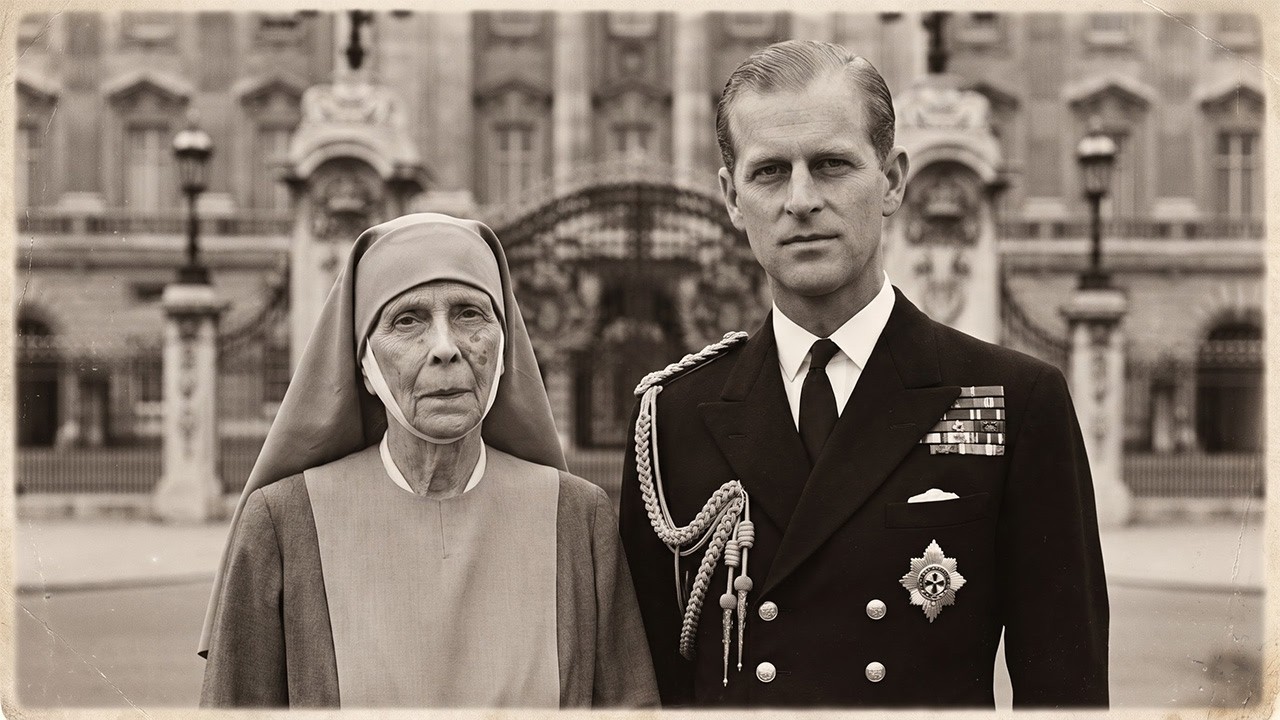
Twenty-five days later, the doctors came to Darmstadt with the morphine and scopolamine. This time, she was not going voluntarily.
Sigmund Freud was consulted on the case, though he never treated her personally. In a surviving letter, he recommended that Alice’s ovaries be exposed to X-rays to accelerate menopause, reasoning that her religious visions were generated by libido. The procedure was carried out.
Alice remained at Bellevue for roughly two and a half years. The record notes escape attempts. In 1932, she was released. She never went back to an institution.
She did not return to her husband or her children. For the next four years, she moved around central Europe with no fixed household, living modestly and keeping in contact with almost no one except her mother.
It took a plane crash to end her separation from the family. On 16 November 1937, a Sabena airliner crashed in fog near Ostend, Belgium. Everyone aboard was killed, including Alice’s daughter Cecily, who was heavily pregnant, her husband, and two of their small sons.
The funeral was held in Darmstadt, where the streets were hung with swastika flags. Cecily and her husband had joined the Nazi party. Alice was there, as was Andrew. Walking behind the coffins was sixteen-year-old Philip, who had just lost a sister, a brother-in-law, two nephews, and an unborn niece in a single afternoon.
From that funeral onward, contact between Alice and her family resumed and continued.
In 1938, she made a decision no one had asked her to make. She went back to Greece alone. She took a small flat in Athens, lived on very little, wore plain clothes, and smoked constantly. She was 53 years old.
The Germans entered Athens in April 1941. The occupation was among the most brutal in Western Europe. The food supply collapsed, and people starved in the streets.
Alice stayed. She organized soup kitchens and worked with orphaned children. She secured food and medicine using the one asset she had left: her name still opened doors on both sides.
In October 1943, a Greek Jewish widow named Rachel Cohen and two of her children moved into Alice’s residence in Athens. The household staff were told that Rachel was a former governess. They stayed for fourteen months.

When the Gestapo came to ask questions, Alice did not answer. She gestured toward her ears and produced the confused expression of a deaf old lady who had not understood a word. This was true: she had not heard a syllable.
What she did not reveal was that she had read every word they said. She had been lip-reading since childhood, and German was the language she grew up inside. She declined to let them know it.
The interview went nowhere. The officers left. Rachel, Tilda, and Michelle Cohen were still in that house when Athens was liberated in December 1944. All of them survived the war.
Prince Andrew died in Monte Carlo on 3 December 1944. He never learned what his wife had done.
In November 1947, Alice came to London for her son’s wedding to Princess Elizabeth. She gave the bride a tiara of Greek key design, the Meander tiara, which is still in the family. The rest of her jewelry she sold.
In 1949, back in Athens, she used the money to found a religious order: the Christian Sisterhood of Martha and Mary, an Orthodox nursing sisterhood. Alice trained as a novice, took the gray habit, and wore it for the rest of her life.
She anticipated the reaction in London. Writing to her family, she summarized it herself: “Well, she’s completely crazy.”
At the coronation of Elizabeth II on 2 June 1953, the mother of the new queen’s husband arrived in a two-tone gray dress and a nun’s veil. She was one of the highest-ranking women in the building, wearing the cheapest clothing in it by an enormous margin. She wore it on purpose.
In April 1967, a group of colonels seized power in Athens. The Greek royal family went into exile for the third time in Alice’s adult life. She was 82 years old and in poor health.
Her son and daughter-in-law, Queen Elizabeth II, invited her to London. She arrived at Buckingham Palace late in 1967 and lived there for the last two years of her life. She kept the gray habit, chain-smoked her way through the palace, and conducted her days in the near-total silence she had lived in since birth.
She died on 5 December 1969, aged 84. When the household came to settle the estate of the Queen’s mother-in-law, there was nothing to settle. She had no property, no investments, no jewelry. The entire material residue of an 84-year life came to three ball gowns.

She had spent forty years systematically disposing of everything she had, in the direction of orphans, soup kitchens, a sisterhood, and a Jewish widow who needed an upstairs room in October 1943.
She was buried in the royal crypt at St. George’s Chapel, Windsor. But that was not where she had asked to be buried. She wanted Jerusalem, near her aunt, the Grand Duchess Elizabeth Feodorovna, in the church of Mary Magdalene on the Mount of Olives.
The family objected that no one would ever be able to visit a grave that far away. Her response was that there was a perfectly good bus service.
It took nineteen years to arrange. On 3 August 1988, her coffin was removed from the vaults at Windsor and taken to Jerusalem, where she was interred in the crypt of the church of Mary Magdalene.
Five years later, in 1993, Yad Vashem recognized Princess Alice as Righteous Among the Nations, the honor Israel confers on non-Jews who risked their lives to save Jews during the Holocaust. The recognition rests on the testimony of the surviving Cohens.
Prince Philip attended the ceremony in Jerusalem in October 1994 and planted a tree in his mother’s honor. Asked about the fact that she had hidden Jews in her home, he said he had not known. She never mentioned it, not to her son, not during the wedding, not during the coronation, not across two years of living in the same building at Buckingham Palace.
Philip put it plainly: it never occurred to her that her action was in any way special.
The case against Alice is real. Asked about his mother’s absence from his childhood, Philip’s entire summary was three words: “She was just away.” The record of what she chose to do after her release in 1932 shows a woman who did not hurry back.
The case for her is the rest of it. She was declared mad by the best psychiatry available, sedated, transported across a border against her will, held for two and a half years, irradiated on the written recommendation of Sigmund Freud, and released into poverty at 47 with no husband, no household, and no country.
She came back. She went to Athens alone, fed people through the worst famine in modern Greek history, hid a Jewish family from the Gestapo using nothing but the disability her own doctors had once mistaken for stupidity, founded a nursing order in her sixties, and gave away every object she owned.
In 1930, the finest psychiatric minds in Europe concluded she was too detached from reality to be at liberty. Thirteen years later, in a city where most respectable people were making their accommodations, she was the one who worked out what the moral situation actually required and acted on it.
The royal family could decide where Princess Alice lived. They were never able to decide where she rested.