In 1861, the young Georgia poet Sidney Lanier, a recent Confederate Army enlistee, attended a mock medieval tournament in Kinston, North Carolina. Watching mounted Confederate officers dressed as knights competing for the honor of a local belle, he was enraptured. To him, the scene was a metaphor for the war itself—the South as a gallant knight battling dark northern materialism in defense of hallowed chivalry. Lanier described the Confederacy’s war as having “the sanctity of a religious cause arrayed in military trapping.
”
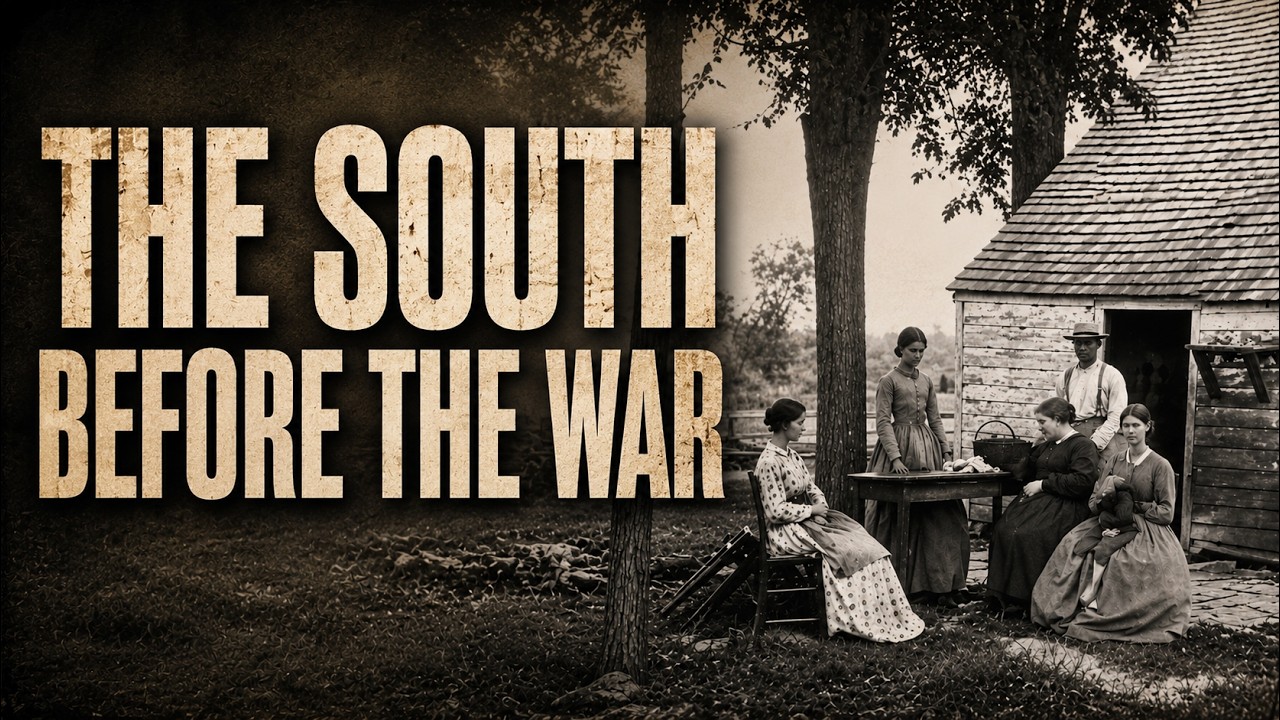
These men, this image of knights in shining armor, represent what many still remember of the antebellum South. Yet they formed only a razor-thin slice of southern society—about half of one percent of a total population of some 9 million. Unlike royalty of old, those planters were part of an aristocracy sired by property, not birth. Most were self-made men from ordinary backgrounds, whose influence was measured in the number of slaves they owned and the acreage of their plantations.
Enjoying leisure and wealth, this small elite had the time and energy to pursue politics. In positions of economic and political power, they enjoyed deference from the masses that made up the majority of the southern white population. That deference meant the majority followed the leadership and adopted the views of a class they would never attain over the course of their entire existence. To put the antebellum South into national perspective, a few realities from the era.
From 1800 to 1860, US territory had quadrupled, expanding from 16 states to 33 plus five territories. Of the 33, 18 were free states and 15 were slave states. Another free state, Kansas, joined the Union on January 29, 1861, making it a 19th state without slavery against only 15 slave states. That meant the slave-holding states had lost significant ground when it came to control of both the House of Representatives and the Senate.
The 15 slave states could not regulate, dictate, or protect themselves from congressional measures dealing with tariffs and funds allocated to ports, canals, and turnpikes—all of which mainly existed in the North. And of course, there was slavery legislation. That is predominantly why, five months after the admission of Kansas as the 34th state, 11 of the 15 slave-holding states left the Union and formed the Confederate States of America. It had been predicted a decade earlier by former Vice President John C.
Calhoun, the South Carolina senator who stated what to him was obvious: “One section has the exclusive power of controlling the government, which leaves the other without any adequate means of protecting itself against its encroachment and oppression. ”
The 1850 census confirmed that northern representation was greater in Congress, since northern population growth had been much faster for some time. The 1860 federal census, released in 1864, reported the US population at 31. 6 million.
The slave-holding states—including Delaware, the District of Columbia, Kentucky, Maryland, Missouri, and the New Mexico territory—had 12. 4 million inhabitants. Of that number, 8. 1 million were white, 262,000 were free colored, and almost 4 million were enslaved.
For the 11 states that would form the Confederacy, the numbers were stark: a total population of 9. 1 million, of which 5. 5 million were white, 132,760 were free colored, and 3. 9 million were enslaved.
The census also recorded 466 centenarians in 1860—137 whites, 39 free colored, and 290 enslaved. Two enslaved individuals in Alabama reportedly died at age 130 and one in Georgia at 137. If those ages are even close to accurate, they are remarkable, since at that time the average life expectancy for a white male was around 40 and for an enslaved male, around 36. Among the slave-holding states, Missouri was the most populous with just over 1 million whites, and Kentucky was second at 920,000.
Maryland had the most free blacks with 83,942. For the Confederate states, Virginia topped the white population list with just over a million, followed by Tennessee at 827,000 and North Carolina at 631,000. Virginia also had the most free blacks at 58,042, followed by North Carolina at 30,463 and Louisiana at 18,647. In terms of enslaved populations, Virginia was again number one with some 491,000.
Four more southern states had more than 400,000 enslaved: Georgia, Mississippi, Alabama, and South Carolina. Both South Carolina and Mississippi had more enslaved people than white people—and they were the first two states to secede. Mississippi’s enslaved population constituted 55. 2% of its total population, and South Carolina’s was the highest at 57.
2%. By contrast, Delaware was the lowest at just 1. 6%. The 1860 census also showed the nation’s urban population—defined as those living in places of 2,500 or more—had grown three times faster than the rural population from 1810 to 1860, rising from 6% to 20% of the national population.
The South did not contribute mightily to that phenomenon: a quarter of all northerners lived in an urban area, but only one in ten southerners did. New Orleans was the South’s most populous city with 168,675 residents. Charleston had only 40,578 and Richmond just 37,910. For reference, New York City was the nation’s most populous city with 805,651.
Despite its smaller population, the South wielded enormous political influence. From 1789 to 1861, 24 of 36 Speakers of the House were southerners, as were 25 of 36 presidents pro tem of the Senate. Southerners served as Supreme Court justices on 20 of 35 appointments, and for 48 of 72 years the president was a southerner—plus 12 additional years under men referred to as “dough faces” who leaned toward the South. Southerners chaired key congressional committees for two-thirds of those 72 years.
In 1859 alone, southerners controlled 16 of 22 Senate committees. Yet by 1860, the North controlled both houses of Congress. The political game was played through evolving parties. From about 1832 to the mid-1850s, southerners belonged to either the Whig or Democratic Party.
Historian Marvin Meyers once observed that the Whig Party “spoke to the explicit hopes of Americans, while Democrats were driven by using their party to address their diffuse fears and resentments. ” Whigs wanted diversified growth; Democrats wanted to preserve the status quo. Those party lines held until the 1850s, when sectionalism destroyed the Whigs as a national party, splitting them into conscience and cotton factions. Members either slid toward the Republicans in the North or the Democrats in the South.
The most divisive issue was slavery and its expansion. South Carolina Senator John C. Calhoun argued that the territories were common property of the several states, while others debated whether the disagreement was about “an imaginary negro in an impossible place. ”
Slavery was safe as a state institution, but was it protected in the territories where Congress had constitutional power to legislate?
The debate over the annexation of Texas in the 1830s and 1840s involved both questions. Its addition as a state was deemed essential for southern slaveholders, who wanted a sphere of influence. This mattered particularly in 1846, when there were 15 free states and 15 slave states, creating great southern interest in the Mexican War that began that same year. Victory in 1848 added one and a quarter million square acres to the United States, almost half of it below the old Missouri Compromise line of 36°30′.
The United States was victorious in great degree due to two southern presidents, James Knox Polk and Zachary Taylor, and two southern generals—Taylor again and Winfield Scott—who led armies of which two-thirds of the volunteer soldiers were southerners. The South’s economy told a revealing story. According to the 1860 census, the South had only 14. 7% of the nation’s manufacturing establishments, 9.
5% of its capital invested, 8. 4% of its laborers, and 8. 2% of the annual value of products. While the proportion of the northern labor force in agriculture dropped from 70% to 40% between 1800 and 1860, the South’s percentage remained constant at 80%.
Rice production was largely confined to the coastal districts of South Carolina and Georgia. Cane sugar production was almost exclusively in Louisiana, which grew 95% of the crop. Tobacco cultivation spread from Virginia and North Carolina to Kentucky by 1783 and Tennessee by 1789. In 1860, Virginia remained the chief tobacco state, with Kentucky second.
Corn was the only grain grown extensively in the lower South, representing 33% of the national output in 1859. But the crop that generated the most attention was cotton. Mississippi led production in 1860 with 1. 2 million bales, followed by Alabama at 990,000, Louisiana at 778,000, and Georgia at 701,000.
Texas by then grew more cotton than South Carolina, largely due to exhausted soil and declining land values in the Southeast. Production jumped from 2 million bales in 1849 to 5. 7 million in 1859. The cotton crop was valued at $191 million in 1860—the American South produced seven-eighths of the world’s cotton and it made up 57% of all American exports.
Four-fifths of Great Britain’s cotton supply came from the American South. So dominant was the crop that on April 22, 1858, South Carolina Senator James Hammond proclaimed: “The slave-holding South is now the controlling power of the world. Cotton, rice, tobacco, and naval stores command the world. No, you dare not make war on cotton.
No power on Earth dares to make war upon it. Cotton is king. ”
The success of the cotton monopoly came with a price. Plans for southern economic diversification vanished.
King Cotton may have reigned, but because of it, King Commerce died. Although the South exported 70% of its cotton, 25% went to northern factories. Yet the South had only 6% of the nation’s ability to manufacture it. In 1860, the city of Lowell, Massachusetts, operated more spindles than all 11 soon-to-be Confederate states combined.
The agrarian South led the nation in only seven of 21 agricultural categories in the 1860 census. Southern success in cash crops proved to be a noose, as southern agrarians saw no need for diversification. From 1850 to 1860, the average price of slaves increased 70%, and the value per acre of agricultural land appreciated 72%, while per capita southern investment in manufacturing increased only 39%. The South found itself with a larger proportion of its capital invested in land and slaves in 1860 than in 1850.
Two-thirds of the factors who helped planters arrange credit, insurance, warehousing, and shipping were northerners or Englishmen. In the late 1850s, those factors reportedly drained as much as $100 to $150 million annually from the South. One observer put it succinctly: “The South is a colony of the North. ”
A curious note from the 1860 census: the average southern white male was twice as wealthy as the average northern white male.
But that wealth was tied up largely in land and slaves. As an English observer described the investment cycle: “Sell cotton in order to buy Negroes, make more cotton to buy more Negroes ad infinitum. ”
The Vicksburg Daily Whig made the point in 1860, writing that the North had been “aggrandized in the most astonishing degree at the expense of the South. ” The paper described New York City as “a mighty queen of commerce” who “grasps our gains, transports them to herself, taxing us at every step.
”
Another ramification of the South’s economic stagnation was a lack of innovation. Of all US inventions patented between 1790 and 1860, only 7% came from the South. One of the most important, however, came in 1793 from Eli Whitney, ironically a transplanted northerner, with his cotton gin. That invention caused an explosion in cotton production and meant the South would shoulder the double yoke of cotton and slave labor.
No southern analysis is complete without examining the nearly 4 million people held in bondage. In 1790, the first US census reported some 700,000 enslaved people. The US banned the slave trade in 1808, the last democratic nation to do so, yet the slave population doubled by natural reproduction every 26 years, reaching almost 4 million by 1860. The 1860 census reported that only 3,000 had been freed since the previous census—double the number liberated in the prior decade.
As for escapes, 1,011 were reported in 1850, or one of every 3,165 held in bondage. In 1860, with a tougher fugitive slave law, 803 escaped, or one of every 5,000. The cost of the “peculiar institution” was steep. In 1810, a field hand was estimated to be worth $600.
That increased to $1,000 in 1840 and anywhere from $1,200 to $1,800 in 1860. If one field hand created a profit of $250 a year, it was considered a good year. Cotton was planted in early summer and picked, ginned, baled, and shipped until winter, usually starting in October. Field work typically began around age 12, with a fraction system rating work capacity: a child was a quarter hand, a young adult a half hand, and an adult a full hand.
Fewer than four out of 100 enslaved people lived to be 60. There was even a slave caste system, with domestic servants sometimes looking down on field hands. In terms of labor breakdown, some 10% of enslaved people worked in mining, transportation, construction, and lumbering, 15% were domestic, and 75% were used agriculturally—55% in cotton, 10% in tobacco, and 10% in rice, sugar, and hemp. Treatment varied.
It was generally better to be enslaved on a plantation in the upper South rather than the deep South, better on a plantation with fewer than 20 slaves, and better working on a cotton or tobacco plantation rather than rice or sugarcane. When discipline was required, the standard whipping was 15 to 20 lashes. About a quarter of all enslaved marriages were broken up. Slavery created a unique and heavy cross for the South to bear, for most of the world had ended the institution.
Spain abolished it in its colonies in 1811, Great Britain in its West Indian colonies in 1833, France in 1848, and Russia freed its serfs in 1859. The United States was the last democratic nation to end slavery and the only one that had to resort to war to do so. Up to the 1830s, slavery had been defended as a necessary evil. Thomas Jefferson believed slavery would die out through “diffusion,” thinking that as the country grew westward, conditions in soil and climate would make slavery unprofitable.
However, in the 1830s, abolitionists began their assaults, moving southern slaveholders to argue that slavery was not a necessary evil but a positive good. The abolitionist message made southern slaveholders defensive, creating a siege-like mentality. An ex-Confederate soldier in 1865 blamed the anti-slavery advocates for sectionalism and the Civil War itself: “The abolitionist, those raving fanatics, continued their work of printing books, tracts, pamphlets, magazines, and newspapers, and scattering them broadcast over the country. They had at last found a sectional issue and a social question upon which they could vent all their fanatical rages…
to drive the South from a union which they themselves had always hated. ”
Others defended slavery in academic fashion. William Harper, Thomas R. Dew, and James Hammond published essays defending slavery as a positive good, basing their findings on biblical scripture, slavery’s role in southern prosperity, the alleged biological inferiority of the Negro, and slavery as a foundation for white supremacy.
George Fitzhugh, a social theorist, argued in his 1854 work “Sociology for the South” and in “Cannibals All! ” in 1857 that the Negro “was but a grown-up child” who needed slavery’s economic and social protection. He also attacked capitalism, accusing it of spawning “a war of the rich with the poor and the poor with one another. ”
One southerner created great consternation by arguing the opposite.
Hinton Rowan Helper, of yeoman farmer stock from North Carolina’s Davie County, published “The Impending Crisis of the South: How to Meet It” in the summer of 1857 when he was 27. He wrote: “Slavery lies at the root of all shame, poverty, ignorance, tyranny, and imbecility of the South. ” He urged non-slaveholders—who made up three-quarters of the southern population—to use the vote to overthrow “this entire system of oligarchial despotism. ” Some southern states made it a crime to circulate the book, yet 68 Republican congressmen endorsed it, and that party raised funds to distribute it.
Helper could not return to his native state or the South. These literary assaults required readers, which turns us to education. Some 80 plus percent of the southern white population was literate. A third of all white children in the South attended school in some form, on average for three months a year.
But the southern states did not have the same revenue for schools as the North, particularly New England. That may explain why the South produced fewer well-known writers. The greatest literary writer produced by the South between 1837 and 1852 was Edgar Allan Poe, born in Massachusetts but reared in Richmond after being orphaned at age three. He was an innovator in fields from poetry to the detective story and even pioneered work as a literary critic.
Other southern writers concentrated on local themes: John Pendleton Kennedy’s “Swallow Barn” in 1832 portrayed plantation life in Virginia, while Augustus Baldwin Longstreet produced “Georgia Scenes” in 1835, dealing with backwoods life. Longstreet was the uncle of future Confederate Lieutenant General James Longstreet. William Gilmore Simms was probably the most prolific southern writer, publishing poetry, historical romances, history, and biography. In poetry, the South was led by South Carolinians Henry Timrod and Paul Hamilton Hayne.
Timrod wrote fiery patriotic poems; Hayne’s poetry emphasized romantic verse and long narrative poems. In popular music, no one captured the fancy of the antebellum South quite like Stephen Collins Foster. Beginning in 1846 while working as a bookkeeper for his brother in Cincinnati, he composed “Oh Susanna,” “Away Down South,” and “Uncle Ned. ” His success prompted him to write for black minstrel shows.
In 1851, he reached an agreement with E. P. Christy, giving Christy’s Minstrels first performance rights while keeping publication rights for himself. Then came a string of immortal songs: “Nelly Was a Lady” in 1849, “De Camptown Races” in 1850, “The Old Folks at Home” (better known as “Swanee River”) in 1851, “Massa’s in the Cold, Cold Ground” in 1852, “My Old Kentucky Home” and “Old Dog Tray” in 1853, “Jeanie with the Light Brown Hair” in 1854, and “Old Black Joe” in 1860.
Despite all his memorable tunes, when he died in January 1864, he left this world in poverty. Another tune, “Dixie’s Land” or simply “Dixie,” was played at Jefferson Davis’s inauguration and immediately adopted as the musical anthem of the Confederacy. It was written by Daniel Decatur Emmett and first performed by Bryant’s Minstrels in New York in 1859. Oddly, both Foster and Emmett, who seemed to know the South so well, were northerners—Foster born in Pennsylvania and Emmett in Ohio.
The enslaved also produced powerful music. Their first tunes, inspired by African music, were called shouts or chants. Over time, the chants became more elaborate, leading to work songs, passionate hymns, and eventually blues, gospel, and rock and roll. One of the most well-known spirituals was “Swing Low, Sweet Chariot,” whose lyrics referred to an underground railroad station in Ripley, Ohio, on the northern bank of the Ohio River.
Other familiar tunes included “Go Down Moses,” “We Are Climbing Jacob’s Ladder,” and “Joshua Fit the Battle of Jericho. ”
A presentation about the antebellum South must also discuss its social makeup. Southern society was patriarchal in the extreme, with the extended family including cousins, aunts, and uncles. As one observer put it, the South was “a lush island of unchangingness in the midst of restless change.
”
At the top were the planters, the aristocracy who owned the bulk of the 4 million enslaved people. Those who owned 20 or more slaves were considered planters, and the Charleston Mercury spoke for them in 1858 when it published: “The North and South are not only two peoples, but they are rival, hostile peoples. ” Those planters made up half of one percent of the some 9 million who lived in the South—maybe 10,000 families. About 75% of the southern population had no direct connection with slavery.
Of the 385,000 families who did in 1860, 88% held fewer than 20 slaves, 72% held fewer than 10, and around 50% owned no more than five. The small planter and the yeoman farmer were more truly characteristic of the southern land-owning class than the estates like Tara in “Gone with the Wind. ” Around mid-19th century, only 18% of southern farms and plantations could be described as plantations. The planters liked to think of themselves as characters from a Sir Walter Scott novel, heirs to the tradition of knights and cavaliers.
They cultivated a taste for blooded horses, fine foxhounds, handmade firearms, and southern belles from affluent families. Deference allowed the wealthy few to control so very much. The next white social class, well over half the southern people, was the middle class of farmers who tilled no more than 100 acres. They generally worked the land with a few slaves or hired hands, cared little for the chivalric ideal, and were often at odds with the planters in state and local politics.
These yeoman farmers were clannish and fiercely independent but shared the same economic goals and, like most Americans of that day, considered African-Americans inferior to whites. The lowest rung consisted of some 2 million poor whites—”sand lappers,” “crackers,” and similar labels—who survived by hunting, fishing, and subsistence farming in the mountains or pine barrens where the soil was usually poor. Three distinct white classes, but one thread ran through all: all were conservative in their traditions, and all were fervently committed to the idea of an agrarian life. Southerners felt that agrarian society produced individuals of higher moral character than the urban north, which the southern press noted “exalted the steam engine and electric telegraph above God.
”
A few saw beyond living purely off the land. In the 1840s, low cotton prices spawned a crusade for economic diversification. But the effort was sabotaged when cotton prices jumped more than 50% in the next decade. Instead of diversifying, planters devoted more acreage to cotton, sugar, and tobacco.
So much so that the per capita output of principal southern food crops actually declined in the 1850s. On the eve of Civil War, the South was headed toward existence as a food-deficient region. One man who tried to sell the idea of a progressive and diversified South was James Dunwoody Brown DeBow, an Allens journalist who published the “Commercial Review of the South and West,” popularly known as DeBow’s Review. He believed the South had to industrialize or remain increasingly bound to the North.
He estimated in 1852 that the South lost annually $100 million in vassalage to the North. A few heeded DeBow’s message. In the 1850s, the South quadrupled its railroad mileage while the North only tripled. Capital invested in southern manufacturing rose 77%, and the value of southern-produced textiles increased 44%.
But in terms of the North’s overall growth, the South still fell farther behind. There were many southern commercial conventions throughout the 1850s, but always much talk and little action. Cotton did too well in the 1850s, and by the late 1850s, southern agrarians reacted bitterly to the gospel of industrialization. Said an Alabama politician: “We want no manufactures.
We desire no trading, no mechanical or manufacturing classes. As long as we have our rice, our sugar, our tobacco and our cotton, we can command wealth to purchase all we want. ”
In 1861, the Muscogee Herald in Georgia agreed: “Free society we sicken at the name. What is it but a conglomeration of greasy mechanics, filthy operatives, small-fisted farmers and moonstruck theorists?
All the northern and especially the New England states are devoid of society fitted for well-bred gentlemen. ”
The message was even trumpeted from southern pulpits. Episcopal Bishop Stephen Elliott of Georgia saw secession and civil war as a chance to destroy “the infidel and rationalistic principles of misguided Yankees” who were attempting to substitute “a gospel of the stars and stripes for the gospel of Jesus Christ. ”
Such was the mentality when the Democrats met in Charleston, South Carolina, to nominate their 1860 presidential candidate.
Southern Democrats came with one purpose: to destroy Stephen A. Douglas. Deep South delegates arrived committed to nominating someone who would so anger the North that the Republicans would be sure to win, forcing the issue of secession. Fire-eaters and secessionists were everywhere, taking over every night on every street corner.
Fire-eater William Lowndes Yancey argued for the party’s adoption of his Alabama platform, which included a federal slave code protecting the institution in the territories. He claimed he made his plea to save the Union, not destroy it. He thundered: “Ours is the property invaded. Ours are the institutions which are at stake.
Ours is the peace which is to be destroyed. Ours is the honor at stake. ”
Despite wild applause, Yancey’s platform was defeated. The vote for Douglas’s popular sovereignty was 165 to 138 against, breaking down 154 to 30 for Democrats in the free states versus 11 for and 108 against in the slave states.
With the announcement, Yancey stormed out, and this time he did not walk out alone. Forty-nine delegates followed him from Alabama, Mississippi, Louisiana, South Carolina, Florida, Texas, and two of three delegates from Delaware. The next day, Georgia and Arkansas walked out. So many left that the remaining delegates were unable to get a two-thirds majority to nominate Stephen Douglas.
After 57 ballots, the convention adjourned to try again six weeks later in Baltimore. There, Yancey and the Deep South delegates walked out again. As his biographer Eric Walther noted, “through years of preparation and despite some brief wavering, William L. Yancey had finally destroyed the Democratic Party.
”
In 1860, four candidates ran. John C. Breckinridge, the Southern Democrat from Kentucky, supported the status quo. Tennessee’s John Bell represented the old Whigs, resurrected as the Constitutional Union Party, which decided to take no stand at all on divisive issues—”to recognize no political principle other than the Constitution, the Union, and the enforcement of the laws.
” Of course, there was also Abraham Lincoln for the Republicans. In the final outcome, Northern Democrat Stephen Douglas carried only Missouri. John Bell won the border states of Virginia, Kentucky, and Tennessee. Breckinridge carried the rest of the South, winning 45% of the region’s popular vote to Bell’s 39%.
When Lincoln’s election was confirmed, Charles Francis Adams proclaimed: “The country has once and for all thrown off the domination of the slaveholders. ”
With Lincoln’s victory, the fire-eaters were in their element—southern extremists like William Lowndes Yancey, Robert Barnwell Rhett, Louis T. Wigfall, Laurence M. Keitt, and Edmund Ruffin.
On election day, November 6, 1860, when Pennsylvania went Republican, Edmund Ruffin rejoiced, for he knew it meant Lincoln would win. When the result was made official, South Carolina immediately called for a secession convention, and Ruffin had to be there. Nothing could keep him away—not the heavy storm that covered the Richmond area with nine inches of snow, not the nightmare of travel, not even the grief for his beloved daughter Elizabeth, who had just died in childbirth. On December 17, 1860, he journeyed to Columbia, South Carolina.
During a stop in Wilmington, North Carolina, he learned an outbreak of smallpox had driven the secession convention to Charleston. He arrived in the soon-to-be cradle of secession the morning of December 19. The day before at 4:00 p. m.
, all had convened at Institute Hall. Business carried over to Wednesday the 19th, when all relocated to the smaller St. Andrew’s Hall. From Montgomery, Alabama, Governor A.
B. Moore sent a note that read: “Tell the convention to listen to no propositions of compromise or delay. ”
On Thursday, December 20, the session convened at noon. Just before 1:00 p.
m. , an ordinance of secession was presented. At 1:07, the roll call began. Delegates’ names were called in alphabetical order, each answering with an “I.
” By about 1:15, the vote was recorded: 169 to zero for secession, unanimous. St. Michael’s bells peeled and artillery salutes rumbled from the Citadel. Businesses closed for the day.
It was, as one observer put it, “July the 4th cloaked in December. ”
Amidst the excitement, Union Judge James Pettigrew encountered a friend on Broad Street. With bells ringing, Pettigrew asked, “Where’s the fire? ” He was answered, “Mr.
Pettigrew, there is no fire. Those are the joy bells ringing in honor of the passage of the ordinance of secession. ” Unfazed, Pettigrew fired back: “I tell you there is a fire. They have this day set a blazing torch to the temple of constitutional liberty, and please God, we shall have no more peace forever.
”
The news of South Carolina’s secession raced like wildfire. More bells joined the bronze chorus, and cannons roared in New Orleans, Savannah, Augusta, Portsmouth, Montgomery, Pensacola, Mobile, Wilmington, and Charlotte. In Baltimore, the news was taken quietly. In Philadelphia, the stock market was relatively steady.
But in Boston and New York City, attacks were levied against South Carolina’s action, and the market staggered due to an uncertain future. In Washington, the telegraph brought the news to Congress about 2:00 in the afternoon and hit like a thunderbolt. Southern members in attendance raced forward to congratulate South Carolina representatives. What would be the response?
Most expected secession to be peaceful. So certain was Robert Barnwell Rhett, editor of the Charleston Mercury, that he wrote: “I will eat the bodies of all men slain as a consequence of disunion. ” Oh, how wrong he would be. But the die had been cast.
The South, its people, its society, its world—dominated by a landed minority like those who gathered in Charleston and like those who jousted in Kinston, North Carolina—had made secession and Civil War a reality. In selling their ideals to a deferential white majority, they began a four-year journey that would destroy the very world they had hoped to protect. The political tension throughout the 1850s had escalated. In the cold light of economics, the two sections were interdependent, perhaps inseparable.
Missouri Senator Thomas Hart Benton concluded: “In brief and in short, the two halves of this union were made for each other as much as Adam and Eve. ”
But there were other factors at work: geography, population, internal improvements, technology, religion, education, reform, politics, and yes, slavery. By 1860, the toxic elixir those factors created meant that the United States was in fact two worlds.