In the summer of 1832, the American painter and traveler George Catlin stood on a low ridge overlooking the upper Missouri River and witnessed something he could barely bring himself to believe. A Sioux horseman, riding at full speed, drove an arrow into the shoulder of a massive bull buffalo estimated at 2,000 pounds. The animal dropped within 40 yards. The rider never slowed, already moving toward his next target before the first bull had stopped kicking.
Catlin had abandoned a legal career in Pennsylvania and headed west out of conviction that the Plains peoples would vanish from the world’s memory if no one painted them. He spent years among the Sioux and other nations, filling hundreds of pages with observations. The buffalo hunt was a subject he returned to again and again. He wrote that he tried to draw what he saw that day but could not, because his hand could not keep up with what his eye had witnessed.
From Catlin’s journals and the diaries of those who came after him, historians have identified twelve specific skills that Plains buffalo hunters honed over thousands of years. Many European settlers either refused to believe them or were unable to learn them. More than a century and a half later, some still resist full explanation. The first recorded skill was stalking.
A hunter could cross open ground on foot in broad daylight and approach within 40 yards of a wary herd, close enough to place an arrow through a specific rib gap no larger than a dinner plate. The method involved using a wolf, or rather a wolf skin. The hunter draped a fresh wolf hide with its head intact over his back, stripped down to arms and legs, and crawled toward the herd on hands and knees, swaying with the wind and staying low in the grass. The technique worked because of buffalo biology.
A healthy adult bull was too dangerous for a lone wolf to take down, so wolves typically hunted calves, old bulls driven out of the herd, and sick or injured animals on the margins. A fully mature herd with nursing cows and strong bulls would ignore a solitary wolf wandering along its edge. If a man moved like a wolf, kept the right shape and pace and patience, the herd would let him into its circle of trust. Catlin tried it himself and failed.
He wrote that the grass tore his hands and knees and that the herd bolted before he covered a hundred yards. His Sioux teacher watched for a moment, looked at him with what Catlin described as pity mixed with laughter, then went out and killed a cow within twenty minutes. The technique demanded attention to wind, tempo, and keeping the head low and angled rather than looking directly at the animals, since buffalo react to direct eye contact like most prey. The second skill was reading a herd from a great distance.
A Plains hunter standing on a rise could look at a herd two, three, or even four miles away and describe it with what European observers called supernatural accuracy. He could tell how long the herd had been in a valley, whether it was about to move, whether it had been disturbed by a fight, a predator’s scent, or a wolf passing in the night, and whether the calves were young or weaned. Captain Randolph Marcy, an American army officer who crossed the Plains during the 1850s and 1860s and wrote the popular book “The Prairie Traveler,” described a Kiowa scout who studied a distant herd for a full minute and then announced it would leave the valley before sunset, heading northwest, with enough water for three days in that direction. Marcy argued, but the scout simply shrugged.
The herd left two hours before sunset, heading northwest. Modern grassland biologists have since identified some of the cues. The color of the grass told a story: a herd that had been in one valley long enough to reach good forage left distinctive yellowish patterns. Old droppings layered into the soil indicated how many days the herd had stayed.
The herd’s own body language signaled an imminent move, with cows drawing calves close and calves beginning to orient toward the direction of travel. The third skill was the throw itself: bow hunting from a running horse at close range, the skill Catlin drew repeatedly and never captured to his satisfaction. A bull buffalo runs at about 35 miles per hour. A short-legged prairie horse could match that pace at a sprint.
The hunter approached from behind and slightly to the side, running 30 to 35 miles per hour on a horse without a saddle, with both hands on the bow and control of the animal coming from his knees alone. The buffalo presented a heavy skull, thick shoulder plates, and a muscular hump that could deflect most arrows. The killing shot had to enter behind the shoulder and before the last rib, slipping between two ribs and into the lungs, on a moving target from a moving platform through dust and uneven ground. This window was roughly the size of a dinner plate.
The short bow, usually about three feet long, was made from Osage orange wood and sometimes laminated with horn and sinew. Skilled Comanche archers could drive an arrow completely through a bull. Army surgeons in the 1870s recorded arrows found embedded in the far shoulder of a bull after passing entirely through the chest cavity. Josiah Gregg, who spent nine years trading on the Santa Fe Trail and wrote “Commerce of the Prairies,” reported watching a Comanche rider loose arrow after arrow at different animals in the time it took his own men to reload a single rifle.
Gregg was a blunt, unromantic trader, and he wrote that no European army could match what he had seen. The fourth skill was the oldest, predating the horse and the bow: the buffalo jump. In the Blackfoot language it was called the “pishkun,” meaning a deep blood kettle. Hunters located a rise of land ending in a cliff 15 to 40 feet high, then built long lines of stone cairns, sometimes stretching for miles, funneling toward the cliff’s edge.
On hunt day, teams of runners wearing wolf and calf skins mimicked the bleating of a lost calf and pushed the herd into the narrow passage. The herd, once inside the funnel, could not see the cliff. From the buffalo’s low angle of vision, the cairns looked like the outer edge of an ordinary valley. The animals on the sides were pushed into what a panicked herd naturally does: run forward, together, packed close.
By the time the lead animal saw the cliff, the mass behind it made stopping impossible. At a site called Head-Smashed-In Buffalo Jump in what is now southern Alberta, archaeologists have documented continuous use of the same jump for nearly 6,000 years, ten times the entire history of the English language. The name comes from a Blackfoot story about a young man who wanted to watch the fall from below the cliff and was caught among the falling animals. European settlers who came across these sites in the 1840s and 1850s often mistook the layers of bone, sometimes three to four meters deep, for evidence of a plague or natural disaster.
It was neither: it was a carefully managed hunting system sustained over sixty centuries. The fifth skill was invisible: brain tanning of hides. A strange biological fact confirmed by modern chemists is that nearly every mammal is born with enough brain to tan its own hide. The lecithins and phospholipids in the brain, worked into a scraped, stretched hide, break down the cell structure and produce soft, pliable, porous leather.
When smoked over a fire, it became waterproof. Plains women, who carried out this work almost exclusively and in all weather, would take a fresh hide, stake it to the ground or stretch it on a wooden frame, and scrape off every trace of fat and flesh. They then turned the hide and removed the hair. Next, they worked a paste of the animal’s own brain, boiled with water until thin, into the hide fibers with bare hands, sometimes for hours, sometimes across two or three days.
The hide was stretched, dried, and worked back and forth over a rope or smooth tree trunk to keep it supple, then smoked over a slow fire of rotten cottonwood. The smoke served two purposes: it set the tan and made the hide waterproof. European tanneries could not produce this leather in 1850 or in 1950. Modern chemical tanning with chrome salts or vegetable tannins produces leather that is either stiff, brittle, or prone to damage.
Brain-tanned buffalo hide, kept dry, could last a hundred years or more without losing its softness. An army officer stationed at Fort Laramie in the 1870s wrote that he offered a Sioux woman what he considered a large sum for a robe. She laughed and said through her interpreter that if he wanted a robe, he could bring her a bull and she would show him what it took. He never brought her the bull.
The sixth skill was pemmican. With no icehouses, no root cellars, and no nearby salt mines, Plains families who followed the buffalo needed food that would last for months of brutal winter. The solution was pemmican, a word derived from the Cree language with roots meaning roughly “maker of fat. ”
The recipe was simple.
Thin strips of lean buffalo meat were dried in sun, air, and smoke until hard and nearly black, then pounded into a fine powder. Melted, strained buffalo fat was mixed with the dried meat in roughly equal parts by weight, sometimes with dried saskatoon berries, wild cherries, or plums. The mixture was packed into rawhide bags, sealed with sinew, and the openings closed with more melted fat. The Hudson’s Bay Company relied on pemmican as a staple for its northern fur trade throughout the nineteenth century and could not have operated without it.
Company records from the 1840s show pemmican cakes shipped east that had been made three or four years earlier and were still, in traders’ language, good and wholesome food. A well-made pound of pemmican contained around 3,000 calories, nearly half from fat, half from protein, plus natural sugars from dried berries, a ratio close to what modern nutritionists recommend for extreme cold, heavy exertion, and long travel. Prince Maximilian of Wied, the German naturalist who traveled the Missouri in the 1830s, first found pemmican strange and greasy. On his return journey, when supplies ran out, he lived on it for nearly three weeks and arrived at Fort Union weighing more than when he left.
The seventh skill was small and nearly invisible in the archaeological record: sinew. The long tendon running along a buffalo’s back is a powerful, almost silvery cord of connective tissue. At butchering, it was pulled out as a long strip, cleaned, and dried. Once dry, it could be split with fingernails or a small knife into threads.
After a brief soak in water, these threads became one of the strongest fibers available to any nineteenth-century human. Sinew was thread, bowstring, cord for binding tools, repair for torn tipi covers, and lashing for arrowheads and moccasins. When wet, sinew shrank and tightened. A seam sewn with sinew would close on itself when wet, nearly fusing.
European linen, cotton, or wool thread did the opposite: it loosened, rotted, and ruined the work. William Bell, a mining engineer who traveled through Kansas in the late 1860s, wrote that when he finally understood this, he had to sit down on a rock and think about what else in the world he might be missing. He watched a Kiowa woman patch a tear in a tipi cover with sinew during a rainstorm, working with wet hands on wet hide. By the next morning, the patch had shrunk so tightly it was almost invisible against the surrounding skin, and not a single drop had leaked.
When he asked how long the patch would last, she looked at him, he wrote, like a person who had been asked a pointless question, and said it would outlast them all. The eighth skill was less a skill than a philosophy, and it was the one the European mind of the nineteenth century was least prepared to understand: when a buffalo was killed, nothing was wasted. Nothing at all. The hide became a tipi cover, winter robes, summer moccasins, and storage bags.
The meat was eaten fresh at the kill site, dried into jerky, or pounded into pemmican. The tongue was a delicacy, slow-cooked over coals, often reserved for elders. The heart and liver were eaten immediately, still warm. Organs went to those most in need.
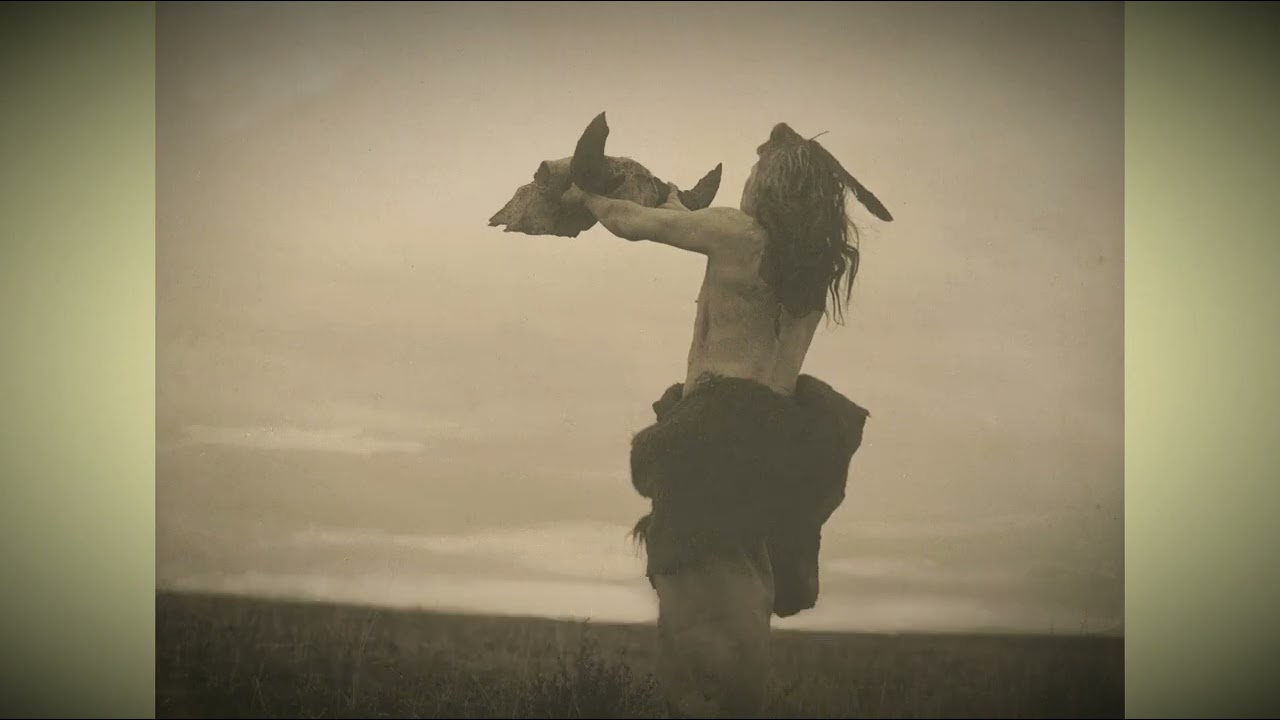
Bones became tools: a shoulder blade became a shovel or scraper, rib bones became sleds, leg bones were cracked for marrow, which was eaten as rich food or rendered into a fine fat for hair, skin, and medicine. Horns became spoons, cups, powder horns, and ceremonial tools. The skull became an altar. Teeth decorated war shirts and bags.
Hair was braided into ropes and used for ornament. Hooves were boiled for glue. The bladder became a water vessel, a fat-storage bag, or a medicine pouch. The stomach became a cooking pot: it could be filled with water, dropped hot stones into it, and boiled soup inside the animal’s own body, one of the oldest cooking methods on the continent.
Even the tail was used. The tuft of hair at its end became a fly whisk, a ceremonial fan, and a hat ornament. The bull’s beard was used to decorate war shirts. The dried gall bladder was used as a dye container, and the dried tongue skin became a tool for sharpening implements.
Francis Parkman, who traveled with the Oglala Sioux in the summer of 1846 and wrote “The Oregon Trail,” described watching a full buffalo bull disappear over the course of an afternoon. By sunset, he wrote, nothing remained on that patch of prairie but the flattened impression of the animal on the grass. The commercial hide hunters who came a generation later took the skins and left the meat, took the tongues and left the rest, killing three hundred buffalo in a single day and leaving the carcasses to rot in the sun. A Sioux hunter using old methods took one buffalo and fed his family for a month, clothed them for a year, and housed them for a decade.
The ninth skill, recorded repeatedly by European travelers as having saved their lives, was making fire without wood. Most of the Great Plains were treeless, and a traveler without fire could not cook, could not stay warm, and could not survive a winter night in the open. The simple solution was dried buffalo dung. Dried for weeks and months under the prairie sun and wind, it was nearly odorless, dry, fibrous, lightweight, quick to light, and burned hot.
With herds of a hundred thousand animals, the supply was almost endless. Later settlers who arrived in the 1870s and 1880s learned to use it and called it prairie coal. They stacked it behind their sod houses, baked bread with it, and warmed their children with it. Prince Maximilian wrote that when a Cheyenne woman first handed him a buffalo chip and gestured for him to put it on the fire, he thought she was joking and nearly refused.
Then he watched it catch, burn clean and hot, with a faint sweet smell of dry grass. He sat by that fire, he wrote, feeling a strange mix of shame and gratitude. The tenth skill was finding water in dry country. Across parts of the American West, a traveler could walk for days without encountering water.
In summer, when streams ran dry and buffalo herds moved to distant sources, a traveler who could not find water died quickly. Plains hunters found water where European hunters said there was none by watching everything. Doves, in particular, flew to water in the evening and morning in straight lines at low altitudes. Bees, when present, flew to water in straight lines at a specific time of day.
Certain species of ants built their mounds where groundwater was close to the surface. Willows only grew where water was within reach of a shallow well, while older and taller cottonwoods indicated deeper water. The color of grass changed in certain seasons over groundwater in ways an experienced eye could see from a hundred yards away. Buffalo trails, followed downhill, led to water in most cases.
A specific technique described in the memoirs of an Osage man named Little Moon, recorded in the 1890s, involved walking along a dry riverbed at dawn while the ground was still cold, looking for the one patch of dew that remained longer than others. Under that patch, digging three feet would reveal damp sand, and another foot would find water. Dirty, not clear, but water enough to keep a person alive. Marcy tried to teach these methods to army officers heading west and said most either did not believe him or did not understand his tricks.
He wrote a line that has stuck for 170 years: the Indian sees a country, while the white man sees only what he expects to see. The eleventh skill was reading the sky. Plains people, without instruments or barometers, predicted weather with accuracy that modern scientists have grudgingly acknowledged often beat early European scientific methods. They read clouds by shape, the color of their undersides, and their speed of drift.
Mackerel skies at dawn meant weather within a day and a half. A halo around the sun or moon meant rain within a day. A low ceiling of gray clouds from the northwest meant a storm that would last three days. A high ceiling of white clouds from the south meant heat.
They read animals. Before a hard storm, buffalo herds turned their tails to the wind and stood still in tight clusters. Horses faced the wind. Wolves moved to lower ground.
Birds flew low, closer to their nests. Ants built up their mounds. Frogs emerged from their burrows. A specific kind of dragonfly common to the Plains only bred in the hours before rain.
Marcy recorded that a Comanche man told a military patrol in dry country under a clear sky that they had one day to reach the river before a flood caught them. The officers did not believe him and laughed around the campfire that night. They stayed where they were. Twenty-eight hours later, a wall of water tore through the valley where they were camped, washing away three mules and a young corporal’s equipment and nearly killing the corporal himself.
Marcy noted dryly that the Comanche had left them the night before without ceremony or explanation. The twelfth skill was the tipi, the most misunderstood of all by those who never lived in one. Behind its simple appearance lay a piece of engineering that European architects, once they understood it, had to acknowledge as exceptional. A tipi had a slight backward tilt.
The rear pole was set closer to the base than the front pole, making the entire cone lean into the prevailing wind. This was not decoration but a structural element that made the tipi deflect wind with ease. Documented cases from the 1860s and 1870s describe tipis surviving gusts that destroyed every army tent in the area. The tipi had two smoke flaps at the top, each attached to a separate pole, adjustable independently to direct smoke from the interior fire out of the cone regardless of wind direction.
It was a natural chimney requiring no external flue, a heating system that vented smoke automatically in all weather. In midwinter, a family could sit around an open fire inside and the smoke would rise out while the warmth stayed in, something traditional European stoves could not do. The tipi had an inner lining, a second layer of hide about four and a half feet high, hung from a rope around the inner frame of the poles. The gap between the outer cover and the inner lining created a chimney effect.
Cold air was drawn up between the two layers and out through the smoke flaps, while warm air stayed inside near the floor. This was, in essence, a modern double-walled thermal design developed at least 3,000 years before European architects began describing it in their theoretical papers. The doorway faced east in most Plains cultures. This was practical: east-facing doors caught the first morning light, warming the interior quickly on cold mornings, and sat opposite the prevailing westerly winds, so doors did not fill with snow during winter storms.
A tipi could be dismantled in fifteen minutes in a prepared camp and rebuilt just as quickly. It could be moved on a travois behind a horse or a large dog. A family might own a small tipi, twelve to fifteen feet in diameter at the base, while a war leader or holy man might have a ceremonial one twenty-five or thirty feet in diameter. The largest recorded in the northern Plains in the 1860s approached forty feet and held fifty people for ceremonies.
Father Pierre-Jean De Smet, the Belgian priest who traveled the northern Plains as a missionary in the 1840s and 1850s, wrote that he spent a full week in a Cheyenne tipi during heavy rain. On the third day, waking up dry and warm in a shelter that had been moved to that location from a distant valley on horseback, he wrote that he understood something he had never understood before. These people, he said, had solved problems Europeans did not even know existed. That, more than any individual technique, was what struck Europeans about the buffalo hunters.
It was not any one skill, not horseback shooting, pemmican, brain tanning, or the tipi alone. It was an entire way of seeing. A century and a half later, most of that knowledge is gone. When the vast herds were killed in the 1870s and 1880s by industrial hunters who left the Plains covered in rotting carcasses, the people who lived on the buffalo, who depended on those animals for shelter, food, and survival, were broken apart.
Not entirely, not forever, but the daily practice of these twelve skills, the constant use and passing down through generations in everyday life, was interrupted. Children raised in that way of seeing were taken from their families and sent to boarding schools where they were beaten for speaking their own language. The chain broke. Some of it survived.
Some of these traditions are returning to life on reservations, in cultural programs, and in the homes of people who kept them through the hard years. Hide tanning is being taught again. Pemmican is being made again. Old horse traditions, the bow, tracking, and reading the herd are being studied again by people who decided this knowledge is worth the effort.
A saying attributed to a Lakota elder in the mid-twentieth century sums it up. He said, in translation, that his grandfather could stand in the middle of the prairie at midnight and know exactly where he was and what the weather would be the next day. He said his father could do most of that. He said he could do some of it.
He said his grandchildren could not do any of it. And he said: that is the whole story. The Europeans who witnessed these skills in the 1830s, 1840s, and 1850s, men like Catlin, Marcy, Parkman, and De Smet, documented everything because they grasped even then that they were seeing something ancient, something that had taken thousands of years to build, something that could be lost within a single generation. Catlin wrote near the end of his life that he had been given, by luck and the accident of his restless anxiety, a window into a world that was closing its doors.
He said he had tried in his paintings and notes to preserve some of what he had seen, but he was not sure he had succeeded. If there was one thing he wished to leave behind, he wrote, it was the hope that someone might someday look at what he had recorded and realize the people he painted were not primitive, not savages, and not doomed to vanish. They were, in every sense of the word, more skilled at living on that land than the people who replaced them.