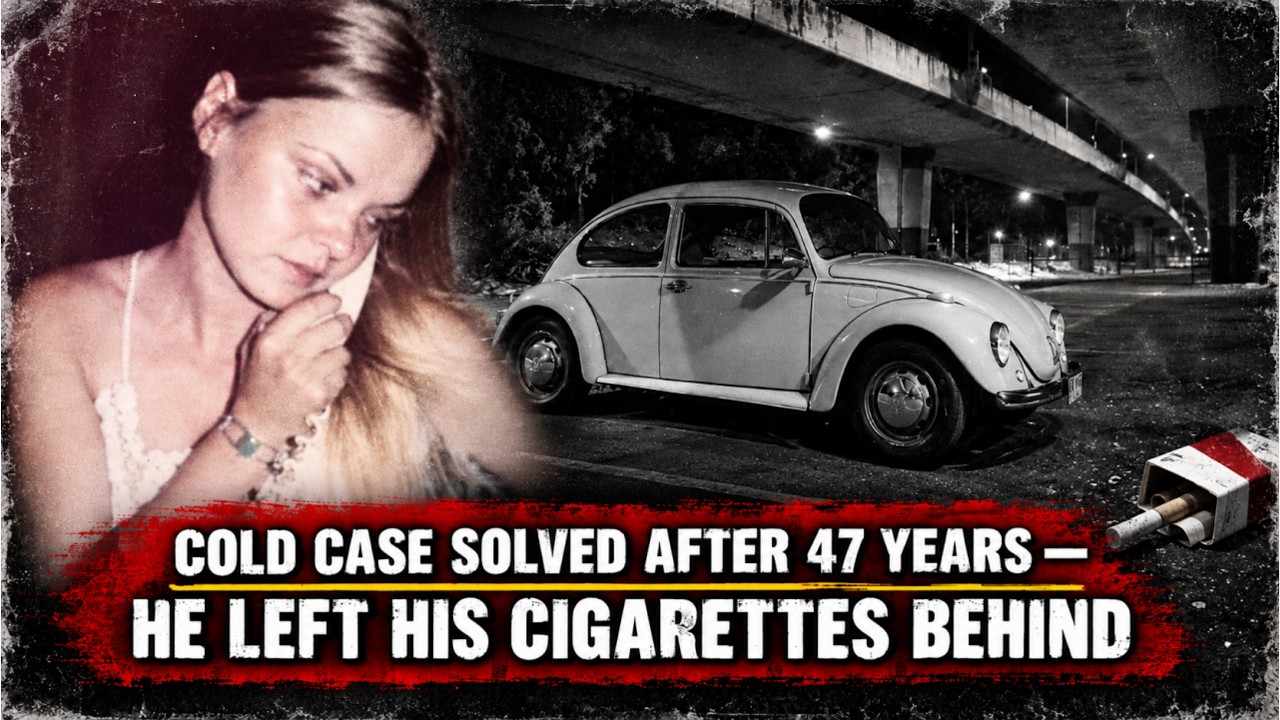
On February 1, 1977, someone discovered a parked Volkswagen Beetle in the carport of a San Jose apartment complex. Wedged into the back seat was the body of Janette Rston, a 24-year-old mother from San Mateo. She had been strangled with her own dress shirt, and someone had tried to set the car on fire with her still inside. The blaze never caught.
Because the car survived, so did the evidence it contained, including items that would sit untouched for nearly half a century before finally giving investigators the name they had been looking for since the night she died. Janette Rston was not famous. She was a young mother with a six-year-old son, a circle of friends in the South Bay, and a routine Friday night out planned for January 31, 1977. She told a friend she was going to a bar called the Lion’s Den on Almaden Road in San Jose.
Before leaving the bar that night, she turned to a friend and said she’d be back in ten minutes. She never returned. That small, ordinary sentence would become one of the last things anyone remembered her saying. Newspaper coverage at the time reduced her to a headline and a case number, but the people who knew her remembered more.
They remembered her habits well enough to recount them to investigators decades later. At the Lion’s Den, Janette was seen talking with a man who was not a regular. There were no security cameras, no way to track her movements, and no reliable way to identify the man except through witness descriptions. A police sketch was created, but without a name attached to it, the drawing led nowhere.
Her body was found the next morning. The medical examiner determined she had been strangled with her own long-sleeved dress shirt and that she had been sexually assaulted before her death. The attempt to burn the car failed, which meant investigators were able to collect physical evidence from the scene, including a fingerprint found on a carton of Eve cigarettes inside the car. In 1977, that fingerprint could not be matched.
Fingerprint databases were not computerized, and matching prints meant comparing them by eye against known suspects. DNA profiling did not exist as a forensic tool. The national DNA database known as CODIS would not be established until 1994. The case went quiet.
Detectives retired. The evidence went into storage. For 47 years, the file sat dormant, waiting for technology to catch up to what was already in hand. The man behind the fingerprint was a 21-year-old Army private named Willie Eugene Sims, stationed at Fort Ord in Monterey County.
Just months after Janette was killed, Sims was convicted in Monterey County of assault with intent to commit murder and robbery. That case involved another woman attacked with a knife. He was sentenced to four years in state prison. While investigators were still trying to identify Janette’s killer, the man they were looking for was already sitting in a California courtroom for a strikingly similar act of violence against a different woman.
After serving his sentence, Sims left California and eventually settled in Jefferson, Ohio, a small town near Lake Erie. There he lived quietly for decades with no new violent charges and no entries into the kind of databases that might have flagged him. The breakthrough came not from a tip or a confession, but from a routine decision by Santa Clara County Deputy District Attorney Rob Baker. In August 2024, the FBI updated the search algorithm behind its national fingerprint database.
Baker decided to run Janette’s cigarette carton print again, describing it as something close to a last resort. This time, the system returned a match. The print matched Willie Eugene Sims. A fingerprint alone was not enough.
A defense attorney could argue it was left innocently. Investigators needed more, and they went looking for it. In 2025, members of the Santa Clara County District Attorney’s Bureau of Investigation and the San Jose Police Department flew to Ohio. With the help of the Ashtabula County Sheriff’s Office, they collected a DNA sample directly from Sims.
That sample was sent back to the Santa Clara County Crime Lab, where scientists compared it against biological evidence preserved from the 1977 investigation, including material from beneath Janette’s fingernails and from the shirt used to strangle her. It matched. Two separate forensic disciplines, separated by nearly five decades, had confirmed the same answer. On May 6, 2025, law enforcement in Ashtabula County, Ohio, arrested Willie Eugene Sims at his home in Jefferson.
He was 69 years old. The arrest was coordinated between the San Jose Police Department homicide unit, the Santa Clara County District Attorney’s Cold Case Unit, the Ashtabula County Sheriff’s Office, and the Ashtabula County Prosecutor’s Office. Sims waived his right to an extradition hearing and did not fight being sent back to California. He was formally charged with murder.
He faces a maximum sentence of 25 years to life in prison if convicted. Before the arrest became public, Baker made a personal call to Janette’s son, who had been six years old when his mother was killed and was now a man in his fifties. He had spent his entire adult life not knowing who killed her. After everything, someone had finally finished the job the original investigator started.
Santa Clara County District Attorney Jeff Rosen said of the case: “Cases may grow old, but they don’t stop looking. ”
Sims was assigned a public defender. A supervisor from that office cautioned that they had not yet reviewed the full evidence and that no conclusions should be drawn before the defense conducted its own investigation. An arrest and a fingerprint match are not a conviction, and Sims is entitled to the presumption of innocence until a jury decides otherwise.
Prosecutors have noted that many of the key witnesses from 1977 are still alive, something cold case prosecutors cannot always count on. Decades of careful evidence preservation by the original investigators, combined with the survival of people who remembered that night at the Lion’s Den, gave the prosecution team a rare opportunity to build a full picture for a jury. As of the most recent court activity, Sims has had a series of pre-trial hearings in Santa Clara County, standard procedural steps in a case this complicated and this old. A status conference was scheduled for early May 2026.
A preliminary hearing will require prosecutors to show a judge there is enough evidence for the case to proceed to trial. The case does not yet have a tidy ending. Sims has not gone to trial, has not been convicted, and has not been sentenced. But after 47 years of silence, the not knowing is finally over.
The Santa Clara County District Attorney’s Cold Case Unit has now solved more than 30 long-unsolved homicides and sexual assaults since it was established, some dating back as far as 1969. Janette’s case stands among the oldest, one that stretched from a San Jose bar to a small town on Lake Erie. Throughout it all, the fact that mattered most never changed. Janette Rston was a mother.
She had a six-year-old son waiting for her to come home on the night she died. That son grew up without her, became an adult without her, and spent decades not knowing who took her from him. Now he knows a name.
Whatever happens in the courtroom in the months ahead, that alone is something the six-year-old boy who lost his mother in 1977 never stopped waiting for.