The legendary rivalry and deep-seated animosity between Major Richard “Dick” Winters and Captain Herbert Sobel, the first commander of Easy Company, has been dissected for decades, but newly surfaced audio recordings and archival interviews provide a stark, unfiltered look at just how profoundly the men of the 506th Parachute Infantry Regiment distrusted their leader’s tactical judgment. In a candid discussion, Winters recounts a specific, almost farcical incident involving a barbed wire fence and an enraged farmer that perfectly encapsulated Sobel’s dangerous lack of common sense, a flaw that nearly cost the company their lives before they ever set foot on a European battlefield.
The incident in question, which was dramatized in the acclaimed HBO miniseries Band of Brothers, occurred during a field exercise in England, where the newly formed Easy Company was honing its skills for the inevitable invasion of Nazi-occupied Europe. According to Winters, Captain Sobel, portrayed by actor David Schwimmer, ordered the men to cut through a barbed wire fence during a tactical maneuver. The order was not only tactically nonsensical but logistically disastrous, as the severed fence allowed a local farmer’s cattle to escape, prompting an immediate and furious complaint to the battalion headquarters the very next morning.
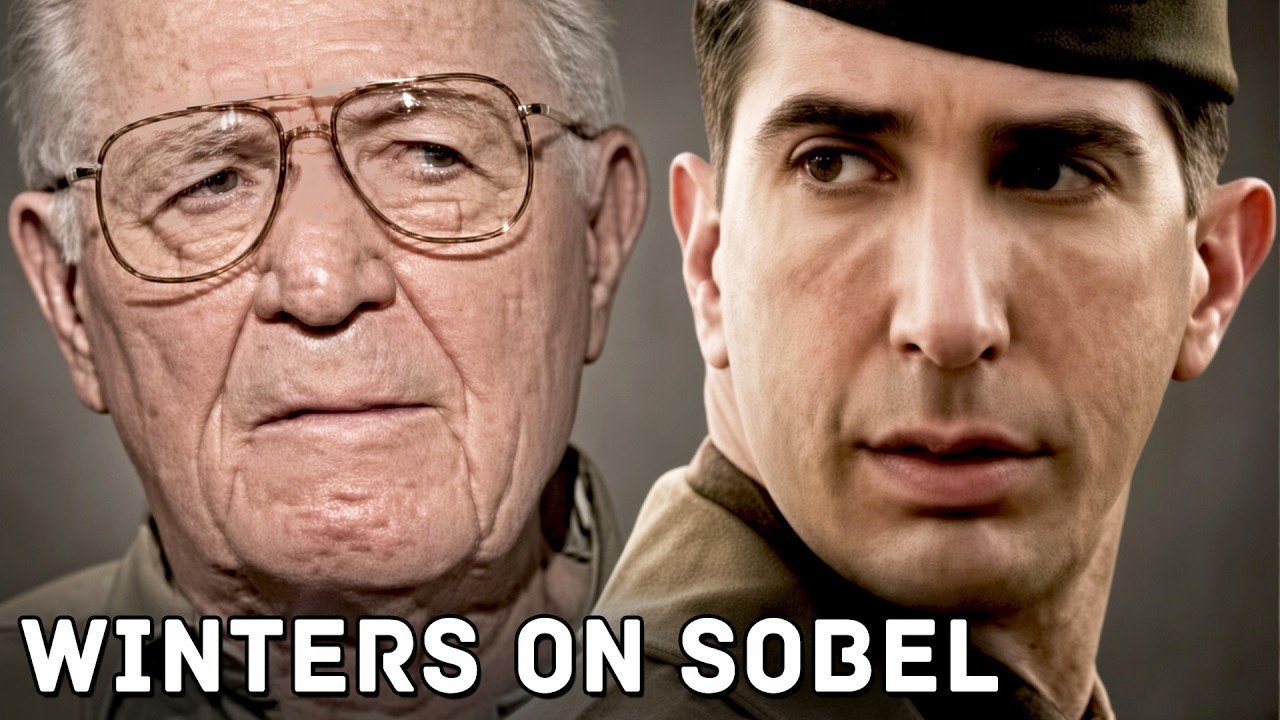 Winters, who later became one of the most decorated officers of World War II, reflected on the moment with a mixture of amusement and exasperation, noting that the men found the situation hilarious at the time, unaware of the administrative firestorm they had inadvertently ignited. The major pointed out that Sobel had multiple viable options to bypass the obstacle, such as going over the top or crawling underneath, but instead chose the most destructive and illogical path. This single act of poor judgment served as a microcosm of a larger, more terrifying pattern of incompetence that plagued Sobel’s leadership throughout the pre-invasion training period.
The deeper significance of the fence-cutting episode, as Winters explained, was that it was not an isolated mistake but rather a glaring symptom of a systemic failure in leadership. While the enlisted men viewed the event as a source of dark comedy, the senior command structure began to take notice that Sobel was repeatedly failing in critical areas, most notably in map reading and tactical decision-making. Winters emphasized that this was just another example of Sobel’s inability to adapt to the fluid, chaotic nature of field operations, a deficiency that would have been catastrophic in the hedgerows of Normandy or the frozen forests of Bastogne.
The animosity between Winters and Sobel was not born of personal dislike but of a fundamental divergence in leadership philosophy. Winters was a natural, intuitive leader who earned the respect and loyalty of his men through competence and empathy, while Sobel relied on rigid discipline and intimidation, which bred resentment and fear. The men of Easy Company, who would later become legendary for their bravery and cohesion, were united in their belief that Sobel’s incompetence would get them all killed if he were allowed to lead them into combat.
This fear was so pervasive that it eventually culminated in a near-mutiny, a drastic and unprecedented action for the United States Army.
As the company prepared for the invasion of Europe, the situation reached a boiling point. The non-commissioned officers, the backbone of any military unit, were so convinced of Sobel’s lethally poor judgment that they collectively agreed to resign their ranks in protest. Each sergeant wrote a formal letter to Colonel Robert Sink, the regimental commander, detailing their lack of confidence in Captain Sobel and their refusal to follow him into battle.
This act of defiance, which could have resulted in courts-martial for all involved, was a testament to the profound desperation felt by the men who would soon be asked to make the ultimate sacrifice.
The crisis came to a head over a petty and vindictive dispute regarding a latrine inspection. Sobel, driven by jealousy and a desire to undermine his popular subordinate, deliberately changed the time of an inspection and failed to notify Winters, setting the stage for a disciplinary action that could have ended Winters’ career. The charges were serious, threatening to derail the future of the man who would later be hailed as a hero of the Normandy invasion.
However, Colonel Sink, recognizing the toxic dynamic and the potential for a catastrophic loss of leadership, intervened to resolve the matter by transferring Winters out of Easy Company and assigning him to oversee the battalion’s food supply, a role Winters famously described as a job for those deemed unfit for anything else.
The resolution of the Winters-Sobel conflict, however, was not the end of the story. The NCOs’ threatened mass resignation had sent a clear message to the regimental command that the situation was untenable. Faced with the prospect of leading a demoralized and mutinous company into the largest amphibious invasion in history, Colonel Sink made the difficult decision to relieve Captain Sobel of his command.
Sobel was reassigned to manage a new paratrooper training school in Chilton Foliat, Wiltshire, a safe administrative post far from the front lines. He was replaced by First Lieutenant Thomas Meehan, a capable officer who took command of Easy Company just weeks before the D-Day invasion.
 In a tragic twist of fate, the very transfer that saved Sobel’s life sealed the fate of his replacement. On June 6, 1944, Lieutenant Meehan’s C-47 transport aircraft was shot down by German anti-aircraft fire during the paratrooper drops over Normandy, killing him and everyone else on board instantly. Sobel, who harbored a deep and bitter resentment over losing his command, never forgave the men who had orchestrated his downfall.
Yet, the historical record suggests that the transfer was the single greatest stroke of luck in his life, as it kept him away from the combat that claimed the lives of so many of his peers.
The two men, Winters and Sobel, would cross paths only once more during the war. This brief, real-life encounter occurred in France between February and April 1945, shortly after Winters had been promoted to Major. The meeting was starkly different from the dramatized version depicted in Band of Brothers, which inaccurately places the confrontation in Austria immediately following Victory in Europe Day.
In the series, the scene is famous for the line, “We salute the rank, not the man,” a powerful moment of defiance that has become iconic. However, historians and Winters himself have clarified that the actual meeting was far more mundane and less theatrical, though it still carried the weight of their shared history.
Despite the intense animosity and the near-mutiny, a complex legacy surrounds Captain Herbert Sobel. While he was undeniably a poor field commander and a toxic leader, many veterans of Easy Company later admitted, often grudgingly, that his brutal and uncompromising training regimen was a critical factor in their survival. The relentless physical conditioning, the grueling marches, and the unforgiving standards of discipline instilled by Sobel forged the men into a hardened, resilient fighting force.
In a strange paradox, the man they despised for his cruelty may have inadvertently prepared them to endure the unimaginable horrors of war, from the bloody beaches of Normandy to the frozen hell of Bastogne.
Winters himself acknowledged this paradox, noting that while Sobel lacked the common sense and tactical acumen required for combat leadership, his obsession with physical fitness and discipline created a unit that was exceptionally prepared for the physical demands of the war. The men of Easy Company were among the fittest and most disciplined in the entire Allied force, a direct result of Sobel’s draconian training methods. This physical superiority often gave them a critical edge in combat, allowing them to outmaneuver and outlast their German adversaries who were often exhausted and underfed.
The story of Captain Herbert Sobel is a cautionary tale about the difference between leadership and management, between authority and respect. Sobel had the authority of his rank but never earned the respect of his men. His rigid adherence to regulations and his inability to connect with his soldiers on a human level created a toxic environment that nearly destroyed the unit from within.
In contrast, Winters, who was not initially the most senior officer, naturally commanded loyalty through his competence, his calm demeanor under fire, and his genuine care for the well-being of his men.
 The legacy of the Sobel-Winters dynamic extends far beyond the pages of military history; it has become a case study in leadership psychology, examined in business schools and military academies around the world. The story highlights the critical importance of trust in a leader, especially in high-stakes environments where failure can mean death. It demonstrates that technical proficiency in training is meaningless if a leader cannot inspire confidence and loyalty in those they are tasked to lead.
The men of Easy Company were willing to risk courts-martial, to throw away their careers, rather than follow a man they believed would lead them to their deaths.
The dramatic tension between the two officers was brilliantly captured in the 2001 miniseries, which brought their story to a global audience. The portrayal of Sobel as a petty, incompetent tyrant and Winters as the stoic, heroic leader resonated deeply with viewers, cementing their place in popular culture as archetypes of good and bad leadership. However, the real story is far more nuanced.
Sobel was not a cartoon villain; he was a man who desperately wanted to succeed but lacked the fundamental qualities necessary for command. His tragic end, which involved a self-inflicted gunshot wound in his later years, adds a layer of melancholy to his story, suggesting a man haunted by his failures and his isolation.
The details of the fence-cutting incident, as recounted by Winters, reveal a man who was fundamentally out of his depth. The decision to cut a farmer’s fence during a training exercise was not just a minor error in judgment; it was a demonstration of a complete failure to understand the operational environment. A competent officer would have recognized the diplomatic and logistical implications of such an action.
Sobel, however, was so focused on the immediate tactical problem that he failed to see the bigger picture, a flaw that would have been fatal in the complex, fluid battles of World War II.
The fact that the battalion command kept the incident quiet to protect Sobel from further embarrassment shows that his superiors were aware of his limitations but were initially unwilling to take decisive action. It was only when the enlisted men, the very people who would have to follow Sobel into battle, threatened to mutiny that the command was forced to act. This highlights a crucial lesson about the flow of information and the importance of listening to the concerns of those on the ground.
The men of Easy Company had a clearer picture of Sobel’s incompetence than the distant officers at regimental headquarters, and their collective voice ultimately saved the company from potential annihilation.
The legacy of Easy Company, the “Band of Brothers,” is one of extraordinary courage, sacrifice, and brotherhood. Their story, from the fields of Toccoa to the Eagle’s Nest in Berchtesgaden, is a testament to the human spirit’s ability to endure and triumph over adversity. But it is also a story about leadership, and the stark contrast between the leadership of Winters and Sobel provides a timeless lesson.
 Winters led from the front, sharing the risks and hardships of his men, while Sobel led from behind, issuing orders from a place of safety and arrogance. The men who survived the war did so because of their training and their bond, but they were able to thrive because they had a leader like Winters who they trusted with their lives.
As historians continue to analyze the war and the men who fought it, the relationship between Winters and Sobel remains a focal point of discussion. It raises profound questions about the nature of command, the psychology of leadership, and the thin line between discipline and 𝓪𝓫𝓾𝓼𝓮. The story serves as a reminder that the greatest asset of any military unit is not its weapons or its technology, but the trust and cohesion of its soldiers.
When that trust is broken, as it was with Sobel, the entire unit is at risk. When it is nurtured, as it was with Winters, the unit can achieve the impossible.
The final chapter of Herbert Sobel’s life is a somber one. After the war, he struggled to find his place in a world that had moved on from the rigid discipline of the military. He worked various jobs, including as a purchasing agent for a company that manufactured bulletproof vests, but he never escaped the shadow of his wartime failures.
In 1970, he was found dead in a hotel room in Waukegan, Illinois, from a self-inflicted gunshot wound. His death was ruled a suicide, and it brought a tragic end to a life marked by contradiction—a man who was despised by his subordinates yet inadvertently contributed to their survival.
In the annals of military history, Captain Herbert Sobel will forever be remembered as the antagonist of Easy Company, the man who almost destroyed the unit he was tasked to lead. But his story is also a reminder of the complexity of human nature, of the fact that even the most flawed individuals can have a profound impact on the course of events. The men of Easy Company became legends not because of Sobel, but in spite of him.
Their success was a testament to their own resilience and to the leadership of men like Winters who stepped up to fill the void left by Sobel’s failures.
The story of the barbed wire fence, the angry farmer, and the cattle on the loose may seem like a minor anecdote in the grand narrative of World War II, but it is a perfect illustration of the stakes involved. In a war where millions of lives were on the line, the difference between a good leader and a bad one could mean the difference between victory and defeat, between life and death. The men of Easy Company understood this intuitively, which is why they were willing to risk everything to remove Sobel from command.
Their actions, though insubordinate, were ultimately justified by the outcome, as they went on to become one of the most celebrated units in American military history.
The enduring fascination with the Winters-Sobel dynamic speaks to a universal human interest in the dynamics of power and authority. We are drawn to stories of good versus evil, of the hero overcoming the tyrant, of the underdog triumphing against the odds. The story of Easy Company provides all of these elements, wrapped in the high-stakes 𝒹𝓇𝒶𝓂𝒶 of the greatest conflict in human history.
It is a story that continues to inspire and educate, offering valuable lessons about leadership, courage, and the indomitable human spirit that remain relevant to this day.