On September 1, 1939, Nazi Germany invaded Poland, igniting World War II. After the Polish army’s defeat, the Germans imposed a brutal occupation regime. In the weeks and months that followed, German SS, police, and army units targeted thousands of Polish civilians, while millions more faced persecution, forced labor, deportation, and death.
By 1942, Nazi Germany began implementing a plan codenamed Operation Reinhard, aimed at the systematic elimination of the Jewish population in the General Government, the German-administered zone in occupied Poland. Three killing centers became the core of the operation: Belzec, Sobibor, and Treblinka. Jews from across occupied Poland were deported to these camps, where very few survived.
At Belzec, the operation reached its peak intensity during the second half of 1942. Within just a few months, hundreds of thousands of men, women, and children lost their lives. The man who commanded the camp during that period personally issued orders that determined the fate of prisoners, terrorized both inmates and guards alike, and oversaw one of the darkest chapters in Holocaust history. His name was Gottlieb Hering.
Hering was born on June 2, 1887, in the village of Warmbronn, near Stuttgart, then part of the German Empire. Between 1907 and 1909, he completed his compulsory military service before voluntarily remaining in the army for another three years. After leaving active military duty, he joined the police and served as a uniformed officer in the city of Heilbronn. In 1914, Hering married, and the marriage produced one child.
World War I began in July 1914, and the following year, Hering was called up to the German army. He was sent to the Western Front, where he served until the conflict ended in November 1918. In recognition of his courage in combat, he received several military decorations, including the Iron Cross First Class.
During the turbulent years of the Weimar Republic, which emerged after the fall of the German Empire in 1918, Hering sympathized with the Social Democratic Party and continued his career in the criminal police. He became an active opponent of the growing Nazi movement and took part in police actions directed against members of the Nazi Party and its paramilitary organizations, the SA and the SS. His hostility toward the movement became so well known that he earned the nickname "Nazi-eater."
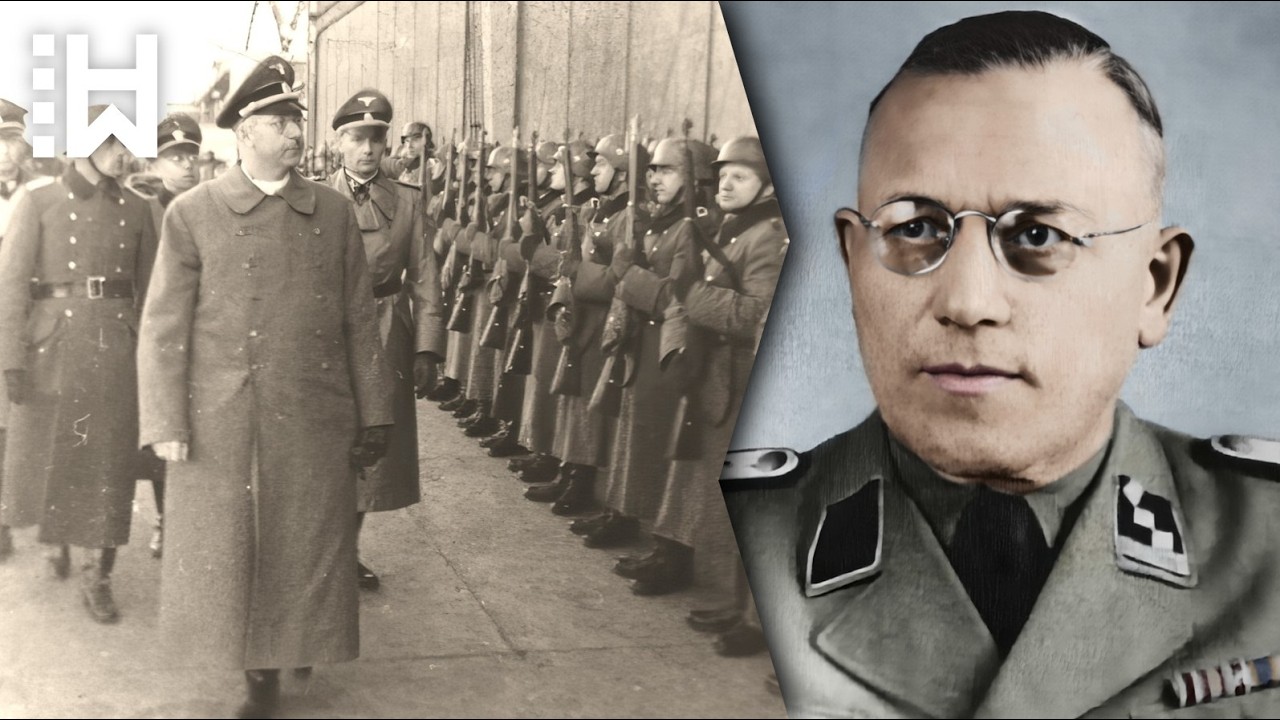
That reputation placed Hering in a dangerous position after Adolf Hitler came to power in January 1933. Local Nazis demanded Hering’s dismissal from the police, and his past activities against the movement were investigated. Reports indicate that his career was saved by the intervention of his old colleague Christian Wirth, a man whose path would cross Hering’s again under far darker circumstances.
Hering’s political stance changed radically shortly afterward. In May 1933, just months after Hitler’s rise to power, he joined the Nazi Party. The policeman once known as the "Nazi-eater" was now a member of the movement he had previously fought.
World War II began on September 1, 1939, when Nazi Germany invaded Poland. In December of that year, Hering and other senior police officials were sent to the port city of Gdynia on the Baltic Sea in German-occupied Poland. Their mission was to help resettle ethnic Germans from the Soviet sphere of influence into Polish territories recently annexed by Nazi Germany.
In late 1940, Hering was transferred to the Nazi euthanasia program known as Aktion T4, which systematically killed people with mental and physical disabilities. He initially served at the killing centers of Bernburg and Hadamar before being moved to Sonnenstein, near the German town of Pirna. There, Hering eventually became head of the special registry office, which helped conceal the killings through falsified official records and fictitious causes of death.
At the Aktion T4 killing centers, victims were murdered in gas chambers using carbon monoxide. Their bodies were then cremated, while their families were deliberately deceived about the true circumstances of their deaths. The program developed a system of organized mass killing that included victim transport, gas chambers, cremation facilities, forged documents, and systematic deception.
In the summer of 1942, Hering was transferred to the Belzec extermination camp in German-occupied Poland. On August 1, he replaced Christian Wirth as camp commandant after Wirth was appointed inspector of the Operation Reinhard extermination camps. Hering took command at a time when the mass killing of Jews at Belzec was entering its most intense phase.

Between July and October 1942, deportation transports arrived at an unprecedented pace. Jews were brought to Belzec from ghettos and communities throughout the General Government. Conditions inside the overcrowded railway cars were so horrific that many victims died of suffocation, dehydration, and exhaustion before even reaching the camp. Those who survived the journey were forced off the trains and driven toward the gas chambers.
Hering ordered that victims too weak or too sick to walk be taken to a separate execution site in the second section of the camp, where they were killed with a shot to the back of the head. Under Hering’s command, the killing continued on a massive scale. During his tenure, at least 320,000 Jews were murdered at Belzec.
Hering quickly became known not only for overseeing mass murder but also for his extraordinary brutality toward prisoners, guards, and even his own German staff. After the war, one of the few survivors of Belzec, Rudolf Reder, recalled a particularly disturbing incident involving Hering. During one killing operation, the engine used to produce gas stopped working while victims were already trapped inside the gas chambers. Instead of allowing them to leave, Hering ordered that the doors remain closed while the engine was repaired. The men, women, and children inside were left waiting helplessly while attempts were made to fix the machinery. There was no escape and no hope of survival. Once the engine was working again, the operation resumed, sealing the fate of everyone still inside.
Another witness, Polish railway worker Tadeusz Misiewicz, described a form of public torture that Hering allegedly used for his own amusement. According to his testimony, Hering tied a Jewish prisoner to his vehicle with a rope and forced the victim to run behind it through the town of Belzec. At the same time, Hering set a dog on the prisoner, which attacked and bit him while local residents watched.
Hering also ruled his own men through intimidation and violence. German staff members who angered him were locked in the camp cellar, and he was known to strike his subordinates across the face with a riding whip. His treatment of Ukrainian guards was even harsher. During his command, several guards accused of attempted mutiny, desertion, or other disciplinary offenses were executed. In one such incident, Hering personally shot two Ukrainian guards. According to one account, the men had expressed opposition to what was happening inside the camp, while another account stated they had been caught stealing valuables confiscated from Jewish victims. The Nazi regime considered these possessions to be property of the Third Reich, and unauthorized theft by camp personnel was viewed as a serious crime. Before killing them, Hering ordered the two guards to wear jackets with Stars of David sewn onto them. They were then executed in front of their fellow guards.
By mid-December 1942, Belzec had served its main purpose and stopped receiving transports of Jewish victims. The extermination operation gave way to a new effort aimed at removing evidence of what had happened there. Unlike Auschwitz-Birkenau, Belzec did not have a crematorium equipped with furnaces. Under Hering’s supervision, Jewish prisoners were forced to reopen the massive mass graves in which hundreds of thousands of victims had been buried. Under heavy guard, prisoners exhumed bodies that were often in an advanced state of decomposition and carried them to huge pyres built from railway tracks and concrete supports. There, their remains were burned day and night in an attempt to erase all traces of the genocide.

More than 400,000 bodies were burned on three or four massive pyres that operated almost continuously between November 1942 and March 1943. Hering personally oversaw this process, ensuring that every possible trace of the camp’s victims disappeared. Once the burning was complete, the remaining buildings were dismantled, the mass graves were leveled, and the site was disguised to appear as though the extermination camp had never existed.
In March 1943, at the urging of SS leader Odilo Globocnik, Hering, who was not a member of the SS, was directly appointed to the rank of SS-Hauptsturmführer, equivalent to a captain in the U.S. Army. Before leaving Belzec, Hering reportedly promised the remaining 300 Jewish prisoners forced to exhume and burn the victims’ bodies that they would be transferred to the city of Lublin and given food once their work was done. Instead, in June 1943, they were taken to the Sobibor extermination camp, where they were all shot shortly after arrival.
After Belzec was closed, Hering became commandant of the Poniatowa labor camp, which was later incorporated into the Majdanek concentration camp system as a subcamp. Once again, he quickly gained a reputation for extreme cruelty. Prisoners later recalled that he sentenced Jews to death for the slightest reasons and personally took part in the killings. One survivor, Estera Rubinstein, remembered that Hering often rode through the camp on horseback, accompanied by a 14-year-old Jewish boy riding a donkey. During these rides, he was said to amuse himself by randomly shooting at prisoners or trampling them with his horse. He was also allegedly responsible for the death sentence handed down to an SS medic named Backhaus, who had engaged in forbidden sexual relations with a Jewish prisoner.
In November 1943, Poniatowa was liquidated as part of Operation Harvest Festival, the largest single massacre of Jews by the Germans during the Holocaust. Over two days, approximately 42,000 Jewish prisoners were killed throughout the Lublin region, including thousands at Poniatowa. Victims were forced to undress before being led to prepared trenches and shot. After the massacre, Hering oversaw the burning of the victims’ bodies.
By the end of 1943, following Operation Reinhard, Hering was transferred to the area around the city of Trieste in German-occupied northern Italy, where he again served under Christian Wirth. He became commandant of the Risiera di San Sabba concentration camp, where up to 5,000 Jewish prisoners and resistance fighters were killed.
World War II in Europe ended on May 8, 1945. With the collapse of the Third Reich, Hering retreated to Germany. After the war, he reportedly returned to Heilbronn, where his police career had begun more than three decades earlier, and briefly headed the local criminal police. On October 9, 1945, he died after falling ill under mysterious circumstances at an emergency hospital in Ramstal, near Stuttgart. He was 58 years old.