The pen barely touched the paper when I froze. It wasn’t hesitation. I hadn’t been more certain of anything in all thirty-seven years of my life. I only wanted to memorize their faces one last time.
My husband Stellan, who had already turned his back to half the room, was confident and worried at once. His mistress Brenn stood beside him, her hand resting on the slight swell of her belly. Her smile was the kind worn by someone who believes she has already won. Behind them, Stellan’s mother Odette stood with her arms crossed, watching me the way people watch a rodent being chased out of their kitchen.
I signed my name, set the pen down, and picked up my coat. “Is that it? ” Stellan said. He sounded genuinely disappointed.
He had hoped I would cry. “That’s it. ”
“I wish you a happy life. ”
Odette made a sound full of contempt from deep in her throat.
“Twelve years in this family and not one word of thanks. You lived like a queen off my son’s income. The least you could do is thank him for his patience. ”
I looked at her once.
I truly looked. Long enough to see the satisfaction hiding behind the contempt. Then I gripped the handle of my suitcase, which had been waiting by the front door since early morning. My seven-year-old daughter, Braer, with her serious little face, slipped off the hallway bench and took my hand without being asked.
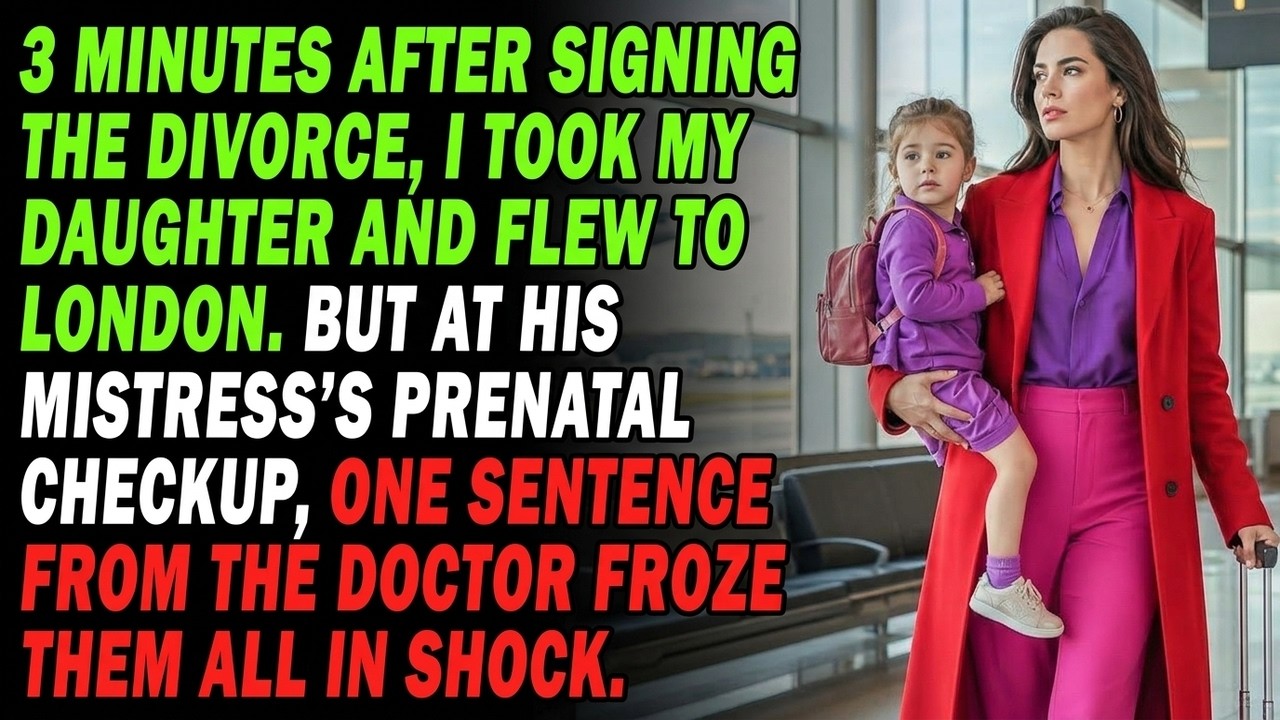
Her small fingers wrapped around mine. None of them knew where we were going. None of them knew that three minutes after I signed those papers, we would be in a car heading to JFK Airport. And none of them had the faintest idea what was about to happen to the comfortable, triumphant life they thought they were walking into.
I married Stellan twelve years ago, in September, on a rooftop in Chicago with the lake glimmering in the distance. He was a senior analyst at a private equity firm in Manhattan. The kind of man who fills a room with his confidence and makes everyone around him feel they’ve gained something simply by being noticed. We met at a finance conference.
He told me he had been watching me from across the room all afternoon. I should have asked myself then why a man like Stellan spent so much time watching. The first two years were good. Or close enough to good that I mistook them for happiness.
In the third year, Odette began visiting us. In the fourth year, Stellan asked me to quit my job. He framed it as generosity. “You don’t need to exhaust yourself working anymore,” he said.
“I earn enough for both of us. I want to come home to a partner, not a colleague. ”
His mother reinforced it with something far less generous. “A woman your age should focus on giving Stellan a family.
Your career can wait. Women in this family do not work. ”
I quit the job. I had Braer.
I stayed home in the way Stellan liked. Dinner at seven, his shirts pressed, his calendar managed, his social life organized down to the seating arrangements. Odette came twice a week and found something to criticize every time. The flowers weren’t right.
I oversalted the food. I didn’t dress appropriately for the wife of a man like Stellan. Did I even try? What none of them knew, not Stellan, not Odette, not Cecile, Stellan’s younger sister who laughed at me at every family holiday, was that I never stopped working.
Before Chicago, before the conference, before all of this, I had spent six years building a reputation as one of the most precise financial crime analysts in the country. My former manager, a man named Mr. Pemberton, had left the regulatory world to launch a private investment consultancy in London. Seven months after my wedding, he called and offered me a remote consulting arrangement.
Quiet work. Hidden work. Tracing suspicious financial flows for institutional clients, identifying fraud patterns in corporate portfolios, writing intelligence reports that moved serious money. I did all of it from a home office while Stellan was at the firm and Braer was at school, in the hours Odette was so certain I was wasting.
Every payment went into a personal account in my name alone, at a bank Stellan had never heard of. A woman without skills. That’s what Odette called me at our wedding rehearsal dinner, in a tone she pretended was a joke. She never stopped saying it.
Neither did Stellan when he was upset, which happened often. The car moved toward the airport through city lights reflected on wet asphalt. Braer slept against my shoulder. I watched the horizon fade and thought about what was waiting on the other side of this journey.
My phone buzzed just before we reached the tunnel. Unknown number. I almost let it ring. Then I answered.
Thalia. Hollis, Stellan’s father, a quiet man who had spent two decades making sure not to stop the things his family did. His voice was heavier than I remembered. “You really left.
”
“I really left. ”
A long pause filled with the sound of his breathing. “Stellan says you left without discussing terms. No alimony agreement, no custody arrangements.
”
“Stellan can discuss terms through a lawyer. ”
“Thalia. ” His tone shifted. Not warm, but not cold like Odette’s.
He sounded tired more than anything else. “Think about Braer. You’ve been out of the workforce for ten years. You have no independent income.
He won’t pay alimony, he’s already told me. With Brenn’s baby coming, his attention will be on his new family. ”
“Hollis,” I said his name the way you say stop. “I appreciate the call, but there’s nothing left to discuss.
I’ve finished it. ”
Braer stirred slightly. “Who was that, Mama? ”
“No one important, sweetheart.
”
She leaned her head back against my shoulder. “Are we really going on the airplane? ”
“We really are. ”
“Is it far?
”
“Very far. ” I kissed the top of her head. “Just you and me. ”
We were at the departure gate when I heard the click of high heels.
The sharp, deliberate kind worn by someone using them as punctuation. Oh dear. Cecile, Stellan’s younger sister, stopped in the middle of the terminal with a suitcase and a group of friends behind her. She was dressed for a bachelorette trip, scarf and all, and she looked at me the way people look at something unexpected and inconvenient.
“What are you doing here? ”
“Traveling,” I said. She looked down at Braer, then back at me. Her friends slowed but kept a polite distance.
Cecile stepped closer and lowered her voice. “Stellan told us you ran off without asking for anything. You didn’t fight for the apartment, the Hamptons house, anything. Mother thinks you’ve lost your mind.
” A small, satisfied smile. “You know he’ll keep everything, right? The accounts, the investments, all of it. You signed it all away when you picked up that pen.
”
“I know exactly what I signed. ”
“You have nothing. ” She tilted her head. “And you’re taking that poor child with you too?
Where? A long-stay hotel with one suitcase? ”
“Somewhere you’ve never been. ”
Cecile laughed and turned to her friends.
“Good luck,” she called over her shoulder. “You’ll be back in two months, broke and humiliated. ”
Braer had heard everything. She stood holding my hand with both of hers, watching Cecile leave with the calm of a child storing something away forever.
She said, “Mama, I don’t like her. ”
“I know, sweetheart. ”
“Do we have to see her again? ”
I squeezed her hand.
“No. We really don’t. ”
The boarding announcement came over the speakers, and we walked toward the gate. Behind us, New York hummed with life, bright and indifferent.
We landed at Heathrow late in the afternoon under a low slate sky and a cold, light rain. Braer was still half asleep, dragging her backpack, leaning against my side. I felt the first thread of real anxiety as we cleared customs, the kind that settles beneath the ribs and tightens when you realize how vast the world is and how small you are in it. In the arrivals hall, I tried the debit card linked to our joint account.
Declined. I tried the credit card Stellan had added me to three years ago. Declined. My phone was in airplane mode.
I turned it on. A message from Stellan had arrived two hours ago, somewhere over the Atlantic. I hope you enjoyed the flight. I have restructured all joint accounts and frozen the supplementary cards as of this morning.
You left without negotiating a settlement, so I consider our financial arrangement terminated. Good luck. Below it, from Odette. You walked out of this family and expect us to keep funding you, you ungrateful woman.
I stood in the middle of the arrivals hall with Braer pressed against my side and one suitcase between us, and I let myself feel it for exactly thirty seconds. The dizziness of being alone in a foreign country with a child and no access to money. Then I took a deep breath. My personal account existed.
Stellan had never touched it because he didn’t know it existed. But external withdrawals above a certain threshold trigger a twenty-four-hour security hold. A protocol Stellan himself had been consulted on when Pemberton’s firm updated its account security standards. In the specific chaos of the past twelve hours, I had forgotten to pre-authorize the transfer.
Which meant all I had was what was in my wallet, four hundred and twenty dollars in cash, and London, which cost twice that for a single night. “Mama? ” Braer’s voice was small. “Are we staying at the airport?
”
“No, sweetheart. ” I pulled her close. “Give me one minute. ”
I was calculating, the way I had trained my mind to calculate, quickly and without panic, when the automatic doors opened behind me and a voice said my name.
“Mrs. Thalia? ”
A tall man in a dark grey coat was crossing the arrivals hall toward us with the quiet dignity of someone who is never late and never in a hurry. I recognized him from a video call years ago.
Mr. Ashby, the managing director of Pemberton’s European operations. “Mr. Ashby, what are you doing?
”
He bent down to Braer’s level with professional gentleness. “You must be Braer. I’ve heard a great deal about you. ” He straightened and looked at me.
“Mr. Pemberton apologizes for not coming himself tonight. We have a car outside and a house in Kensington, with staff and a room ready for Braer. Let’s get you both settled before anything else.
”
The knot in my chest loosened, the one I hadn’t realized was even tied. “He knew I was coming,” I said. Ashby said, “He has known for some time that this day was probable. And he prepared for it.
”
He reached for the suitcase before I could protest. “Please. ”
We followed him outside into the London evening. The house was on a quiet street lined with plane trees, its windows warm against the dark.
The housekeeper opened the door. Tea was ready, and a nanny from a trusted London agency arrived within the hour and introduced herself to Braer with cheerful patience. Braer, who had held herself together for sixteen hours, looked once at her room, made up with a duvet covered in tiny yellow stars, and burst into exhausted, relieved tears. I sat with her until she fell asleep.
Then I went downstairs, sat across from Mr. Ashby at the kitchen table, and began to listen. For the past fourteen months, Pemberton’s analysis team had been tracking unusual valuations in a cluster of mid-sized real estate investment trusts across three states. Those structures had been established by Stellan’s firm.
The pattern, viewed as a whole, was systematic. The asset valuations reported to investors ranged from one hundred forty to two hundred percent of the actual appraised value. The difference, exceeding forty million dollars over four years, had been moved through a network of Delaware and Wyoming LLCs into a holding company in the Cayman Islands. Ashby said, “The paper trail is deliberately fragmented.
Whoever built this knew exactly what they were doing. Mr. Pemberton believes you are uniquely positioned to untangle it. ”
I looked at the cup of tea in front of me.
Twelve years without skills, with every comfort provided, constantly reminded that I was nothing without Stellan. I said, “Show me the files. ”
Mr. Pemberton came himself in the morning.
He was in his late sixties, with the quiet precision of a man who had spent decades in rooms where a careless word cost millions. He shook my hand with both of his and said simply, “I’m sorry it came to this. ”
I said, “I’m not. ”
I worked for three days.
On the first day, I traced the flow of money through the LLC structure. On the second day, I identified the beneficial owner of the Cayman holding company. On the third day, I compared that name against every database I could access. Then I compared it to a name Ashby had mentioned in passing.
The man who had accompanied Brenn to a private women’s clinic in midtown Manhattan on a visit recorded nine weeks before her supposed meeting with Stellan. The names matched. Denton Kirby, sixty-one years old, three aliases over two decades, a long history of targeting ambitious, arrogant men in finance. Men who wanted to believe they were untouchable, which made them easy targets.
Brenn, whose real name was Mira, had been working with him for at least four years. The plan was elegant. Kirby had identified Stellan as a target eighteen months prior. Mira had approached him, allowed herself to appear pregnant at exactly the right moment, giving Stellan the perfect emotional justification to destroy his marriage and stop monitoring his firm’s accounts closely.
While Stellan was distracted, celebrating his new life, pretending to be a man who had finally made the right choice, Kirby had kept draining the fund. Brenn wasn’t three months pregnant. She was five and a half months pregnant, and the baby was Kirby’s. I sent the full report to Pemberton’s legal team and to the SEC on the morning of the fourth day.
That same morning in New York, Stellan and Odette accompanied Brenn to a prenatal appointment at an Upper East Side clinic. Odette had insisted on coming. She had announced this was her grandchild, her first grandson, the heir she had always deserved. Cecile came too, just back from her weekend, wearing a cashmere scarf and an expression of pre-emptive congratulations.
The appointment was supposed to confirm a twelve-week pregnancy. The doctor showed the images, took two measurements, and a silence stretched far too long. He said carefully, “Miss Brenn, I’m seeing fetal development consistent with approximately twenty-two to twenty-three weeks. ”
No one in the room spoke.
Stellan said, “That’s… that can’t be right. She’s three months along. ”
“We’re only… twenty-two weeks is about five and a half months. ” The doctor set down his instrument and turned to his screen.
“I also see that this patient previously visited our clinic, about two months ago, under a slightly different name. That visit’s intake form lists a companion, an older man, recorded here as her husband. ”
Odette made a sound like a woman who had just stepped on something sharp. “Her husband?
”
Cecile turned to look at Brenn, who had gone the color of old chalk. “This isn’t… the dates must be…”
Brenn started to speak. “The images are quite clear,” the doctor said, in the firm professional tone of someone accustomed to delivering worse news. Stellan’s phone rang.
His partner at the firm, in a voice entirely stripped of its usual calm. “The SEC just froze all the accounts. There are federal agents in the lobby, Stellan. You need to come in now.
”
The phone fell to the floor. Stellan didn’t pick it up. Three weeks later, I walked through the door of a Manhattan conference room that Pemberton’s fund had acquired for a fraction of its inflated value, wearing a navy blazer, and sat at the head of the table. Stellan sat across from me, his lawyer beside him, his hands folded with the stillness of a man who had run out of options.
Odette sat along the wall because there was no longer a chair with her name at the table. Hollis was at the back of the room, diminished and silent, staring at the floor. Stellan looked at me for a long moment before he spoke. “You planned this.
”
“No. I didn’t plan it. ” I said. “I just documented it.
”
“You were supposed to be—” He stopped. “A woman without skills,” I said. “I always liked that phrase. ”
Pemberton’s lawyer opened the file and read the terms without emotion.
Securities fraud, wire fraud, false reporting to federal regulators. Civil damages of forty-seven million dollars to be returned to defrauded investors. The criminal referral had already been made, and Stellan faced a prison sentence of eight to twelve years. The financial liability was non-dischargeable.
It would follow him after his sentence, with interest compounding, for the rest of his life. His assets had been seized or frozen. Odette, who had signed two of Stellan’s largest fraudulent transactions because he told her they were legitimate family investments, was jointly liable for eleven million dollars. When the lawyer finished, Stellan covered his face with his hands.
Odette did not. She looked at me with something from which all cruelty had drained, replaced by something rarer. A woman trying to understand how she had ended up in this room. “You sat at my table for twelve years,” she said.
“Yes,” I said. “And you were working the whole time. ”
“I was always only working,” I said. “You just never looked closely enough to notice.
”
She had nothing to say to that. I stood, nodded once to Pemberton’s lawyer, and walked out. Denton Kirby was arrested ten days later at a regional airport in Arizona, carrying a passport under his third alias. All his accounts were frozen within forty-eight hours of my report.
Mira Brenn was arrested the same week. Her lawyer was already negotiating a plea deal in exchange for testimony against Kirby. Her pregnancy was real, and certainly his. She had three arrest warrants in two states, and no reason left to protect anyone.
I learned all of this from a brief email on my phone while sitting on a train from Paddington, headed to a village in the Cotswolds where Braer was spending the weekend with a school friend she had made in her first three weeks. I looked out the window at the November countryside, bare hedgerows, grey fields, flashes of warm light from a farmhouse in the distance, and waited for the feeling of triumph I expected to come. The vindication. The cold satisfaction of an account finally settled.
What came instead was quiet. The particular quiet of a room after a long storm, when someone finally opens the windows. My phone buzzed. A message from Braer, sent from her friend’s mother’s phone.
Mama, can we get a dog? She has a dog. His name is Biscuit. I laughed out loud in the empty train carriage.
A real laugh. The kind that comes from a place you forgot you still had access to. I wrote back, We’ll talk about it when I come to pick you up tomorrow. Her reply came in under ten seconds.
That means yes, right now. I put the phone in my coat pocket and watched the fields pass. Somewhere behind me, Stellan would spend the next several years learning what it meant to be without resources in a world that didn’t care. Odette would learn what it meant to work for the things she needed.
Cecile, who had lived on an allowance tied to frozen family accounts, would have to learn the same. Hollis, who had spent twenty years facilitating every cruelty his family committed through his silence alone, would have to live with what that silence had cost everyone around him. I didn’t need them to suffer forever. I only needed them to stop.
They had stopped. The train pulled into the small stone station as the low evening sun finally broke through the clouds, laying a band of gold across the fields beyond the window. I gathered my bag and stood. Mr.
Pemberton had offered me a permanent management position, with a title and salary that would have stunned Stellan. I accepted with particular pleasure, like someone reclaiming a right earned long ago, one that had been patiently waiting. The house in Kensington had a small garden. Braer had already decided where the dog bed would go.
I stepped off the train into the cold, clean air. The village around me was quiet. Stone walls, a church tower, wood smoke rising. Somewhere down the road, my daughter was probably trying to teach Biscuit tricks.
I had work I loved, a city I was learning to love, and a daughter who slept in new places as though she had always belonged there. She had inherited her father’s eyes and my stubbornness, and in every way that mattered, she was entirely her own person. A person I had helped build during the hours everyone thought I was wasting. A woman without skills.
I smiled at my reflection in the dark window of the train carriage as it pulled away behind me. Then I turned and walked down the road toward the sound of a child’s laughter. I wasn’t going back. I had left nothing behind worth returning for.
What was mine had been mine all along. I had carried it silently for years through a home where no one thought to look. I was already exactly where I was supposed to be.