In February 1905, a 76-year-old widow staying at a hotel in Waikiki screamed for her secretary, said she had been poisoned again, and told those in the room that her jaws were going stiff. The woman was Jane Lathrop Stanford, and within hours she was dead. Her death was officially attributed to heart failure, a diagnosis that would stand for nearly a century. Jane Stanford was one of six Gilded Age widows who took control of the empires their husbands left behind.
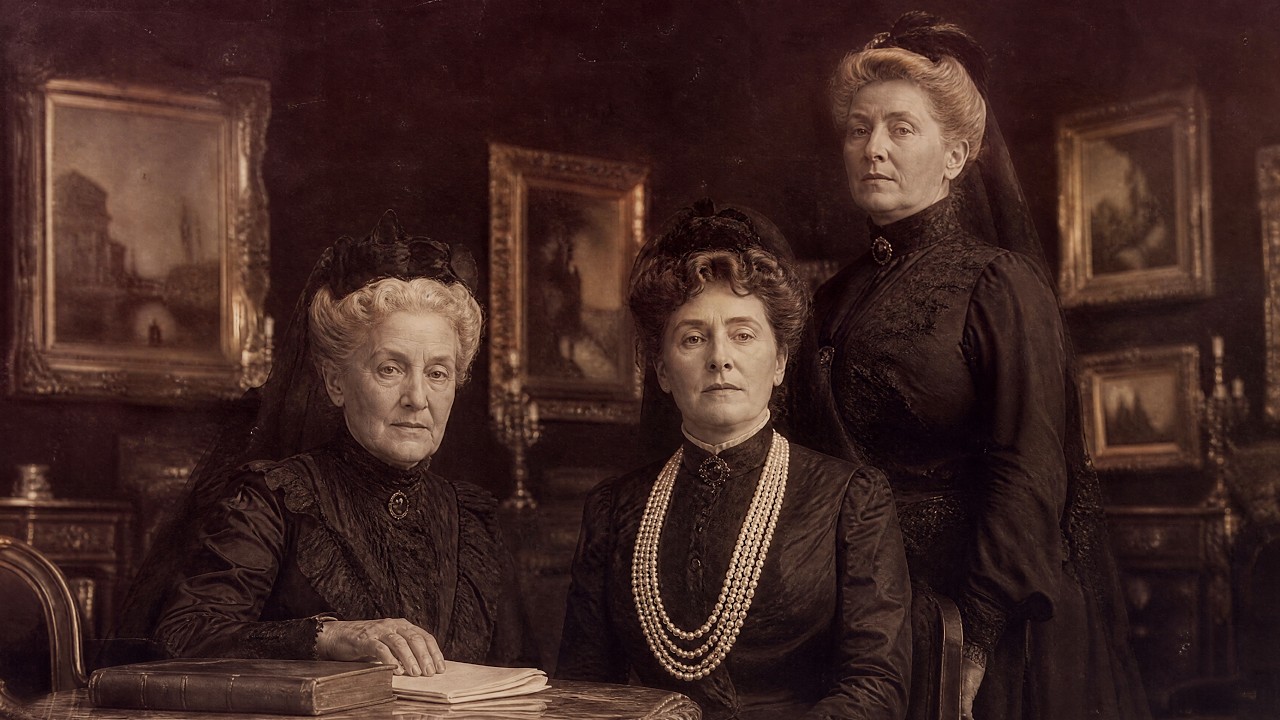
Each of them wielded enormous real power in a society that denied them even the right to vote. Each had to build a workaround to hold what she had inherited, and each paid a personal price for doing so. Bertha Honoré Palmer inherited an estate conservatively estimated at $8 million when Potter Palmer died in 1902. She more than doubled it to $20 million by the time of her own death.
She ran State Street properties and the Palmer House hotel, bought up to 100,000 acres of Florida land and launched one of the state’s first major cattle operations, fencing open range and fighting local ranchers over tick eradication. When she died of breast cancer in 1918, the world was told she had died of pneumonia. She had concealed her illness from everyone but her immediate family. Miriam Leslie inherited her husband Frank’s publishing empire in 1880 along with roughly $300,000 in debt.
She went to court to legally change her own name to Frank Leslie so no one could question who ran the company. She stopped the presses after President Garfield was shot, rushed her own artists to Washington, and raised her flagship weekly’s circulation from 30,000 to 200,000. She repaid her rescue loan early, redeemed her pawned diamonds, and when she died in 1914 left nearly a million dollars to suffragist Carrie Chapman Catt to fund the fight for women’s voting rights. Nettie Fowler McCormick, widow of reaper inventor Cyrus McCormick, directed the McCormick Harvesting Machine Company for 39 years.
She was never an officer or director and held no title. Her son, a 25-year-old, held the presidency while she ran the company from her bedroom, conducting affairs through a hearing tube as she went deaf. Two of her children spent their adult lives confined in purpose-built houses under diagnoses of mental illness, and her own son’s doctors barred her from entering the same room as him for about 20 years. Phoebe Apperson Hearst inherited everything from her senator husband in 1891, but her son William Randolph Hearst received nothing outright.
The will gave him half the fortune only if she remarried. She never did. For 28 years she paid him a reported $10,000 a month, once liquidating $7. 5 million of Anaconda copper stock so he could buy a New York newspaper.
She converted her authority into philanthropy, funding the University of California campus competition, the mining building, and the founding of the Parent-Teacher Association. Jane Stanford inherited a railroad fortune in 1893, but within a year the federal government sued the estate for $15 million. The university she had founded in her dead son’s name had no income of its own. Her lawyers told her to close it.
Instead, she had the probate court reclassify the faculty as her personal household servants so their salaries could be paid from a widow’s domestic allowance. She carried half a million dollars in jewels to London to try to sell them. The Supreme Court ruled in her favor in 1896, and she ruled the university as sole trustee until her death. When she was poisoned in her bedroom in January 1905 and survived, she dismissed the attempt.
Six weeks later, she was poisoned again and died. The coroner’s jury took less than two minutes to conclude she had been murdered by persons unknown. The university president, David Starr Jordan, who traveled to Hawaii after her death, told the press it was a natural death from heart failure. Historians who reopened the case later described that diagnosis as untenable, and one has pointed to her secretary Bertha Berner as a suspect, though no proof has ever been established.
Arabella Huntington inherited the largest share of Collis P. Huntington’s fortune in 1900 while his nephew Henry took about a third. Thirteen years later, she married the nephew, closing the legal division his lawyers had carefully written. She used the combined wealth to buy some of the greatest paintings in the world, including works by Rembrandt, Vermeer and Gainsborough, while going progressively blind.
She gave multiple contradictory birth dates and names throughout her life, paid a known blackmailer, and left instructions that her personal papers be destroyed. Her secretary carried it out. Only about 12 of her letters survive. Each of these women hid something.
Bertha Palmer hid her cancer. Miriam Leslie hid her age, her mother, her first marriage and her past. Nettie McCormick’s family hid two adult children in custodial homes. Phoebe Hearst’s own newspapers replaced her Missouri farm childhood with an invented governess.
Jane Stanford’s murder was concealed behind a heart disease diagnosis. Arabella Huntington hid herself entirely. What they built with their power took the names of the men around them. The Palmer collection carries Potter Palmer’s name because his wife asked that it should.
The Hearst Memorial Mining Building commemorates a plain, honest man and good miner, not the woman who paid for it. The university in Palo Alto is named for a boy who died at 15. The Huntington Library is named for two men. What survived longest was not a house or a painting or a company.
It was the bequest Miriam Leslie left to the suffrage movement. The $977,875. 02 that reached Carrie Chapman Catt in 1922 funded the campaign apparatus that helped secure ratification of the 19th Amendment in 1920. As one organizer later put it, she wondered whether they would still have been going up to the capital without that bequest.
Bertha Palmer stood before the Woman’s Building at the 1893 World’s Columbian Exposition and answered the sentimentalists who asked whether she would really have woman step down from her pedestal. “Yes,” she said, “a thousand times yes. ” She went home that night to a castle whose front door had no handle on the outside, a door that opened only from within.