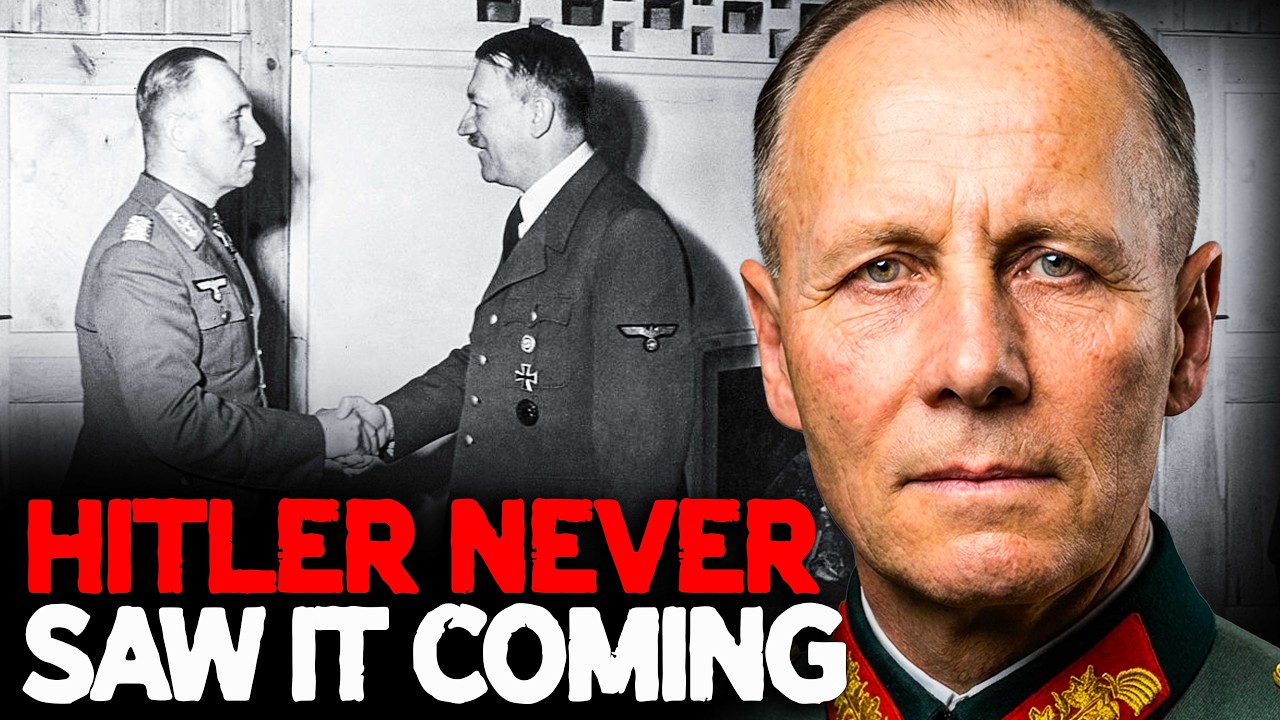
Erwin Rommel was the most celebrated German general of the Second World War. He was personally handpicked by Adolf Hitler, promoted rapidly, decorated heavily, and adored by the German public. Yet by October 1944, the Nazi regime had decided he had to die.
Rommel was not a disgruntled officer who had always opposed Hitler. He was not a closet resistor who spent the war secretly working against the regime. He was Hitler’s favorite general, a man whose photograph hung in the Führer’s own office. Winston Churchill himself called him a great general in the middle of the war.
In October 1944, two SS generals arrived at Rommel’s home in Herrlingen in southern Germany. They gave him a choice. He could take the poison they had brought, or face trial for high treason. A trial would destroy his family, strip his son of his military career, and end with Rommel hanging from a meat hook in a Nazi prison.
He chose the poison. The regime gave him a state funeral and told the world he had died of his wounds. It was one of the most elaborate lies of the Nazi era.
Erwin Johannes Eugen Rommel was born on November 15th, 1891, in Heidenheim an der Brenz, a small town in the Kingdom of Württemberg in southwestern Germany. He was the second of five children born to Erwin Rommel senior, a secondary school headmaster, and Helene von Luz, the daughter of a local government president.
The Rommel family was solidly middle-class, educated, and Protestant. There was no particular military tradition in the family. The elder Rommel was a quiet, studious man, and young Erwin inherited something of that careful analytical temperament.
As a boy, Rommel was not especially remarkable in his studies, but he displayed an unusual capacity for mechanical thinking. He had an interest in mathematics and engineering, and a physical tenacity that would define him for the rest of his life. He enjoyed long bicycle rides and dreamed for a time of becoming an aeronautical engineer.
It was his father who suggested the military as a career path. In 1910, at the age of 18, Rommel entered the Royal Württemberg Infantry Regiment Number 124 as an officer cadet. He attended the Royal Württemberg Military Academy at Danzig, where he met Lucy Maria Mollin, a young woman of Italian and Polish descent who would become his wife.
In 1912, he was commissioned as a second lieutenant. Within two years, the entire world was at war.
The First World War was the making of Erwin Rommel as a soldier. He was assigned to the Western Front in France in the opening months of the conflict, and almost immediately he began demonstrating the instincts that would later make him famous across the world.
Rommel was aggressive by nature, always preferring attack to defense. He believed that speed and surprise could compensate for numerical inferiority. He had an almost preternatural ability to read the terrain and the enemy’s intentions simultaneously. He was wounded three times during the war and earned the Iron Cross first class in 1914 for extraordinary bravery under fire.
It was on the Italian front in 1917 that Rommel achieved the feat that would cement his reputation forever. During the Battle of Caporetto in October and November of 1917, Rommel led a small force of roughly 600 German and Austro-Hungarian soldiers in a series of lightning infiltration attacks through Italian mountain positions.
In the space of just 52 hours, his unit captured approximately 9,000 Italian soldiers and secured a mountain position of enormous strategic importance. The Italian army at Caporetto suffered one of the most catastrophic defeats in the war’s history. Rommel’s personal contribution was recognized with Germany’s highest military honor, the Pour le Mérite, the famous Blue Max.
He was 26 years old. The experience of mountain warfare and infiltration tactics would stay with Rommel for the rest of his military life.
The interwar years were difficult ones for Rommel. The humiliation of Versailles, the political chaos of the Weimar Republic, and the economic catastrophe of the Great Depression shaped the world in which he tried to build a peacetime military career. He served in various infantry roles and rose slowly through the ranks.
In 1929, he was assigned to the infantry school at Dresden as an instructor. It was a role that suited him perfectly. Rommel was a gifted teacher, able to distill complex tactical problems into clear, practical lessons. He began writing down his experiences from the First World War, organizing them into a teaching text that would eventually be published in 1937 under the title *Infantry Attacks*.
The book was a detailed technical account of Rommel’s First World War exploits. It became an immediate success, not just in Germany but eventually in military circles around the world. Adolf Hitler himself read it and was deeply impressed.
When the Nazis came to power in 1933, Rommel’s career began to accelerate rapidly. He was promoted to lieutenant colonel in 1933, to colonel in 1937, and in 1938 he was assigned as the commanding officer of the Führerbegleitkommando, the battalion responsible for guarding Adolf Hitler’s personal headquarters during field operations.
This assignment brought Rommel into close proximity with Hitler for the first time. The two men developed what can only be described as a genuine mutual admiration. Hitler recognized in Rommel something rare. A combat commander of exceptional instinctive ability who combined physical bravery with tactical intelligence.
Rommel was genuinely impressed by Hitler in these early years. He shared the Führer’s contempt for the cautious, hidebound thinking of the old Prussian military aristocracy. He admired Hitler’s boldness and his willingness to take strategic risks.
He was not, it should be said, a committed ideological Nazi. He was not anti-Semitic in the virulent, murderous sense that characterized the true believers of the movement. He was at heart a Swabian conservative who believed deeply in Germany, in military service, and in personal honor.
But in those early years, he saw Hitler as a great leader. This belief would take a long time and a great deal of suffering to die.
When the Second World War began in September 1939 with the invasion of Poland, Rommel commanded Hitler’s escort headquarters and observed the campaign at close range. He watched the Blitzkrieg in action and was electrified by what he saw. He immediately understood the potential of armored warfare.
He lobbied Hitler directly for command of a Panzer division. Hitler agreed. In February 1940, Rommel was given command of the 7th Panzer Division despite having no previous experience commanding armor.
The German invasion of France and the Low Countries began on May 10th, 1940. Within days, Rommel’s 7th Panzer Division had established itself as the most audacious formation on the battlefield. Rommel operated his division with a ferocity and a pace that left his superiors, his colleagues, and his enemies equally breathless.
His fundamental tactical philosophy was simple. Never stop. Never give the enemy time to recover or reorganize. Drive forward with everything you have and accept the risks that come with that approach.
The 7th Panzer Division moved so quickly and so unpredictably that its own army group headquarters frequently had no idea where it was. German soldiers nicknamed it the Ghost Division because it appeared and disappeared from the battlefield like something supernatural.
Rommel himself led from the front in a way that was almost reckless by conventional military standards. He drove in his command vehicle in the vanguard of his columns, making decisions on the spot. In the course of the six-week campaign, the 7th Panzer Division advanced further and faster and captured more prisoners than any other German formation.
By the time France signed the armistice, Rommel had made himself the most talked-about divisional commander in the German army. Hitler had noticed.
In February 1941, Rommel was promoted to lieutenant general and given command of the newly formed Deutsches Afrika Korps. It was being sent to North Africa to bolster Germany’s Italian allies, who were being dismantled by the British in Libya. This posting would make Rommel a legend.
The North Africa campaign lasted from February 1941 to May 1943. In its course, Rommel rose from a relatively junior general to one of the most famous soldiers in the world. The desert was the perfect environment for his particular brand of warfare.
There were no civilians to consider, no forests or rivers to slow the armor, no fixed defensive lines that could not be flanked. The desert was a vast open space in which speed, surprise, and tactical genius could dominate.
The Afrika Korps arrived in Libya in February 1941 with orders to stabilize the Italian position and conduct a limited defensive operation. Rommel immediately ignored these instructions. Before his forces had even fully disembarked, he was planning an offensive.
On March 24th, 1941, just weeks after his arrival, Rommel launched an attack that the British high command had considered impossible. In the space of just two weeks, he drove the British back across the entire width of Cyrenaica, a distance of several hundred miles. He captured or killed several British generals in the process and laid siege to the port city of Tobruk.
This first dramatic offensive stunned everyone. Field Marshal Walter von Brauchitsch, the commander-in-chief of the German army, was furious at Rommel for exceeding his orders. General Friedrich Paulus was sent to North Africa specifically to rein Rommel in. Paulus came away deeply impressed and recommended that Rommel be given more resources rather than less.
On the British side, General Archibald Wavell called Rommel the most dangerous German general on any front.
Rommel was promoted to General of Panzer Troops in June 1941 and to Colonel General in January 1942. He was by now so famous that his name was known in every household in Britain as well as Germany. The British press had given him the nickname that would follow him to the grave. The Desert Fox.
On January 27th, 1942, Winston Churchill stood up in the House of Commons and said of Rommel: "We have a very daring and skillful opponent against us, and may I say, across the havoc of war, a great general."
The remark caused a political storm in Britain. Churchill was unapologetic. He believed in giving credit where it was due, even to the enemy.
What was the secret of Rommel’s extraordinary tactical success? In large part, it was what military historians call *Fingerspitzengefühl*. Literally, fingertip feeling. The ability to sense through intuition the fluid dynamics of a battle.
Rommel had this gift in abundance. He combined it with a physical endurance and a willingness to share the dangers of his soldiers that generated a loyalty bordering on devotion.
But the campaign was never as one-sided as the legend sometimes suggests. The Afrika Korps was perpetually undersupplied. Ships carrying fuel, ammunition, tanks, and reinforcements were regularly sunk by the British Navy and Air Force.
Rommel sent message after message to Berlin, to Rome, to Hitler himself, pleading for more supplies. The replies were always the same. Promises that could not be kept.
On June 21st, 1942, he achieved what was perhaps the single greatest triumph of his career, capturing the fortress city of Tobruk in a single day of fighting. He took over 33,000 British and Commonwealth prisoners in the process.
In Berlin, Hitler was so delighted that he immediately promoted Rommel to the rank of Generalfeldmarschall, field marshal. At 50 years old, he was the youngest field marshal in the German army.
The news reached Rommel in the desert. By his own later account, his first thought was that he would rather have had another division of soldiers than the promotion.
Rommel pushed on east toward Egypt, aiming for Alexandria, for the Suez Canal, for the oil fields of the Middle East. But at a small railway halt in the Egyptian desert called El Alamein, the advance finally stopped.
The British Eighth Army, now commanded by General Claude Auchinleck, used the terrain to build a defensive line that Rommel could not outflank. For the first time in North Africa, the Desert Fox’s greatest trick, the wide enveloping movement, was unavailable to him.
The First Battle of El Alamein in July 1942 was a grinding attritional affair. It stopped the German advance cold. Rommel was ill, exhausted, and running desperately short of fuel and ammunition.
In August 1942, Churchill appointed General Harold Alexander as commander-in-chief Middle East and gave command of the Eighth Army to Bernard Law Montgomery. The war in North Africa changed completely.
Montgomery was in many ways the polar opposite of Rommel. Where Rommel was intuitive and improvising, Montgomery was methodical, careful, and unwilling to attack until he was certain he had an overwhelming advantage.
The Second Battle of El Alamein opened on October 23rd, 1942, with one of the heaviest artillery bombardments of the entire war. Rommel was not even in Africa when it began. He had returned to Germany for medical treatment.
When the news of the British attack reached him, Hitler ordered him to return immediately. Rommel flew back to North Africa knowing what he would find. His forces were desperately short of fuel and ammunition, outnumbered in tanks by a ratio of roughly two to one.
He fought with everything he had for 12 days. Then on November 2nd, 1942, he sent Hitler a message asking permission to conduct a fighting withdrawal westward.
Hitler’s reply came back within hours. "Stand fast, do not retreat, victory or death."
Rommel was stunned. He knew with absolute mathematical certainty that to obey that order was to destroy his entire army. He agonized for 24 hours, then began the retreat anyway.
This moment, this defiance of Hitler’s direct order, was one of the first significant cracks in the relationship between the two men.
The end in North Africa came in May 1943. Rommel had been replaced in command of Panzer Army Africa by General Hans-Jürgen von Arnim and had returned to Germany in March 1943 for what was supposedly temporary medical leave. He was never to return.
In May 1943, some 230,000 German and Italian soldiers surrendered to the Allies in Tunisia. The Africa campaign was over.
In December 1943, Rommel received the assignment that would bring the story of his relationship with Hitler to its dramatic and tragic conclusion. He was given command of Army Group B in France and the Low Countries, with specific responsibility for organizing the Atlantic Wall defenses against the Allied invasion.
He threw himself into the work with typical energy. He inspected hundreds of miles of coastline, ordered millions of additional mines to be laid, and pushed for more obstacles on the beaches.
Somewhere in the course of those gray, cold months in France, watching the Reich’s defenses and understanding with perfect military clarity how inadequate they were, Erwin Rommel crossed a threshold from which there was no return.
He began to talk to people he trusted. Not about treason, not yet, but about the need for Germany to end the war before it was utterly destroyed.
He spoke to his chief of staff, Major General Hans Speidel, who was already deeply embedded in the resistance networks planning an attempt on Hitler’s life. He spoke to Admiral Friedrich Ruge, who shared his assessment that Germany was heading toward catastrophe.

Rommel began communicating through intermediaries with officers who were actively planning to assassinate Adolf Hitler. He allowed his name to be discussed cautiously as a possible leader of Germany after Hitler was removed.
He was not the driving force behind the July 20th plot. He did not plant the bomb. But he knew what was being planned, and he did not stop it.
The Allied invasion of Normandy began on June 6th, 1944. D-Day remains the largest amphibious assault in military history. 150,000 soldiers crossed the English Channel in a single day.
Rommel was not at his command post when it began. He had gone home to Germany to celebrate his wife Lucy’s birthday. He raced back to France as soon as the invasion reports began flooding in.
In the weeks that followed, Rommel threw everything he had at the Allied beachhead. But the combination of Allied air power, naval gunfire, and the sheer volume of men and material pouring across the channel made the task impossible.
Rommel watched his forces being methodically ground down and drew the only logical military conclusion. The war in France could not be won.
He sat down and wrote a memorandum to Hitler. He wrote that the troops were fighting heroically, but that the disparity in resources was too great to overcome. He wrote that the German position in Normandy was unsustainable.
He concluded by stating that the political leadership must draw the necessary consequences from this military assessment. In Hitler’s vocabulary, that meant one thing. Negotiating an end to the war.
Hitler received it on July 15th, 1944. He never replied.
Five days later, on July 17th, 1944, Rommel’s staff car was attacked by British Typhoon fighter-bombers on the road between Livarot and Vimoutiers in Normandy. The driver was killed outright.
Rommel was thrown clear when the car crashed into a ditch at high speed. He suffered a massive skull fracture, shattering the left side of his face, damaging the left eye socket, and causing severe brain injuries.
He was moved progressively toward Germany as Allied forces advanced. By August 1944, he was home in Herrlingen near Ulm, recovering slowly from his injuries. He could barely walk. He suffered from severe headaches, double vision, and periods of confusion.
It was in this condition that Rommel received the news of July 20th, 1944. The assassination attempt had failed.
Colonel Claus von Stauffenberg had managed to place a briefcase bomb in Hitler’s conference room at the Wolf’s Lair headquarters. It had detonated as planned, but Hitler had survived with minor injuries. The briefcase had been moved further from him just before the explosion.
The wave of reprisals that followed was vast, systematic, and merciless. The Gestapo and the SS arrested, interrogated, and executed hundreds of people. Under torture, conspirators named names.
Somewhere in those chains of accusation and confession, the name of Erwin Rommel appeared. His name had been mentioned as a potential figure for post-Hitler Germany. Mentioned by Speidel, mentioned by other officers.
Speidel himself was arrested in September 1944. Under interrogation, he managed the extraordinary feat of protecting Rommel as much as possible while still providing enough information to save his own life. But the threads connecting Rommel to the conspiracy were multiplying.
Hitler was presented with the evidence against Rommel in late September and early October 1944. A straightforward arrest and trial would have been the obvious course of action, but Hitler hesitated.
Partly, this was tactical. Rommel was the most popular military figure in Germany. Arresting and publicly trying him for treason risked catastrophic damage to home front morale.
Partly, it was perhaps something more personal. For all that Hitler had grown increasingly angry with Rommel, there remained some residual echo of the days when Rommel had been Hitler’s chosen champion.
Whatever the reason, Hitler chose not to arrest Rommel publicly. Instead, he sent two generals to Herrlingen on October 14th, 1944. They arrived at noon.
The two generals sat down with Rommel in his private study and presented him with the regime’s offer. They had evidence that Rommel had been aware of the conspiracy against Hitler.
He had a choice. He could drive with them to Berlin and stand trial before the People’s Court, ending in death sentences carried out with deliberate sadism. Or he could take the cyanide capsule they had brought with him, die at home within minutes, be declared a victim of his wounds from July, be given a state funeral, and have his family protected from reprisals.
The choice was not a choice at all in any meaningful sense. Rommel asked for 15 minutes.
He went upstairs and spoke to Lucy. He came back downstairs and spoke briefly to his 15-year-old son, Manfred. He said, according to Manfred’s later account: "I shall be dead in a quarter of an hour."
He walked to the generals’ waiting car. He was driven a short distance from the house, and there in the car on a country road in the Swabian Hills of Germany, Erwin Rommel took the cyanide capsule. He was dead within seconds. He was 52 years old.
The body was taken to the local hospital at Ulm, where the death was recorded as the result of the brain injuries sustained in July. Hitler sent a message of condolence to Lucy and ordered a state funeral.
Rommel was given the full honors of a German hero. The lying in state, the military escort, the speeches praising his valor and sacrifice. Field Marshal Gerd von Rundstedt delivered the funeral oration.
The lie was maintained completely. It was not until after the war ended, when Lucy Rommel and Manfred Rommel began speaking about what had really happened, that the truth began to emerge.
The story of the two generals with the cyanide capsule transformed the historical understanding of Erwin Rommel completely.
The Nazis went to such elaborate lengths to conceal the nature of his death precisely because they feared the truth. They feared what it would mean for German morale if it became known that the most popular general in Germany had been compelled to kill himself because he had turned against Hitler.
The question that historians have argued about ever since is exactly how far that understanding had gone and exactly what Rommel had actually done as a result of it.
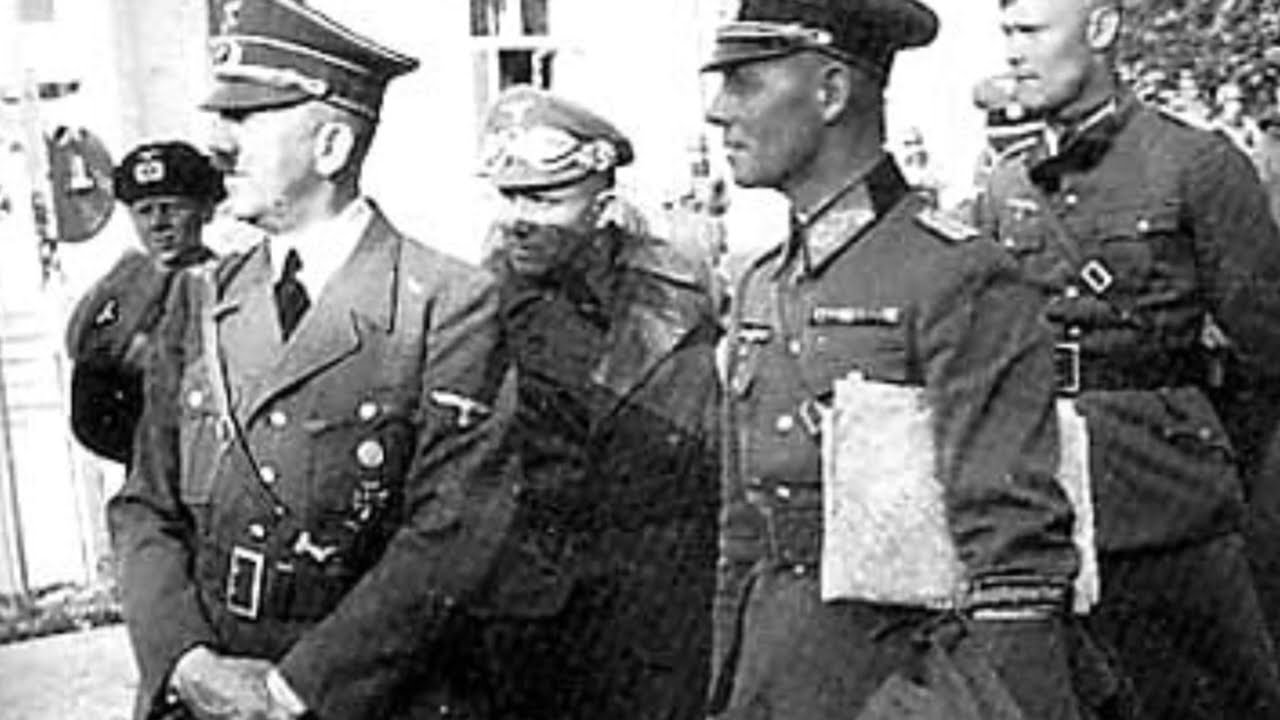
Was he a genuine resistor, a man who had actively committed himself to the overthrow of the Nazi regime? Or was he something more ambiguous? A man who had lost faith in Hitler’s leadership without quite having the commitment or the opportunity to translate that loss of faith into concrete action.
The answer almost certainly lies somewhere between these poles.
The most important figure in understanding Rommel’s relationship with the resistance is his chief of staff in France, General Hans Speidel. Speidel was already deeply connected to the resistance network when he joined Rommel’s headquarters in April 1944.
Speidel introduced Rommel to other resistance figures. Through Speidel, Rommel met Caesar von Hofacker, a Luftwaffe officer and cousin of Klaus von Stauffenberg who was one of the key figures in the resistance network in France.
Hofacker spoke to Rommel on several occasions about the conspiracy. These conversations appear to have been the most direct contact Rommel ever had with the actual plotters of the assassination attempt.
What seems clear is that Rommel expressed his conviction that Hitler must be removed, that the war must be ended, and that he was willing to have his name associated with a future German government. He maintained reservations about assassination as the method of achieving Hitler’s removal.
Rommel seems to have believed that Hitler should be arrested and put on trial rather than killed outright.
The answer to how and why the most celebrated German general of the war arrived at the point of contemplating resistance did not come all at once. It came in stages.
The first element was purely military. Rommel came to understand with a clarity that his position on the front line gave him that Germany was losing the war.
He understood it in North Africa when he was watching his forces starve for want of supplies. He understood it more completely after El Alamein when 230,000 of Germany’s best soldiers were lost in Tunisia. He understood it in France in 1944 when he watched Allied air power make daylight movement of German forces almost impossible.
There was also a growing moral horror. Rommel in North Africa had run a campaign that was by the standards of the Second World War relatively clean. He did not involve himself in atrocities. When a direct order came from Hitler that Jewish soldiers taken prisoner were to be killed, Rommel reportedly destroyed the order rather than transmitting it.
Rommel felt betrayed in a quite personal sense by Hitler’s conduct of the North Africa campaign. He had done everything that could have been done with the resources at his disposal. The defeat he suffered was in his view a defeat produced by Berlin’s failures rather than by his own.
The driving force behind the July 20 plot was Colonel Claus Philipp Maria Schenk Graf von Stauffenberg. He had been catastrophically wounded in April 1943, losing his right hand, two fingers of his left hand, and his left eye.
During his long recovery, Stauffenberg had undergone what can only be described as a moral revolution. He emerged convinced that it was his personal duty to kill Adolf Hitler.
On July 20th, 1944, Stauffenberg carried a briefcase containing two pounds of British-made plastic explosive into Hitler’s conference room at the Wolf’s Lair. He placed it as close to Hitler as possible, excused himself, and left.
When the bomb exploded, he was convinced that Hitler must be dead. He flew immediately back to Berlin to begin implementing the takeover of the German government.
He did not know that the briefcase had been moved, that Hitler had survived, that the coup was already failing.
By midnight on July 20th, Stauffenberg had been arrested in Berlin and shot in the courtyard of the Bendlerblock alongside three of his fellow conspirators. He died shouting: "Long live sacred Germany."
The post-plot reprisals were extraordinarily savage. The People’s Court under its president Roland Freisler conducted show trials designed to humiliate, degrade, and destroy the accused.
The executions carried out at Plötzensee prison in Berlin were designed to be as agonizing and degrading as possible. The condemned men were stripped naked and hanged with nooses made from thin cord or piano wire, suspended from meat hooks.
In the months following July 20th, 1944, nearly 5,000 people were arrested and roughly 200 were executed.
Against this background of systematic mass murder, the regime’s treatment of Rommel can be understood as an act of expediency. By October 1944, Germany was fighting desperate defensive battles on every front.
Rommel was one of the most powerful symbols of national purpose still living. To arrest him and hang him from a meat hook would have been to commit a piece of political suicide.
So instead, they gave him a cyanide capsule and a state funeral.
The question of what the postwar world should make of Erwin Rommel has occupied historians and the broader public ever since.
In the immediate postwar years, there was a powerful tendency to embrace a largely heroic narrative. He was the good German, the professional soldier who had fought honorably, who had been forced to serve an evil regime but had eventually turned against it.
This narrative was comforting in various ways. It reassured the Allies that their German opponents had not all been dedicated Nazis. It gave West Germany a military figure of whom it could be proud without shame.
Rommel’s son, Manfred, who would go on to have a distinguished career as a politician and eventually as Lord Mayor of Stuttgart, actively cultivated this heroic image of his father.
But the heroic narrative has also been seriously challenged by a generation of historians who have examined the evidence more carefully.
The claim that Rommel was somehow isolated from the reality of what the Nazi regime was doing is considerably overstated. He received a direct order regarding the killing of Jewish prisoners of war in North Africa. While he apparently refused to implement it, he also did not report it or protest it through official channels.
Even if we accept the most generous interpretation of his role in the July 20th conspiracy, this still does not add up to a profile of heroic resistance. He came to his opposition to Hitler late, privately, and cautiously.
None of this makes him a villain. It makes him a human being. A complicated, gifted, ultimately tragic figure who served a monstrous regime with great skill for most of the war.
The real reason Rommel turned against Hitler was not a sudden flash of moral revelation, but the slow, grinding accumulation of military reality, personal humiliation, and moral horror that left him unable by the spring of 1944 to see any path forward that did not involve the removal of the man who had made him famous and was now guaranteeing Germany’s destruction.
Rommel’s story is important not because he was a simple hero or a simple villain, but because it resists simplification. It requires us to think carefully about what it means to serve, to resist, to fail, and to pay the price of one’s failures.
The story of Rommel’s so-called betrayal of Hitler matters not just as military history, but as a story about the hardest questions human beings face. When do you finally say no? And what are you willing to pay for saying it?