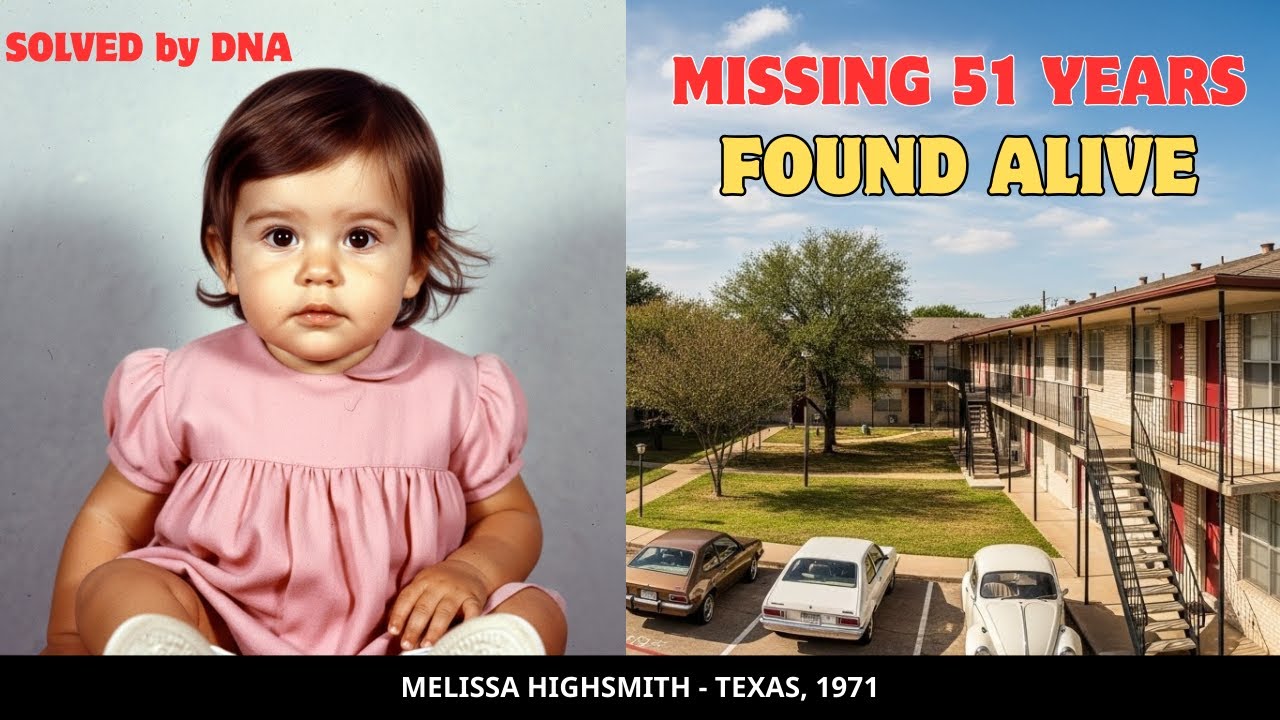
On a hot summer morning in August 1971, Fort Worth, Texas, was moving through an ordinary Monday. Alta Antenco, a 22-year-old single mother, was trying to balance work and childcare. She had recently separated from her husband and moved to the area with her 21-month-old daughter, Melissa Susan Highsmith. Melissa was a curious toddler with brown hair, expressive eyes, and a distinctive red birthmark about three inches long on her upper back.
To support them, Alta worked as a waitress. She needed reliable childcare, so she placed a simple ad in the local Fort Worth Star-Telegram. A woman named Ruth Johnson responded. Her voice was warm and reassuring. She said she loved children and had a big yard where they could play safely. Alta felt it was a good fit.
That morning, Alta dressed Melissa in a pink dress and white sandals. She left her daughter with her roommate, instructing her to hand the toddler over when the babysitter arrived. Alta kissed Melissa goodbye and went to work, relieved that the day’s childcare was settled.
Later that afternoon, the plan unraveled. The roommate confirmed that a woman had arrived, dressed strangely for the heat. She wore all white, long gloves, and a scarf wrapped around her head and neck. She took Melissa gently and left. There were no warning signs at the time, but the apartment fell silent. Melissa was gone.
When Alta returned home, she found Melissa’s toys still on the floor and her blanket neatly folded. There was no message, no sign of the babysitter’s return. Panic set in, and Alta called the police immediately. Officers arrived quickly, took detailed statements, and recorded every description they could gather. Ruth Johnson had provided no real address, no references, and nothing traceable. The name was likely an alias.
A search began at once. Police combed the neighborhood and distributed flyers with Melissa’s photo and description. The red birthmark was highlighted as a key identifying feature. Local media picked up the story quickly. The Fort Worth Star-Telegram ran a front-page article, and radio and TV stations broadcast Melissa’s description. A hotline was set up, and tips poured in. Most were well-meaning but led nowhere.
The FBI joined within the first week, given the possibility of interstate transport. Agents reviewed evidence and searched for patterns. They traced the phone number Ruth used to a public payphone at a small store. There were no cameras in 1971, and no useful fingerprints. The kidnapper had taken steps to stay hidden.
As weeks passed, the investigation slowed. Detectives interviewed Alta’s coworkers and her ex-husband’s extended family. They found no motive and no personal grudge. It appeared to be a stranger abduction, the hardest kind to solve. Alta faced repeated questioning and carried guilt, but she remained cooperative and hopeful.
By the fall of 1971, the intense daily activity faded. The file stayed open, but leads dried up. Alta returned to the apartment each night, leaving the lights on and the door unlocked. She kept Melissa’s toys and pink dress untouched, refusing to accept defeat.
In the years that followed, Alta rebuilt her life. She remarried and had four more children: Sharon, Rebecca, Victoria, and Jeffrey. Each new child brought joy, but also reminded her of the one who was missing. The younger siblings grew up in a home where Melissa’s name was spoken with love, not sorrow. Alta kept Melissa’s photos on the wall and told stories about her laughter and favorite things.
Every August 23rd, the family celebrated Melissa’s birthday. Alta would bake a cake, set an extra place at the table, and light candles. The children would blow them out, wishing for Melissa’s safety and happiness wherever she was. The ritual was a quiet affirmation that Melissa remained part of the family.
As the children grew, they joined the search. Sharon helped staple flyers on neighborhood bulletin boards. Rebecca and Victoria distributed information at school events and church gatherings. Jeffrey, the youngest, grew up with a Facebook page dedicated to finding Melissa. The family updated her description regularly, always including the birthmark, and shared age-progressed images created with the help of the National Center for Missing and Exploited Children.
Decades passed with many disappointments. Tips came in, but each one led to a dead end. Yet the family never stopped. Alta gave interviews whenever asked, always ending with the same message: she is out there, we just have to keep looking.
By the early 2020s, the world had changed. DNA testing had become accessible to ordinary families. Commercial databases like AncestryDNA, 23andMe, and MyHeritage allowed people to upload a simple cheek swab and discover relatives they never knew existed. Law enforcement and private genealogists began using these tools to solve cold cases.
In 2021, Jeffrey decided to take a different step. He bought a 23andMe test kit. His primary goal was to learn about his family’s ancestry, but he also hoped for a connection to Melissa. In 2022, the results came back. Among his matches were several close relatives, but one group stood out. The DNA segments suggested a very recent, direct connection to descendants of a woman living near Fort Worth.
Jeffrey cautiously reached out through the 23andMe messaging system. He contacted a woman named Melanie. She was in her early fifties and lived in the area. When she read Jeffrey’s message, she was stunned. She had grown up believing her name was Melanie Brown, later Melanie Walden after marriage. She had been raised by a woman she called “Mom,” but her earliest memories were fuzzy. She had no baby photos before age two or three. Family stories were vague, and she always felt something was missing.
Melanie was hesitant at first. The idea that she might have been kidnapped as an infant was overwhelming. But the DNA results were clear. The overlap indicated a very close relationship, consistent with siblings. Jeffrey suggested bringing in an expert. A genealogist agreed to help, building a family tree using public records, census data, birth certificates, and DNA matches.
By late 2022, the evidence was strong enough to involve law enforcement. The Fort Worth Police Department reopened the case with fresh eyes. They coordinated with the family and Melanie for an official DNA test through a certified lab. The results arrived in November 2022. The match was conclusive, with a 99.99% probability that Melanie was indeed Melissa Susan Highsmith, Alta’s daughter.

When the family learned the news, the emotions were overwhelming. Jeffrey called his mother first. Alta, now in her seventies, listened as her son explained what seemed impossible. Tears came immediately, tears of shock, joy, and disbelief. She had waited 51 years. The words she had longed to hear were finally true: we found her, she is alive, she is coming home.
The siblings gathered quickly. Sharon, Rebecca, Victoria, and Jeffrey embraced, crying and laughing at the same time. They had grown up without Melissa, but they had never stopped loving her. Now, the sister they knew only through photos and stories was about to return to their lives.
Melissa, still processing the news, felt a mix of emotions. She had lived a full life under a different name, facing challenges including an abusive upbringing and running away from home as a teenager. She had built her own family and never knew her true origins. The revelation was both devastating and liberating. She felt fear, excitement, and confusion, but above all, a strong pull toward the family that had been waiting for her.
The first contact was tentative, through messages and phone calls, then video chats. They exchanged stories, photos, and memories. Alta told Melissa about the birthday cakes, the empty chair at holidays, and the love that never stopped. Melissa listened with tears streaming down her face, beginning to understand the depth of the life that had been taken from her.
In November 2022, more than 51 years after that summer day, the family prepared for the moment they had dreamed of since 1971. They chose a safe, meaningful location: a church in the Fort Worth area. It was Thanksgiving week, a time full of gratitude, and the date felt right.
Alta arrived early with her children. They sat together in a small room, holding hands and breathing deeply. Melissa arrived with some of her own children. She had spent the previous days in a whirlwind of emotions, from shock and fear to curiosity and a growing sense of belonging. Now, at 53, she was about to join a family that had waited for her since she was 21 months old.
When the door opened and Melissa walked in, time seemed to stop. Alta stood up first, her eyes filling with tears. She crossed the room slowly, arms open, and embraced her daughter in a hug she had dreamed of for half a century. Melissa hesitated for a moment, then surrendered to the embrace. Mother and daughter held each other tightly, tears flowing, no words needed.
One by one, the siblings joined, forming a circle of arms around their sister. They had never met face to face, but they had loved each other their whole lives. There were tears, then laughter, then more tears. They studied each other’s faces, noticing familiar details, the shape of a smile, the way hair fell, the way one tilted her head.
Jeffrey, who had started the DNA journey, stepped back for a moment, watching his mother and sister together, then moved in to hug them both. Sharon whispered, “We have been waiting for you.” Rebecca and Victoria clung to each other, afraid of separation. They spent hours talking. Alta told Melissa about the birthday parties, the empty chair at every gathering, and how she never stopped setting a place for her. She shared stories from Melissa’s infancy, how she loved to be held on her lap, how she clapped along to music, how her laughter filled the apartment.

Melissa, in turn, revealed her own journey. She spoke softly about the woman who raised her, who called herself “Mom,” and who had taken her on that summer day in 1971. She described a childhood marked by control and hardship, her teenage escape, and the strength it took to build her own family. She had no memory of the abduction itself, her earliest memories starting around age two or three. The truth was a shock, but it also answered questions that had haunted her for decades.
The reunion was not a single moment but a process that stretched over days, weeks, and months. They met repeatedly for family dinners, quiet evenings at Alta’s home, and outings where they talked endlessly. The siblings shared decades of stories, childhood memories, family traditions, and how holidays were spent with one family member missing. Melissa listened, absorbed, and gradually shared details of her own life, the challenges she faced, the strength she found to raise her children, and the quiet questions she had about her early years.
They laughed at their similarities, shared habits, the same taste in food, and cried over the lost years. But mostly, they simply spent time together. Melissa’s children and grandchildren became part of the extended family too. They met aunts, uncles, and cousins they never knew existed, feeling the warmth of a welcome that had been waiting for generations. The Highsmith home, once filled with absence, now echoed with new voices, new laughter, and new memories being made.
In 2023, Melissa made the decision to reclaim her identity fully. She went to a court in Fort Worth to legally change her name to Melissa Susan Highsmith. The hearing was simple but emotional. Alta and her siblings attended, watching as the judge approved the change. When the paperwork was signed, Melissa looked at her mother and said, “I am home now.” It was a moment of deep healing, not erasing the life she had lived, but honoring the life she was born into.
The family also worked with the Fort Worth Police Department to close the investigation file. Although the statute of limitations for the kidnapping had long expired, the case was officially resolved as a stranger abduction. With the child recovered alive, the focus shifted from pursuit to support, ensuring Melissa had the resources she needed for the transition.
The story spread through media outlets including CNN, the New York Times, People magazine, and local Fort Worth stations. The National Center for Missing and Exploited Children highlighted the case as one of the strongest examples of what forensic genetic genealogy can achieve. By 2024 and 2025, the center reported about 30 long-term missing children cases solved with the child found alive, thanks to advances in DNA technology and commercial databases. Melissa’s case was among the most prominent.
The family used the attention wisely. They spoke publicly when ready, always with the same message: hope remains. Alta emphasized never giving up on a missing child. Melissa shared her perspective that even if you don’t know your origins, you can still find your way home. Jeffrey, who initiated the DNA test, encouraged others to explore genetic testing responsibly, not just for ancestry but for the potential to solve family mysteries or cold cases.
Melissa now lives near her family in the Fort Worth area. She has slowly and steadily rebuilt relationships, honoring her past life as Melanie while embracing her new life as Melissa Highsmith. She participates in NCMEC events when invited, speaking about the importance of hope and the potential of science to change lives. The family gathers often, for birthdays, holidays, and ordinary weekends, filling the empty chair that waited so long.
Looking back, the Highsmith story is not just about a missing child found after 51 years. It is about the unbreakable bond between a mother and daughter, the quiet strength of siblings who grew up carrying an absent sister in their hearts, and the resilience of a family that refused to let time erase love. It is a story about the power of modern science, once considered science fiction, now a bridge spanning decades. And it carries a timeless message: hope, if nurtured, can withstand anything.
For everyone who has ever waited for a loved one, carried an unanswered question, or wondered if time can heal a wound, the Highsmith family offers a quiet and powerful reminder. Never stop searching. Never stop loving. Because sometimes, after the longest night, the light comes. And when it does, it shines brighter than anyone could have imagined.