The summer of 1995 in the outer ring of Columbus, Ohio carried a specific kind of heat. The air smelled like fried dough and livestock. County fairs were the heartbeat of the season, and for one night in August, that feeling of safety was the exact thing that made a predator invisible.
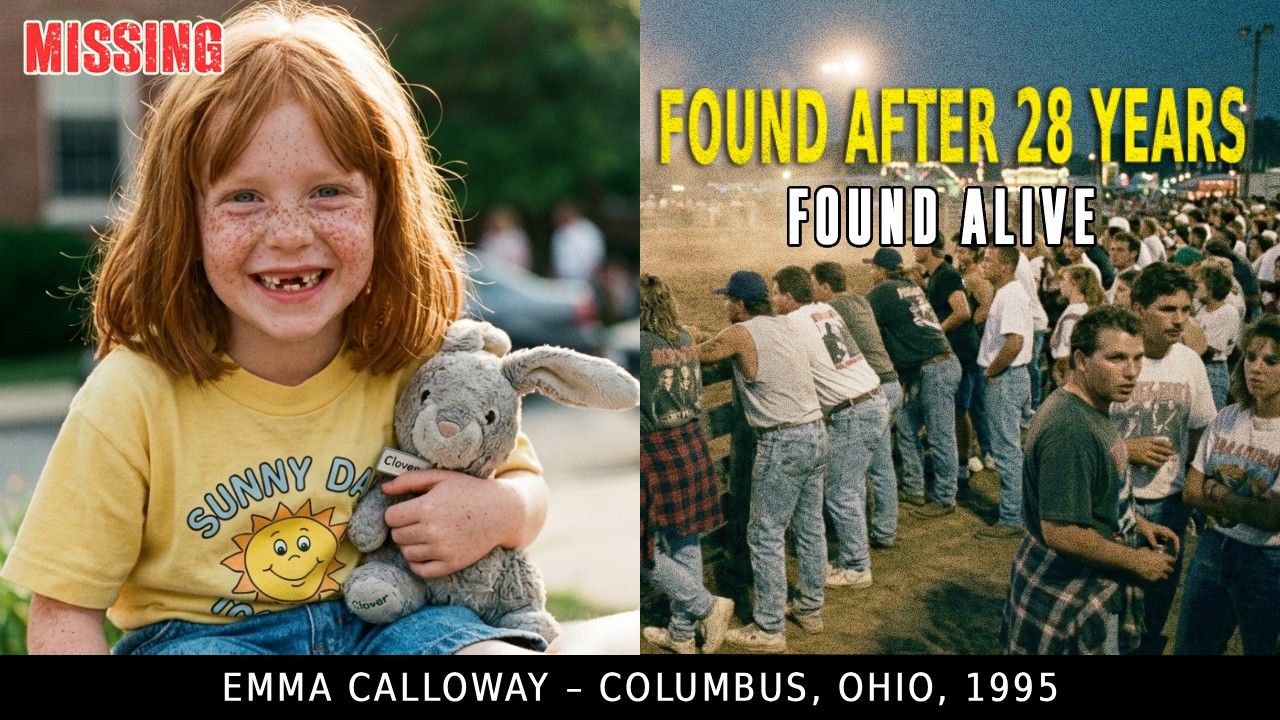
Her name was Emma Callaway. She was 6 years old. She had red hair that caught the light like a lit match and freckles so dense they seemed to form constellations across her nose and cheeks. She loved strawberry ice cream. She slept with a stuffed rabbit named Clover. On the night of August 14th, 1995, she walked into a county fair with her family and never walked out.
The Callaway family lived in Glenbrook Crossing, a suburb just outside Columbus. David worked in logistics. Renee taught third grade. They had two children, Emma and her older brother Tyler, who was nine that summer. The fair was a family ritual. They arrived around 6:00 in the evening. They rode the Ferris wheel. They ate corn dogs. Emma demanded cotton candy and consumed half of it before declaring she was full.
Around 8:30, the family moved toward the livestock arena for a scheduled performance. The arena was packed. Emma was standing between her parents. At some point, she said she needed to use the restroom. Renee told her to hold on just a minute. Then a horse reared back unexpectedly. The crowd shifted and murmured. In that 30 or 40-second window of distraction, Emma Callaway was gone.
What followed was the specific kind of terror no parent should ever know. They split up and searched. An announcement was made over the PA system. Sheriff's deputies arrived within 20 minutes. A grid search of the fairgrounds was conducted. Emma was not found. By midnight, it was clear this was not a case of a child wandering off. By 1:00 in the morning, the Franklin County Sheriff's Department had formally opened a missing child investigation.
The first 72 hours are critical in any missing child case. Deputies canvassed the area. A description of Emma went out over regional police radio. Emma Callaway, 6 years old, red hair, blue eyes, 4 ft tall, approximately 45 lb, wearing a yellow T-shirt with a cartoon sun on it, denim shorts, and white sneakers. Last seen at approximately 8:40 p.m. at the county fairgrounds outside Columbus, Ohio.
The case drew immediate local attention. Renee and David appeared on the news, visibly shattered, holding a photograph of Emma that would become the defining image of the case. In it, Emma is sitting on a porch step, squinting into the sun, grinning that oversized grin. The National Center for Missing and Exploited Children was notified. The FBI field office in Columbus opened a file. The case was classified as a child abduction.
Investigators had almost nothing to go on. No witnesses came forward who saw Emma leave. No one reported seeing a car leave in a hurry. But there was one thing. In the southwest corner of the fairgrounds parking area, in what was designated as lot C, there was a single security camera mounted on a utility pole. It recorded onto VHS tape. The tape from the night of August 14, 1995 had not yet been overwritten.
They found it. They reviewed it. What they saw was a low-resolution smear of gray and black shapes moving through the dim light of the parking lot at the edge of the camera's range. Investigators could make out what appeared to be a figure leading a smaller figure toward a vehicle. That was it. They could not determine the gender of the adult. They could not read a license plate. They could not confirm the smaller figure was Emma Callaway. They documented the tape, logged it as potential evidence, and kept it. But it was not actionable.
The investigation moved through standard channels. Registered sex offenders were interviewed. Tips flooded the hotline. Most went nowhere. One name did come up in those early weeks, almost accidentally. A church volunteer coordinator mentioned that one of their regular volunteers had left the fairgrounds that evening earlier than expected. Her name was Donna Reeves.
Donna Reeves was 51 years old in the summer of 1995. She lived in Glenbrook Crossing, the same suburb as the Callaway family. She was a fixture at Trinity Hope Church, known as a reliable volunteer who showed up when others canceled. She had never married. She had no children. She lived alone in a two-bedroom house about a mile and a half from the Callaway home.
When investigators spoke to Donna Reeves in the first week after Emma's disappearance, she was cooperative. She said she had left the fair that evening because she had not been feeling well. A headache. She went home, took aspirin, and went to bed early. She was soft-spoken. She expressed what seemed like genuine distress about what had happened to Emma. A background check turned up two items of note. In 1991 and 1993, Donna had applied to become a licensed foster and adoptive parent in the state of Ohio. On both occasions, the application was reviewed and denied.
There was no physical evidence connecting her to Emma's disappearance. There were no witnesses who placed her near the livestock arena that evening. The parking lot tape was too degraded to be useful. After those two conversations, Donna Reeves receded from the active investigation. The case went cold.
Not immediately, but in the slow and terrible way that cold cases happen. The tips slowed. The leads ran out. The Callaway family held vigils. Renee spoke at missing children's advocacy events. The first anniversary came, then the second, then the fifth, then the 10th. The case was reviewed periodically. Each time, the box containing the degraded VHS tape from lot C went back into storage.
What nobody in the investigation knew and could not have known was that Emma Callaway was alive. She did not know who she was. She knew only the name she had been given. She knew the woman who raised her. She knew the house they lived in, which was not in Ohio. She knew the schools she attended, the friends she made. She knew, if she thought hard enough, a fragment of a memory that never quite made sense. A loud place, bright lights moving overhead, the smell of animals, something soft being pressed into her hands.
The woman who took her had constructed a story with the precision of someone who had been planning it for a long time. The story was simple. We moved. You were very young. You do not remember much. That is normal. The girl who had been Emma Callaway grew up believing it.
She grew up in Knoxville, Tennessee after a period of years spent further south in a small town in rural Georgia. To the people around her in Tennessee, Donna Reeves was a quiet older woman raising her niece. That was the story. The parents had been unable to care for the child. She had stepped in. Nobody pressed too hard.
The girl grew up and became a young woman. She graduated high school in 2007. She went to community college and earned an associate degree in early childhood education. By her late 20s, she had settled into a position at a local library where she worked part-time in the children's section. She did not think about Ohio.
Donna Reeves grew old. She developed health problems over the course of the 2010s. Her mobility declined. The young woman took care of her with a loyalty that comes from having your whole understanding of the world shaped by one person's version of it. She called her mom. Donna never corrected her.
In the spring of 2021, Donna had a minor stroke that left her with some cognitive effects. The young woman, by then 32 years old, became her primary caretaker. Donna in those years after the stroke was different. Quieter in some ways. Once, only once, she said, "I should have done things differently." The young woman asked what she meant. Donna said it was nothing. "Old thoughts."
There was a box in the closet of the spare bedroom. On the outside, in Donna's handwriting, were four words: "Open when I am gone." The young woman saw this and assumed it was Donna's instructions for her estate. She left it alone.
Now, here is where the story pivots on something so small, so ordinary, so completely 21st century that it almost feels like a joke. On a Saturday afternoon in late January 2023, the young woman, whose name was Breonna, went to a Walmart in Knoxville to pick up a few things. She was with her long-time friend. They were walking past the bakery section, the fresh donuts under the glass case, and Breonna's friend said something that made Breonna laugh hard. Her friend pulled out her phone on reflex and took a short video.
Breonna posted it to Facebook that evening with a short caption about having the best Saturday. The video did well, better than her usual posts. A few thousand views over the next day. And then, something different.
By the end of the first week, the video had been seen by a listener of a true crime podcast called Found or Forgotten. The host had been covering the Emma Callaway case for 5 years. One of her listeners, a woman who had been following the case since the late '90s, watched Breonna's Facebook video and paused it, and paused it again. She was looking at a specific page on the Callaway family's memorial website, the medical records section. There was one specific distinguishing feature noted by Emma's pediatrician during a checkup when Emma was 4 years old. A small port wine birthmark located on the posterior surface of the left auricle, approximately 1 cm in diameter, with a shape described in the clinical notes as irregular, resembling a butterfly or a moth.
On Breonna's Facebook video, in the frame captured at the exact moment she was laughing, her head was tilted at just enough of an angle that her hair had fallen away from her left ear. Behind that ear, on the skin where the ear met the head, was a mark. Small, irregular, exactly where it should be.
The listener posted about it on the Found or Forgotten subreddit at 11:47 p.m. on a Tuesday night. She included a screenshot, annotated. She included the corresponding page from the Callaway website. She wrote one sentence under the images. "I need someone else to look at this."
By morning, the post had over 300 responses. By afternoon, the podcast host had been tagged so many times she lost count. By the following day, the thread had been reviewed by two former law enforcement consultants. Both had said the same thing independently. This is worth reporting. The host placed a call to the FBI field office in Columbus, Ohio.
But before that call could happen, there was something else. Something sitting in an evidence storage facility. Something that had been sitting there for exactly 25 years that was about to change everything about what investigators thought they knew. Because it turned out the tape from lot C, the tape everyone had written off for being too degraded to matter, had never actually told its story yet.
The technology that would finally read that tape had not existed in 1995. It had barely existed in 2015. But by 2023, a specific category of AI tools had reached a threshold that changed what was possible in cold case forensics. The process is called AI-assisted video enhancement. It works by analyzing degraded footage frame by frame and using trained neural networks to reconstruct probable visual information based on pattern recognition. It cannot create evidence that was not there. What it can do is pull signal out of noise.
When the renewed inquiry came in from the podcast host, the agent assigned to review the cold file pulled the original evidence logs and found the notation about the lot C tape. He submitted a formal request to have the tape processed through the bureau's digital forensics unit.
The results came back in late February 2023. Significant portions of the tape remained recoverable. What emerged was a sequence of footage from the parking lot of lot C on the night of August 14th, 1995, beginning at approximately 9:30 p.m. and running for about 12 minutes. In that window, investigators could now see the following. A woman, heavy-set, wearing a light-colored blouse and dark pants, walking through the parking lot toward a vehicle parked toward the rear of lot C. She was holding the hand of a small child. The child had light-colored hair. The child was not resisting.
In one frame, the woman turned her head slightly toward the camera. A facial recognition specialist generated a preliminary match assessment. The match came back at 71% probability to a reference photograph of Donna Reeves. 71% is not a conviction. But combined with everything else now aligning, it was enough to move.

A partial license plate, also partially recovered from the footage, yielded three legible characters. Filtered against Ohio DMV records from 1995, filtered by make and model, filtered by the residential address of Glenbrook Crossing, the list narrowed to a single entry. A 1991 Buick Century registered to Donna Marie Reeves of 14 Westerfield Lane, Glenbrook Crossing, Ohio.
The next step was Breonna. Reaching out to someone under these circumstances is one of the most delicate things an investigator can do. The agent made the decision to approach through Instagram direct message. The message identified the sender as a special agent with the FBI. It said investigators were working on a case and believed Breonna might have relevant information.
Breonna received it on a morning in early March 2023. She read it twice. She thought it was a scam. What made her pause was the professionalism. She called the main FBI line, gave them the reference number, and confirmed it was real. She sat on the edge of her bed for a long time after that. Then she called the number.
The initial conversation lasted 45 minutes. The agent asked about her background, her family situation, where she had grown up. He asked about Donna in a way that sounded like a routine community inquiry. Breonna answered everything openly. She described Donna as her aunt who had raised her. She said her parents had been unable to care for her when she was very young. When the agent asked whether she had any distinguishing birthmarks, she paused. She said yes, behind her left ear. She had had it her whole life. Donna had always called it her little mark.
The meeting took place four days later in a private room at a government building in Knoxville. Breonna brought her friend, the same woman from the Walmart trip. The agent walked Breonna through what investigators knew, carefully pausing between each piece to let her absorb it. He showed her the Callaway family website. He showed her the medical record noting the birthmark. He showed her the enhanced still from the lot C footage.
Breonna was quiet for a long time. Then she asked to see the photographs of Emma Callaway again. She looked at them slowly, one by one, and then she stopped at one in particular. Emma on a front porch step squinting into afternoon sun holding something in her lap. A doll. Yellow yarn hair, blue dress, small embroidered smile. Breonna knew that doll. She had owned that doll. It had simply always been there among her earliest things until it was lost during the move from Georgia to Tennessee when she was 14 or 15. She had cried when she realized it was gone. She had not thought about it in years. And now she was looking at a photograph of a 6-year-old girl in Ohio and the doll was in that girl's hands and that girl had the same freckles and the same red hair and the same mark behind her left ear.
She started to cry. When she was ready, she said, "What do you need from me?"
A DNA sample was collected that same day. 72 hours later, the result came back. The DNA sample collected from the young woman known as Breonna was a definitive biological match to the genetic profiles of David and Renee Callaway of Glenbrook Crossing, Ohio. Emma Callaway was alive. She was 34 years old. She was living in Knoxville, Tennessee, and she had, until 4 days earlier, had no idea.
The call to Renee Callaway was made on a Tuesday morning in mid-March 2023. Renee answered on the second ring. She did not speak for a long time after the agent began. She made a sound that was not quite crying and not quite words, and then she sat down on the kitchen floor slowly, like the strength just left her all at once.
Meanwhile, Breonna was waiting. Floating, she would later describe it. When the agent called with the confirmation, she was standing in her kitchen. He told her the match was confirmed. He told her that David and Renee Callaway had been informed and very much wanted to speak with her when she was ready. She said, "Okay." Then she sat down on the kitchen floor. She sat there for probably 20 minutes, just thinking about Donna, about the house in Georgia, about the doll with the yellow yarn hair.
Donna Reeves had died on March 4th, 2023. A stroke, the second in 2 years, this one severe. She was found by a neighbor when she did not answer her door for 2 days. She was 79 years old. Breonna had been with her in the final weeks. Donna had never said a word.
It was 3 days after the DNA confirmation, 4 days after Donna's funeral, that Breonna finally went to the spare bedroom closet to begin sorting through her things. She took the shoeboxes down one at a time. And then, the box on the upper shelf. The heavy one. The rubber band and the strip of packing tape and four words in faded handwriting on the outside. Open when I am gone.
Inside, arranged with deliberate care, were several items. A folded document. Breonna's original birth certificate. The real one. The one that said Emma Callaway and listed David and Renee Callaway as parents. A small photograph of a house in a Columbus suburb she did not recognize. A printed page from the Callaway Memorial website. And underneath all of that, held together with a binder clip, 14 handwritten pages in Donna's careful slanted cursive.
The first page had no date. It began with two words. "I am sorry."
What those pages contained was a full account of what Donna had done on the night of August 14, 1995 and in the years that followed. She described arriving at the fair. She described the crowd. She described seeing Emma near the livestock arena separated by a few feet from her parents in the press of people. She described the doll she had brought, yellow yarn hair and a blue dress bought at a craft fair weeks earlier. She described speaking to Emma, asking if Emma wanted to take the doll for a walk. She described walking to lot C. She described driving out of the fairgrounds with Emma asleep in the back seat at 9:51 p.m.
She described the reasoning she had built around what she was doing, not to excuse herself. She said that plainly. "I am not excusing what I did." She described the two court rejections, the want that had lived in her for longer than she could name. She described the guilt as something structural, a weight she had built her life around.

She wrote, "After the first stroke, I knew the second was coming. I did not know when, but I knew." She had assembled the box in the weeks following that first stroke in 2021. She wrote, "I could not tell her while I was alive. I was too afraid of what she would feel about me. I know that is selfish. Everything about this has been selfish from the beginning, but I am leaving this so that she will know and so that when she knows, she will also know that I loved her every single day."
The final page was addressed directly to Breonna. It ended with a single line. "You always deserved to know who you were. I just was not brave enough to be the one to tell you."
Breonna sat on that floor until the light in the room changed. The next morning, she called the FBI agent and surrendered the entire contents of the box to the investigation voluntarily and without hesitation. She kept a copy of the letter.
Donna Reeves was dead, so there would be no trial. But the case would be formally closed, the record corrected, and Emma Callaway would be legally restored to her own identity. That process took several months.
The reunion between Breonna and the Callaway family did not happen immediately. There were phone calls first. A first call with Renee that lasted an hour and a half and covered almost nothing practical and somehow everything important. A quieter call with David. A video call where they simply looked at each other for a while. Tyler, now 37 and living in Indianapolis with his wife and two children, was told by his parents before the in-person reunion. He had been 9 years old when Emma disappeared. When his parents called him, he did not speak for about 2 minutes. Then he said her name. Her original name. Then he said he needed to sit down.
The in-person meeting happened in June 2023 at a hotel in Cincinnati, a midpoint city chosen deliberately. Renee walked into that room and saw her daughter for the first time in nearly 28 years. Emma was six the last time Renee had held her. She was 34 now. She had her father's eyes, which Renee had not expected. The red hair had deepened over the years into something richer with a few strands of gray beginning to show at the temples.
They stood about 4 feet apart. Neither spoke. Then Renee took one step forward and opened her arms. And the woman who had been both Emma and Breonna took one step forward and accepted the embrace.
What happened in that room belongs to the family. What we know is that they spent several hours together that first day and agreed to keep going carefully on their own terms. They did not attempt to reconstruct the family structure severed in 1995. What they built instead was something slower and more honest. Phone calls, visits, a birthday, eventually a holiday.
The Found or Forgotten podcast devoted three episodes to the resolution of the case. The AI enhancement of the lot C tape was covered widely as a case study in forensic technology applied to cold cases. Several other cold case units around the country reached out to the FBI to inquire about applying similar methods to footage from their own files.
There is something almost unbearable about that detail. The tape. The footage existed. A significant part of the answer was there in 1995 on a cassette in a parking lot in Ohio. 28 years of a family in grief. 28 years of a woman living a life built on someone else's crime. And the tape was there the whole time. Waiting for the technology that could finally see it.
Donna Reeves died before that technology arrived. Whether that was coincidence or something she was aware of and quietly counted on, nobody can say with certainty. What she left behind suggests a woman who had made a kind of peace with the idea that the truth would outlast her.
There are people in the communities following this case who have argued for months about Donna Reeves. Some point to the letter, to the evident love, to the fact that she prepared the truth to be found. Others point to everything before the letter. The abduction. The destroyed family. The 28 years of silence while Renee and David woke up every morning in a house where one room was still wrong. Both of those things are real. Neither resolves the other.
Breonna has said she is not interested in other people's verdicts about Donna. She says she has to find her own. She says that is going to take a long time, possibly the rest of her life. She has also said one thing she is certain of in a brief interview published in the fall of 2023. She said, "I was loved by someone who did something unforgivable. And I was loved by people I did not know existed who never stopped looking. I do not know how to hold both of those things yet, but I am trying."
As of the time this story was reported, Breonna remains in Knoxville. She has visited Ohio three times. She is in regular contact with the Callaway family. She has met Tyler's children, her niece and nephew, and they call her Aunt Bree. She has not changed her first name. She has legally added Callaway to her last name.
The case of Emma Callaway, opened on August 14th, 1995, was formally closed in September 2023. Resolved. Victim located and identified. The investigation spanned exactly 28 years and 1 month.
Emma Callaway was 6 years old when she disappeared at a county fair outside Columbus, Ohio. She is 34 now. She is building something out of what was broken and what was found on her own terms, in her own time, in the city she chose, and the life she is still writing. That is where we leave her. Not at the fair, not in the parking lot, not in the box on the shelf. Here, present, moving forward.