Angie Dickinson, the iconic actress of Hollywood’s golden era, spent decades in the spotlight as a star of film and television. But behind her celebrated career and high-profile marriage to composer Burt Bacharach lay a private struggle that would define her life far more than fame ever did. Her only child, Lea Nikki Bacharach, was born in July 1966, three months premature, weighing just 1 pound 10 ounces, and doctors warned she might not survive. Nikki, as she was known, spent her first three months in an incubator, too fragile for her parents to hold or touch.
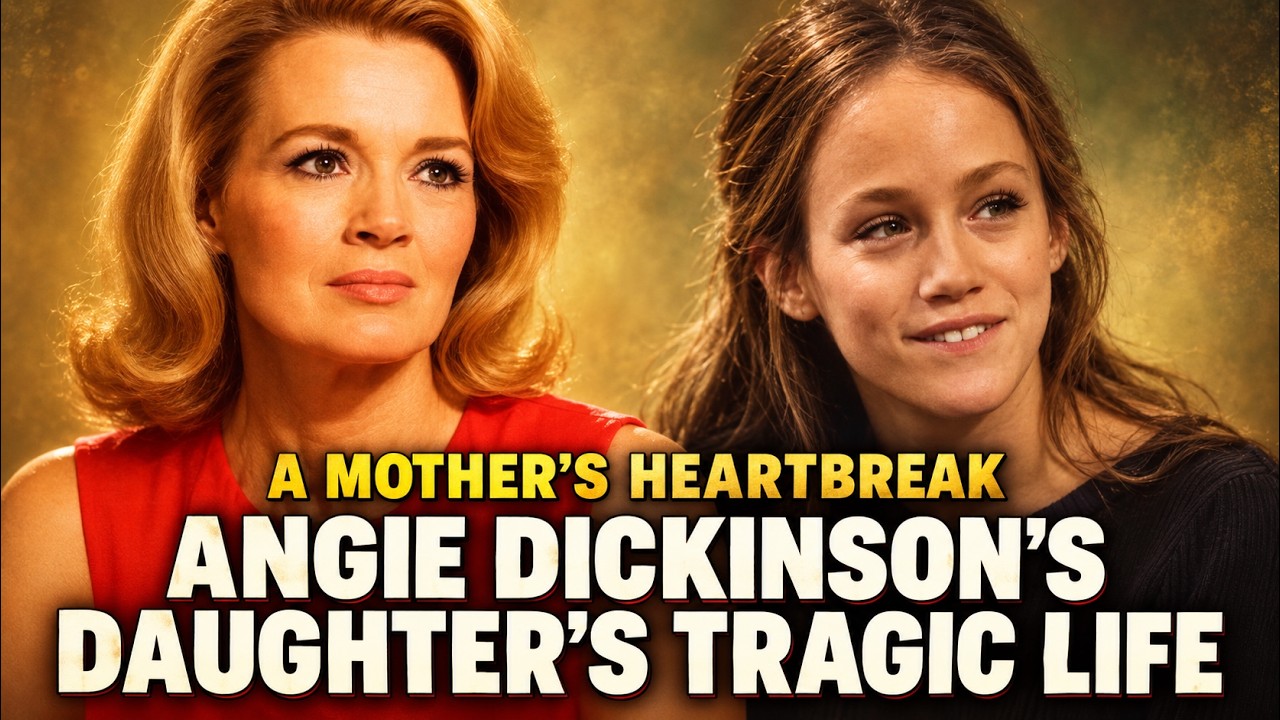
Against all odds, she survived, but her traumatic beginning shaped a life marked by profound challenges that were poorly understood at the time. As a child, Nikki showed signs of what would later be recognized as Asperger’s syndrome. She did not speak her first word until age three. She struggled with extreme sensory sensitivities, finding the hum of a vacuum cleaner physically painful, becoming distressed by certain textures, and overwhelmed by noise or crowds.
She developed rigid routines and detailed collections of unusual objects, from batteries to oddly shaped rocks. She was also exceptionally gifted, with a deep talent for mathematics and the sciences. Nikki could name every U. S.
president in order, recalled obscure historical dates with remarkable accuracy, and kept meticulous journals about weather patterns. Her intelligence was profound, but it was trapped inside a mind that processed the world through an overwhelming filter. In the 1960s and 1970s, autism spectrum disorders were barely understood. Doctors labeled her condition with vague terms like minimal brain dysfunction or severe learning problems, leaving her parents without a clear map to help her.
Angie stepped back from the height of her career to care for her daughter, turning down roles and searching for specialized schools and therapies. The relentless stress of raising a child with such profound needs began to strain her marriage to Burt Bacharach, who was often away and consumed by his music. “When you almost lose a child, you hold on even tighter,” Angie later said. “I spoiled her badly, maybe too much because I never knew if I would get to keep her.
”
Burt and Angie separated in 1976 and divorced in 1980, but they remained connected through their shared devotion to Nikki. As Nikki entered adulthood, she studied geology at California Lutheran University, hoping to turn her love of nature into a career, but her poor eyesight and sensitivity to sound made the environment difficult. She took low-pressure jobs, volunteered at animal shelters, and wrote poetry. She longed for romantic connection but struggled to navigate social expectations, and never found someone who could fully understand her.
As she reached her 30s, Nikki’s mental health declined sharply. She developed treatment-resistant depression, severe social anxiety, and paralyzing panic attacks. She described her brain as a computer with a virus that was not working right. Angie had a special apartment designed for her with soft lighting and sound-dampening materials to reduce sensory overload, but Nikki’s world grew smaller and more isolated.
Her one true sanctuary was Tahiti, where she and her mother traveled more than 30 times. The calm of the ocean seemed to quiet her internal storm like nothing else could. In January 2007, at age 40, Nikki passed away at her home in Thousand Oaks, California, following a long struggle with her mental health. The family’s statement said she “quietly and peacefully chose to escape the ravages to her mind brought on by Asperger’s.
” Her final wish was to be cremated and have her ashes scattered in the turquoise waters of her beloved Tahiti. Angie was shattered. “She was my life,” she later said. “I think about her every day.
There isn’t a moment she isn’t with me. ”
Burt Bacharach also carried deep regret. “I tried to fix her,” he said years later. “I was always trying to find a doctor, a therapy, a solution.
I should have just accepted her. I should have let her be. ”
After Nikki’s death, Angie retreated from public life, effectively ending her acting career. She continued to live quietly in Beverly Hills, keeping a small circle of close friends.
When she did speak, she spoke with honesty about her daughter’s struggles, and admitted, “If I had known, if I had understood what we were dealing with, maybe I could have helped her in a different way. ”
Without launching a foundation or publicity campaign, Angie quietly became a voice for parents of children on the autism spectrum, supporting mental health and autism research through private, anonymous donations. She turned 93 in 2024, described by those close to her as kind and reflective, forever marked by the loss that defined her later years. “You don’t stop being a mother when your child dies,” Angie once said.
“You just keep loving them differently. ” That enduring love, rather than her fame or films, became her most lasting legacy.