On the afternoon of April 12, 1945, President Franklin Roosevelt was sitting for a portrait in Warm Springs, Georgia, when he suddenly said, “I have a terrific headache. ” Those were his last complete words. He collapsed and never regained consciousness. The woman beside him was not his wife.
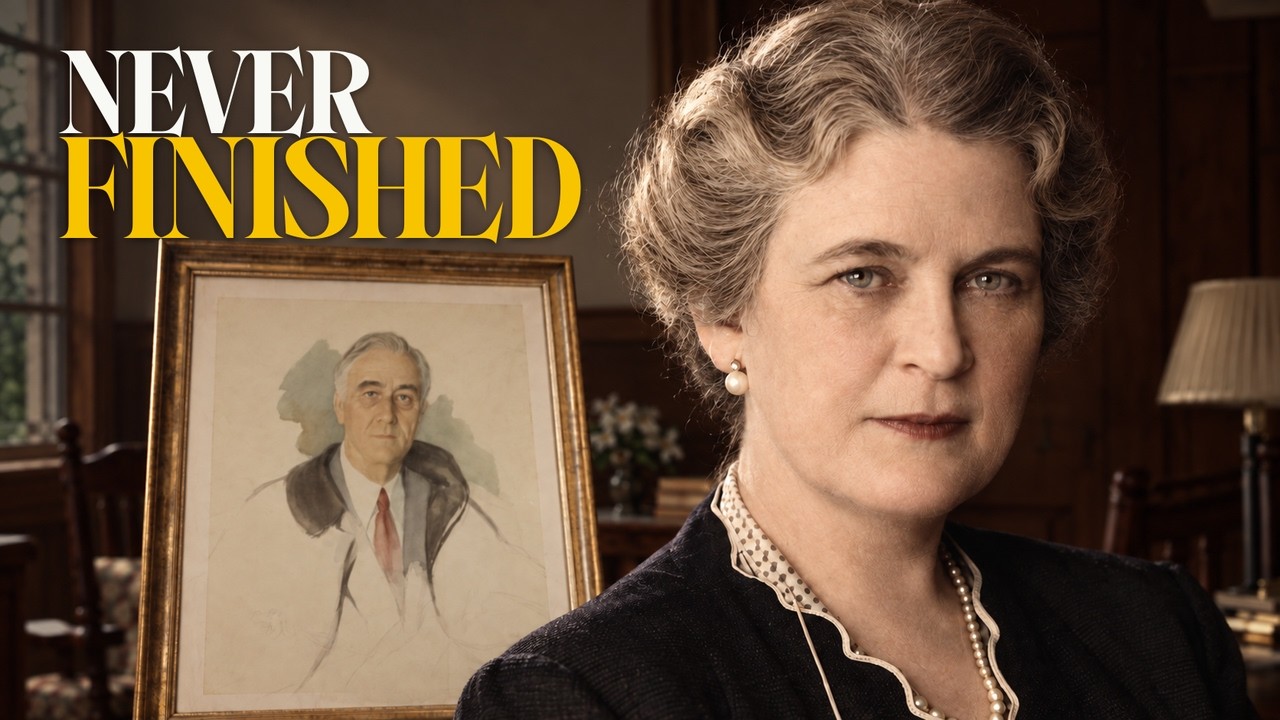
She was Lucy Mercer Rutherford, the woman he had loved in secret for nearly three decades. By the time First Lady Eleanor Roosevelt arrived in Georgia after midnight, Lucy had already been driven away, removed from the story as carefully as she had been hidden for 27 years. The portrait, painted by artist Elizabeth Shoumatoff, was left unfinished. It still hangs today in the same cottage, the president’s face fully rendered while the background remains bare canvas.
No one has ever been asked to complete it. The story begins in 1913 Washington, when a young woman from a distinguished but impoverished Maryland family took a job that most women of her class considered beneath them. Lucy Mercer became the social secretary to Eleanor Roosevelt, managing correspondence and appointments for the busy mother of five who was married to the Assistant Secretary of the Navy. Lucy was discreet, efficient, and carried herself with the quiet refinement of old money that had run out.
Eleanor trusted her completely. Franklin, then in his early thirties and married for nearly a decade, noticed her for reasons that had nothing to do with the mail. By 1916, something had shifted. Franklin found reasons to linger near her desk.
Lucy stayed late, long after the rest of the household had gone home. Nothing was said aloud, but everything was understood in the silence that governed houses like the Roosevelts’. In the summer of 1918, Franklin sailed to Europe on a war inspection tour. He returned home thin and sick with influenza, having contracted the illness aboard ship during the global pandemic that would ultimately kill tens of millions.
Eleanor met him at the pier, brought him home, and began unpacking his luggage while he recovered upstairs. Between his shirts, she found a bundle of letters. She recognized the handwriting immediately. They were love letters from Lucy Mercer to her husband.
According to her biographer, Eleanor sat on the floor of that quiet room for a long time before opening them. When she finally did, she read every one. She later described that evening starkly: “The bottom dropped out of my own particular world, and I faced myself, my surroundings, my world, honestly for the first time. ”
Eleanor did not scream.
She did not throw the letters in his face. When Franklin was well enough to confront, she offered him a divorce, simply and without threats. In 1918, divorce carried a social price that fell almost entirely on the wife, and Eleanor was fully aware of the cost. Franklin asked for time to think.
He was 36, ambitious, and already looking far beyond the Navy Department. Two people soon weighed in. His mother, Sara Delano Roosevelt, controlled the family fortune and made it unmistakably clear that divorce would cut off his access to it forever. Her grip on the family name, the Hyde Park estate, and the money had never loosened, and she had no intention of allowing a replacement for the daughter-in-law she had chosen.
The second voice was Louis Howe, the journalist-turned-political adviser who had tied his entire career to Franklin’s future. Howe told him bluntly that no divorced man could win national office in that era. He was not speaking as a worried friend; he was protecting an investment. Howe had believed for years that Franklin could become president, and a scandal would destroy that path.
Between the mother who controlled the money and the adviser who understood ambition, the calculation became brutally simple. Whatever Franklin felt for Lucy Mercer was not worth the price of keeping her. He promised Eleanor he would never see Lucy again. She accepted the promise, not because she believed one sentence could repair the marriage, but because the alternative cost more than she was willing to pay with six children to raise.
From that year forward, biographers agree, the Roosevelt marriage functioned as a practical political partnership. Genuine mutual respect and shared purpose remained. The wound never fully healed. Lucy Mercer built a different life.
On February 11, 1920, at age 28, she married Winthrop Rutherfurd, a wealthy widower nearly 30 years her senior with six children of his own. To outsiders, it looked like a sensible match for a well-born woman without money. She gained a name, a home, and standing she could never have recovered as a single woman connected to scandal. In 1922, she gave birth to her only child, Barbara.
Two years after that marriage, Franklin was struck by illness again. In the summer of 1921, at his family retreat on Campobello Island, he contracted a disease that left him paralyzed from the waist down for the rest of his life. He fought his way back into public life through years of grueling rehabilitation, learning to stand behind podiums with steel braces and the arm of another man holding him upright. In 1924, he was brought to a run-down resort in rural Georgia built around naturally warm mineral springs, where the buoyant water helped him regain some use of his legs.
The difference was so significant that he returned year after year, eventually buying the property and turning it into a treatment center for polio survivors who could not afford care. Warm Springs became the one place where Franklin Roosevelt could be simply a patient among patients, rather than a politician under constant watch. Eleanor had nursed him through the terrifying early weeks of his illness, sitting by his bedside through fevered nights. In the recovery years that followed, she became one of the most important political partners of his career, attending rallies he could not reach and delivering speeches in halls he could not enter.
At some point in the mid-1920s, according to historians who have tracked the evidence, Franklin’s 1918 promise quietly stopped being kept. The exact year remains disputed among biographers. There was no announcement, no dramatic scene. Just a slow return of letters exchanged, apparently, through trusted hands rather than ordinary mail.
Only four letters from that period remain, dated between 1926 and 1928, preserved in the private Roosevelt family archive. Their contents remain sealed from public view. Their existence alone confirms that correspondence resumed; what they said has never been made available to historians. Lucy, by then, was a wife and mother running a large household of stepchildren in New Jersey.
On paper, their lives had moved in entirely separate directions. Any correspondence that still passed between them traveled through channels far quieter than their public lives suggested. In 1933, at the height of the Great Depression, Franklin Roosevelt became President of the United States. He was the most photographed, most protected, and most constantly watched man in the country.
One might have expected keeping a secret at this level of exposure to become more difficult. Instead, the White House itself, with its layers of loyal staff and restricted access, became one of the safest places in the country to keep one. On more than one occasion during the early and mid-1940s, according to reports, a woman signed the White House visitor log not as Lucy Rutherfurd but under the alias “Mrs. Paul Johnson.
” She was allowed to go quietly upstairs to the private quarters, away from the press corps below and away from staff who might recognize her name from two-decade-old headlines. Eleanor was rarely in the White House for long stretches during the war years. She crossed the Atlantic to visit troops in Britain in 1942 and toured the Pacific theater in 1943, traveling tens of thousands of miles to see the war herself rather than read about it from Washington. It was exactly the kind of prolonged absence that had once allowed something else to grow quietly inside her home in 1917 and 1918.
By the 1940s, it happened again. By the summer of 1944, the arrangements had become bolder and required outside help. Franklin’s daughter Anna, who served as her father’s unofficial hostess while her mother traveled for war causes, took on the task of arranging private dinners between her father and the woman her mother must never know about. Anna carried the secret heavily.
She was protecting a father she loved while concealing something serious from a mother she loved equally. There is no evidence that Eleanor ever learned of Anna’s role during Franklin’s lifetime. In the final year of his life, mother and daughter lived in the same White House, each carrying entirely different versions of what was happening inside it. In the spring of 1944, Winthrop Rutherfurd died after a long illness, making Lucy a widow for the first time since 1920.
For the first time in 24 years, she was no longer anyone’s wife. Her visits to Franklin, though brief and carefully kept secret, became, in a strange way, the only part of her life that still felt entirely her own choice. Franklin’s health in that year was telling a harsher story than the newsreels showed. A private medical examination revealed serious heart disease and dangerously high blood pressure, in a man the public saw only standing on platforms and waving from car windows, the symbol of steadfastness.
He traveled to Yalta in February 1945 to help shape the postwar world and returned thinner, paler, and more exhausted than the country had ever been allowed to see. Still, the nation re-elected him in November 1944 to a fourth term, something no other president had ever done or ever would. Few Americans watching him wave from the back of that car understood how little time remained, or how carefully both truths had been kept from them: his failing health and the secret that still held. On April 11, 1945, Lucy arrived at the Little White House in Warm Springs, accompanied by Elizabeth Shoumatoff, who had been hired to paint the president’s portrait as a gift.
Shoumatoff later wrote about that afternoon in her own memoirs. She continued sketching the background while Lucy watched. It was an ordinary scene, almost familiar: an artist working by the window light, a president reviewing papers at his small desk, and a woman sitting near him without a word, in the place where she had learned over 27 years to make her presence natural without declaring it. That evening passed quietly, as most evenings at Warm Springs did.
A small gathering of old friends around the president, a radio playing in another room, the particular ease of a dying man who does not yet know this is his last. The painting, still only an outline, remained waiting on its easel for the morning light. The next morning, April 12, Franklin sat for the portrait again while Shoumatoff worked quietly at her easel a few feet away. He was reviewing correspondence and signing documents brought by an aide, for a few more minutes just a man at a desk performing the ordinary tasks of the presidency.
Lucy sat where she always sat in that cottage, close enough to watch, far enough not to interfere. Just before one o’clock, he raised his hand to his temple. “I have a terrific headache,” he said. It was the last complete sentence of his life.
He slumped forward in his chair, and the quiet room became a scene of sudden, desperate motion. He never regained consciousness. Doctors were called from the nearby clinic. An ambulance was summoned.
Within hours, the President of the United States, elected four times, the man who had steadied a nation through depression and world war, was dead at 63. The news reached Washington within the hour. Vice President Harry Truman was called to the White House that evening and was sworn in as president before the day was out, inheriting a two-front war and an unfinished peace, almost without warning and with no preparation for the office. None of that grief, as it rolled across the nation in the following days, carried any hint of the detail witnessed in the small room at Warm Springs.
Lucy Mercer Rutherfurd did not wait to be asked to leave. Before the president’s widow landed in Georgia, before any official photograph was taken, before the world’s cameras reached the gates of Warm Springs, she was already being driven away from the cottage grounds, out of the story, exactly as she had spent 27 years learning to do. She did not attend the funeral. She appeared in no photograph of that day or any day connected to it.
For 30 years afterward, her name appeared in no official account of how Franklin Roosevelt spent the final hours of his life. The woman beside him when he died was not his wife. She was the woman he had promised 27 years earlier, in a Washington bedroom with a bundle of letters lying on the floor, that he would never see again. On the easel behind them, the portrait remained exactly as Shoumatoff had left it when the room erupted into motion.
The president’s face was carefully painted, while the background around him was still raw canvas untouched by any brush. There was nothing left to paint. Eleanor Roosevelt landed in Georgia that night and learned more than one kind of loss within hours. She learned her husband had died.
She also learned, piece by piece in the following days, that Lucy had been there at the end, and that their daughter Anna had been quietly arranging those meetings all along. It was a double wound delivered at once: the husband who had broken his promise, and the daughter who had helped him keep breaking it. Eleanor said little about it publicly, then or later. She had spent 27 years learning how to carry a secret without showing it on her face, and she carried this one the same way.
She went on to become a stateswoman in her own right, a United Nations delegate, and a driving force behind the Universal Declaration of Human Rights. She built that second life on the same discipline her marriage had demanded of her since 1918. She did not drown in bitterness. She did not rewrite the records to punish anyone, not her husband and not her daughter.
She simply continued her public life as she always had, carrying in private what she now knew about both of them. Lucy Mercer Rutherfurd returned to her home in New Jersey, also a widow now, in a life without a husband and without any right to the man she had just lost as well. She gave no interviews. She wrote no memoirs.
At some point in the years that followed, according to all available accounts, she destroyed almost all of her correspondence with Franklin Roosevelt. Decades of letters reduced to nearly nothing by her own hands. Only four letters survived, hidden in an archive she likely never expected the public to see. It was, in her own way, a final chapter of the discipline that had defined her entire adult life: protecting him, protecting his family, and disappearing from the records just as completely as a name that had once opened every door in Washington could disappear.
Whatever Lucy Mercer Rutherfurd’s true feelings were toward the man she had loved in secret for most of her life, she deliberately chose to take them with her. On July 31, 1948, she died of leukemia at her home in Aiken, South Carolina. She was 57 years old, three years almost to the season after the death of the man she had loved for most of her life. The portrait Elizabeth Shoumatoff was painting on that final morning was never finished.
No one has ever been asked to complete it. It hangs today exactly as it was left on April 12, 1945, at the Little White House museum in Warm Springs. The president’s face is painted in careful tones. The space around him remains empty canvas.
A woman who was never allowed into the frame remains forever standing outside it. Two women loved the same man for most of their lives. One received his name, his children, the public partnership, and a place in the official history books. The other received a handful of secret afternoons, an alias in a visitor log, and an empty space on an unfinished portrait where her presence should have been.
In the end, neither received the full truth spoken aloud while he was still alive to say it. The portrait remains unfinished. Perhaps some things are meant to stay that way.