A Memphis parking lot, April 4, 1968, six in the evening. An ambulance was being loaded. Three parties made predictions about what would happen to the women closest to Martin Luther King Jr. after his death.
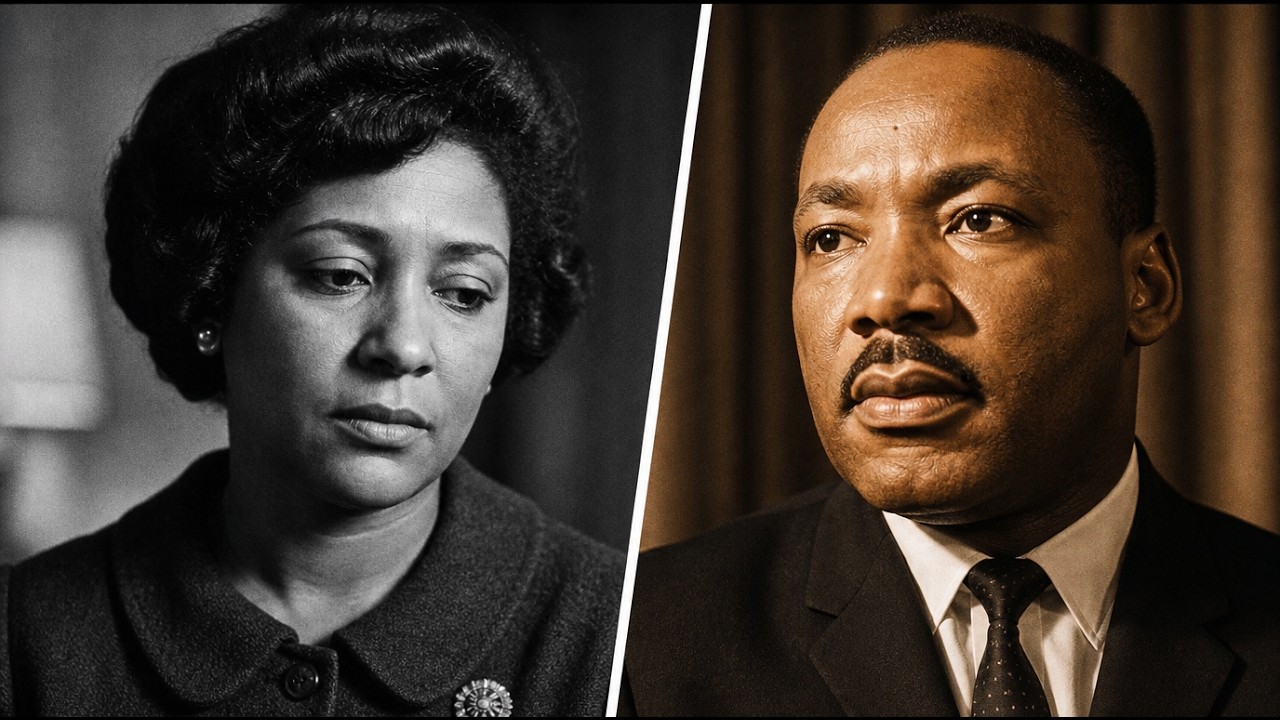
The FBI, through years of electronic surveillance and hotel room recordings, believed the private records they had collected would ultimately destroy his public legacy. J. Edgar Hoover had called King the most dangerous man in America, and he meant it as an operational directive. His agents were confident with total institutional certainty that exposure would end King’s career.
Movement organizers calculated that his private life could be contained, that the women would stay silent, and that the official biography would hold. Somewhere in that parking lot, one aide made a split-second calculation that a woman was about to make a mistake. He stepped in front of her and said, “No, Senator, I don’t think you want to do that. ” She stopped.
She was not the wife. She returned to her room. Two of those predictions were wrong. One woman wrote her memoir.
One died in the neighboring room. The wife built the legacy with everything she had, including everything she knew and chose never to say. Her name was Georgia Davis Powers. She was 44 years old, the first African American and first woman elected to the Kentucky State Senate, taking office in January 1968.
She was in Memphis to support King’s march for the striking sanitation workers. She had a room in the same building. She had been with King the night before. When the shot rang out from the balcony above, she moved toward the ambulance.
The aide who blocked her path was Andrew Young, who later became U. S. Ambassador to the United Nations and mayor of Atlanta. He said what he said.
The ambulance left without her. But here is what the official account of that night never made clear. There were two women in that building who were not Coretta Scott King, and only one of them was turned away from the ambulance. Georgia Davis Powers was born on October 19, 1923, in Springfield, Kentucky.
She organized campaigns for fair housing, founded allied civil rights organizations, and in 1964 helped bring King to Frankfort for the march that helped push Kentucky to become the first Southern state to pass a civil rights law. She first met King at that march. Three years passed. The relationship began in March 1967.
In her memoir, published in 1995, she described it in her own words. The relationship between Martin Luther King Jr. and me began with mutual admiration. Gradually, we grew attached to each other until it went beyond fellowship into intimacy.
His aides knew about it. They worked to keep it secret. King was the most closely watched public figure in America, and every piece of personal information was used as a weapon against him. On the evening of April 3, 1968, King delivered his “Mountaintop” speech at Mason Temple, a speech those present described as marked by an unusual clarity about the possibility that he would not survive.
That night, Georgia Powers was at the Lorraine Motel. The next afternoon, he was shot on the balcony outside. She flew back to Kentucky. She did not speak about any of it for 27 years.
She kept the secret for 27 years. Then she sat down and wrote her memoir. This is what she said about that decision. She had lived for decades in fear of exposure.
She said she no longer felt that fear. So she told the truth. The book, “I Shared the Dream,” was published in 1995. It confirmed what Ralph Abernathy, King’s closest friend, had written in his 1989 memoir: that King had been with a Black woman who was a Kentucky legislator on the night before his death.
Abernathy did not name her. Georgia Powers named herself. She said he was a great man, but ultimately still a human being. She continued her work in Louisville after leaving the Senate in 1989.
She chaired Jesse Jackson’s two presidential campaigns at the state level, and received honorary doctorates from the University of Kentucky and the University of Louisville. The president of the Kentucky NAACP said of her: “When you think of civil rights in Kentucky, you must start with Georgia Davis Powers. ” She died of congestive heart failure on January 30, 2016. She was 92 years old.
As for the woman in the neighboring room, Dorothy Cotton was born on June 9, 1930, in Goldsboro, North Carolina. She studied at Shaw University by cleaning the home of the university president, earned a master’s degree from Boston University, and joined the movement through a church in Petersburg, Virginia. She became the only woman on the executive staff of the Southern Christian Leadership Conference, and its education director, where she ran the Citizenship Education Program that taught thousands of Black Americans their voting rights and trained organizers across the South. In August 1963, she printed the “I Have a Dream” speech.
In December 1964, she traveled with King to Oslo when he received the Nobel Peace Prize. She was registered in the room next to King’s at the Lorraine Motel in April 1968. She was among the last people to see him alive. She was in the room next door.
She had been there for years, the woman who wrote the Dream speech, who traveled to Oslo, who was the only woman on the executive staff. When David Garrow named her publicly as the most important woman in King’s private life, Dorothy Cotton had been dead for exactly one year. Pulitzer Prize-winning King biographer David Garrow, in his 1987 biography “Bearing the Cross” and in a 2019 article based on FBI surveillance summaries, described Cotton as King’s constant companion throughout the movement years. Cotton herself never publicly confirmed or denied the intimate dimension of what existed between them.
After the assassination, she built her own lasting legacy. She worked at the King Center in Atlanta, served as director of student activities at Cornell University from 1982 to 1991, and founded the Dorothy Cotton Institute to continue the civic education work that began in the 1960s. In 2010, she received the National Freedom Award from the National Civil Rights Museum. She published her memoir in 2012.
It was about the structure of the movement. It was not about Memphis. In July 2017, as her health declined, she gave two days of interviews to academic Jason Miller. She spoke unexpectedly about King and said the memories of those final hours in Memphis had never left her, and that she had suppressed them for 50 years.
She died on June 10, 2018. She had turned 88 the day before. The David Garrow article naming her publicly was published in June 2019. One year after her death.
She never had to read it. In 1964, a package arrived at the King home addressed to Coretta. It was from the FBI. It contained surveillance materials and a written letter designed to end the marriage and end the man together.
She opened it. She and Martin read it together. Then she continued her work. And when he was killed four days after Georgia Powers left the Lorraine Motel, Coretta Scott King traveled to Memphis and led the march he had been planning.
Coretta Scott King was born on April 27, 1927, in Marion, Alabama. She was in Atlanta when King was shot. She received the call. Four days later, she traveled to Memphis and walked through the city where her husband was killed with their children beside her.
She founded the King Center for Nonviolent Social Change in Atlanta in the same year he died. She spent the following decades campaigning to make his birthday a national holiday. Reagan signed the legislation in 1983, and it was first observed in January 1986. Her memoir, “My Life with Martin Luther King Jr.
,” published in 1969, described the movement, the marriage, and the public man. There was no mention of Georgia Powers, no mention of Dorothy Cotton, no mention of what was in the envelope the FBI sent to her home. She maintained that position through 37 years of widowhood. She died on January 30, 2006.
The same date Georgia Powers would die ten years later. The women closest to King’s private life shared a death date they never shared publicly in their lifetimes. In July 2025, the Trump administration released more than 240,000 pages of FBI surveillance files on King, over the explicit objection of his sons Martin III and Bernice, who asked those reviewing the files to do so with compassion, restraint, and respect for the continuing grief of our family. The files confirmed what historians had understood in outline for decades: a systematic government operation whose explicit goal was to destroy King through defamation.
The FBI thought it had the power to write his ending. It turned out the women decided that. Georgia Powers chose to tell her story on her own terms, 27 years after Memphis, when she had finally let go of fear. Dorothy Cotton held her memories for 50 years, then confided them cautiously to one researcher in her final year, and died before the archives could catch up with her.
Coretta Scott King chose silence as a deliberate act, and built the King Center, the national holiday, and 37 years of continuous advocacy from that choice. She outlived the director who sent the package to her home. She outlived every agent who recorded what happened in those hotel rooms. Three women, three silences, three completely different choices about what to do with what they knew.
The FBI thought it could write the ending. The women wrote it themselves.