In 1965, Falstaff Beer was the third-best-selling beer in the United States, trailing only Budweiser and Schlitz. The company shipped 7. 5 million barrels in a single year and operated 16 breweries from California to Rhode Island. For working-class drinkers across Missouri, Nebraska, Louisiana, and Texas, Falstaff was not a preference.
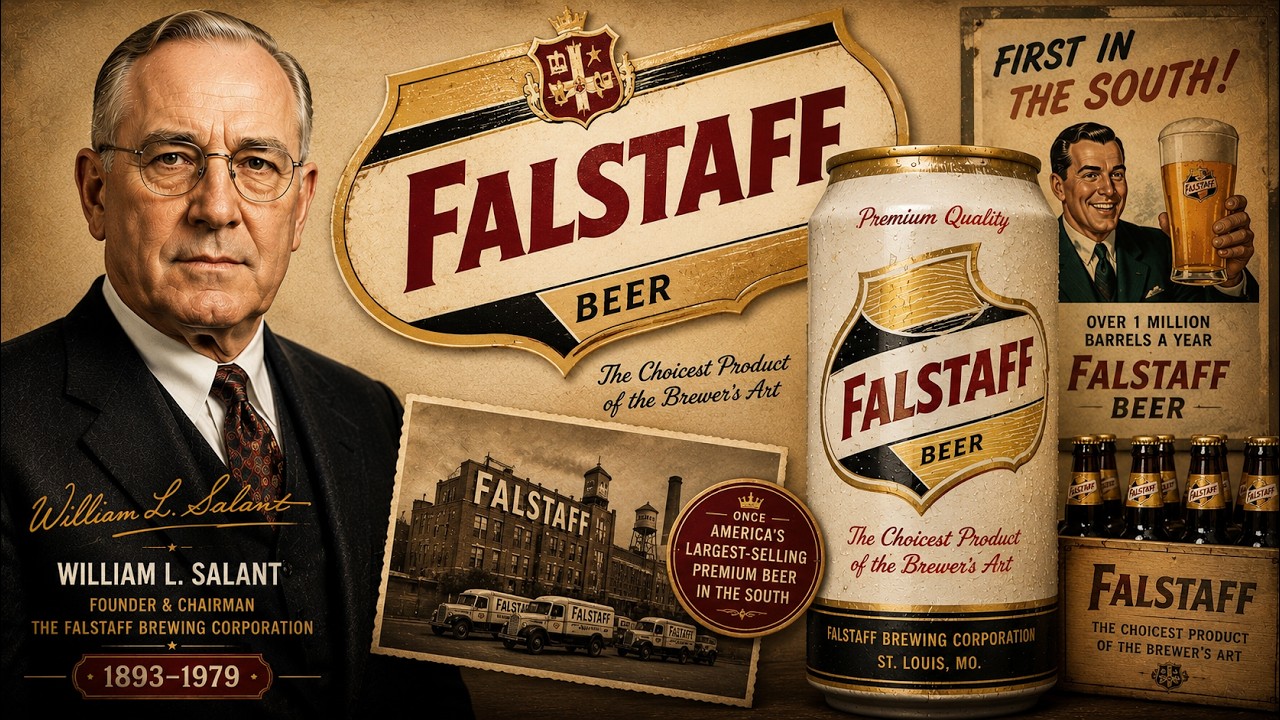
It was simply what beer was. Thirteen years later, in 1978, Falstaff Beer filed for bankruptcy. The collapse did not happen because a stronger competitor outspent the company or because Americans stopped drinking beer. Consumption was rising.
Falstaff collapsed during one of the longest sustained periods of beer consumption growth in American history, while people were still buying the product. The story begins in St. Louis, Missouri, in 1917. The city was the fourth-largest in America, a working river city where German immigrant families brewed beer in limestone cellars above the Mississippi.
Heinrich Adam Griesedieck, born in Stroberg, Germany, in 1851, arrived in the United States in the 1870s. He settled in St. Louis, worked as a brewer’s assistant for years, and by the 1890s had enough capital to open his own operation. The Griesedieck Brothers Brewery took its first commercial orders in St.
Louis in 1911 at 1920 Shenandoah Avenue. The early years were difficult. The American brewing industry was dominated by established names like Anheuser-Busch, Pabst, and Schlitz. The Griesedieck operation focused on the neighborhoods the big breweries ignored: union halls, corner taverns, and working-class wards where customers ordered by habit and valued consistency above all.
Then came 1920. The 18th Amendment ended legal alcohol production in America. More than 1,300 breweries were operating in 1919; most never reopened. The Griesedieck family did not leave or sell.
They converted the brewery to near beer, soft drinks, malt syrup, and ice. A debt of roughly $40,000 borrowed against the property sustained them through the 13 years of Prohibition. When the 21st Amendment repealed Prohibition on December 5, 1933, Joseph “Papa Joe” Griesedieck, Heinrich’s son, saw what most people missed. The competition was gone.
More than a thousand breweries would never return, and the demand for beer had merely been compressed, not eliminated. Papa Joe acquired the rights to the Falstaff name and trademark in 1933 from a dormant St. Louis brewery. He moved production into the Shenandoah Avenue facility, hired back workers he could find, and brewed the first commercial batch of Falstaff Beer before the end of the year.
First-year production was approximately 75,000 barrels. Falstaff was built on the German lager tradition: bottom-fermented, cold-conditioned, aged longer than most competitors were willing to wait. The recipe used domestic two-row barley malt and a modest proportion of corn adjunct, a common American practice. Papa Joe’s brewmasters kept the adjunct ratio low enough that the malt character survived.
The result was cleaner than pre-Prohibition ales, lighter than dense German imports, and dry without being bitter. Falstaff adopted steel can distribution earlier than most regional competitors and priced its standard can or bottle at 11 cents, one cent below Pabst Blue Ribbon and two cents below Budweiser. At a time when a St. Louis factory worker earned about $1.
20 an hour, that price point meant a man could buy a beer after work without thinking about it. Papa Joe did not try to compete in markets where Anheuser-Busch and Pabst had deep roots. He went to midsized industrial cities along the Mississippi corridor, Gulf Coast port towns, and railroad junction cities of the central plains. By the late 1930s, Falstaff had established company-owned distribution routes connecting St.
Louis to Kansas City, Memphis, and New Orleans. The refrigerated trucks guaranteed that each delivery tasted the same as the last. In 1936, Falstaff signed its first regional radio sponsorships in Missouri and Illinois, linking the brand to baseball broadcasts. By 1940, the company held tap lines in union halls, corner taverns, and railroad dining cars from St.
Louis to the Gulf of Mexico. The 1940s transformed the company. When the United States entered World War II, grain was rationed, steel for cans was diverted to military production, and gasoline was allocated by government permit. Falstaff adapted by supplying beer directly to the U.
S. military. Specially marked cans were shipped to American forces in the Pacific theater. On the production lines, women entered the brewery in significant numbers for the first time.
The company did not miss a single major distribution commitment during the war years. When veterans returned in 1945 and 1946, many returned to Falstaff because it was what they had drunk before leaving. Sales increased 31 percent between 1945 and 1948. A second production facility opened in Omaha, Nebraska, in 1948, the first major geographic expansion beyond St.
Louis. Papa Joe then hired an advertising agency and told them to find the voice of the brand and make it sound like it had always been there. They found that voice in Dizzy Dean, one of the most celebrated pitchers in St. Louis Cardinals history and winner of a 1934 World Series.
Beginning in 1950, Dean became the television and radio voice of Falstaff Beer, calling Cardinals games on the Falstaff Broadcasting Network. His casual Arkansas draw and genuine enthusiasm made the endorsements believable. For nearly a decade, for millions of Midwestern and Southern sports fans, Dizzy Dean and Falstaff Beer were essentially the same thing. The campaign, built around the slogan “Falstaff – America’s Premium Quality Beer,” ran consistently through the 1950s.
By 1950, Falstaff was shipping more than 3 million barrels annually. By 1955, the figure had climbed past 5 million. The brand held dominant market positions in Missouri, Nebraska, Iowa, Louisiana, Texas, and New Mexico. Papa Joe Griesedieck died in 1955.
He had built one of the five largest brewing operations in the United States in 22 years. Leadership passed to his son, Alvin Griesedieck. Alvin was not Papa Joe. Papa Joe had built the company through relationships, geographic discipline, and an understanding that a regional brewery’s greatest asset was the trust of a specific community of drinkers.
Alvin inherited the company during the age of the conglomerate, national scale, and the management consultant. The lesson American corporations drew from the postwar boom was consistent: bigger was better. Alvin believed it. The expansion continued.
A new brewery opened in San Jose, California, in 1954. A facility in El Paso, Texas, came online in 1956. In New Orleans, Falstaff opened a major production facility on Cleo Street that would become one of the largest single-site brewing operations in the South, employing more than 600 workers at its peak. By 1960, Falstaff operated 12 breweries across nine states.
By 1964, the number had grown to 14. In 1965, Falstaff reached its defining number: 7. 5 million barrels shipped in a single year, third place in the American beer market. One in 14 beers sold in the United States carried the Falstaff name.
The company employed more than 6,000 people across 16 facilities, and annual revenue exceeded $200 million. The Falstaff Broadcasting Network had expanded to carry games for the Houston Colt 45s, the Oakland Athletics, and minor league affiliates. What the numbers did not show was what was happening inside the product. Sixteen breweries meant 16 separate production environments, 16 sets of local water chemistry, and 16 slightly different interpretations of a recipe developed in a single facility in 1933.
Quality control systems of the mid-1960s could not maintain absolute consistency across that geographic spread. The beer was still good in most markets, but it was no longer precisely the same beer in New Orleans as in St. Louis, or in San Jose as in Omaha. Some loyal drinkers felt faintly that something had shifted.
In 1966, Anheuser-Busch increased its national advertising budget by 40 percent in a single fiscal year. The company was not competing for market share; it was competing for the entire market. Miller Brewing Company, acquired by Philip Morris in 1969, moved in the same direction with a tobacco conglomerate’s capital reserves behind it. Miller High Life, repositioned and backed by an aggressive advertising campaign, was becoming a serious national competitor.
Falstaff’s management reached a logical, coherent, and catastrophically wrong conclusion: the only way to compete at national scale was to become larger. The acquisition strategy began in the late 1960s and accelerated into the early 1970s. In 1965, Falstaff acquired the Narragansett Brewing Company of Cranston, Rhode Island, the largest-selling beer in New England, for approximately $17 million. On paper it looked like a bargain.
But the acquisition brought aging equipment, deferred maintenance, and a regional identity so specific it could not survive a St. Louis ownership structure. In 1972, Falstaff acquired the Ballantine Brewing Company of Newark, New Jersey, a brand with roots back to 1840 that was already in serious decline. Falstaff was not buying strength; it was buying distress at prices that seemed reasonable until the operational costs of rescue were added to the ledger.
Each acquisition required capital investment, new sales staff, distributor relationships, and advertising. Each added debt to a balance sheet that had been clean and conservative under Papa Joe. By 1973, Falstaff operated breweries in 17 locations. The economics behind the number were not sound.
The quality problem became impossible to ignore. Drinkers in St. Louis noticed Falstaff from the Missouri facility tasted different from the beer from newly acquired Northeast plants. Bartenders in New Orleans reported inconsistent kegs from the Cleo Street facility.
Grocery buyers in Texas began asking questions they had never asked before. In Pittsburgh, by one account, bartenders were pulling untouched pints off tables at the end of the evening. That had not happened before. Letters began arriving at St.
Louis headquarters in 1971 and 1972 from men who had drunk Falstaff since before the war, asking what had changed. The company’s response was formal, professional, and entirely inadequate. Form letters went out, assurances were offered. The drinkers were not reassured.
They stopped buying. The sales numbers told the story. Falstaff shipped 7. 5 million barrels in 1965.
By 1970, the figure fell to 6. 2 million. By 1973, it was under 5 million. Each year’s report arrived with a new explanation: competitive pressure, rising ingredient costs, the oil embargo.
The explanations were not false; they were insufficient. In 1973, Falstaff introduced new packaging and a modernized can design intended to appeal to a younger demographic. The redesign cost money the company could not easily spare and moved no meaningful volume. Then came the price cuts in 1974 and 1975, which distributors read as a signal of desperation.
Several large regional distributors in Texas and the Midwest quietly shifted their primary commitments toward Budweiser and Miller. The advertising budget, which should have been protected above all else, was cut instead. The Falstaff Broadcasting Network, the radio and television infrastructure built around Dizzy Dean, was dismantled progressively through the early 1970s. Sports sponsorships were allowed to lapse.
The voice of Falstaff went quiet at the exact moment the brand needed to be heard most. The cascade moved with the efficiency of compound interest working in reverse. Fewer advertising impressions meant fewer new drinkers. Fewer new drinkers meant declining volume.
Declining volume meant less revenue for distribution. Less distribution meant fewer tap handles and fewer shelf positions. The loop closed on itself. The acquisitions became anchors.
Narragansett was losing money. Ballantine never recovered. The debt became critical in 1975. Falstaff’s bankers, who had extended credit through the acquisition years on the assumption that volume would grow, saw volume declining in every major market.
The New Orleans brewery on Cleo Street closed in 1975; 623 workers received their final paychecks. The Fort Wayne, Indiana facility closed in 1976, followed by the Galveston, Texas plant the same year. In 1977, Falstaff sold the original St. Louis brewery on Shenandoah Avenue, where Papa Joe had brewed the first batch.
The transaction closed on a Friday. There was no ceremony. The end came in 1978. Falstaff Beer filed for Chapter 11 bankruptcy protection on February 18 of that year.
Total liabilities exceeded assets by a margin that made reorganization effectively impossible. The Omaha brewery continued limited production through the proceedings, then stopped. The last Falstaff keg was tapped. The last delivery truck made its final route.
The sign came down. The Falstaff name did not disappear entirely. The trademark passed through several ownership changes. Anheuser-Busch acquired the brand in the 1980s and attempted limited production in a few markets, contracting with existing breweries.
The beer bore the name and the red-and-white design, but little else of what Papa Joe had built. Pabst Brewing Company acquired the Falstaff brand in 1999, adding it to a portfolio that also included Ballantine, the same brand Falstaff had purchased in 1972. Today, Falstaff beer is produced through contract brewing arrangements available in limited markets, primarily in the Midwest and South. It is inexpensive and consistent, but not by any reasonable measure the same product a union worker in St.
Louis ordered on a Friday evening in 1962. Among collectors of vintage American brewery memorabilia, Falstaff occupies a position of serious demand. Flat-top Falstaff steel cans in good condition from the early 1950s sell for $45 to $120, depending on variant and provenance. An original Falstaff neon bar sign in working condition sells for $350 to $800.
Falstaff branded serving trays from the Dizzy Dean era have sold at auction for prices that seemed implausible to the men who ordered them in 1952. These objects are valuable not because they are rare but because they are specific. They carry the physical evidence of a particular moment in American commercial and social life. The Griesedieck name did not vanish from American brewing when Falstaff collapsed.
Joseph Griesedieck III, grandson of Papa Joe, became a respected figure in the craft brewing movement of the 1980s and 1990s, building on the very principles Papa Joe had practiced: small batches, local identity, and quality over volume. The original Falstaff Brewery at 1920 Shenandoah Avenue in St. Louis was demolished in stages through the 1990s. The site today is a mixed-use development with residential units and light commercial space.
A small historical marker stands nearby; most people walk past it without stopping. What Falstaff represents is more precise than a cautionary tale about overexpansion. It is the story of what happens when a company mistakes the map for the territory, when the growth chart becomes more real than the product, when the acquisition target becomes more important than the drinker already holding a glass. Papa Joe Griesedieck understood that Falstaff’s value was not in its scale but its specificity.
That understanding did not transfer with the title deed. It rarely does.