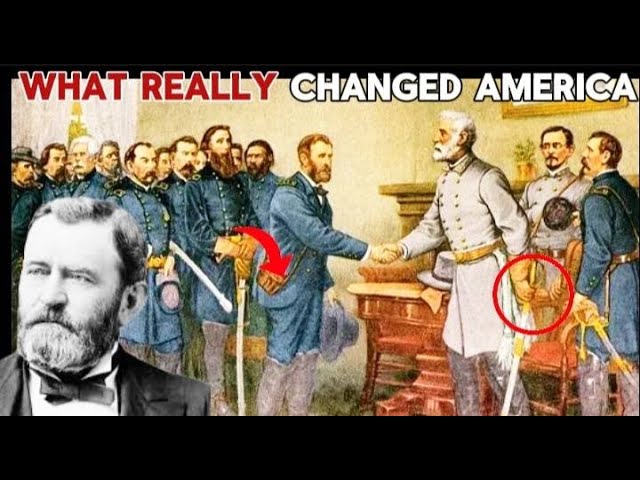
On April 9, 1865, Confederate General Robert E. Lee surrendered to Union General Ulysses S. Grant at Appomattox Court House, effectively ending the American Civil War. Lee’s army, exhausted and running out of supplies, had been surrounded by Union forces after a final desperate Confederate charge failed to break the Union lines.
By 1865, the Confederate Army of Northern Virginia was in disarray after four years of brutal conflict. Confederate General John Brown Gordon later described the army as merely a shadow of its former strength. Despite the dire situation, Lee initially resisted calls to surrender, insisting the South had sacred principles to uphold and rights to protect. On April 7, 1865, several of Lee’s closest officers confronted him.
Led by General James Longstreet, they argued that further resistance was futile and urged him to begin surrender negotiations. Lee reacted adversely at first, demanding they continue fighting. Gordon later recalled that Lee understood the soldiers’ dedication, noting they were tattered, famished, and ready to stop, but Lee remained resolute. That same day, Grant dispatched a message to Lee, writing, “The results of the past week must convince you of the hopelessness of further resistance on the part of the Army of Northern Virginia in this struggle.
” Lee responded, acknowledging his wish to prevent needless bloodshed and asking what conditions Grant would offer for the surrender of his army. Despite this exchange, Lee resolved to continue fighting. The Confederate army pressed westward, but Union forces under General Philip Sheridan outmaneuvered them, severing supply lines and capturing thousands of Confederate troops near Sailor’s Creek. This accelerated desertions within Lee’s ranks and left his army with little choice but to capitulate.
After further correspondence between the two commanders, Lee finally accepted the inevitable. He reportedly said, “Nothing remains except to meet General Grant, and I would rather die a thousand deaths. ” On April 9, Lee raised a white flag and arranged a meeting with Grant at the home of Wilmer McLean in Appomattox. Grant arrived in what he later described as “coarse attire,” having not anticipated the surrender happening so quickly.
Lee, in contrast, wore his full dress uniform and carried a valuable sword. Grant later noted the stark contrast between his own appearance and that of the impeccably dressed Confederate general. During the negotiations, Grant quickly penned the terms of surrender. He decided that demanding Confederate officers relinquish their swords would be a needless humiliation, so he amended the terms to specify that sidearms, personal horses, and baggage would be excluded from the surrender.
Lee accepted the terms, and the two generals shook hands before Lee departed. Witnesses described the scene as somber. As Lee left the house and stood on the front steps, Union officers respectfully rose in his honor. One observer characterized the moment as a grave affair.
After the surrender was secured, Grant telegraphed Washington with the news: “General Lee surrendered the Army of Northern Virginia this afternoon upon terms proposed by myself. ” He later noted in his memoirs that his soldiers began firing a hundred-gun salute to celebrate, but he ordered it stopped, explaining that the Confederates were now captives and he refused to celebrate their defeat. His order was overruled. Lee returned to his troops to inform them of the surrender, while Grant saluted him by raising his hat as he departed.
Grant later told his men, “The war is over. The rebels are our countrymen again. ”
Although the surrender at Appomattox effectively ended the war, sporadic clashes continued for several weeks afterward.
The event nonetheless paved the way for the cessation of hostilities, the reunification of the country, and the Reconstruction era that followed, fundamentally reshaping American history.