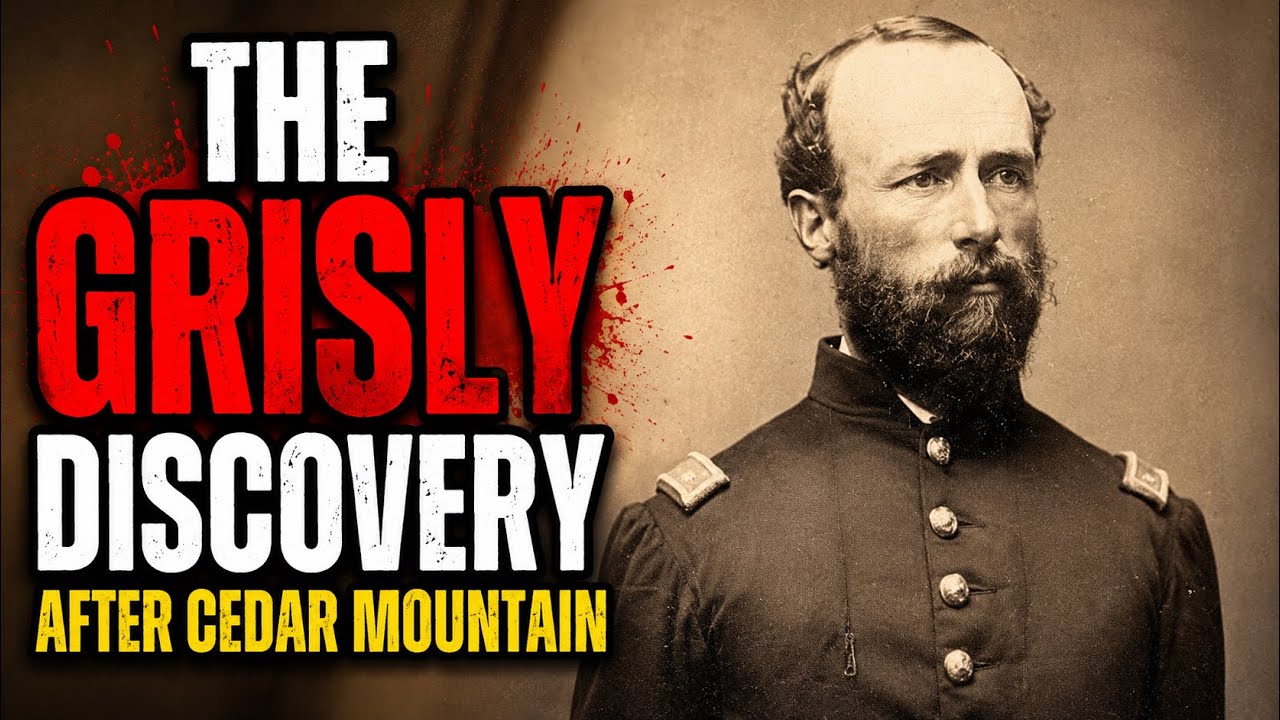
In August 1862, Union General George Gordon returned to a battlefield he had just lost and found the body of one of his most popular officers lying among the dead. The officer, William Blackstone Williams of the 2nd Massachusetts Infantry, had been killed at the Battle of Cedar Mountain. Gordon never forgot the sight, and Williams’s body was eventually sent home to Massachusetts for a funeral attended by a large crowd of mourners. The Battle of Cedar Mountain took place on August 9, 1862, in Culpeper County, Virginia.
Union General Nathaniel Banks had sent roughly 8,000 to 9,000 men to secure a crossroads, unaware that Confederate forces under General Thomas “Stonewall” Jackson were approaching with a much larger force of about 22,000 soldiers. The fighting began near Crittenden Lane around noon, when Confederate troops under General Jubal Early opened fire on Union cavalry. The battle intensified as Union soldiers advanced across open fields into heavy fire from Confederate infantry and artillery. Temperatures reached the triple digits, and many men on both sides were suffering from thirst as the fighting dragged on.
Williams was an engineer from Jamaica Plain, Massachusetts, who had worked on railroad systems in the West and in Mexico before traveling through Europe. He returned to the United States in 1858, just before the war began. Before the conflict, he held strong political views and blamed the Republican Party and what he called the “agitation” of the slavery question for pushing the nation toward rebellion. Despite his political views, Williams enlisted when the war began and became an officer in Company E of the 2nd Massachusetts Infantry.
He was described as a gentle-spoken and highly respected leader, admired by both enlisted men and fellow officers. During the battle, Union troops launched repeated attacks across the field toward the Confederate position on the ridge. Some estimates suggest Union soldiers crossed the field about nine times in their attempts to break the Confederate line. The attacks initially had some success, with Union forces pushing through a gap in Jackson’s left flank near the Crittenden Gate, but Confederate reinforcements soon arrived and turned the tide.
Williams was killed sometime during the Union assault on the Confederate position. After the fighting ended, General Gordon came back to the field and found Williams’s body lying near four other popular officers from the 2nd Massachusetts. Williams was identified and his remains were sent home to Massachusetts. A memorial service was held for him at the Unitarian Church in Jamaica Plain, attended by a large group of mourners.
The pastor said of Williams: “My friends, his best eulogy cannot be spoken. It is the silent homage to his worth of which this immense concourse of friends is the expression. It is the unbounded confidence, respect, and love of his companions and arms. ”
The Battle of Cedar Mountain was a tactical victory for the Confederates.
Jackson’s forces stopped the Union advance, though the Union army later moved on and Jackson eventually had to leave the area. The battle is considered a prelude to the Second Battle of Manassas, which followed shortly afterward. Casualties at Cedar Mountain were heavy on both sides. Approximately 1,400 Confederate soldiers and 2,400 Union soldiers were killed, wounded, or missing.
More than 600 men died on the field, and the battlefield’s interpretive materials note that many of the dead are still buried there, with some graves remaining unnamed. The battlefield has been preserved in large part through the efforts of Confederate veteran Daniel A. Grimsley, who ensured that many of the battlefield markers were installed in 1902. He also reportedly gave a tour of the field to President Theodore Roosevelt.
The American Battlefield Trust has since partnered to preserve the land and install interpretive signs. A witness tree that was already mature at the time of the battle still stands on the field today. Union soldiers from Wisconsin and Massachusetts attacked across the open ground near that tree, and it survived the battle and the decades that followed. The battlefield also contains a cemetery holding the remains of a Confederate soldier from Georgia who died on August 9, 1862.
According to the park’s trail map, some of the soldiers killed in the battle are still buried on the field, and many graves may never be identified. The battle also produced one of the more famous scenes of the campaign. When Jackson learned that his left flank was collapsing, he rode out to rally his retreating troops. His sword had rusted into its scabbard from lack of use, so he pulled the entire thing out and shook it over his head while grabbing the regimental colors and calling out that Jackson was with his men.
His efforts helped slow the retreat long enough for reinforcements under A. P. Hill to reach the field and secure the Confederate victory. The field at Cedar Mountain remains a site of reflection for visitors.
Soldiers from both sides fought and died across its open ground, and the land remains marked by the memory of the men who fell there, including the officer from Massachusetts whose death was witnessed by his general and mourned by his unit.