In the spring of 1893, Princess May of Teck wrote a letter that historians have consistently noted and moved past. The letter concerned her engagement to Prince George, Duke of York. She would spend 43 years beside him. The letter does not mention love, not once. She lists his qualities the way a solicitor lists assets. She mentions duty. She mentions gratitude. She describes the match as suitable.
Queen Mary has come down to us as the devoted anchor of the Windsor marriage. Steady, loyal, unshakable. But that letter asked a question nobody pressed while she lived. What was this marriage actually like behind the composure?
Queen Mary did not choose George. She chose his brother. In December 1891, Princess May was engaged to Prince Albert Victor, Duke of Clarence, the heir presumptive. Albert Victor was charming in the way men are charming when they have never been required to develop anything beneath the surface. Intellectually limited by most contemporary assessments and romantically unreliable, his private life circulated in whispers. What mattered was that he was first in line.
Six weeks after the engagement was announced, Albert Victor was dead. Influenza complicated by pneumonia. He was 28 years old. The grief was genuine. What followed was handled with characteristic efficiency. Within months, the question was actively discussed in palace circles. Might Princess May transfer her attachment to the surviving brother?
Prince George was now heir apparent. He required a suitable wife. May had already been examined, approved, and positioned for the role. The reassignment was managed quietly, swiftly, with the pragmatic momentum of an institution that understood its own continuity as more important than the feelings of the individuals serving it.
May's private record of this interval is sealed. Her diaries from early 1892 survive. They note the weather. They record the titles of books read and the names of callers received. They do not record the experience of being quietly redirected from one royal brother to another like a carefully evaluated asset reconsidered for a different position.
George proposed formally in May 1893. She accepted. The engagement lasted six weeks before the wedding. George wrote with a warmth that occasionally tipped into urgency. These were the letters of a man who found this woman genuinely compelling. May's replies were shorter, more measured, composed with a precision that left very little of herself visible inside them. Correct affection, controlled register, nothing unguarded.
This asymmetry would define the texture of the marriage for the next four decades. George reaching forward, Mary composed and self-contained.
The public image of this marriage is one of the great success stories of the modern British monarchy. Against a backdrop of royal scandals and broken marriages, George V and Queen Mary appeared to represent exactly what a royal partnership should be. Stable, dignified, enduring. The historical record suggests the reality was considerably more complicated.
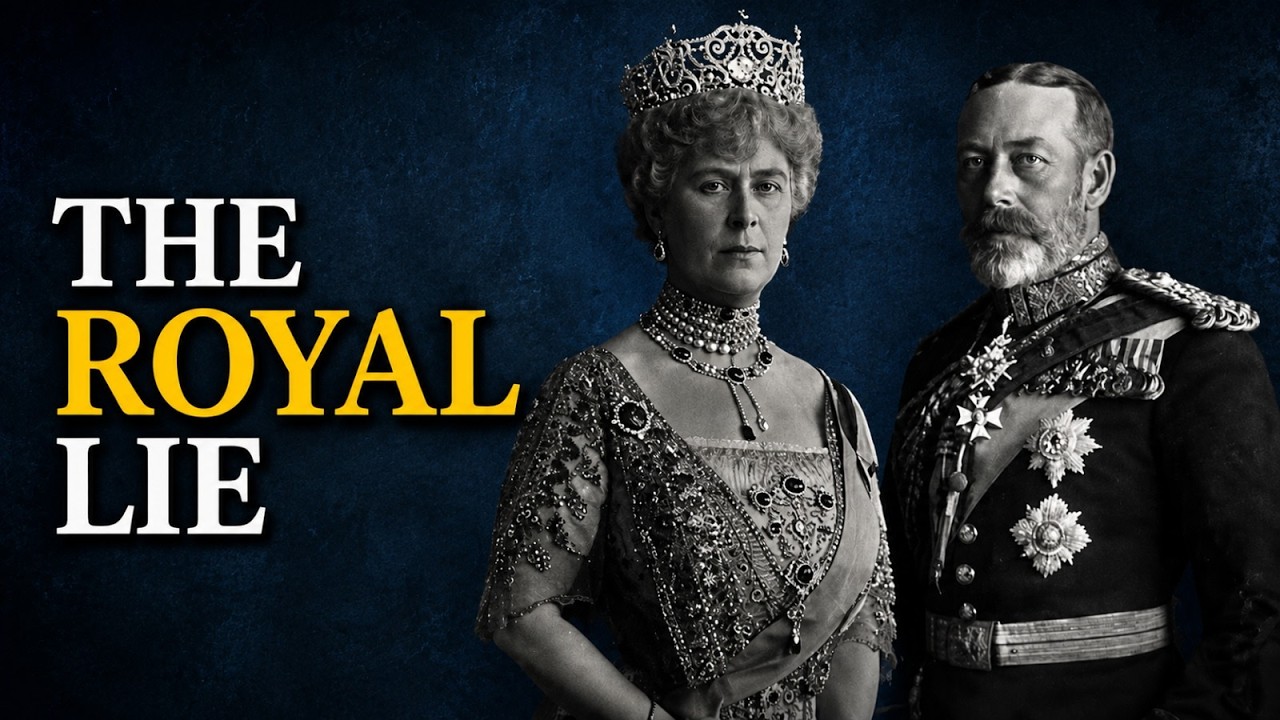
The stability was built on a foundation that one partner found sustaining and the other found quietly insufficient across a lifetime of trying to reach beyond it.
The letters are the primary material. George V and Queen Mary corresponded across decades of separation. The most important examination belongs to James Pope Hennessy, commissioned in the 1950s to write the authorized biography of Queen Mary. He was granted access that no subsequent researcher has matched. His published biography is careful and largely admiring. But his unpublished research notes are considerably less restrained.
Those notes describe a woman that multiple household members characterized in strikingly consistent terms. Not cruel, not deliberately withholding, but operating at a remove from the people around her that made ordinary emotional exchange difficult. Not locked against anyone specifically, simply not open.
George V's letters read against this description take on a particular quality. He wrote to his wife with a consistency and emotional directness that most men of his class and generation would have found excessive. He told her he missed her. He described the house as feeling wrong without her presence. He wrote in more than one letter that he did not know what he would do without her.
Her replies thanked him for his kind words, and moved on to other subjects. When the correspondence is considered across its full duration, what emerges is the portrait of a man who spent the whole of his married life seeking an emotional reciprocity that his wife either could not provide or had concluded she should not provide.
Harold Nicolson, whose authorized biography of George V was published in 1952, notes with diplomatic precision that the king derived particular companionship from certain members of his household in ways that supplemented his domestic life. He is signaling that George looked beyond his marriage for the emotional ease that his marriage did not consistently provide. Not through infidelity, but through relationships that offered the warmth and uncomplicated reciprocity that 40 years of reaching toward Mary had not reliably returned.
The most revealing evidence comes from the household the marriage created and from the six children raised inside it. Four of those six children experienced emotional histories that are individually troubling and collectively impossible to explain without examining what the household provided and withheld.
Edward, the eldest, abdicated in 1936. The constitutional explanation for that decision is accurate as far as it goes. But the relationship between Edward and his parents had been deteriorating for decades before Wallace Simpson entered the picture. Edward's memoirs describe a childhood organized around paternal intimidation and maternal distance.
Lord Esher, a senior courtier whose private diaries are among the most candid documents of the Edwardian court, recorded observations about the emotional atmosphere of the royal nurseries. The children were raised with minimal physical affection. Discipline was the dominant register. Emotional expression was not cultivated. It was managed. Where it could not be managed, it was suppressed.

The nurse responsible for the youngest princes subjected at least two of the boys to treatment later understood as genuinely abusive. She was eventually dismissed. She had been employed there for three years before that dismissal occurred. Neither George nor Mary intervened, not because they approved, but because they did not look closely enough to see the pattern.
Prince George, Duke of Kent, the most emotionally expressive of the siblings, struggled across his abbreviated life. He died in a wartime air crash in 1942 with addiction, volatile relationships, and a desperate hunger for warmth that his upbringing had never reliably provided. Prince Henry, Duke of Gloucester, presented to the world as the most emotionally underdeveloped of the brothers. Princess Mary, the only daughter, married Viscount Lascelles in 1922. He was 15 years her senior. Those close to her described the marriage as unhappy.
Then there was John. Prince John was the youngest child, born in 1905. He suffered from epilepsy, and his presentation suggests a developmental condition beyond the epilepsy itself. As his episodes became more frequent, a decision was made. He was moved to Wood Farm, a separate residence on the Sandringham estate, in the care of a nurse who gave him genuine affection. He was separated from the main family. He died in January 1919. He was 13 years old.
Queen Mary wrote a letter the following day. It described his death as a great relief. Those four words have occupied historians for decades. The case for charitable interpretation is genuine. Queen Mary had watched her youngest child suffer for years. Relief in this reading is the response of a mother whose grief was inseparable from exhaustion.
But the case for the alternative reading is also genuine. The phrase is consistent with everything else the record shows about how Queen Mary processed emotional experience. She translated feeling into management. She converted grief into forward momentum. The phrase is Queen Mary's emotional register applied to the most unbearable circumstance she ever faced.
Examine Queen Mary's life across its full arc, and one pattern becomes impossible to avoid. She experienced emotion most completely through objects, through history, and through aesthetic meaning. Rarely through people. Almost never through the unguarded reciprocal intimacy that personal relationship requires.
Her knowledge of royal history was extraordinary. Her connoisseurship across furniture, porcelain, silver, textiles, and painting was expert. Her dedication to recovering items of historical significance to the crown was relentless. When she visited aristocratic houses, admiration for a particular piece was understood to function as a politely framed request for donation.
Lady Airlie, one of Queen Mary's closest companions across six decades, recorded that Mary's passion for objects was the clearest window into a woman who otherwise kept her windows closed. It was the one place where genuine enthusiasm broke through the composed surface without apparent effort.
Lady Airlie also records that Queen Mary was aware at some level of the distance between herself and others. She occasionally expressed something approaching regret that she found human intimacy so difficult to inhabit. She envied women who could love without the constant mediation of composure.

The emotional distance in Queen Mary's marriage was not simply the product of a woman who felt nothing. It was the product of a woman who felt and could not release what she felt into the ordinary registers of human exchange. The architecture of her self-control was not a wall built against feeling. It was a structure that feeling inhabited without being able to find the door.
George V sought warmth through directness. Through the letter that said plainly what he felt. Mary gave warmth through presence, through the absolute consistency of her loyalty, her counsel, her management of everything around him that required managing. These were not incompatible forms of love, but they were forms that never quite met in the middle.
George V died on the 20th of January, 1936 at Sandringham. Queen Mary was at the bedside. Her diary entry for that night is brief and composed. It records that he had passed peacefully and that she had been present. She was 68 years old. She had been his wife for 43 years.
The abdication crisis, which detonated within the year of George's death, provoked the most openly emotional response Queen Mary ever committed to correspondence. Edward's decision to choose Wallace Simpson over the throne drew from his mother letters of a directness and unconcealed fury that her writing almost never displayed.
Some historians have treated those letters as the final proof of a woman who valued institution above family feeling. The reading is not wrong, but it is incomplete. Queen Mary's fury at Edward was not only institutional. It was deeply personal. She had spent her entire adult life doing the thing Edward now refused to do. She had disciplined her emotional life, had sealed it, had maintained its composure across wars and deaths and the quiet private loneliness of a marriage that gave her almost everything except the one thing her husband most wanted to give.
Queen Mary died in March 1953, ten weeks before the coronation of Elizabeth II. A ceremony she had dressed herself to attend. A continuity she had worked her entire life to make possible.
What the historical record collectively suggests about this marriage resists a simple verdict. George V loved his wife completely, consistently across four decades. Queen Mary loved her husband with an equally complete loyalty, total in its commitment, absolute in its reliability. Expressed through everything she was willing to give, which was considerable and notably absent in the one register he most persistently sought.
The marriage endured. It functioned. It produced one of the most stable and consequential royal partnerships of the modern era. But endurance is not warmth. Loyalty is not intimacy. The distance between what George needed and what Mary could give was where this marriage actually lived year after year across four decades.
Cold is one word for it. Sealed is more precise. A marriage sealed not by indifference, but by the accumulated weight of duty, temperament, and an institutional role that asked its participants to become less human in public in exchange for historical permanence.
Both of them paid that price. George paid it with a longing he never fully resolved. Mary paid it with an interiority she never fully unlocked, even when the person most persistently knocking on the door was the man she had promised in 1893 to spend her life beside.