Jim Marshall ran 66 yards while 32,000 fans at Kezar Stadium screamed. He pumped his fist, believing the roar was for him. It wasn’t. San Francisco 49ers center Bruce Bosley caught up to him and patted him on the back.
“Thanks, buddy,” Bosley said. Marshall realized in that instant that he had just scored a touchdown for the wrong team. The date was October 25, 1964. The Minnesota Vikings were leading the 49ers in the fourth quarter when San Francisco quarterback George Mira threw to halfback Billy Kilmer.
Kilmer caught the ball but was hit hard, and the ball came loose. Marshall scooped up the fumble and ran, seeing a clear path to what he thought was the end zone. He crossed the goal line, raised his arms, and threw the ball into the stands in celebration. Marshall had actually run the wrong way and scored a safety for San Francisco.
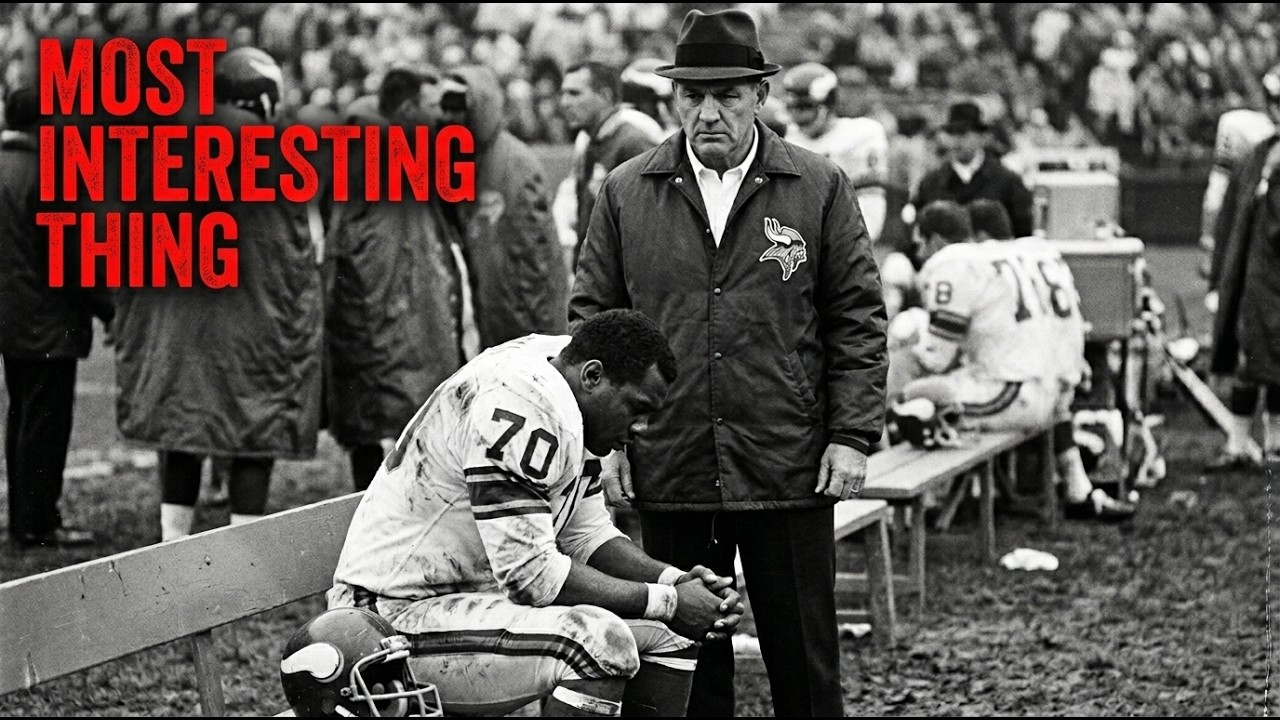
The referee signaled two points for the 49ers. The crowd’s roar turned into laughter and confusion. Marshall walked back to the Viking sideline, where coach Norm Van Brocklin met him with a flat, dry sentence: “Jim, you did the most interesting thing in this game today. ”
The mistake threatened to define Marshall, who had already endured a turbulent path to that moment.
Born in Wilsonville, Kentucky, in 1937, he was good enough to be drafted by the Cleveland Browns in the fourth round of the 1960 NFL draft. But coach Paul Brown wanted to change his position, and the fit never worked. In 1961, Marshall was traded to the expansion Minnesota Vikings, a brand-new franchise that had never played an NFL game. He was 23 and starting over.
Over the next three seasons, Marshall quietly became one of the most durable and ferocious defensive ends in the NFL. By 1964, he was playing alongside Carl Eller on a defensive line that would eventually become known as the Purple People Eaters, one of the most feared defenses in football history. After the wrong-way run, Marshall did not hide. The score was close, and the Vikings still needed him.
He strapped his helmet back on and returned to the line of scrimmage. Still in the fourth quarter, he forced a fumble, and Carl Eller scooped it up and ran it back for a touchdown. The Vikings won 27 to 22. Marshall made the mistake, and Marshall helped fix it, on the same field, in front of the same 32,000 people.
The locker room celebration was muted because reporters were focused on the wrong-way run. Marshall sat in front of his locker and answered every question without flinching. “I don’t think I’ve ever done anything in my life that’s hurt me more than this,” he said. Days later, an envelope arrived with a handwritten note.
It was from Roy Riegels, a former University of California player who, in the 1929 Rose Bowl, had run 65 yards in the wrong direction and cost his team the game. Riegels had lived with that memory for 35 years. His note to Marshall was short: three words. “Welcome to the club.
”
Marshall kept that letter for the rest of his life. He went on to play 282 consecutive NFL games after that October afternoon, a record for defensive players at the time, surpassed decades later only by a punter and a Hall of Fame quarterback. He started 270 consecutive games, an iron mark for any defender in the sport. He played 20 seasons and appeared in four Super Bowls with the Vikings, losing all four.
He never won a ring, but he showed up every single week. He recovered 29 fumbles over his career, a record when he retired, and was a three-time All-Pro. In 2008, NFL Films ranked him the second-best player not in the Hall of Fame. Despite that record, Marshall has not been inducted into the Pro Football Hall of Fame, and the debate remains one of the unresolved arguments in NFL history.
His former quarterback Fran Tarkenton described him this way: “Jim Marshall set the tone for how this franchise goes today. The leader of the band was Jim Marshall. ”
Johnny Carson made jokes about Marshall on The Tonight Show. Sports Illustrated ran the photograph.
For decades, the story ended with the 66 yards. But Marshall’s story did not end there. He kept playing in the right direction, week after week, because the answer to a mistake of that magnitude was not hiding but showing up. Jim Marshall died on June 3, 2025, at the age of 87.
At his memorial, former teammates talked about the 282 consecutive games and the man who became the iron heartbeat of one of the greatest defenses the NFL ever produced. Nobody led with the wrong-way run. The mistake is famous.
The man who got up after it is legendary.