In autumn 2001, the body of a woman was found in an apartment in Paris. She was alone. No husband, no child, no one. Forty years earlier, she had been the Queen of Iran, chosen by the most powerful man in the country, Mohammad Reza Pahlavi, the last Shah.
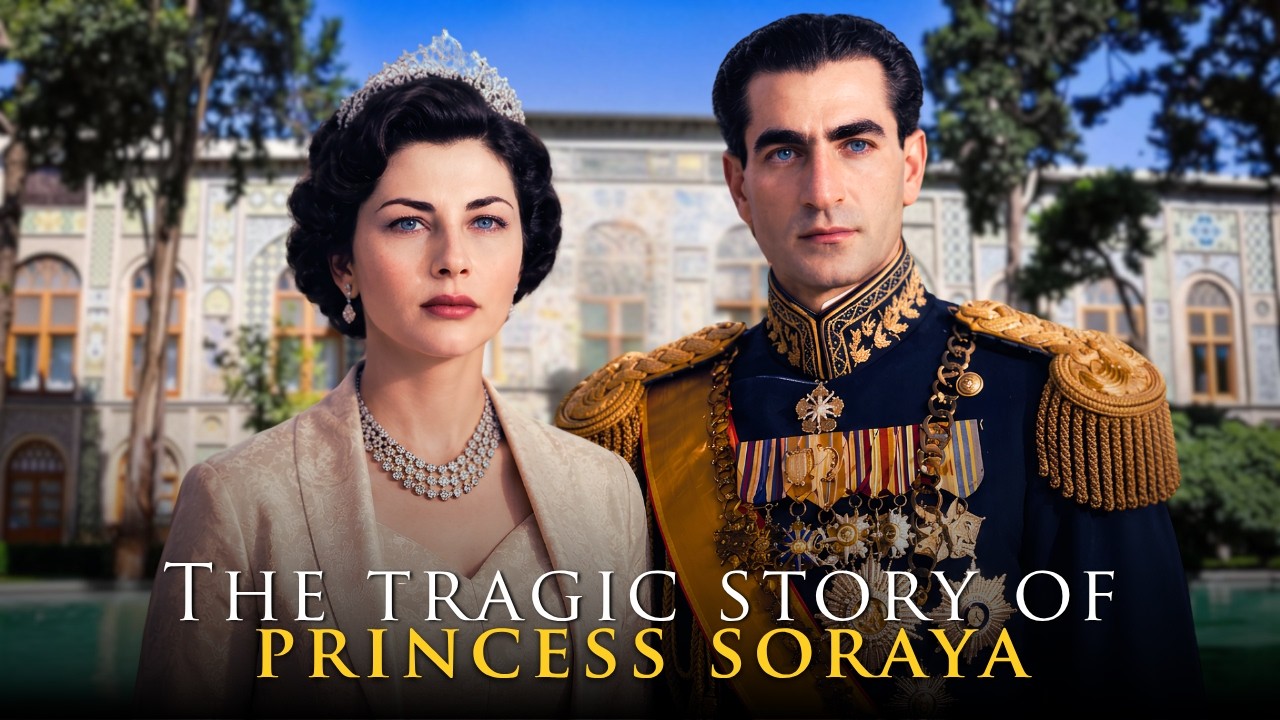
He gave her palaces. He gave her a diamond the size of a thumbnail. Then, because she did not bear him a son, he gave her up. She titled the book she wrote about her life “Le Palais de la Solitude” – The Palace of Solitude.
This is the story of Soraya, the sad princess, and the single promise that cost her everything. A particular kind of photograph survives from the mid-twentieth century. Black and white, slightly overexposed, of a young woman with a crown smiling at a world that still believed in fairy tales. For a few brief years, one of those photographs belonged to the most envied woman in the Middle East.
Her name was Soraya Esfandiari Bakhtiari, and from the start she felt she belonged to two places at once, and not entirely to either. She was born in the summer of 1932 in a missionary hospital in Isfahan, the old city of blue domes and turquoise tiles. Her father was a Bakhtiari nobleman, the son of one of Iran’s great tribal families, who later became a diplomat representing his country abroad. Her mother was German, a woman named Eva Karl who had migrated east and married a Persian.
So Soraya grew up moving between worlds, between Isfahan and Berlin, between Persian and German. She was educated in London and Switzerland, learning to pack her bags at an early age. Her pale green eyes, which would one day make her famous, were a gift from her mother, and in Tehran they gently marked her as someone not quite her own. She might have lived an ordinary life of quiet luxury, but in the late 1940s a search began that she knew nothing about.
The young Shah Mohammad Reza Pahlavi had recently divorced his first wife, Princess Fawzia of Egypt. That marriage had produced a daughter, but no son, and a king without a male heir was a king in trouble. His mother, the formidable Queen Mother, wanted a new bride, and she wanted one quickly. Word spread among the Bakhtiari relatives.
Was there not a suitable girl among them? One relative remembered a beautiful niece, educated, fluent in several languages, finishing her studies in England. Her photograph was taken in London by her cousin at the quiet request of another. It showed a seventeen-year-old girl with dark hair and unusual pale eyes, sitting half a world away from the throne she was about to be measured against.
She did not yet know that a few square inches of paper would determine the course of her entire life. When the Shah’s sister traveled to London and met the girl in person, she did not bother to meet anyone else. She sent an urgent message home. By some accounts, she simply said this young woman was born to be a queen.
Soraya arrived in Tehran in autumn 1950, ostensibly on an ordinary visit, though it was in fact a test for the throne. Her father accompanied her. The Shah’s sister had warned her beforehand not to expect too much, saying her brother was not especially handsome. Then Mohammad Reza entered the room wearing the uniform of an air force general, and the warning dissolved.
In her memoirs, written decades later, Soraya remembered him with a single word: “magnificent. ” By all accounts, the feeling was mutual. That same night, at two in the morning, the Shah called her father and asked for her hand. Soraya was eighteen; the king was past thirty.
She agreed. He gave her a diamond. It weighed more than 22 carats, a stone the size of a thumbnail, cold and enormous on a teenager’s hand. The wedding date was set, then postponed due to the bride’s illness.
Finally, it took place in February 1951 at the Marble Palace in Tehran. Outside, snow fell thickly, and in Persia snow on a wedding day is considered a blessing, an omen of good fortune. Inside, Soraya wore a gown designed by Christian Dior, made of silver lamé, said to be embroidered with thousands of feathers and tiny diamonds. The dress was so heavy, and she was still weak from illness, that one of the bridesmaids had to kneel and cut away meters of fabric just hours before the ceremony so the bride could walk down the aisle herself.
Her shoulders were wrapped in white mink against the cold. Gifts arrived from across the divided world. President Harry Truman sent a bowl of American glass. It is said that from behind the Iron Curtain, from Joseph Stalin himself, came a mink coat and a writing desk inlaid with black diamonds.
The Shah asked his guests to donate money instead to a charity for Iran’s poor. For a time, this was the fairy tale the photographs had promised. The early years were happy. The couple was rarely apart.
They traveled to Europe, America, and the Soviet Union, where they shook hands with Nikita Khrushchev. Soraya took on the duties of queen, renovating palaces and lending her name to charities that aided the poor. She supervised her charitable work carefully, bringing order and beauty to rooms that had known only ceremony, and moved through the formal world with the grace of a woman who had learned how to behave from a young age. She kept a pet seal in one of the palace fountains.
The cameras never tired of her image, the queen of the ancient throne with the green eyes, young, radiant, beloved. In pictures from those years, she is almost always smiling. But a throne is not a marriage. A throne keeps its records in a cold hand.
In the Pahlavi records, beneath all the extravagance and official visits and diamonds, there was one item no amount of love could settle: an heir. Mohammad Reza was only the second king of his dynasty. His father had seized the crown barely thirty years earlier, and a new dynasty like this needed one thing above all else to feel secure: a son to inherit. The Shah already had a daughter, Shahnaz, from his first marriage.
A daughter, in the cold arithmetic of succession, was not enough. From almost the beginning, a hidden pressure began to build in the corners of the marriage. Not from the Shah, at least not at first. It came from those around him.
The main source was his mother. The Queen Mother, Tadj ol-Molouk, was a powerful woman and could not stand her son’s bride. Soraya was half foreign and half Bakhtiari, a tribe the Pahlavis had reason to distrust. Worst of all, as the months passed, she did not become pregnant.
By some accounts, the Queen Mother’s dislike turned into something like a campaign. It is said she set her household to watch the young queen, to watch her thinness, to watch what she ate, looking for the first sign of the child who did not come. The child did not come, and year after year, this failure ceased to be a secret. People began looking for causes.
Some later pointed to an illness before the wedding, a bout of typhoid that had left the bride bedridden and weak. Whether that had anything to do with what followed, no one can say. What is certain is that the search for a cure gradually became the center of the couple’s life. The most envied woman in the Middle East became a patient.
She traveled to specialists in Switzerland, France, and the United States, undergoing countless examinations and treatments, carrying with her everywhere the question the world was asking. In 1954, her husband advised her to go to America to consult the world’s best fertility doctors. They sailed from New York. The first doctors were kind, even optimistic.
They said perhaps it was just tension, the stress of the past two years. For a brief time, she believed them. Then, to be sure, the couple went to Boston for a second opinion. The Boston doctors did not soften the blow.
She was infertile. They told her she would never have a child. There would be no son, not for the throne, not for her, ever. The return journey is said to have been silent, as if the ground were tilting beneath their feet.
What had been a worry was now a documented fact in a doctor’s handwriting, and no diamond on earth could erase a single word of it. Soraya was 22 years old. Remarkably, the records of those years show that the Shah did not simply cast her aside. By everyone’s testimony, he loved her, and he desperately searched for a way out that would let him keep her.
Could his younger brother produce an heir? That hope also faded when the brother died in a plane crash. Could the constitution itself be changed so the throne would one day pass to Shahnaz, the daughter? After all, the Shah promised Soraya he would convene a council of wise men to do exactly that, to change the laws of the kingdom rather than abandon her.
For a moment, she believed him. But a king is not free, whatever crown he wears. The Senate pressed, the clergy pressed, the Queen Mother pressed hard. A nation that had waited years for a prince was visibly losing patience.
Not even the Shah could stand forever between the woman he loved and the machinery of a dynasty pursuing its own interests. Then came the proposal that would put an end to everything. If Soraya could not give the throne a son, perhaps she should step aside a little to allow another woman to do so. Let the Shah take a second wife.
Soraya could remain queen. She could keep the title, the palaces, the diamond. All she had to do was share him with another woman. She refused.
She would not share her husband’s love with another woman, she said. This was perhaps the only decision in this story that she made entirely on her own, and it cost her everything. By refusing to be half a wife, she left the throne only one door. In February 1958, Soraya left Iran.
The official story was that she needed rest, to visit her parents, who were then living in Cologne, Germany. The Shah even promised her once more the council of wise men, the constitutional amendment, the way out he kept insisting he would find. But she had lived inside this machine for seven years. She felt the walls closing in, and as her car carried her away from Tehran toward the airport and the bitter European winter, she realized in her heart that she was not leaving for a holiday.
She was being eased, gently and delicately, out of the stage of her life. She would never live in Iran again. What followed happened with such excessive politeness that it made things worse. There were no accusations, no scandal, no raised voices heard by the public.
From Tehran, the Shah sent Soraya’s uncle to Germany to plead one last time for her to return home and accept remaining queen until another woman bore the country a prince. Again, she refused. On March 5, the Shah called her himself. He told her the choice was now clear: accept a second wife or accept a divorce.
Five days later in Tehran, a council of advisers met to discuss their troubled king’s marriage. On March 14, 1958, it was announced to the world that the Emperor and Empress would separate. Soraya did not rage. She did something finally more devastating than rage.
From her parents’ home in Germany, the deposed queen issued a statement to the people of Iran, the people who had once lined the streets to welcome her. She did not blame her husband. She did not blame the doctors or the Queen Mother or the cruelty of a law that measured a woman by her ability to bear a son. She took the entire burden on herself, framing it as a duty.
She said that since His Imperial Majesty had seen the necessity of a male heir to the throne, she, for the sake of the future of the state and the welfare of the people, and with deep regret, agreed to the separation. Then came the phrase that would follow her for the rest of her life. She said she would sacrifice her happiness. “Le sacrifice de mon bonheur” – the sacrifice of my happiness.
Read it again and consider the weight of feeling in it. There is no anger in it. It is simply a twenty-five-year-old woman publicly agreeing to give up the man she loved, wrapping her grief in the language of service, as if the throne had asked her a favor and she had graciously granted it. Years later, in her memoirs, she allowed herself a sharper thought.
She wrote about the Duke of Windsor, the King of England who two decades earlier had abdicated the throne itself for the woman he loved. She noted that this was not her husband’s case. In her telling, the Shah was at heart an Eastern man, a man of rank and tradition in which one does not abdicate a throne for love, but abdicates love for the throne. It is a quiet and terrible distinction.
Edward chose the woman over the crown, and Mohammad Reza chose the crown over the woman, and Soraya was the one who lost in that choice. The divorce became final in April. The settlement was generous, as settlements are generous when they serve as an apology. The Shah bought her a luxurious apartment in Paris valued at three million dollars.
He arranged a regular monthly income for the next twenty years, until the revolution of 1979 toppled the throne that had cost her so much and stopped the payments. By special decree, he granted her a title that would stay with her forever. She would remain an Imperial Princess for the rest of her life. In short, he gave her everything except the one thing she wanted.
He gave her money, a title, and a beautiful empty apartment in a foreign city. He could not give her back her years. He could not give her the children she would never have, and he could not give her himself. Two years later, Mohammad Reza married for the third time, to a young woman named Farah.
Within a year of that marriage, Farah did what Soraya could never do. She gave Iran a son. The throne finally had its heir. Somewhere in Europe, in a city that was not her city, the woman who had been replaced read the news.
She was twenty-eight years old, and the love of her life was gone. Most of her story, the loneliest part of it, still lay ahead. Only once would she allow herself to love again. But first, she had to learn how not to be someone.
And that, for a woman who had been queen, was a slow education in itself. In Iran, something strange happened after she left. She was not vilified. She was not exiled in any formal sense.
Her page was simply turned. From the day she left in 1958 until the revolution two decades later, an informal silence hung over her name. Her pictures were removed. The newspapers stopped publishing news of her.
The green-eyed queen who had dominated front pages was erased entirely from the official memory of her country, as if a nation had agreed at once to forget a face it had loved. So she became European. She moved between capitals, Rome and Paris, and the resorts where the wealthy and titled wintered. She had an apartment in Paris.
She had an income. She had the diamonds and the borrowed glamour of the cafés. To the photographers who still followed her, she was a fascinating subject. But the glamour had changed.
They no longer photographed a triumphant young queen. They photographed a beautiful woman who seemed never to smile. In those years, the press gave her the name that would endure. They called her the Princess with the Sad Eyes, “la principessa triste.
” It was a cruel kind of poetry, because it took what she could not hide, the sorrow that inhabited her face, and turned it into a brand. There is even a story about her brief and unexpected flirtation with cinema: a producer cast her in a role and put it in the contract that she must never smile on screen. The sadness itself seemed to be the product. She did try cinema.
That is part of the strangeness of those years. In the mid-1960s, the former Queen of Iran, of all people, agreed to appear in a film, an Italian anthology of three stories about women. It was supposed to be a footnote, an expensive hobby for a wealthy divorcee. Instead, it changed the course of her life.
On set, Soraya met a man. His name was Franco Indovina. He was one of the film’s directors, a Sicilian, a serious man of cinema who had trained as an assistant to the great director Antonioni. He was not a king.
He had no throne, no dynasty, no mother counting the months. He was simply a man who looked at the most photographed woman in Europe and seemed to see the person behind the legend of sorrow. They fell in love, and for the first time since a snowy morning in Tehran, Soraya was happy. This was not an arranged love story of a teenager handed to an emperor.
This was something she chose for herself, freely, as an adult woman who had lost much and knew exactly what she was risking. They lived together in Rome. For nearly five years, the woman the world insisted on calling tragic was, in her quiet and private way, the opposite. Infertility, the watchful eyes, the public sacrifice, the silence of an entire nation: she found her way back to something ordinary, yet extraordinary.
She found someone who loved her, and she was free. It is said her ex-husband, the Shah, was so furious at the idea of his former queen appearing in romantic scenes with other men that he tried to buy every copy of the film and destroy it. Even then, even after the divorce, the throne could not leave her alone. But Indovina was not a film one could buy and burn.
He was now her life, the second chance she had stopped waiting for. Her luxurious Paris apartment could wait. The sadness in the photographs could wait. For five years, Soraya Esfandiari Bakhtiari, the princess, the queen, the cautionary tale, was simply a woman in Rome in love with a man who loved her back.
After everything it had taken, life finally seemed ready to pay her back. It is the cruelest position a person can be in. That brief, bright moment when you think the worst is over. In spring 1972, Franco Indovina boarded a plane.
It was an ordinary flight, Alitalia Flight 112, a routine evening run from Rome to Palermo, his hometown. He had made this flight, or similar ones, many times. There was no reason to believe this one would be different. Somewhere in Rome, the woman who loved him was simply waiting for him to come home, as people wait a thousand times without once imagining that the waiting will not end.
The plane never reached Palermo. During its nighttime descent, in poor visibility, it struck the side of Mount Longa, hitting the rock a few hundred feet below the summit, so close to clearing it. All 115 people on board died. To this day, it remains the worst aviation disaster in Italian history.
Among the dead, Franco Indovina was somewhere on that dark mountainside. He was forty years old. And so her love was taken from her a second time. The throne had taken the first man she loved.
Now a mountain in Sicily had taken the second. The difference was that the throne had at least warned her, for years, slowly, cruelly, clearly. This time there was no warning at all. There was only a plane that was supposed to land and did not.
There is a particular cruelty to this kind of loss, and Soraya knew both kinds. The first love ended by decision, by men in a council chamber, by a constitution, by the cold needs of a dynasty. It was a wound you could at least name an offender for. The second ended with no cause, with weather, with altitude, with three hundred feet of empty air between a wing and a summit.
No one to blame, no crime, no appeal, just the complete random indifference of the world. She never recovered from it. By her own admission, in the memoirs she wrote near the end of her life, she suffered from depression from that day on that never fully lifted. The grief did not pass through her; it settled in and stayed.
Consider the full picture of what was given to this woman and what was taken from her. She arrived in this life between languages and countries and versions of herself that never fully merged. An empire chose her for the beauty of her face, then rejected her for her body. A king loved her and did not keep her, then a man loved her and could not stay.
She was queen of an ancient nation that erased her, and a legend in Europe that wanted only her sorrow. By the early 1970s, still in her late thirties, Soraya Esfandiari Bakhtiari had outlived nearly everything a life is supposed to be built on. There were thirty years left. Thirty years.
This is the part the fairy tales never mention. Not the tragic loss, but the long silence that follows it. Decades in which nothing happened, decades in which a woman who had been loved grew old, alone, in beautiful rooms in a city that was not her home. She spent those decades moving between Paris and a villa in Spain.
She gave interviews from time to time. She remained admired to the end, especially by a new generation in Iran that would one day discover her face and fall in love with her memory. But the core of her life was empty. There was no husband.
There were no children. There had never been children. And now there never would be. All that remained was the memory of two men, both lost, and a slow accumulation of empty years.
Near the end, she gathered all of it into a book. She wrote about the king and the director, and the long loneliness between them. When it came time to name the book, she chose, with a merciless honesty, the truest words she had. She did not call it “My Life as a Queen.
” She did not call it “The Sad Princess,” the name the world had given her. She called it “Le Palais de la Solitude” – The Palace of Solitude. Imagine an entire lifetime’s grandeur compressed into that phrase. She lived in real palaces: the Marble Palace in Tehran, her luxury apartment in Paris, her villa in Spain.
In the end, each was a single building: a palace of solitude, a beautiful, gilded, perfectly appointed place to live alone. That is the title she gave her life. Soon after, in the apartment in Paris, with no husband and no child, she lived out the final words of that title. It came in autumn 2001.
She was 69 years old. She died in her Paris apartment, the one the Shah had bought her so many years before, a gilded compensation for a life that had been lived. She was alone when it happened. There was no husband to find her, no child to call for.
The exact cause of death was never established. Some accounts mentioned bleeding; others simply said a heart that had carried too much for too long finally gave out. Either way, the shape of it is what matters. The most photographed woman in the Middle East, chosen and then discarded by royalty and empire, the legend a whole continent had followed for half a century, died quietly, alone, in a room in a foreign city.
The Palace of Solitude kept its promise to the end. Then came the detail that ends the story, the one that seems too perfect to be true, except that it is. Only one person in the world had truly stayed with Soraya: her younger brother Bijan, who had shared her exile and her loneliness. He did not outlive her long.
Within days of her death, he was gone too. The diplomat’s two children from Isfahan, the boy and the green-eyed girl who had once been the most envied woman alive, left the world almost together, as if one could not bear the loneliness without the other. Her body was taken to Munich. There, in a quiet German cemetery, she was buried beside her parents, who had raised her between two countries.
Her brother was buried nearby shortly afterward. The girl who belonged to two worlds and to neither, finally settled in the world her mother had come from. Not in Isfahan, not in Tehran, not in any place she had ruled. The throne kept the country, but it did not keep her bones.
In Iran, the silence around her name has long since broken. In the years after her death, a new generation, born long after the revolution, who had never seen her reign, discovered the old photographs online. They fell in love with the sad queen of a vanished kingdom, shared her pictures, copied lines from her memoirs, and mourned a woman most of them had never been old enough to lose. The country that had extinguished her in 1958 eventually brought her back to life.
She outlived even her own erasure. But that is the world’s version of Soraya. The icon, the beauty, the tragedy made lovely and safe by time. The real picture is smaller, harder to look at.
It is a picture of a young woman in London, seventeen years old, sitting for a photograph she did not think mattered. She does not know this picture will be carried across a continent. She does not know it will give her a crown and a king and a diamond the size of a thumbnail. She does not know it will also give her a watchful mother-in-law, a doctor in Boston, a council of wise men, a public sacrifice, and a Sicilian man on a plane that will never land.
She knows nothing of the forty years in beautiful empty rooms, or the title she would eventually give herself. She is just a polite girl sitting still in front of a camera. Everything the world envied Soraya, the throne, the jewels, the fame, the beauty, all of it came from that photograph. And all of it came at a price the photograph could not show.
She sacrificed her happiness, as she said, for the future of the state. The state got its future. It got its son, its heir, its dynasty for a few more years, until a revolution took even that. Soraya got what was left.
She got the solitude. She got the palace and the long silence that surrounded it. They called her the sad princess, and they were right, though not for the reason they imagined. The sadness was not in her eyes.
It was in everything she saw, and in that small phrase spoken by a twenty-five-year-old girl that turned out to be the story of her entire life: the sacrifice of my happiness. She kept her promise. She kept it for forty-three more years.