On the morning of July 3rd, 1863, Confederate Brigadier General Richard Garnett pulled on his dress uniform despite a fever that had left him unable to walk any real distance. He climbed onto a black horse and led his brigade into the open ground at Gettysburg. He did not return. No body was recovered, no grave was marked, and no official confirmation ever explained what happened to him.
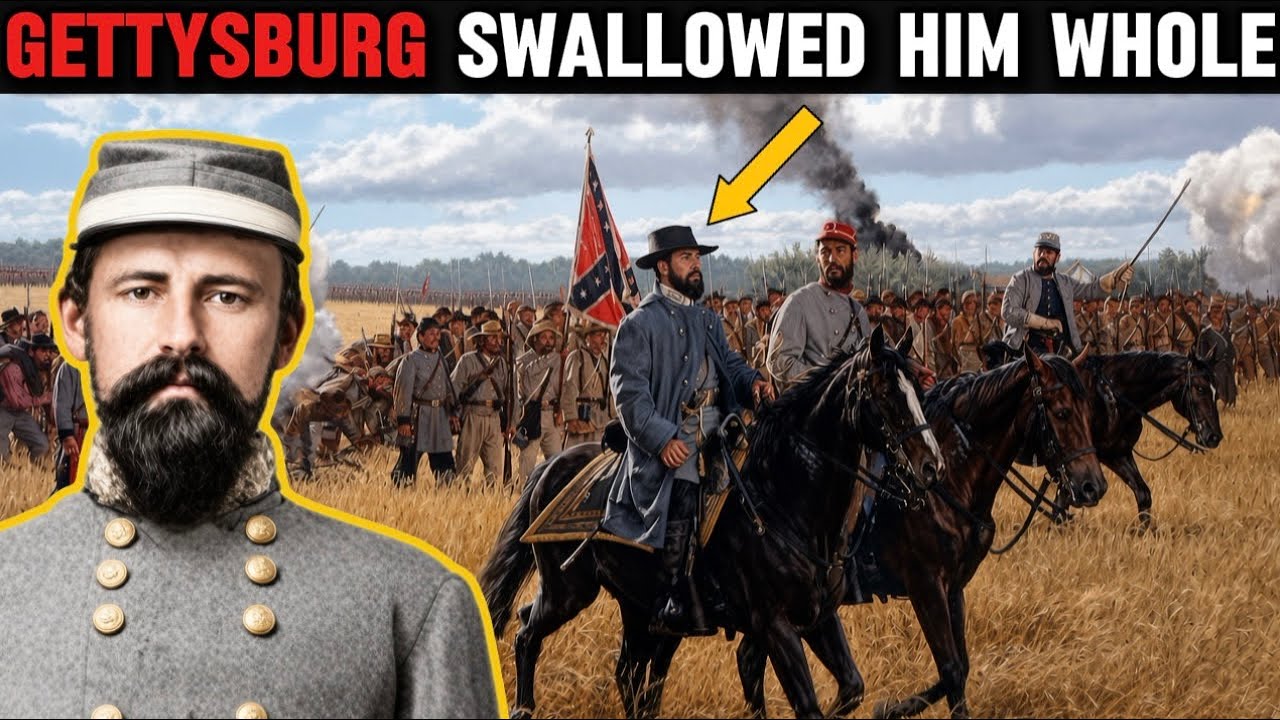
Only his riderless horse came back to the Confederate lines. For 160 years, that disappearance has occupied historians, battlefield archaeologists, and Garnett’s descendants. The mystery is not simply what happened to one Confederate general on one July afternoon. The deeper question is what drove him onto that horse when his body was already failing, and why the ground at Gettysburg swallowed him so completely that a century and a half of searching has produced nothing.
To understand any of that, the story begins 16 months earlier in the Shenandoah Valley, with a confrontation between Garnett and Thomas Jonathan “Stonewall” Jackson. Jackson was the kind of superior officer who made his subordinates permanently watchful. He did not explain his reasoning. He gave orders and expected them to be executed completely, immediately, and without discussion.
He won battles that became legend within months, and he made no allowances for the on-the-ground judgment that field officers exercise when the situation in front of them diverges from what headquarters has imagined. On March 23rd, 1862, at the Battle of Kernstown in the northern Shenandoah Valley, Garnett commanded the Stonewall Brigade. Jackson had ordered an attack against what turned out to be a Union force considerably larger than Confederate intelligence had reported. Garnett’s men fought hard across broken ground, but their ammunition reached critically low levels, and the Union line began extending beyond the Confederate flank in a way that threatened to encircle the brigade entirely.
Garnett assessed what was actually in front of him, and he made the decision the situation demanded. He ordered a retreat. He did not send a courier to seek Jackson’s approval. He concluded that continuing the assault meant the destruction of his entire command.
Jackson was not merely angry. He relieved Garnett of command almost immediately, then went further. He preferred formal court-martial charges against Garnett, accusing him of neglect of duty for retreating without authorization. These were written charges formally filed and made known through official channels throughout the officer corps.
In Confederate military culture, where a man’s professional reputation was the foundation of his standing among his peers, being publicly charged by Stonewall Jackson was a blow that could not be quietly absorbed and forgotten. The court-martial proceedings moved forward slowly through 1862 without resolution. Testimony largely sided with Garnett. Officers who knew the ground at Kernstown privately believed the accusation was wrong.
But there is a substantial difference between holding a private view and expressing it as formal testimony in a military proceeding with Stonewall Jackson as the accusing party. Garnett was transferred out of Jackson’s command and eventually assigned to George Pickett’s division, where he commanded a Virginia brigade through the campaigns of late 1862 and early 1863 with the competence that had always characterized his service. The charges remained permanently in the background of every officer’s conversation that touched on his name. In May of 1863, Jackson died from pneumonia, the result of wounds received by friendly fire at Chancellorsville.
His death brought the court-martial to a halt, not by resolving it, but by removing the man who had driven it. No finding was issued. No official ruling declared Garnett innocent. The case simply stopped, which meant that Richard Garnett arrived at Gettysburg as a man the army had never officially cleared of anything.
The charges had evaporated, but the story they created was still present in the officer corps. Garnett was, by the consistent testimony of people who actually knew him, a different kind of officer than the Jackson charges implied. He was a West Point graduate from the class of 1841, which meant he had spent more than two decades in the service of the United States Army before Virginia’s secession required him to choose a side. He had served in Florida, in garrison postings across the western territories, and in Kansas during the brutal border violence of the 1850s.
He was a professional soldier with the deliberate, unglamorous competence that a career of that length produces. When Lee’s army converged on Gettysburg at the end of June 1863, Pickett’s division arrived after much of the rest of the army had already begun fighting. By the evening of July 2nd, after two days of severe combat, the Army of Northern Virginia had inflicted and absorbed enormous casualties without achieving the decisive result Lee had pursued. Pickett’s division remained comparatively fresh west of town.
On the evening of July 2nd, Lee announced the plan for the following day. The assault would strike directly at the Union center on Cemetery Ridge. James Longstreet, who would coordinate the attack, opposed it strongly, in detail. He had studied the Union position.
He understood what the artillery mass on the ridge would do to infantry crossing three-quarters of a mile of open ground without meaningful cover. Lee listened, considered, and did not change the plan. Pickett’s fresh division would carry the center of it, and Garnett’s brigade would be among the lead elements. Garnett spent the morning of July 3rd sick, feverish, his leg painful enough that walking the distance of the assault at the pace of advancing infantry would have been impossible.
He made his decision. He would ride. He understood what mounting a horse meant in terms of the target he would present, the visibility it would create, and what it would say to any officer who knew the Kernstown story and happened to be watching. The Confederate artillery bombardment that preceded the infantry assault opened at approximately 1 p.
m. and was the largest artillery exchange the continent had witnessed. Confederate guns massed along Seminary Ridge opened fire on Cemetery Ridge. Union batteries answered across the open valley.
Henry Hunt, commanding the Union artillery, managed his batteries with deliberate care, conserving ammunition and pulling certain guns back from the crest to create the impression that they had been knocked out of action. When the Confederate guns fell silent and the infantry began to move, the Union artillery was largely intact. 12,000 Confederate soldiers stepped off from Seminary Ridge and began crossing the open ground. Among them, visible above the mass of infantry by the simple and irreversible fact of being on horseback, Richard Garnett moved on his black horse at the front of his brigade.
Men fell in ones and then in numbers as the Union guns found their ranges and the Confederate lines closed the distance to the wall. The men of the 69th Pennsylvania Infantry, positioned at and behind the stone wall at the Angle, later testified to seeing a Confederate general on a black horse advancing near the front of the assault. Confederate survivors from Garnett’s own brigade gave accounts in the same broad register. They had watched him riding among them as the line moved forward, and he had gone down somewhere in the final approach to the wall.
What the testimony collectively establishes is that Garnett was present and at the front of his men until very close to the end of the assault’s forward movement. The mounted officer went down somewhere in the approach to the Union position. What the ground did with him after that is where the historical record stops completely. The assault had broken against the Union position.
The field in front of Cemetery Ridge held Confederate dead and wounded in numbers that made individual identification difficult even in the immediate hours following the fighting. A Confederate general who fell from his horse near the Angle, stripped in the aftermath of a sword and whatever else marked his rank, could easily have become indistinguishable from the surrounding casualties. When Pickett accounted for his survivors and officers, Garnett was missing from every role. He was not in Confederate field hospital records.
His horse returned to Confederate lines without him, a detail that appeared in enough independent accounts to carry genuine credibility. The horse came back. The rider did not. In the days immediately after the battle, inquiries about Garnett went unanswered on both sides.
Union officers made reasonable efforts to provide what information they had. What they had on Garnett was nothing. No prisoner roster, no hospital record, no burial documentation that carried his name. Official Confederate records listed him killed in action, which was the only category that fit the evidence.
The evidence was not enough to produce a burial, a grave, or a body. His sword surfaced in 1905 in a Baltimore pawn shop, 42 years after Pickett’s charge. The most direct explanation is that a Union soldier stripped it from Garnett’s body in the hours after the assault collapsed, and it passed through successive hands before reaching a Baltimore pawn broker. The sword’s appearance in Baltimore is probably the clearest physical evidence available that Garnett died close to the Union line, in a position where Union soldiers could access his body after the charge.
The sword eventually reached his family. The man himself did not. The burial situation at Gettysburg in the days after the battle was governed by conditions that did not permit careful method. Mass graves were dug quickly against the July heat.
Identification was attempted where it could be, but the effort was fragmentary. A Confederate general stripped of identifying material could have been buried in any number of locations across the field with nothing connecting the burial to a name. After the war, organized efforts moved Confederate remains from Gettysburg to southern burial grounds. Hollywood Cemetery in Richmond received thousands of Confederate dead from the battlefield, most of them unidentified.
The man in one of those plots might be Richard Garnett. That possibility is genuine, permanent, and given current methods, unverifiable. Modern archaeological work at Gettysburg has applied methods unavailable to earlier investigators, including ground penetrating radar surveys and systematic excavation at documented burial sites. None of it has produced remains that can be identified as Garnett’s.
The National Park Service maintains active stewardship of the site. If his remains are in Pennsylvania soil rather than among the Confederate dead moved to southern cemeteries, they have not been located. Of the three brigade commanders who led Pickett’s assault, Lewis Armistead died at the Angle and left enough of a recoverable record to be buried with some documentation of his identity. James Kemper survived severely wounded.
Garnett left nothing recoverable. A battlefield marker, a sword in family hands, and the accounts of men who watched him ride forward are the only material traces of a soldier who gave more than two decades to military service and died somewhere in one of the most documented military engagements in American history. What the history of Richard Garnett illuminates about the war is not primarily about Confederate strategy or the merits of Lee’s decisions on July 3rd. It is about the particular and lasting damage that an unresolved accusation inflicts in a culture that organizes professional standing around personal honor.
Jackson’s charges did not formally end Garnett’s career or prevent him from functioning as a capable and respected officer in the time he had remaining. But they followed him to the field at Gettysburg, where he rode at the front of his brigade, and where the ground took everything the record could ever recover.