The Routham family of the Arkansas Ozarks was known for generations as the most violent clan in the hills, a name they cultivated so deliberately that local mothers used it to frighten children into obedience. Outsiders who entered their valley were driven off or never returned. The county eventually demanded the family be destroyed. What the county never understood, and what took a century, a courthouse fire, and the recorded testimony of an old woman to piece back together, was that the Routhams were not killers who wanted the valley.
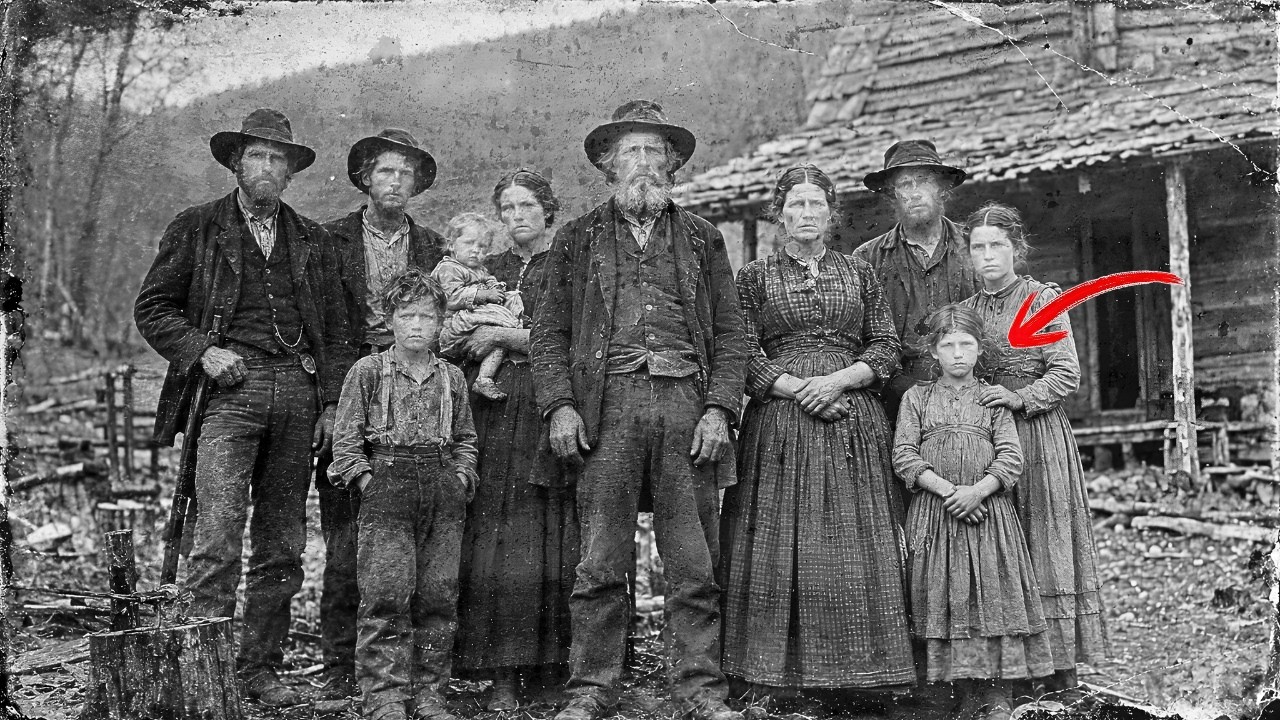
They were killers who wanted every living soul to stay out of it. The valley itself, later called Routham Hollow, runs nearly two miles into the hills, a long narrow gash with steep rock walls and only one entrance. A cold spring-fed stream runs down its center. The lower third near the entrance held cabins and farmland.
The middle third was where trouble always started. The upper third was some of the finest virgin bottomland in three counties, deep black soil, level, and watered by the same cold spring. For a hundred years, no one plowed it. Men in that part of Arkansas would still take an extra hour on the road rather than pass the mouth of the hollow and could not say exactly why, only that their fathers and grandfathers had told them to stay away.
About two-thirds of the way up the valley, a perfectly straight cut runs across the valley floor and continues up both sheer rock walls without bending. Old families called it simply the Cut. Plumb lines dropped into it found no bottom. Water poured into it vanished without sound.
A straight edge laid along it showed no deviation over a length where the earth itself curves. The rock it crosses is natural mountain stone, the same gray rock as the entire ridge, with no crack or fault it could be following. The line was cut deliberately, by someone who meant it, in a way no local hands could have achieved. Carved over the older markings were three rough lines in simple English, written by someone who spelled poorly but meant every word: No living thing crosses the Cut and returns the same.
Keep the near side full and the far side empty. What comes back from the far side wears your face. This was the law of Routham Hollow, and the Routhams sacrificed everything to keep it. The Cut divided the valley into two lands.
The near land, the lower two-thirds, belonged to the living. The far land, that beautiful empty upper stretch, was where no living thing was permitted to remain. A person could cross the Cut and walk in the far land in daylight and return unharmed, as long as they did not linger, did not sleep there, and returned before dark. But leave something alive on the far side overnight, or let someone cross and come back slowly and casually, and the far side kept part of them.
It returned them changed. It returned them inverted. The old people had a name for those who were changed: the Turned. A man who spent a night in the far land came back inverted.
The part in his hair jumped to the other side. A childhood scar on his left hand was now on his right. When he signed his name, the letters ran backward. Within a day or two he could no longer read anyone’s writing.
His heart beat on the wrong side of his chest. None of it hurt him, which was the horrifying part. He felt fine. He sat at his table and smiled at his family, then gradually went silent over a week.
Then one evening he stood and walked toward the head of the valley, and if you tracked his footprints, he was walking backward, heel first, facing you all the way, still smiling. He crossed the Cut and disappeared forever. Every soul the far land took that way made the line a little easier to cross next time, from the far side back toward you. The family passed down a story long before the war.
A Routham cousin named Owen lost a bet and crossed the line at dusk to prove his courage. He stayed long enough to be brave, then came back smiling. He was fine for one day. On the second day he went silent.
On the third morning his mother found him standing at the window before dawn, facing the head of the valley. When she called his name, he answered backward. They tied him to his bed that night. In the morning the ropes were still knotted and the bed was empty, with footprints in the yard beginning heel-first and walking calmly backward up the valley.
The tracks ended at the line. The family never spoke of Owen as dead. They spoke of him as taken, and used him as a scar to teach every child exactly what the far land did and why the line was not a game. Every Routham child learned to walk before they learned Owen’s story.
After Owen, no one went past the middle of the valley alone. The family could not simply put up a sign, because signs attract readers. They could not fence off the head of the valley, because a fence means something worth taking, and men climb fences. The only fence that empties a piece of land and keeps it empty for a hundred years is fear.
So the Routhams made fear. They made it known that anyone who went up their valley past the middle never came back. They drove off honest travelers with cruelty so those travelers would tell the story. They dealt with the stubborn in ways that made the county hate them, so the county stayed at the foot of the hills.
Every barn burned, every survey party driven off, every grave laid at their door was a stone in a wall that had to stand, because the alternative was worse. The alternative was a family from over the ridge finding that fine land empty, moving in, and sleeping there on a summer night. Whatever came out of that far land before dawn, wearing their faces, would have been the true catastrophe. The Routhams were not the horror of that valley.
They were the price of keeping the horror asleep, and the price was becoming horrifying themselves. There was a bargain. As long as the line was guarded and the far side kept empty of the living, the near land of Routham Hollow was blessed beyond belief. Corn grew in droughts that starved the rest of the county.
Game never ran short. The spring never dried up or froze. Fevers climbed the hills every few summers and burned settlements around them, then came up the valley to the middle and turned back at the line, never touching the near land. The Routhams did not sicken.
They mostly did not age or weaken. They died hard deaths by violence in feuds and ambitions, because that was the life their role forced on them, but they did not wither. The land sustained them as long as they kept the line. Keep the far side empty, walk the line at midnight, never leave for good, let no living soul cross the line, and the near land would protect and feed them and turn disease back at the water.
Break any of it, and the far side would come down the valley and take the near land too, inch by inch, and never give it back. The family learned, over the years, to rejoice in things no one should ever rejoice in. They were glad to have a large family at the mouth of the valley, because more souls on the near land meant more weight on the line. They felt, deep down, gratitude when a plague passed their valley to strike the next one over.
Their safety always depended on suffering elsewhere. In time no Routham could tell the difference between loving his family and needing them to stay as guards at the door. No Routham could ever leave, not for a season, not for a wife from another county, not even to see the ocean before he died. One of them had to walk the Cut every night at dusk in every weather for his entire life, with no substitute, no thanks, and no one who acknowledged the work, because the essence of the job was that the county must never know it existed.
The guard who is seen is a guard who arouses the very curiosity he exists to prevent. When the Civil War came, the Ozarks did not see a clean war. There were no fixed front lines, only gangs and partisans settling old scores under cover of the greater conflict. Farms burned, families fled to Missouri or Texas, and entire settlements emptied.
When it ended, the hills were full of silent land, cabins standing open and fields growing up in brush, with no one left to say who owned what. That made the far land of Routham Hollow exceedingly dangerous in 1866, and it had nothing to do with the supernatural. A man who rode into the county and heard about fine empty land at the head of a hollow did not think it was empty for a reason no one understood. He thought it was empty for the same reason half the county was empty: the war had taken the people and the land wanted them back.
The horror had spent a century hiding behind a savage family. Now it could hide behind the most ordinary emptiness in the world, and that was a better hiding place than the Routhams had ever built. The family’s old guard, Jubal Routham, the last man who understood the duty to the bone, was killed in the second winter of the fighting. Not in any battle, but at the line itself.
A band of bushwhackers ambushed him at dusk while searching for his cattle, and found him in the far land where no man should have been. He died on the line he had walked his whole life, and with him died most of what the family knew, because Jubal kept the secrets in his head and intended to pass them on slowly, but the war did not give him the years. What he left was three grown sons and a ruin. This is how old defenses usually fail: not at once, not in battle, but because a war or a fever or a bad season kills the one person who understood the reason before he could pass it on, leaving only rigid rules that have lost their meaning.
The children remember they must walk the line. They forget why. They remember no one may stay in the far land. They forget what will happen if they do.
And a rule followed without understanding is a rule you will eventually decide is foolish, because the very danger it protects you from, thanks to that rule, has never happened once in your lifetime. The eldest son was Caleb Routham, who came home from the war a broken man. He had ridden with brutal gangs, seen and done what such gangs do, and came back to a dead father, a cursed name, and a valley the county spat on. He decided to pull away.
Caleb did not believe. He had walked the Cut as a boy because his father ordered it, and grew up believing it was his father’s insanity. He wanted out. He wanted to clear the Routham name, sell that black land at the head of the valley to the first buyer with cash, and become a respectable man in a town where no one knew him.
To Caleb, the Cut was a scar his family had carved into its own life, and the empty far land was fortune sitting idle on superstition. The youngest was Ren Routham, whom the family always called the simple one. He rarely spoke. He could barely read.
Neighbors thought him feeble, and even his kin treated him gently, as one treats someone not quite right. But here is what no one outside the family knew. Through all four years of the war, while men died and the country tore apart, Ren, the simple boy nobody counted, went out every night and walked the Cut. He did not understand it in words.
He understood it the way an animal understands weather. He knew the line had to be walked and the far side kept empty, and he knew the dust, the leaning posts, and the backward-running stream meant the line was weakening, so he held it alone. A boy the county thought an idiot kept the true watch for four years and had no words to say it, while his brother Caleb thought he wandered the valley at night because he was mad. One detail the sister recorded makes the whole story real.
Ren could not read, but he had watched his father straighten the leaning posts a thousand times and watched him clean the dust from the Cut, so Ren did exactly that every night without knowing the name of what he did or what it meant, because it was simply what must be done. In the second winter of the war, after Jubal died, the line began to weaken the way it weakened when walking lapsed. Ren alone never let the walking lapse. He did everything correctly, barehanded, on memory alone.
Between the brothers stood their sister, a piece the family hid even from itself. What she knew did not surface until the end. And into this situation broke the outside world, and it did not come wearing a black hat. His name was August Fenwick, a land agent.
It is important to say plainly that Fenwick was not an evil man. That is what makes the story what it is. After the war, the government and private companies moved into the emptied hills to settle abandoned land, survey it, open it, and bring people back to it. Freed men who had nothing and nowhere to go were hungry to own a piece of ground.
Refugee families had lost everything and needed a place to start over. Fenwick’s job was to find good empty land and put those people on it. He believed with all his heart that he was doing nothing less than the Lord’s work. When he arrived in that district and heard of a valley with the finest land anyone had ever seen, empty and withheld from settlement by a family of murderers who held no legal title and allowed no one near it, he did not hear a warning.
He heard an injustice that an honest man was bound to correct. So Fenwick did what no one had dared do for a hundred years. He looked at that beautiful, empty, black-soiled land at the head of Routham Hollow, and instead of being afraid and staying away, he decided to give it to those who needed it. He plotted it out.
He filed the papers. He brought in families. A freedman named Isaiah Hill, his wife, and their children, good people who had spent their lives enslaved and wanted nothing on this earth except their own land to farm. And a white refugee family, the Colliers, whose old farm had burned in the war, starving and grateful beyond words.
Fenwick stood on that black land with those families in the spring of 1866 and told them it was theirs. They wept. Isaiah Hill knelt and took a handful of that soil and let it run through his fingers while his wife stood beside him, unable to speak. The tragedy of Routham Hollow is not that evil people came to it.
Good people came for the noblest reasons, led by a good man, to the one place on earth where goodness and right would save none of them. Caleb did not stop them at first, a thing he carried to his grave. Part of him wanted it to happen. Part of him thought: let the fools farm the bottom, and when nothing comes out of that ground to eat them, everyone will finally see that my family’s curse was always a lie, and I will be free of it.
Caleb said that to himself. He wanted so badly to be right that he was willing to gamble other people’s lives on it. Ren tried to stop it. Ren, who could not string together two coherent sentences, went to the mouth of the valley and stood in front of Fenwick’s wagons and refused to move, making sounds no one understood, pointing up the valley, shaking.
And Fenwick, the good man, gently took him by the shoulders and moved him aside, thinking: poor boy. This is what that family does to its own. The Hill and Collier families settled on the far land, and everyone slept. The first morning, nothing happened.
The families laughed at their fear and began clearing brush. The second morning, nothing happened, except the corn they had planted came up overnight to ankle height, which should have frightened them but instead delighted them. On the morning of the third day, Isaiah Hill’s youngest daughter came back from the spring. The part in her hair was on the wrong side.
Her little wooden cross hung backward on its cord. She could not tell her right hand from her left, and she smiled at her mother but could not read the letters her father had been proud to teach her, because the letters all ran the wrong way. She had crossed the Cut in her sleep, gone up into the true far land, lain down in the black soil, and come back. The far land had turned her.
She was the first. Isaiah Hill did what any father would do. He carried the child and ran down the valley for help, burst into the settlement at the mouth, holding the turned child in his arms, begging for a doctor. And here the trap closed, the cruelest trap in the entire story.
The people of the near land looked at that inverted child and did not think the far land had done this. They thought the Routham family had done it. Of course they thought that. For a hundred years, every terrible thing that came out of that valley was done by the Routhams, because the Routhams had spent a hundred years making sure of it.
That was the wall. That was the lock. The one honest warning that could have saved those families, the statement that the far land itself was what had turned their child, sounded, word for word, exactly like the way the murderous Routhams talked to keep people off their land. The only truth that could have saved those families was the family’s oldest lie.
Ren knew and could not say it. Caleb knew and would not say it, because saying it aloud meant the curse was real, and all his hope of freedom was dust. It always accelerates once it starts. Within a week, half the settlers on the far land were turned.
The Collier boys came back with their features reversed after a night in the field. Fenwick’s own young surveyor, the most mocking of them, was found one morning writing his notes right to left without knowing why. The Hill girl, the first turned, stopped speaking altogether, and her mother, who never left her side, woke on the fourth night to find the child sitting in the dark facing the mouth of the valley, her shadow falling on the wall in the wrong direction, toward the light instead of away from it. Those who were turned were not violent.
That was the essence of the horror. They were quiet and docile and strange, and they loved you with inverted faces, and each one, given a few peaceful nights, rose and walked up the valley heel-first and did not return. Those left behind had to decide whether to tie their children down or let them go. Both choices were a grave.
Then, because the far side had fed on enough living souls to lean hard against the failing line, the second thing began, the thing the Routhams had spent a century making sure never happened. The far land came down the valley. They found the first empty cabin at the top of the settlement, the Hill place. The door was still latched, the fire warm, supper on the table, the family gone.
They had not fled. They had vanished. And the cabin itself was wrong in a way that made a grown man retreat to the yard and vomit. The door hinges were on the wrong side.
The hearth had moved to the opposite wall. Everything, every stitch and piece, was inverted end to end. Where the family had stood was a single set of footprints pressed into the dirt floor, leading out the door and up toward the far heights, walking backwards heel-first into the dark. The entire family in a row, walking calmly backward up the valley.
The tracks reached the Cut, crossed it, and stopped. The Hill family was never found. The Collier family followed three nights later, their cabin inverted the same way, their footprints walking backward up the valley and over the line and ending. A man who entered that second cabin said what stayed with him was not the inverted hearth or the wrong-hinged door, but a photograph on the shelf, a tintype of the two dead Collier sons in uniform, and in the picture the buttons were on the wrong side and the boys’ hair parted the wrong way.
The far land had not only taken the family. It had reached back and inverted even a flat tin image of two boys already dead in the war. The far side was no longer sending warnings through reversals. It was reaching across the thinning line and taking the living whole, house by house, every house it took new ground gained.
The empty far land was expanding. It had eaten the head of the valley and was eating its way down the hollow, inverted cabin by inverted cabin, and the line where the living could safely stand was being pushed back toward the settlements. The county’s response was to come and kill the Routhams. Of course it was.
Settlers were vanishing from land the Routhams had guarded by murder for a century. To every sane person in that county, the math was simple: the savage clan was slaughtering the new families to hold their stolen ground. A man named Dorsey Brill, who had led militia in the war and carried an old grudge against the family, raised a company of armed men. They rode into Routham Hollow in the early summer of 1866 to break the family for good and open the head of the valley for honest settlement.
They came to destroy the lock, believing with all their hearts they were saving lives. What Brill’s men found in the upper valley did not fit what they expected. They found empty cabins turned inside out. They found footprints going the wrong way.
They found the young surveyor sitting in a field writing backwards and humming, and when they spoke to him, he answered in garbled nonsense, smiling the whole time. They found the Cut. Many of the men went silent at the sight of it and refused to speak of it for the rest of their lives. One old scout, who had covered more ground than any man among them, put his hand near the gap and snatched it back, saying the stone was cold the way stone should not be cold, cold as the bottom of a well coming up.
He refused to cross the line even in daylight, standing on the near side gripping his rifle while the younger men mocked him. And the younger men went pale within the hour. They found a freshly smoothed patch in an empty field, a long clean oval of packed earth pointing up the valley, no hole, no marker, and none of them could say what it was or wanted to dig it. Whatever the far land buried there remains buried today.
And they found Ren Routham, the simple boy, alone in the far land in broad daylight, walking the line, pulling a leaning post upright with his bare hands, weeping, trying to close a door a hundred living souls had helped open. They assumed he was the killer they had come for, a dumb Routham wandering the killing ground among the empty houses. Brill’s men seized him. Caleb reached them before they could hang his brother, and Caleb Routham, the man who had wanted so badly for the story to be a lie that he had let strangers onto that land, stood before Dorsey Brill and finally told the truth.
He told them, plainly, knowing exactly how it would sound. His family had not killed those people. That land had killed them. That line across the valley was older than all of them and held back something that turned the living into monstrosities and drew them into the ground.
The Routhams had kept people out of it for a century by being the thing everyone hated, because being hated was the only way to keep them alive. And now it had gotten loose because they had let it loose. If they did not help him close it, it would not stop at this valley. It had already advanced a quarter mile.
It was coming down the hollow. It was coming for their county. He knew how a Routham saying “stay away from our land” sounded. He had heard his father say it.
But he was not telling them to stay away from their land. He was begging them to help him close it before it took their land. Dorsey Brill did not believe him. Why would he?
It was the oldest Routham lie in the world, from the worst member of the family, over ground full of vanished families. The far side settled the argument for everyone. The sun set while they argued, and with darkness, the line thin and a post down and no one guarding it, the far land reached out and took one of Brill’s men. He had been standing at the edge of the upper field with a rope in his hand, and the men nearest him said he simply began walking backwards up the slope, facing them, crossed the gap before any of them could reach him, and disappeared.
Then it took a second man the same way. Dorsey Brill, the hard man who had seen a brutal war, stood in the dark and finally understood that he had led his company to the mouth of something bottomless, and that the only two men on that mountain who knew how to close it were the two he had come to kill. He did not apologize. Men of that time and place did not apologize, and no apology would have meant anything against what he had nearly done.
What he did instead was better. He cut Ren’s ropes with his knife, turned to his company, some of whom were already riding back down the valley with their eyes shifting, and told them that any man who left that night would leave alone in the dark past the far lands, and any man who stayed would do exactly what Routham told him until the thing was closed. No questions, no argument. Then he looked at Caleb, the outlaw son he had come to hang, and said the only thing that needed to be said: “Tell us what to do.
” In that moment the lock regained its guards, not the family that had always kept it, but a company of the very men who had come to break it. What they did through that summer and into the winter was the thing the Routhams had always done with no one to thank them. They closed it. Not with prayers, not with gunpowder.
With work, the same brutal work the family had always done, this time with Caleb doing it instead of hiding from it, and Brill’s company doing the hauling, with Ren finally leading because he was the only one who truly knew the road. They gave up the land that had been taken. That is the part that answers the question this whole account began with. They did not retake the head of the hollow.
They could not. The land the far side had claimed was lost, changed, erased, and any living thing that remained on it was erased with it. So they did the only thing that would hold. They made the boundary smaller.
They rerouted the line. Ren and Caleb went up to the last good ground above the settlements and cut a new line by hand over weeks, hammer and chisel and bleeding hands, aligning it to the old line, planting new posts, carving the same three lines in plain English into the fresh stone. They drew the boundary for the living lower down the slope, leaving everything above it to the emptiness, then salted and burned the strip below the old line so no green might tempt a family to farm there again. And they made the new far land as despised and feared as the old.
It was slow, brutal work, and it could only be done in a certain order, from the mouth upward, never the reverse. They could only work in daylight. At dusk every night they came down the mountain and walked the old boundary, all of them, Routham men and Brill’s men together, watching it and walking until dawn, then climbing back up to cut more. Men who had ridden into that valley to hang a family found themselves, week after week, in the freezing dark, carrying stone for that same family under the silent direction of Ren.
Something happened to them in that work that none of them ever spoke of clearly. They came to kill the guards and stayed to become guards themselves for one winter, and learned in their backs and bleeding hands exactly what a century of Routham horsemen had cost. There is a price. Of course there is a price.
The far side does not give up an inch it has won without payment. Ren was lost in the deep of that winter, on a rock shelf above the new line, reseating a post that would not stand. The men working below him said he did not cry out. He was straining at the post to seat it, and then he began walking backwards up the slope, unhurried, facing them, and crossed the old line into the darkness he had held back alone for four years, and did not return.
He kept that valley closed when he was a boy nobody cared about, and in the end the valley took him doing the only thing he was ever good at. Caleb knelt on that cold shelf and did not chase him, because you cannot chase a man across that line and come back. The last thing Ren gave his brother was a look over his shoulder as he walked backwards up the slope, and by every account that look was not afraid. It was the calm of a boy going to where he had always known he would end up, to do his father’s work one last time.
They never found him. There is no grave for Ren Routham. Only the far land he spent his short life keeping people out of, and the new line his brother cut and walked alone for forty years after, and one sentence in the sister’s account: “My youngest brother saved more souls than any preacher in that county, and not one of them ever knew his name. ”
Caleb walked alone after that, as the last true Routham guard, walking the new line every night at dusk for the rest of his life.
He never cleared the family name. He never became that respectable man in a town that did not know him. He had wanted out more than anything, and the price of understanding why the family could never leave was that he could no longer leave either. He died an old man, alone, in a cabin at the mouth of that valley, hated by a county he had saved, and the last thing known about him is that he walked the line.
The sister is the reason we know the truth. She is the one who wrote it down, against every rule the family had kept. In her last years, she wrote a plain account in clear handwriting and gave it to a historical society two counties east, because she could not bear for it all to be buried in the ground with the last of the family. She recorded the three rules of the law, how the line worked, the turning of the settlers, the taking of the families, and the fates of her brothers.
She wrote one sentence at the end that is not easy to forget: “We were the most hated family in the hills, and we deserved it on purpose. ” And on the day the county finally got its wish and broke us, she wrote, was the day the county nearly got taken into the ground itself and never knew it. That was the only payment any Routham ever received, and the only one they ever wanted. Stepping back from the family, there is a larger matter that deserves to be said plainly.
Whoever cut that line was not a Routham. Someone with the ability to cut a groove into vertical rock where no one could stand to carve, in an alphabet older than any local records, set a boundary in a mountain and left a warning in clear instructions that what lay on the far side changed the living and must be kept empty. That is not a fence. That is not a property line.
That is a seal. Someone who came before us, with the skill to do work we still cannot explain and the knowledge to name a danger we still cannot see, set apart a piece of land from the living and left a guard on it, then disappeared so completely that the people who inherited their prison did not even know it was a prison. They thought it was bad land and an outcast family, and the family let them think it, because a lie that keeps people alive is worth more than a truth that will get them killed. How many other lines are cut into other mountains, held by other hated families, or held by no one now because the last guard died and the reason died with him?
We tell ourselves we are the first intelligent people to live on this earth. The Cut tells us we are squatters in the ruins of people far more careful than we are, living over doors we did not build and cannot read. The valley never returned to what it was. That is the aftermath, and it is quiet.
The blessing of the near land broke when the line broke and never fully returned, because a boundary forced to retreat and cut anew stands, but it does not bless. The corn became ordinary again. Fever came to the valley as it came anywhere else. The Routhams died out or scattered, the last true guard gone and no one replaced him.
The county drained away slowly as hill counties do, the old settlements at the mouth collapsed, grass grew over the roads, and in time the name of the place itself faded from modern maps. The far land, that true emptiness at the head of the hollow, that beautiful black bottomland everything began over, has remained empty. It remains empty now, not because anyone guards it, but because the last thing the Routhams succeeded in doing was making it so hated and so feared that even after the last of them was gone, no human soul has been reckless or greedy enough to go up there and lie down in that soil in the dark. That emptiness is not neglect.
That emptiness is the lock. It is the last and only thing the Routhams ever did that the world allowed to stand, and the world does not even know it is standing on it. If you went there now, you would not find a monument. You would find a piece of land in the Arkansas hills that the maps avoid, where property lines stop and then begin again on the other side, with the middle left empty and no reason recorded.
A parcel owned by no one in any record, never logged despite good timber, no road reaching it, though roads reach everything now. Hunters who cross into the upper end come back and do not know why they turned around, only that the birds went silent and the ground felt kept. One or two of them, the honest ones, admit that at the head of the valley they felt a pull inviting them to lie down in that soft black soil and rest a while. They did not.
Something in the oldest part of the brain said no, turned them around, and brought them out. That pull is the far side, still reaching patiently, doing the only thing it has ever done: inviting the living to come and stay. There is more, and it comes from the records, because these things usually do. In the 1930s, at the height of the Depression, the government sent writers into the hill country to record the stories of old people before they were gone.
One of those writers sat with an old woman in a cabin and over two days took down an account of a valley and a savage family line that kept people off good land for reasons the county did not understand until it was almost too late. The writer filed the story. A supervisor classifying folklore for the state dismissed it as unlikely and unfit and set it aside for disposal. Due to a clerk’s small error, it was archived instead into the adjoining county’s records, in a box of land surveys, where it did not belong and where no one would think to look while hunting ghost stories.
That filing error is the only reason it survived the courthouse fire that later consumed most of the county’s memory. One small error kept a family’s hundred-year vigil from going entirely into oblivion. The woman who found it and placed it beside the sister’s written account, recognizing at last that the two documents described the same place, was a records researcher named Thea Marsh, who spent much of her career in the archives of that historical society two counties east. She was not hunting a monster.
She was tracing land titles, trying to understand why a tract of good land at the head of a hollow was never owned, farmed, taxed, or claimed in the entire recorded history of the county. Empty land leaves a strange trace in the records: a gap where deeds should be. She followed that gap back through the fire, through the mis-filed written account, to the sister’s memoir. She read the three lines of the law.
She did what responsible people do with something like this. She did not publish it for sensation. She put the documents together in a closed drawer and wrote a single plain note to place on top for whoever found it after her. What she told the few she trusted was that the hardest part was not believing the story.
Believing was easy once the two accounts lay side by side and agreed on details neither writer could have borrowed from the other. The hardest part was carrying the weight of knowing afterward. Once you know, you cannot un-know, and you spend the rest of your life aware that there is a good piece of land a few counties over that must stay empty, and the only thing keeping it empty is that no one has decided otherwise yet. She keeps the drawer closed, she said, not because the papers are dangerous.
Papers are just ink and old paper. What she fears is the other thing, what the papers only point at from a distance: the land itself out there under those trees where no one goes, patient and level and empty, waiting the way a lock waits for some careless hand to decide an old warning is just an old story. The note says, in short: The Routhams were never the danger. They were the lock, and they made themselves hated on purpose so the lock would hold, and it cost them everything and earned them nothing but a bad name that outlived them.
The line at the head of the hollow was forced closed once at a terrible price, and a forced lock is not a sound lock. It holds. But it has been opened before. The far side has tasted the living, and the thing that came down the hollow and fed once does not forget the path.
It does not need an evil man to release it again. It only needs one more good man. Another Fenwick with kind eyes, another generous soul looking at that beautiful empty land and seeing an injustice to correct and a gift to give, settling a family there and letting them sleep in the dark. Keep the near side full and the far side empty.
That is the whole law, and there is no one left to enforce it. The only thing keeping the head of that hollow closed now is that no one has yet been kind enough, curious enough, or hungry enough to be the next one to try. There is a lesson in Routham Hollow that has nothing to do with ghosts, and it is the part one keeps returning to. We are so certain of ourselves and our age.
We look at the old fears of the people who came before us, the places they did not go, the ground they did not plow, the families they did not approach, and we call it ignorance and pride ourselves on not sharing it. Most of the time we are right. Most old fear was just fear. But sometimes, rarely and terribly, the old fear is the last surviving trace of a real warning, eroded across generations into something we, with our rational ears, dismiss as superstition.
It was kept alive by people who no longer remembered why, but remembered in their bones that it was real. Fenwick was a good, modern man who looked at the taboo of a strange savage family and did the enlightened thing and ignored it. He was right about the family and wrong about the land, and the land did not care that his heart was in the right place. The wound does not respond to good intentions.
It only responds to how far you stay away from it. It is a humbling thought that the universe might contain a few dangers on which our goodness and progress and certainty have no effect at all, and which simply require us to keep doing something old and dull and frightening that our ancestors did forever without ever understanding why. So the next time you hear a story about a savage family in the hills, a clan everyone fears, a hollow no one dares enter, pause before you decide who the monster is. Some fences are cruel because what is behind them is crueler.
Some families are hated because they chose to be, so that people would stay away from the one piece of land that might swallow them. And some empty places in this country are not empty because no one wanted them. They are empty because someone long ago gave up everything he had to keep them that way, asked for nothing, received nothing, and is no longer even remembered. Who would you have believed, standing at the mouth of that hollow in the summer of 1866?
The good land agent with his deeds and grateful families and good intentions, or the worst man in the most savage clan in the hills begging you, in the same words his murderous family had always used: please, for God’s sake, stay away from the empty land.