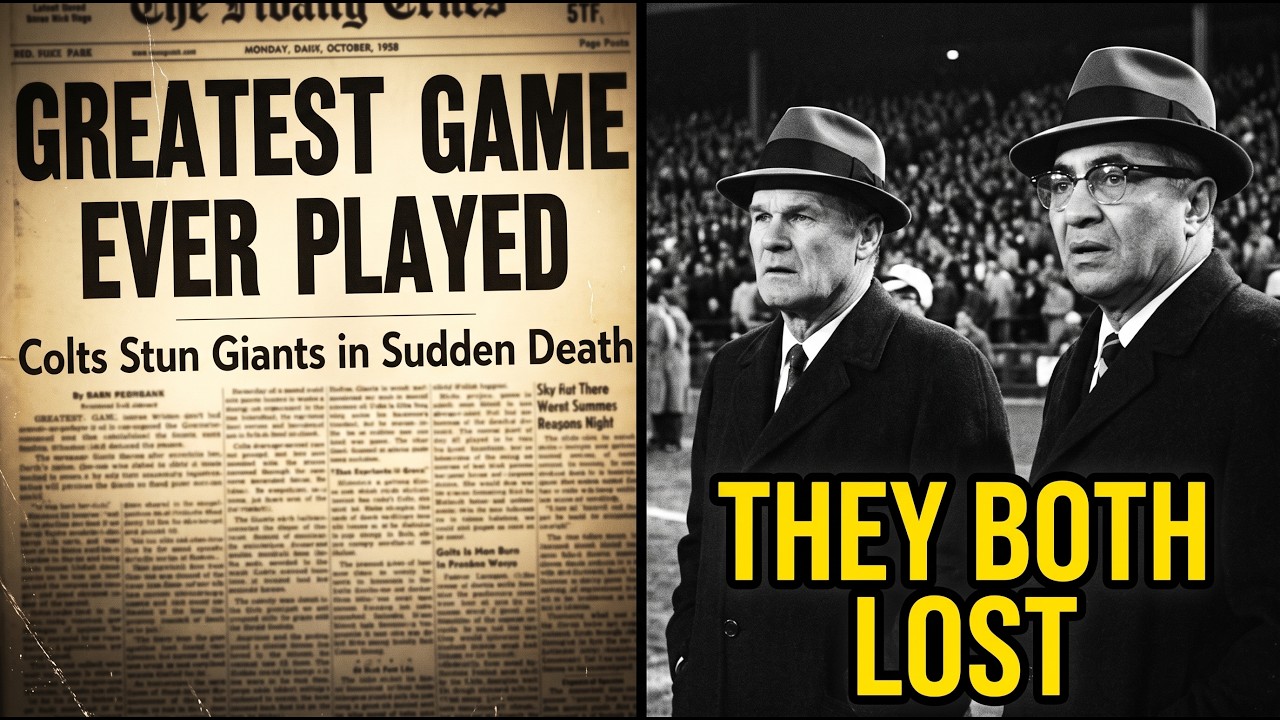
On December 28, 1958, at Yankee Stadium, 64,185 fans packed the stands for the NFL Championship game between the Baltimore Colts and the New York Giants. On the Giants sideline stood two assistant coaches who would later define professional football: defensive coordinator Tom Landry and offensive coordinator Vince Lombardi. But the man who beat them that day was supposed to be there least of all—Johnny Unitas, a quarterback his hometown team had cut before he ever threw an NFL pass. John Constantine Unitas was born in Pittsburgh on May 7, 1933, the third of four children.
His father, Leon, ran a small coal delivery business until his death from pneumonia in 1938, when Johnny was five. His mother, Helen, took over the business, took a second job, and raised four children alone during the final years of the Depression. Unitas later credited watching her relentless work with teaching him to keep going no matter what. Unitas was throwing footballs by age seven and by 13 was the best player in his neighborhood, but he was small and largely unnoticed.
Notre Dame rejected him for being too small, and he failed the entrance exam at the University of Pittsburgh. The University of Louisville gave him a chance. Over four years there he added 56 pounds and two inches, learning and working his way into a legitimate prospect. Meanwhile, in Paris, Texas, a boy named Raymond Berry was growing up under a different kind of pressure.
His father, Ray Berry Sr. , was head coach at Paris High School. Raymond wanted nothing more than to play for his father’s team, but his body presented severe obstacles: a congenital back condition that compressed his spine and made one leg appear shorter than the other, forcing him to wear a back brace under his pads and specially modified shoes. His eyesight was so poor that without contact lenses the field was a blur.
He was slow and thin, and his father refused to start him until his senior year—not out of cruelty, but out of honesty about what his son had to overcome. Berry made the team on his own and developed an obsession with preparation. He studied film before film study was common, charted defensive tendencies on paper, and ran routes with exact precision. By his own count, he developed 88 different moves to create separation from defenders.
Selected by the Baltimore Colts in the 20th round of the 1954 draft—232nd overall—he turned every physical limitation into a technical advantage. He would finish his career with 631 receptions and just one fumble. In 1955, the Pittsburgh Steelers selected Unitas in the ninth round, 102nd overall, his hometown team. He reported to camp with a wife, a child, and nothing to fall back on.
He threw touchdowns in scrimmages and outperformed the quarterbacks around him. But Steelers coach Walt Kiesling decided Unitas was “not intelligent enough to play quarterback in the NFL. ” Kiesling cut him before he threw a single exhibition pass. The man kept instead, Ted Marchibroda, started 11 games in his entire career.
Unitas went home to Pittsburgh with $6 in his pocket and a wife and child to support. He took a construction job as a pile driver, climbing 100-foot steel scaffolding in the Pittsburgh cold to grease machinery. On Wednesday and Saturday nights, he played quarterback for the Bloomfield Rams, a semi-pro team on a dirt field. They sprinkled oil on the dirt to keep the dust down, and he earned $6 a game, giving the money to his wife.
“We sort of made up the plays as we went along,” he later said. “You might have a 140-lb blocker trying to hold off a 225-lb linebacker crashing in on you. But I was hardened enough and lucky enough to escape injury. ”
In February 1956, the Baltimore Colts called.
Unitas and a teammate borrowed gas money to drive to Baltimore for a tryout. He was terrified a failed audition would end his career. He played like Johnny Unitas, and the Colts signed him for $7,000 as a backup to starter George Shaw. Shaw broke his leg in week four of the 1956 season.
Unitas stepped in. His first NFL pass was intercepted and returned for a touchdown. He never looked back. By December 28, 1958, he was 25 and had been Baltimore’s starter for two full seasons.
Raymond Berry had become his favorite target—a receiver with poor eyes, a back brace he wore for 13 years, and 88 different ways to get open because he knew he couldn’t outrun anyone. Together they formed the most dangerous combination in professional football. The New York Giants had assembled a roster many considered the finest ever put on a field, anchored by Sam Huff, the most feared linebacker in the game, and featuring Frank Gifford and Pat Summerall, with Landry and Lombardi coaching. Huff later described facing Unitas and Berry: “You couldn’t out-think Unitas.
It just seemed like Unitas to Berry, Unitas to Berry, over and over again, like a nightmare. ”
For three quarters the Giants led. With two minutes left in the fourth quarter and Baltimore trailing 17-14, Unitas took the ball. Over the next 119 seconds he engineered one of the greatest two-minute drives in the sport’s history.
Lenny Moore slipped through the right side for 11 yards and a critical first down. Then Berry took over, catching passes of 25, 15, and 22 yards, three straight completions that the league’s finest defense could not answer. With the ball at the Giants’ 13-yard line and seven seconds left, Steve Myhra kicked a 20-yard field goal, tying the game at 17. For the first time in NFL history, a championship game would be decided in sudden-death overtime.
Many of the 64,185 fans had never seen overtime in any sport and did not know the rules. Neither did an estimated 45 million Americans watching on NBC. Deep in overtime, with the Colts driving and the ball at the Giants’ 8-yard line, the national television feed went dead. It was not an accident.
Someone had unplugged the signal wire, and in the NBC production truck outside the stadium a decision was made in seconds. An NBC employee ran onto the field to stop the game and buy time to reconnect the cable. Officials blew whistles, players looked around, and the crowd had no idea what was happening. The disruption bought NBC just enough time to restore the signal.
The man was escorted off the field and play resumed. Here is what happened during the roughly 90 seconds America could not see. The Giants won the coin toss, went three plays, and punted. Baltimore took over at their own 20-yard line, 80 yards from the end zone with the championship on the line.
In the huddle, fullback Alan Ameche recalled, Unitas said simply: “We’re going to go right down the field and score. No doubt about it. ” It was a statement of fact from a man who had been told he was not intelligent enough to play in this league. They drove 13 plays and 80 yards.
Berry caught two passes for 33 yards in overtime. Near the goal line, Colts head coach Weeb Ewbank grabbed Unitas by the arm. “Keep it on the ground,” Ewbank said. “We don’t want an interception here.
” Unitas nodded, then dropped back and threw a six-yard pass to Jim Mutscheller along the right sideline. Ewbank erupted. The crowd gasped—an interception would have ended everything. The pass was complete, giving Baltimore a first down at the one-yard line.
Asked afterward why he had ignored his coach’s direct order in the biggest moment of his career, Unitas replied without hesitation: “When you know what you’re doing, you don’t get intercepted. ”
On the next play, Alan Ameche took the handoff and fell across the goal line from one yard out. Baltimore Colts 23, New York Giants 17. On the losing sideline, Tom Landry stood motionless.
Vince Lombardi looked at the field for a long moment. Both men had studied Unitas for a week, and both had been wrong. Both would spend the rest of their careers making sure they were never wrong like that again. In the Baltimore locker room, Raymond Berry slipped away from the celebration into a stall, away from the noise, the champagne, and the photographers.
He sat down in silence and prayed—not for fame or recognition, but quietly, as he had before and after every game for 13 years, from a man every possible sign had told he was not supposed to be there. Pete Rozelle, later NFL commissioner, said of that game: “The reason pro football took off was because that happened just at that time, in that season, and it happened in New York. ” Before December 28, 1958, professional football ranked behind baseball, boxing, horse racing, and college football in American sports. Sports Illustrated’s Tex Maule wrote the morning after: “Never has there been a game like this one.
” In 2019, 66 media members polled as part of the NFL’s 100th anniversary celebration voted it the greatest game in the league’s first century. After the final whistle, as the celebration swept Yankee Stadium and networks scrambled for coverage, Unitas received an offer of $750 in fees for television appearances scheduled that night and the following morning—serious money in 1958. He turned it down and rode the bus back to Baltimore with his teammates. Thirty thousand people were waiting at the airport, standing on the tarmac in the December cold in the middle of the night for a football team.
Tom Landry left the Giants the following year to become head coach of the Dallas Cowboys, an expansion team with no players, no fans, and no reason to believe they would ever be relevant. He built them into “America’s Team,” with 20 consecutive winning seasons and two Super Bowl championships. Vince Lombardi left the Giants to lead the Green Bay Packers, a franchise that had won one game the year before he arrived. He built them into one of the most legendary teams in NFL history, with five championships in seven years.
The Super Bowl trophy bears his name. Johnny Unitas played until 1973, completing 2,830 passes for 40,239 yards and 290 touchdowns. He threw a touchdown pass in 47 consecutive games, a record that stood for more than 50 years. He was inducted into the Pro Football Hall of Fame in 1979.
Raymond Berry played 13 seasons, with 631 receptions, 9,275 yards, and 68 touchdowns, and he fumbled once. He was inducted into the Hall of Fame in 1973 and later coached the New England Patriots to Super Bowl XX. Unitas died on September 11, 2002, at age 69. The Pittsburgh Steelers, the team that had cut him for not being intelligent enough, won their first Super Bowl in January 1975, the year after Unitas retired.
What stands out about December 28, 1958 is not only the statistics, the overtime, or the brief national blackout. It is the two men who made the moment possible. One climbed 100 feet in the air on a steel construction frame in the Pittsburgh cold because no one would give him a chance, and spent his Wednesday nights playing football for $6 on a dusty sandlot because he refused to stop believing he belonged. The other invented 88 ways to get open because his body gave him no other choice, wore a back brace under his pads for 13 years, and caught 631 passes with a single fumble because perfect preparation was the only advantage he would ever have.
Together, on a December night at Yankee Stadium, they beat two men who would become the greatest coaches in NFL history, in front of 45 million people. When it was over, Unitas turned down $750 in television fees to ride the bus home with his team, and Berry slipped away from the celebration to give thanks quietly, without anyone watching. That is the real story of the greatest game ever played.
It was not won by the favorite, but by the kid nobody wanted and the receiver his own father almost didn’t play.