When restoration workers opened the roof cavity of a farmhouse in Suffolk during routine repairs, they expected to find the usual accumulation of centuries: dust, old nests, scattered straw, and cobwebs. Instead, they found a single leather shoe, its sole worn at the heel, wedged into the joint where a tie beam met a principal rafter. The leather had darkened to match the surrounding wood. It had not been hidden behind any clever mechanism.
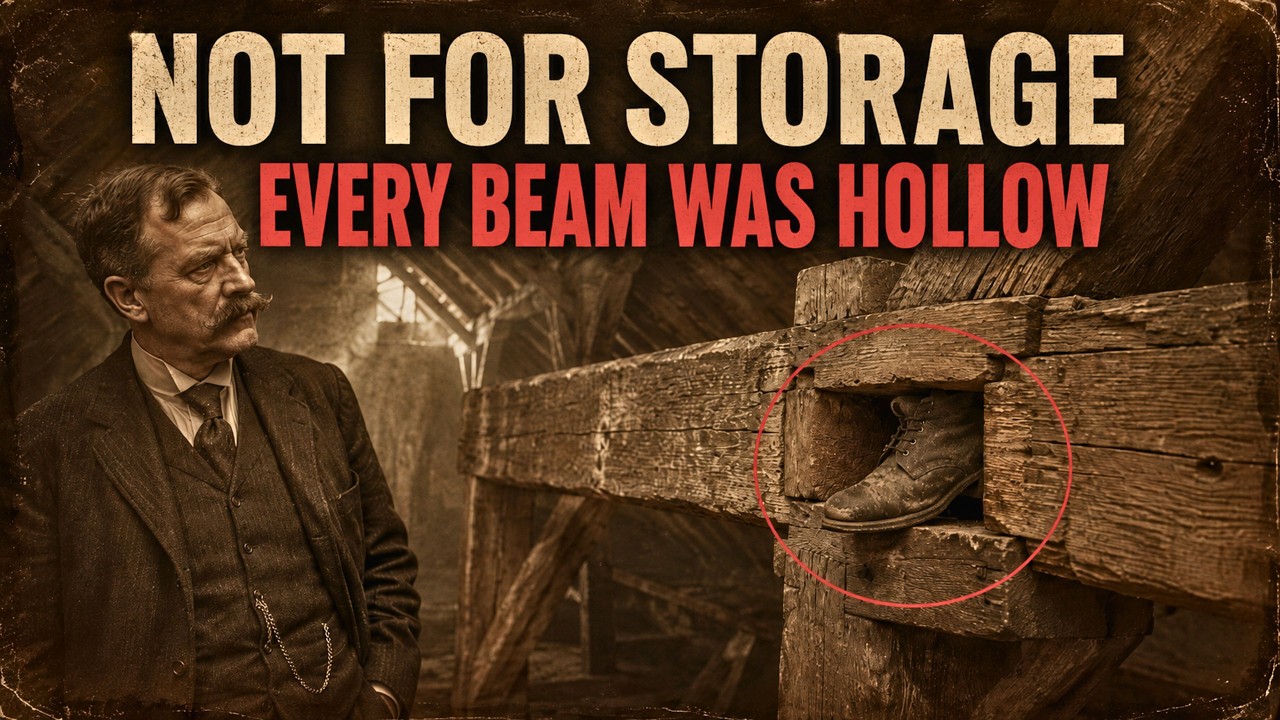
It was simply placed there by someone who wanted it in that exact spot and never intended for it to be seen again. This was one of the most common objects a restorer can pull from an old roof, chimney cavity, or wall void. Alongside mummified cats, sealed bottles filled with pins, worn coats, bodices pushed into plaster gaps, and timbers carved with symbols that predate any recorded signature or date of the building itself. For centuries, the people who built and lived in ordinary houses treated the roof space and its supporting beams less like a storage room and more like a threshold.
It was the part of the house most exposed to everything they feared entering. They built accordingly, and they kept building that way for far longer than most people assume. The buildings involved were not limited to grand estates or prominent architecture. Ordinary farmhouses, village inns, parish churches, and townhouses appear in the records almost as frequently as the more famous country homes.
This makes the pattern difficult to explain as a family quirk or an architect’s private joke. The practice spans the entire built landscape, from the humblest surviving cottage to the largest standing hall, wherever roofs were framed in timber and sealed by hand. Ask an architectural historian about the purpose of an attic and the answer seems too simple to record. Attics regulate temperature, drain summer heat, and provide a barrier against winter cold.
They keep the roof structure accessible for repair before the invention of central heating. The unheated roof void also prevents moisture from condensing on the underside of the tiles or thatch, protecting the timber from rot. Medieval and early modern carpenters understood roof framing as engineering: load paths, joints, and the geometry needed to stop the heavy covering of brick, slate, or thatch from pushing the walls outward or dropping the entire structure. That engineering is real and well documented in surviving guild records, building contracts, and the roofs themselves.
It explains why a roof needs a frame. But it does not explain what keeps appearing inside that frame when someone actually opens it for the first time in a hundred years. Dating those frames precisely is a science in itself. Dendrochronology, the technique of matching tree-ring growth against a master regional sequence built from thousands of other samples, allows researchers to date beams to within a year or two of the tree being felled, sometimes to the season.
Applied across enough buildings, it has allowed historians to map roof construction and repair with a precision written records alone could never provide. Thanks largely to this dating work, researchers can now say confidently when a particular roof void was last open to the air, which in turn tells them, within a narrow range, when whatever was found inside was most likely placed there. Architectural restorers, museum curators, and academic researchers studying historic buildings across Britain, continental Europe, and parts of North America and Australia settled by European builders have spent most of the last century cataloguing a second, unofficial purpose operating beneath the structural one. Roof spaces, hearth openings, and the beam joints that frame them were chosen again and again as hiding places by people who were not storing anything they intended to recover.
Objects were pushed into voids that were then sealed behind them, or condemned to be closed under floorboards nailed over them, or placed inside walls that would not be opened again for a hundred years, sometimes four hundred. The person who put them there was not careless. They were finishing a task, using the last moment a roof or wall would be open again, to deliberately place something inside it. None of this exists in isolation from the more visible architecture built around the same impulse.
The gargoyles and distorted statues carved on the facades of medieval churches and cathedrals across Europe served a real drainage function, directing rainwater away from stone walls so it would not undermine the masonry below. Medieval accounts and later folklorists also attributed a protective purpose to them. Their exaggerated, often frightening faces were meant to ward off evil before it reached the building. Historians generally treat the gargoyle and the concealed shoe in the roof void as expressions of the same underlying impulse operating at two different levels.
One carved in stone for every passerby to see, the other hidden inside a beam joint specifically so that almost no one would see it. The best documented version of this practice concerns shoes. At the Northampton Museum in England, a collection built since the 1950s holds records of more than a thousand shoes found inside the walls, floors, chimneys, and roof spaces of old buildings. The vast majority are English, with enough additional reports from the Netherlands, Belgium, Germany, Australia, and North America to establish the practice as a common custom rather than a regional whim.
The collection exists because a museum curator named June Swann, while classifying the institution’s footwear holdings in the 1950s, began noticing a pattern in the donations and reports reaching her desk. People kept sending in old shoes found in strange places during construction work. They were always described in the same way. Wedged into a gap near a chimney, or fixed above a door frame, or pushed deep into the corner where the roof timber meets the wall plate.
Swann began keeping a formal index. The index grew through the rest of her career, and researchers have continued adding to it ever since, matching new finds against the same handful of variables every time. The age of the shoe, its wear pattern, and the precise structural point where it was found. The pattern that emerged was consistent enough to rule out coincidence, and consistent across social classes in a way that undermines any idea that this was a superstition limited to poorer or less educated households.
Shoes appeared in the roof voids of modest laborers’ cottages and in the attics of grand houses alike. The same custom was practiced by families who could barely afford to lose a shoe and families who could afford to lose a hundred. The shoes were almost never a matching pair. They were almost always worn, often worn through at the sole or heel in a way that matched the specific foot of the owner.
The leathers had taken the shape of a particular gait. These details carry more weight than they might first appear to. Leather was expensive during most of the period this custom covers, and used shoes were routinely sold, repaired, cut down to fit a smaller foot, or given to others rather than discarded. A shoe hidden inside a beam joint is a shoe deliberately removed from that recycling cycle at a real cost to the family that gave it up.
Children’s shoes appear in the records at a rate far exceeding normal patterns of use and disposal. Some are small enough to have belonged to an infant, barely large enough to have been worn out through use. It is a detail most researchers are careful not to over-interpret, given what it might suggest about the families who concealed them. A number of the indexed shoes contain a secondary cache inside them.
A coin, a scrap of cloth, or a piece of paper tucked into the toe of the shoe before it was placed within the wall. This suggests that sometimes the shoe was not the offering itself, but a vessel designed to carry something smaller and more private. The placement was never random. In the vast majority of cases, these shoes appear at what restorers now describe as entry points.
Hearth chimneys, voids around doors and windows, and most often, the roof space itself, tucked beside the beams and rafters on which the entire covering of the house depends. Historians who study the custom generally connect it to what folklorists call sympathetic magic. The idea that an object closely associated with a person, especially one that has taken the physical form of their body, can act as a kind of substitute for them. A shoe worn by a particular person for years was among the most personal possessions an ordinary family owned.
More closely shaped to a single body than almost anything else the family kept. Hiding it at a weak point in the building’s structure provided a kind of substitute presence in the place where protection seemed most needed. The theory holds that it was meant to lure any threat passing through that opening and trap it there, rather than letting it reach the people actually living in the house. The custom was not limited to a single century.
The earliest examples dated with certainty go back to the fourteenth century. The practice continued with little notice and rarely documented through the Tudor and Stuart periods, through the Georgian and Victorian eras, and confirmed finds date from construction work carried out as late as the early twentieth century, long after any builder would be likely to describe what they were doing as magic to anyone who asked. Whatever the custom meant to those who practiced it, it survived the transition from a world that took magic seriously as a legal and religious threat to a world that had officially stopped believing in it. Shoes continued to be placed inside walls anyway.
Shoes were not the only worn garment to end up sealed inside a house this way. A research project at the University of Winchester, based on the work of restorer Dyane Estop, spent years cataloguing a similar custom: coats, bodices, hats, and other worn clothing pushed into wall cavities and roof voids alongside the shoe or instead of it. Like the shoes, the clothing is almost always old and worn, not new, and almost always found at the same structural points. Chimney breasts, roof voids, and the frames around doors and windows.
Taken together with the shoe record, the clothing finds suggest the custom was not specifically about shoes. It was about placing something that had absorbed the shape and presence of a real person into the most weakly fortified point in the house, as the builders understood it. Shoes and clothing were not the only things left inside the timbers themselves. Carved and burned directly onto the beams of thousands of buildings surveyed across Britain and continental Europe is a set of symbols that architectural historians now classify under the term ritual protection marks, sometimes called apotropaic marks, from the Greek word meaning to turn away or repel.
The most common is a circular design with six petals known as a daisy wheel or hexfoil, drawn with a compass in a single unbroken line, so that the pattern never lifts the tool from the wood. Alongside it, surveyors find a mark resembling two interlocking Vs, often read as an invocation of the Virgin Mary under the title Virgo Virginum, and sometimes a single M carved for the same reason. This detail has puzzled more than one researcher, given that England was officially a Protestant nation with a more complicated relationship to the veneration of Mary for most of the period these marks were carved. Whatever theological line the church authorities drew, the families and carpenters who carved these symbols into their roof beams clearly drew their own line elsewhere.
The marks appear in Catholic and Protestant regions of continental Europe in almost identical forms, suggesting the practice drew on an older logic largely indifferent to the doctrinal divide that marked the period. There are also lattice or interlocking patterns carved into the wood in tight parallel lines, and small circular burns made by holding a candle or wick directly against the timber until it charred. Sometimes called wick burns or fire marks, they are sometimes found clustered in groups of a dozen or more around a single joint. Many of these marks remained invisible for centuries simply because they were shallow, scratched with a knife or compass point rather than deeply cut into the wood, and easily lost under layers of limewash, soot, and paint.
Surveyors now find them using a technique called raking light, holding a lamp at a low angle across the beam surface so that even scratches a fraction of a millimeter deep cast shadows. The East Anglian researcher Timothy Easton was among the first to document these symbols systematically, beginning in the 1980s, surveying farmhouse after farmhouse in Suffolk and finding the same handful of symbols repeated at the same structural locations: around hearths and chimney breasts, framing doorways and window openings, and carved again in the roof timbers themselves, on tie beams, collar beams, and the principal rafters closest to the ridge. More recent survey work, including a public project run by archaeologist James Wright that documented marks in buildings ranging from ordinary farmhouses to great historic estates like Knole in Kent, and in structures as varied as parish churches, barns, and mill buildings, has expanded the index into the thousands, with members of the public regularly reporting marks in their own homes once they know what to look for. The logic behind the daisy wheel, as most researchers now understand it, rests on the idea that an evil spirit or witch entering a house would be forced to follow any unbroken line it encountered to its end before it could do harm.
The hexfoil, drawn without lifting the compass, has no end. It simply turns back on itself. Carved into a beam at the precise point where the roof timber meets the open sky, or burned into the wood beside a chimney where smoke, and therefore anything that could travel through it, passes in and out of the house. The mark was meant to catch whatever passed through it and hold it there, tracing the same unbroken circle forever instead of reaching the sleeping people below.
The roof space received no special treatment in this record. It received the same treatment as every other opening in the house. Doors, windows, and chimneys were marked because they were understood as places where something could enter. The roof was marked for the same reason.
In a world where witches were believed capable of flight, the roof was treated as another door rather than as the top of the house, and in some ways a harder one to guard, since no one could close it at night the way they closed the front door. Witch bottles form a related custom with its own separate physical record. Small stone jugs imported from Germany in large numbers during the sixteenth and seventeenth centuries, known today as Bellarmine jugs after the bearded face cast into the neck, or later plain glass bottles, were stuffed with a specific and consistent set of contents. Bent pins, iron nails, thorns, human hair, and in a fair number of documented cases, urine.
The pins appear bent rather than straight so consistently in the records that researchers treat the bending itself as part of the ritual, not as damage from use. These bottles have been found buried under hearths and built into the walls and roofs of houses throughout England and the American colonies. The prevailing belief recorded by the few contemporary writers who described the tradition was that the bottle worked as a reverse trap. Rather than warding off harm, a witch trying to curse the house would be drawn into the bottle, trapped inside by the pins and nails, and forced to feel whatever pain the bottle’s contents caused as long as it remained sealed and untouched.
Museums that have examined surviving witch bottles using modern imaging, including CT scans that allow researchers to see inside a sealed vessel without opening it, have confirmed that the contents match the old descriptions closely, suggesting that the recipe, however strange it seems today, was followed in the same way by families who most likely never had direct contact with one another. Concealed animals form another aspect of the same practice. Dried and preserved cats, the most surprising, and less commonly dogs, rats, and birds, have been found built into roof spaces, wall cavities, and chimneys of buildings throughout Britain, in numbers large enough that many pubs and historic houses now display the animals found on site behind glass, treating them as part of the building’s history rather than hiding them again. What distinguishes most of these finds from an animal that was simply trapped and died is the position of the body.
Investigators have repeatedly found the animals placed in specific poses, with legs extended as if mid-leap, sometimes arranged with a rat or bird stuffed in front of them as prey, frozen in an act of hunting that would not have happened naturally inside a sealed void. Some researchers argue for a gradual origin in at least some of these cases, suggesting that a cat actually trapped while hunting mice inside a roof void might have been left in place after discovery by the household, even deliberately arranged rather than removed. Its accidental death was reinterpreted as a charm worth keeping rather than a problem worth solving. In either case, whoever sealed the void wanted the pose to be read in a specific way: as a permanent guardian caught in the exact moment of catching whatever tried to enter.
Researchers working across all these categories, shoes, clothing, marks, bottles, and animals, have increasingly come to treat them as facets of a single underlying system rather than separate traditions that happen to share the same era. The materials differ. The logic does not. A worn, sharp, or carved object is placed at the structural point where the design of the house forces an opening to the outside, born of the recognition that it was a point of weakness the family could not otherwise protect.
The English records are exceptionally well documented, but not unique. Archaeologists working in completely different regions and periods, from Roman foundations to traditional buildings in Asia and the Americas, have classified a broader category they call foundation deposits or builder’s deposits. Coins, tools, food, and small personal objects are deliberately placed under thresholds, beneath hearths, or inside the foundations of a structure during its construction. The custom recorded in the roofs of English and European houses belongs to this older and far more widespread family of practices, which appears present in almost every building tradition that has left enough physical evidence to study.
What distinguishes the hidden shoe and the daisy wheel within that larger pattern is not that English builders invented something new. It is how long this particular form endured, how precisely it can now be dated, and how much of it survives for direct examination rather than being inferred from a few scattered references. None of this arose in a vacuum. The centuries in which concealed shoes, protection marks, and witch bottles appear densely in the archaeological record overlap with the period of official legal campaigns in Europe against witchcraft.
The first English witchcraft act was passed in 1542 under Henry VIII, making witchcraft a crime punishable by death. The act was repealed and reinstated twice more, in 1563 under Elizabeth I, and then in 1604 under James I, a king with such a personal interest in the subject that he wrote and published his own treatise on it before taking the English throne. Under that last act, Matthew Hopkins, a self-appointed witchfinder, traveled through the eastern counties of England during the 1640s, extracting confessions and securing the execution of accused witches in a few years than the rest of the country had executed in the previous century. In the exact same region, Suffolk and its neighboring counties, Timothy Easton would later find the densest concentrations of protection marks on the surviving beams of farmhouses.
Across the German states, France, Scotland, and Scandinavia, similar laws and the trials that followed ran from the mid-fifteenth century until the early eighteenth century, with historians’ estimates for the total number of executions on the continent reaching tens of thousands. A figure disputed in its details but not in its general scale. In the American colonies, the most famous incident occurred at Salem, Massachusetts, in 1692, where accusations spread within a single community over months, ending with the execution of twenty people before the governor intervened and the trials collapsed. Long family dynasties on both sides of the Atlantic lived their entire lives under the assumption that witchcraft was a reality, prosecutable, and present within their communities.
Living under that assumption changed how people related to their homes. The witch, under the belief system on which the trials were based, was often a neighbor rather than a stranger: someone holding a grudge, someone denied help, or someone involved in an obscure dispute that popular logic explained by attributing it to a supernatural cause: livestock disease, crop failure, or the sudden death of a child. All of it could be traced back to malicious intent sent through the air or through an unguarded opening in the house. Protecting the home was an ordinary, practical precaution, akin to what fitting a lock or a fire alarm means to a household today.
It was taken by people dealing with a real danger as they understood it, using the tools their culture gave them to deal with it. That the roof received this specific attention fits the broader pattern of places where danger was believed to enter. Smoke left the house through the roof. Storms, hail, and lightning struck it first.
Birds nested in it. And in the folklore recorded across the same regions and centuries, witches were frequently described as traveling through the air, over rooftops, through chimneys, and through any gap. The construction of a roof left it open by accident. A door could be bolted.
A window could be shuttered. The roof, by its very nature, could not be closed the same way while still functioning as a roof. The marks, shoes, and bottles were placed at the points where the structure of the house itself created an opening its occupants simply could not shut. The folklore of the period drew a real distinction between what threatened the house from below and what threatened it from above.
The roof space fell clearly on the more pressing side of that line. The cellar or threshold connected the house to the ground, and the fears associated with underground spaces concerned the dead, decay, and things that might rise. The roof connected the house to the open sky, and the fears associated with it concerned things that traveled. Storms, lightning, diseases carried in foul air, birds considered ill omens, and witches who were repeatedly described in trial testimony as flying to their gatherings rather than walking to them.
The threshold could be guarded with a single bottle buried under a single slab. The roof spanned the entire house, and every part of it, according to the logic of the time, was part of the open sky. The practice also depended on something more ordinary than belief: opportunity. Traditional roof structures, whether built around a crown post, side purlin, or using complex wooden trusses in halls and large churches, consist of separate timbers assembled with mortise and tenon and lap joints and fastenings, rather than being a single connected mass of wood.
Before the roof was covered with thatch, tile, or lead, and throughout the later repair periods that keep it exposed, these joints created easily accessible voids precisely where the main structural timbers met. Tie beams where they meet wall plates, the crown post rising to the ridge, or the purlin running the length of the roof and passing through a series of principal rafters. All of these joints naturally left small hollow spaces, easy to reach and easy to seal once something was placed inside them. A mason working in solid stone or brick would have to design a deliberate hiding place.
A carpenter fitting a roof already had dozens of hiding places built into the design before anything was placed inside them. The carpenters were not outside this belief system, merely working for superstitious clients. They were craftsmen living in the same villages, attending the same churches, and subject to the same laws as everyone else, and the building and guild records of the period show that the same craftsmen often returned to the same property for repair, re-roofing, or renovation over decades, sometimes throughout their entire careers. It is likely that some of the concealments were carried out by the builders themselves at the moment of construction, using their unique knowledge of the structure, rather than only by homeowners stuffing things into gaps after completion.
Apprenticeship periods in building work lasted for years under a single master. That is enough time to transmit a specific custom, including where to leave something inside the roof and how to close the wood around it without leaving a visible trace from below, from one generation of craftsmen to the next, as part of the craft itself, rather than as a belief one needed to consciously hold. A roof built this way did not need a separate hidden compartment designed into it. The hiding places were a byproduct of the way a roof had to be built to stand.
And whoever understood the structure well enough to build it also understood where something could be placed inside it so that it would never be found without deliberately dismantling the structure. The practice has never lost its relevance, because a large number of the buildings in which it was practiced still stand. Britain alone retains hundreds of thousands of structures built before the twentieth century, and a large proportion of them contain timber-framed roofs that have not been fully opened since their original construction or their last major restoration. Every year, restoration projects, re-roofing works, and building surveys are carried out for purely practical reasons.
Checking for rot, assessing structural safety, and upgrading insulation continue to expose beam joints and roof voids that have not been touched for centuries, and some of them still reveal a shoe, a bottle, a marked piece of timber, a folded garment, or, less frequently now, the remains of a concealed animal. Local newspapers across Britain publish a handful of these discoveries every year, often during entirely unrelated renovation work. From roofers replacing tiles to homeowners converting an attic into an extra bedroom. Heritage organizations have been forced to develop formal guidelines for what to do when these finds occur.
Restorers are generally advised to document the discovery in detail, photograph its location before moving it, and return the object to the same void whenever possible after repair work is complete, rather than permanently transferring it to a museum collection. A practice adopted not out of belief in the object’s protective power, but out of respect for the documented history of the building, and in some cases because of genuine reluctance among current owners to be the ones to break a chain of tradition that extends in some houses back five hundred or six hundred years. Many museums, including the Northampton Museum, now coordinate directly with construction and restoration companies to ensure new finds are recorded and added to existing indexes rather than disposed of without attention. A practice that has allowed researchers to continue building a current dataset from ongoing construction work rather than relying only on historical records.
A smaller number of homeowners and builders, once the history is explained to them, choose to continue the custom deliberately during their renovations, placing a coin, a child’s toy, or a written note bearing the date and their names into a beam joint before sealing it for what may be another century. Few of them describe this as a belief in magic or curses. Most describe it as a way to add their own layer to a record that already extends further back than anything else in the building. A personal continuity with everyone who did the same thing in the same place long before they were born.
What is harder to explain than the origin of the custom is its persistence. Almost every culture of that period had a version of household protection practices, and most of them faded once the legal and religious apparatus supporting a belief in witchcraft broke apart. Builders, roofers, and homeowners kept doing it for generations after that apparatus disappeared. Even in the age of gas lighting, then electricity, then indoor plumbing, when no one working in a house could plausibly claim to fear a legal charge of witchcraft.
The most consistent explanation researchers offer is not the survival of supernatural belief itself, but craft tradition. A specific learned practice passed from one craftsman to another long after people stopped talking about the original reasons behind it. It stayed alive because it was what you did when you opened a roof. In the same way certain building customs continue today for reasons most craftsmen performing them could not fully explain if asked directly.
In the specific case of the concealed cats, researchers also point to a more straightforward parallel explanation that requires no survival of belief at all. A dead cat sealed inside a roof void, whatever its original purpose, kept rodents away from that space as long as the scent lasted. And deliberately leaving a live cat in the roof space to hunt before sealing the void would have solved a real and ongoing problem for any household storing grain or feed nearby. Ritual and pest control were not necessarily in competition.
A family that half-believed in the protective purpose and fully believed in the practical one had no reason to abandon the habit, whatever explanation they privately preferred on any given day. None of the people who did this work left their names attached to what they left behind. The shoe carries no note. The daisy wheel carries no signature.
The witch bottle was sealed specifically so that the person who filled it would never open it again. Because canceling the protection, according to the logic of the time, most likely depended on the object remaining hidden and untouched for as long as the house stood. History usually preserves a name or a story through documents, portraits, and monuments built to be remembered. What remains here is different.
An act repeated by thousands of unconnected people across hundreds of years, all of whom reached the same conclusion about the weak points of a house and what to do about them. Return to that roof void in Suffolk, the tie beam, and the single worn shoe pressed into the joint by a person who died centuries ago and whose name is not recorded anywhere the shoe can be traced. Multiply that by the thousands of similar finds indexed at Northampton. With the worn coats and bodices recorded by the Winchester project; with the daisy wheels and candle burns surveyed across Suffolk, Kent, and the wider English countryside; with the sealed bottles of pins examined by museum scanners without breaking them; and with the animals still displayed behind glass in the pubs and historic houses that extracted them, arranged them, and preserved them from their roof spaces.
It was a deliberate and consistent system across regions that had no direct contact with one another, built into that part of the house that could not be fully closed against what its inhabitants believed might come through it. Those roofs are still in place. The timber beams, erected before the witchcraft laws were repealed and before belief in these practices was something anyone would openly profess, still carry the boards, tiles, and thatch above thousands of buildings older than the insurance documents required to maintain them today. Most of what was placed inside those roofs will never be found, because most of those spaces will not be fully opened again in our lifetimes.
But every year, somewhere, a construction crew removes part of the roof of a building old enough to remember a century when the roof over your head protected you from more than just the weather. And somewhere at the meeting point of two beams, where something was tucked by a hand that departed long before any living memory, that object is still waiting in the same place it was left.