A cold January evening in 1914 turned into one of London’s most haunting unsolved mysteries when a young messenger discovered a child’s body beneath a train seat. On Thursday, January 8, 1914, 15-year-old Robert Stillwell boarded the 4:14 PM North London Railway train from Chalk Farm station to Broad Street. As the train pulled out of Midway Park station, he noticed a small hand protruding from under the seat in front of him. Unable to get a porter’s attention, the frightened boy waited until the train reached Shoreditch, where he rushed to the station master’s office.
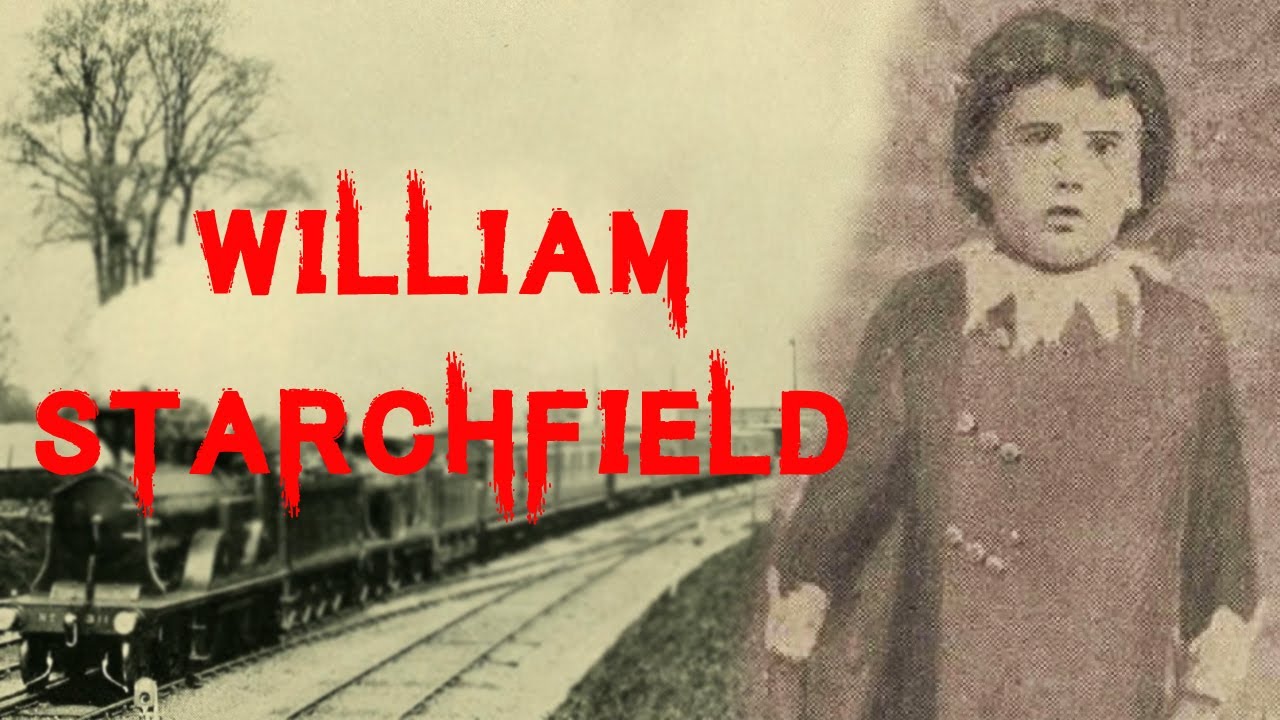
Police soon found the lifeless body of a five- or six-year-old boy beneath the seats. The child had golden curly hair, bruises on his face, blood on his lips, and marks on his neck indicating strangulation. A post-mortem revealed he had been dead for no more than two hours, and the cause of death was confirmed as strangulation. The boy was identified later that evening as five-year-old William Starchfield.
His mother, Agnes Starchfield, told police she had been living apart from her husband and had already lost two other children to natural causes. She said she had been out looking for work on the day of William’s disappearance and learned he was missing when she returned home around 3 PM. William had been sent to a local stationer’s shop by his landlady to collect a card advertising rooms to let. When the shop owner returned two cards instead of one, the landlady sent William back with instructions.
He never returned. Police questioned William’s father, John Starchfield, a newspaper seller who worked near Tottenham Court Road station. He said he had been asleep at his boarding house until about 3 PM and had not seen his son in about three weeks. He was then told his son had been murdered.
The case drew national attention, partly because John Starchfield was already known to the public. In September 1912, he had attempted to disarm an Armenian criminal named Stephen Titus during a gun rampage at London’s Horseshoe Hotel. Titus shot the hotel manager and wounded a barmaid before fleeing into the streets. Starchfield, a former soldier, was shot in the chest during the struggle but held Titus until help arrived.
He was hailed as a hero, awarded £50, and given a weekly payment from the Carnegie Hero Fund. Titus was found to be insane. Several witnesses came forward during the investigation. One woman said she saw a child eating a cake while walking hand in hand with a man with a mustache wearing a dark coat, heading toward Camden Town station.
She identified the man as John Starchfield. Another witness told of seeing a boy fitting William’s description with a foreign-looking man who boarded a bus with the child, who seemed reluctant. A train signalman said he saw a man in a dark coat leaning over someone, and an engine driver reported seeing a powerfully built man in a third-class carriage leaning over as if tying a parcel. Investigators initially believed the murder may have happened in Regents Park, a short walk from Chalk Farm station, before the body was placed on the train.
But after a second autopsy, detectives concluded William was alive when he boarded the train and was killed during the journey of less than 15 minutes between Chalk Farm and Maiden Lane. At the inquest, the jury returned a verdict of willful murder, and John Starchfield was charged with the crime. He pleaded not guilty at his trial on March 31, 1914. During the trial, the defense attacked the credibility of key prosecution witnesses.
It was revealed that two witnesses had seen a photograph of the defendant in a newspaper before identifying him. One had asked whether he might receive a reward for information leading to a conviction, and another had attempted to take his own life since giving evidence. Because their identifications could not be relied upon, the trial collapsed, and the judge instructed the jury to return a verdict of not guilty. William’s funeral took place on Saturday, January 17, 1914.
More than 3,000 mourners lined the streets as the procession made its way to Kendall Street Cemetery. Thirty police officers and four mounted officers managed the crowds as the coffin was lowered. Agnes Starchfield broke down with grief; it was the third child she had buried. The tragedy continued to affect Agnes deeply.
In June 1914, she was arrested after expressing a desire to end her life. Six weeks later, she appeared in court accused of striking a married woman named Lucy Delgano. She claimed self-defense but was found guilty. The judge described her as a neurotic and excitable woman, ordered her to pay £5, and bound her over to keep the peace for twelve months.
John Starchfield died in 1916 from complications related to his old gunshot wounds. He always maintained his innocence and believed the murder was an act of revenge orchestrated by a friend of Stephen Titus. In 1918, a drifter from Liverpool named John Fitzpatrick confessed to killing William, but his account did not match the known facts of the case. A doctor examined him and concluded he was suffering from insanity, and it was determined he could not have committed the crime.
The murder of William Starchfield was never officially solved. Over time, the case faded from public memory and became one of many forgotten tragedies of the era. Today, William’s grave lies quietly in a corner of the cemetery, a quiet reminder of a short life cut short by a crime that never found its answer.