In February 1988, a welfare check at a rural Minnesota home uncovered a scene of shocking violence that would haunt investigators for decades. The case shattered the image of a devout Catholic family and raised difficult questions about mental illness, justice, and punishment.
The Braum family of Rochester appeared to be the picture of stability. Bernard and Plette Braum met in college and built their marriage on their shared Catholic faith. Bernard, 41, worked for IBM, while Plette, also 41, stayed home to raise their four children and directed the church preschool.
The household was lively with 18-year-old Joe, 16-year-old David, 13-year-old Diane, and 11-year-old Richard, known to everyone as Ricky. The children attended Catholic schools and did well academically. Bernard was especially close to David, and the two spent time together fixing up an old car.
On the surface, life seemed orderly and content. But tensions were quietly building beneath the family’s calm exterior.
Joe, the oldest, had entered a phase of teenage rebellion. He dyed his hair bright colors, listened to punk rock, and rejected his parents’ strict beliefs. After finishing high school, Joe moved out to stay with a family friend and worked at a local restaurant.
The departure deeply affected David, who looked up to his older brother. Around the same time, David’s two closest friends moved away. At just 16, David was struggling with severe depression that had already led him to attempt suicide twice.
Mental health issues carried heavy stigma in the 1980s. Even though the Braums were involved in church counseling work, they kept David’s struggles completely hidden from friends and fellow parishioners.
David began to imitate Joe’s style, listening to punk rock and changing his appearance. Joe helped David get a part-time job washing dishes at the same restaurant, giving the brothers a way to stay connected.
The first warning came from David’s high school. Staff contacted police after troubling rumors spread among students that David may have hurt his father. David had been seen near the school that morning but never attended class. None of the Braum children showed up at school that day, and Bernard failed to appear at IBM.
When deputies from the Olmstead County Sheriff’s Office arrived at the family home around 6 p.m., they found tire marks in the fresh snow and a garage light on. The house doors were shut but unlocked.
Inside, the home looked lived-in and normal. The only oddity was a bathroom scattered with hair clippings and what appeared to be black hair dye.
Then Deputy Toruson went upstairs. As he reached the top landing, he saw two pairs of bare feet covered in dried blood.
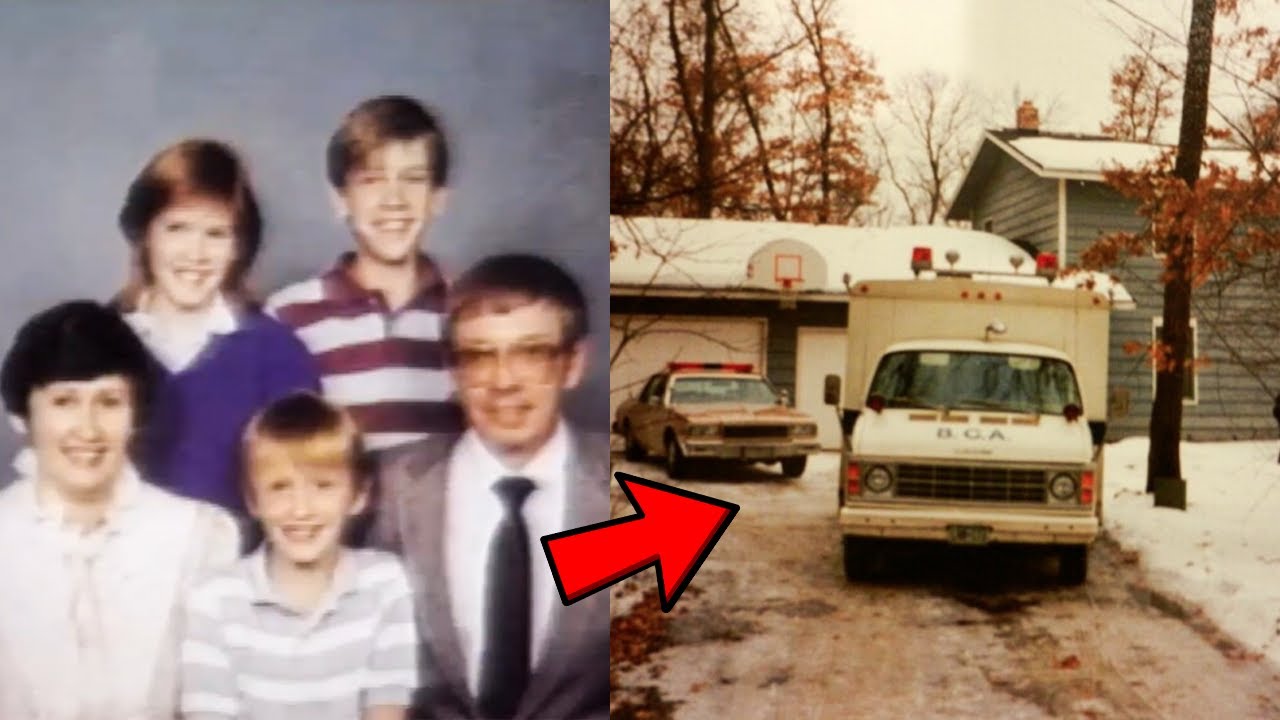
In the master bedroom, Bernard was found kneeling beside the bed. He had been struck 22 times in the face, head, hands, arms, and back. In another bedroom, young Ricky was found curled up on his bed holding a blanket. He had been struck nine times, and his throat had been cut after he was already dead.
Plette had suffered five blows to the head, while Diane had been struck eight times. In the basement, investigators found a 28-inch axe covered in blood. It belonged to Bernard.
Four family members were confirmed dead. Two were unaccounted for. At first, detectives believed Joe and David may have been taken by the attacker.
Officers soon found Joe at the restaurant where he worked as a cook. Heartbroken by the news, he could not tell police where David might be.
The case shifted suddenly when one of David’s friends shared a disturbing story. Earlier that morning, David had approached her before school and tried to get her to skip class. During their talk, he admitted, “I hit my dad with an ax. I kept hitting him and my dad kept getting back up.”
David explained that he argued with his father around 11:30 p.m., then spent hours thinking before acting at about 3 a.m. While everyone slept, he took his father’s axe and attacked Bernard first, then his mother. He then went into Ricky’s room.
When Diane woke up and found her wounded mother trying to leave the bedroom, David attacked both again to make sure they were dead.
After the killings, David carried on as if nothing had happened. Security cameras and witnesses tracked his movements across Rochester that day. He drove the family van, stopped at a park, visited stores, picked up pizza, returned to the house where the bodies remained, and withdrew $250 from a credit union.
The bathroom mess was explained: David had dyed his hair black to change his appearance.
Police issued a warning that David likely had black hair and was wearing bright pink tennis shoes. Panic spread through Rochester as reports of sightings came in from across the city.
By 11 p.m., police found the family van abandoned at Methodist Hospital. The search continued through the night.
At 8:30 a.m. on February 19th, a witness spotted a young man matching David’s description using a pay phone and called police. Officers took him into custody without a struggle. David had shaved the sides of his head, leaving a black mohawk.

During his arrest and early processing, David stayed completely silent. His fingerprints and palm prints matched those found on the blood-covered axe.
The community struggled to reconcile the crime with the David they knew. He was the helpful teenager who babysat for neighbors and shoveled driveways without accepting payment. Some friends said he had told them he planned to kill his parents, while others insisted he could never be capable of such violence.
The case drew national attention, and one bizarre story surfaced when a punk band called Negative Land claimed federal authorities had placed them under house arrest. The band said their song “Christianity is Stupid” had sparked the deadly argument. Reporters quickly found the story was fabricated. The band had invented the press release to hide that they were cancelling their tour due to money problems.
David was charged with four counts of first-degree murder and eight counts of second-degree murder. The central issue became whether he would face trial as a juvenile or as an adult.
Court-appointed psychologist Dr. Carl Malquist testified that David had suffered from worsening depression that left him feeling trapped and oppressed at home. The assessment confirmed David’s two suicide attempts in June and September of the previous year.
Judge Gerald Ring initially ruled that David should be tried as a juvenile, though he personally disagreed with the decision. After appeals, the Minnesota Supreme Court ruled unanimously that David would be tried as an adult. They concluded that the brutality of the murders meant a 16-year-old should face adult penalties rather than risk release at age 19.
David’s trial began on September 27th, 1989, under Minnesota’s two-phase process for insanity defenses. The first phase dealt only with guilt, and the jury was told not to consider his mental state. After just four hours of deliberation, the jury found David guilty on all first-degree murder charges.
The second phase focused on whether David was legally insane when he committed the killings. The defense brought in psychiatrists who argued that David did not understand that killing his family was wrong. Dr. James Stevens testified that David suffered from visual hallucinations and had developed three distinct alternate personalities. However, Stevens admitted he had never directly observed these personalities and based his conclusions entirely on what David told him.
The prosecution called four psychiatrists. Two stated David was not legally insane, while the other two offered no opinion on his sanity. All agreed he had some form of mental illness or impairment.
After 21 hours of deliberation, the jury delivered their verdict on October 3rd, 1989, which happened to be David’s 18th birthday. They ruled that he was sane when he committed the murders and found him guilty on all counts.
Judge Anne Morse handed down three consecutive life sentences for the killings of his parents and brother, along with a single concurrent life sentence for the murder of his sister. The concurrent sentence for Diane’s death caused controversy, with many questioning why her life appeared to be treated as less significant.
David would serve at least 52 years before becoming eligible for parole in 2041. The surviving family members had asked that all four sentences run at the same time, which would have made David eligible for parole in only 17 years. Judge Morse denied their request.

“This was a case of extreme and monumental tragedy caused by a pathetically sick, depressed mind,” she said, expressing hope the case would lead to changes in Minnesota’s laws on the insanity defense.
David was transferred to Minnesota Correctional Facility in St. Cloud. In 1990, the Minnesota Supreme Court upheld his conviction.
For 29 years, prison officials described David as a model inmate. He followed the rules, took part in programs, and kept in touch with surviving relatives, including his aunt and grandparents. Even with his family, David never spoke about the murders or revealed why he had committed them.
In 2023, David was moved to a different facility. That same year, Minnesota passed a law establishing an incentive release credit program that applied retroactively. Even violent offenders could now qualify for early release by demonstrating good behavior and taking part in rehabilitation programs.
As a result, David’s minimum sentence was shortened, making him eligible for parole immediately, 34 years earlier than expected. The law stirred immediate controversy.
Minnesota House Representative Matt Bliss introduced a bill aimed at preventing the most violent criminals from earning early release credits, but the bill was blocked in committee. Representative Sandra Feist, who authored the original early release legislation, defended David’s case, stating, “No one should have to spend their life in prison for a crime they committed as a child, especially after spending decades undergoing rehabilitation.”
In 2025, David faced the parole board for the first time in nearly 40 years. He told the board he wanted to apologize to the family and friends of Bernard, Plette, Diane, and Richard, saying he had caused tremendous loss and left them with grief, pain, confusion, and unanswered questions.
David shared insight into his mindset for the first time. He said he had struggled with depression that clouded his thoughts and his ability to process things. He developed a short-sighted view, believing his feelings would last forever. In the fog of his depression, he began to blame others, and he placed that blame on his parents and family because he was often more depressed at home.
He said his time at the Oaks Treatment Center in Texas, along with his religious faith, helped him begin to understand his depression, though real clarity did not come until his early 20s. He stayed in touch with several relatives, including his brother Joe, and reached out to one of Diane’s friends.
“It was always difficult to hear how painfully you’ve affected someone else’s life,” David reflected. “It was also honestly sometimes difficult to hear their acceptance of me into their lives as I struggled to go through the journey of finding a way to forgive and accept myself.”
The parole board approved his release. On July 29th, 2025, David Braum left prison at the age of 53. He was taken to a halfway house in the Twin Cities, where he joined a work release program while wearing an ankle monitor and remaining under supervision.
The ruling ignited heated debate across Minnesota and nationally. David’s actions left friends, relatives, and an entire community in shock, grappling with the heartbreak of what happened and the sharp contrast between the person they thought they knew and the reality of what he became.
Decades later, David’s release has reopened difficult questions about justice, punishment, and rehabilitation. The case remains a tragic reminder of how quickly a seemingly perfect family can be shattered by hidden pain.