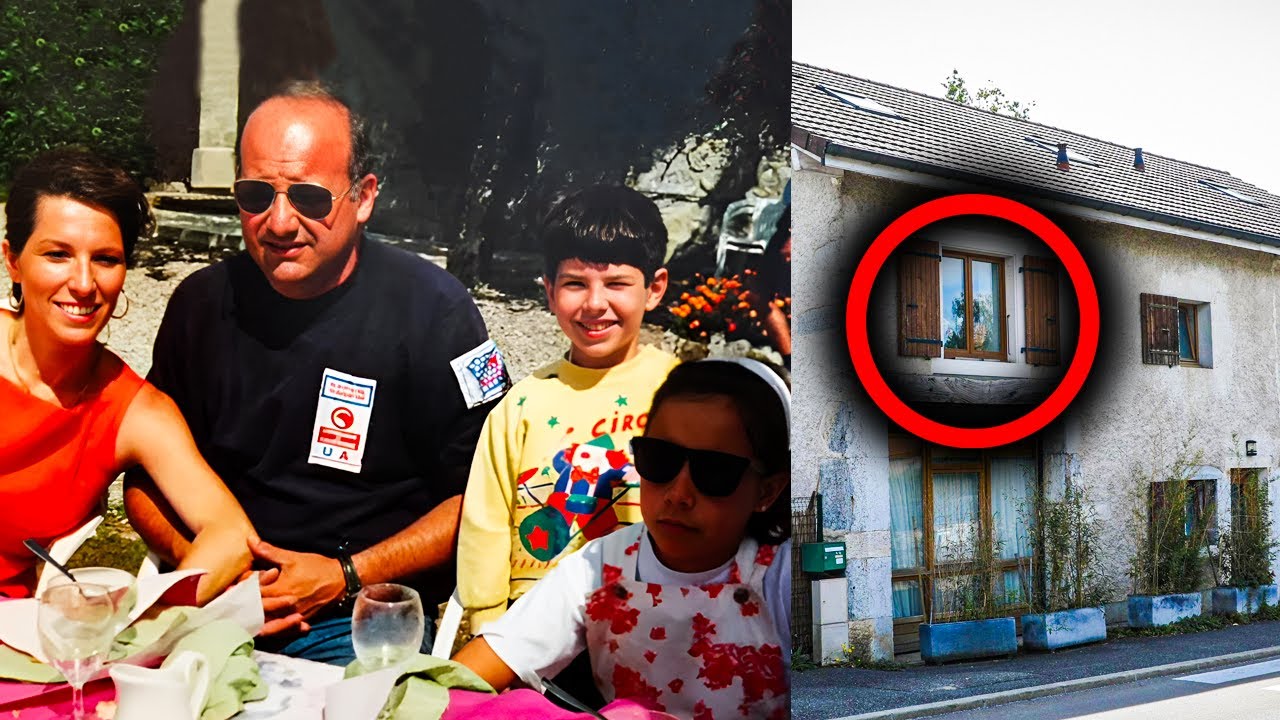
On January 11, 1993, garbage collectors making their early morning rounds discovered a home ablaze in the French town of Prévessin-Moëns. They immediately alerted the fire brigade, who rushed to the scene. While extinguishing the fire, responders observed movement in an upper bedroom window—someone was inside and clearly needed help.
Medical personnel were summoned, and the individual, later identified as Jean-Claude Romand, was rescued. He appeared to be in a state of shock and was unable to communicate. He was transported to the hospital, where he eventually slipped into a coma.
Meanwhile, bodies were recovered from the premises. Authorities determined that the victims had been murdered rather than perishing in the fire. This unsettling revelation prompted widespread speculation about who could have perpetrated such a heinous crime against this seemingly innocent and beloved family.
Jean-Claude Romand was born in Lons-le-Saunier, France, on February 11, 1954, and raised in Clairvaux in the Jura region. He attended high school until completing his baccalauréat in 1971. He started classes at Lycée du Parc in Lyon but left after one term. Later, he joined medical school.
He would later marry a woman named Florence Croizet. Florence was born on March 6, 1956, and studied at the University of Lyon to become a doctor. It was there that she met Jean-Claude Romand, who was a distant cousin of the family. Initially, Jean-Claude did not catch Florence’s interest. They barely knew each other and did not spend much time together.
Over time, through mutual friends and study sessions, they began spending more time together. Jean-Claude Romand was immediately smitten with Florence and made persistent efforts to win her over. She, on the other hand, saw him as an ordinary guy—not particularly attractive to her or well-spoken. Florence had envisioned marrying a typical doctor: intelligent, attractive, and charming.
Following a failed second-year exam, she switched from medicine to pharmacy together with Romand and a friend named Luc Ladmiral. They maintained a routine for the next decade, studying, taking exams, and supporting each other until graduation in 1980. Florence and Jean-Claude Romand tied the knot, and six years later, they had their first child, Caroline. Two years after Caroline’s birth, their son Antoine arrived.
Florence lived the life of a conventional wife and mother, working at local pharmacies to support her family while her husband worked at the World Health Organization in Geneva, a short distance from their home in France. A few days after Christmas in 1992, Florence was out in Ferney-Voltaire when she bumped into the school president. After exchanging holiday greetings, the conversation shifted to an intriguing incident involving her husband.
The president mentioned the headmaster’s demotion due to an affair with a teacher, prompting a school board meeting. He mentioned his intention to discuss the matter with Jean-Claude, as he also served on the school board. The president’s secretary attempted to find Jean-Claude’s contact information in the WHO directory, but strangely, his name was not listed.
Florence found this amusing and laughed it off, but she was also intrigued. She assured the president that there must be a valid explanation and promised to address it with her husband upon his return from work. After exchanging farewells, they never spoke again.
Jean-Claude Romand kept his work life quite private, sharing minimal details with both family and friends. Florence believed her husband engaged in significant research and commanded respect in the medical field. He maintained a clear boundary between his professional and personal life, to the extent that Florence never had access to his office phone number. Romand insisted on remaining undisturbed during work hours. If Florence ever needed urgent communication, she had to page him, and he would promptly return her call.
Friends often inquired about Jean-Claude’s role at the WHO. Florence would deflect the question with a chuckle, confessing that she too was uncertain. Occasionally, she would playfully speculate that one day she might discover her husband was a secret spy.
During the Christmas season of 1992, Florence learned of an annual Christmas tree event organized by the WHO. This gathering allowed staff members to bring their families to the office to decorate a large Christmas tree together. Surprisingly, her husband had never mentioned this event to her.
Florence felt unsettled by the situation—from the school president’s revelation about her husband’s absence in the WHO directory to the discovery of the unmentioned family event at his workplace. As recounted by Florence’s brother, who joined the family for the holiday season, a profound sadness seemed to shadow Florence during those days.
A couple of days into the new year of 1993, Florence and Jean-Claude Romand found themselves shopping together. Florence insisted that Romand purchase a new suit and eventually persuaded him. Later that same day, after parting ways with his wife, Romand made a visit to a pharmacy, placing an order set to be ready by January 9th.
On the evening of January 5th, Romand made withdrawals from two different ATMs totaling 2,000 francs. He generously gave 500 francs to a homeless individual he encountered before proceeding to a gun store. Exiting the store, he carried tear gas canisters, cartridges, a silencer for a .22 caliber rifle, and a stun wand.
Returning home, the night passed uneventfully. Time passed until a frantic call to the fire brigade was placed on January 11th at 4:00 a.m., reporting a fire engulfing the house. When the fire was extinguished, first responders entered the premises. Their family friend, Dr. Luc Ladmiral, was summoned to the scene, witnessing with dread as stretchers carried out the charred remains of Antoine, Caroline, and Florence.
Whenever a household fire results in fatalities, the police launch an inquiry to uncover the circumstances. During the examination of Florence’s remains, the medical team made a disconcerting observation: evidence of blunt force trauma to the back of her skull. This revelation sparked suspicion, particularly after determining that Florence’s demise resulted from blunt force trauma rather than the fire itself.
During the examination of the children, another distressing revelation emerged. Contrary to initial assumptions, both Caroline and Antoine did not perish in the fire. Instead, they met their demise from gunshot wounds hours prior to the inferno. This stark reality indicated that the events unfolded before the household was consumed by flames.
Law enforcement commenced an inquiry into the suspicious deaths. However, with Jean-Claude Romand incapacitated in a coma, investigators faced the daunting task of pursuing alternative leads. They reached out to relatives, acquaintances, and neighbors in a bid to unravel the mysteries surrounding the family.
Luc Ladmiral was contacted as part of the investigation. When questioned about potential enemies of the family, Luke couldn’t identify any. Nevertheless, he was summoned for an interview several days later. Despite thorough questioning, the consensus remained unchanged: the family enjoyed a positive reputation, and no significant incidents preceded the tragedy.
The focus then shifted to Jean-Claude Romand, revealing a shocking revelation. Romand had never been employed by the World Health Organization, nor had he delivered any lectures at the University of Dijon. In fact, he was not a qualified doctor at all.
Initially skeptical, Luke’s disbelief grew as he recollected their shared academic journey. He recounted an incident from their second year when he had noticed Jean-Claude Romand’s absence during an exam. Upon visiting Romand at his residence, Luke observed his friend’s ailing condition—clammy skin, pale complexion, and dark circles under his eyes. Jean-Claude disclosed that he was battling lymphoma, a form of cancer, exacerbated by exam-related stress. At Romand’s request, Luke pledged to keep this information confidential, especially from Florence.
Investigators noted peculiarities within the residence. They discovered that all doors had been locked internally, indicating that no unauthorized individuals had entered the premises. Initially, an accidental fire was the primary hypothesis until the condition of the bodies was revealed.

During Jean-Claude Romand’s coma-induced weeks, law enforcement zeroed in on him as their prime suspect. Upon contacting the educational institution, it was confirmed that Romand had pursued studies for 12 years. While he successfully completed his first-year exams, he failed to pass those in the second year. Exploiting the absence of enrollment restrictions, Romand continuously re-enrolled in the second year throughout his academic tenure.
As investigators delved into the deaths of Florence and the children, they were confronted with another grim discovery. Jean-Claude’s uncle, seeking to relay the tragic news to his parents, arrived at their residence only to encounter an eerie silence. Upon entering, he discovered the lifeless bodies of his mother and father, both victims of gunshot wounds. A ballistic examination confirmed that Jean-Claude’s parents had been fatally shot with the same firearm used on Antoine and Caroline.
Following the public disclosure of the tragedies, the police received an anonymous call from a woman unwilling to disclose her identity. She revealed that she had engaged in a romantic relationship with Jean-Claude Romand after meeting him in Paris. She too had been told that he was a researcher at the WHO. Romand had misled her into believing he was a specialist with influential connections.
Romand enticed her with the opportunity to invest funds in a Swiss bank, offering an impressive 18% interest rate return. Through persuasive tactics, Romand managed to persuade his lover to make a financial investment. Initially hesitant, they reached an agreement wherein the woman would provide him with 990,000 francs for investment, with the expectation of receiving returns after three months.
As the deadline approached in early January, she reminded Romand of their arrangement. Following negotiations, they arranged to meet for a dinner gathering, with Romand extending an invitation to dine with a prominent political figure. On the agreed day, Romand picked her up in Paris. As night descended, they found themselves still on the road, clearly lost.
Suddenly, Romand pulled over and launched a surprise attack on the woman inside the car. He employed tear gas, a stun wand, and a cable in an attempt to incapacitate her. However, she fiercely fought for her life and managed to escape from the vehicle. Romand pursued her but inexplicably halted when she pleaded for mercy.
He begged for forgiveness, claiming that his lymphoma was flaring up, causing him to behave erratically. In a state of survival mode, the woman agreed to remain silent about the incident in exchange for Romand safely returning her home.
Investigators began to develop a grim perception of Jean-Claude Romand. He was a pathological liar, a manipulator, and a scam artist. But the question that lingered was: was he also a murderer?
Upon awakening from his coma, Jean-Claude Romand was approached by investigators. They sought a confession, but Romand chose to remain silent. He sat in his hospital bed, gazing into the distance with a vacant expression. Despite relentless questioning about the events of January 9th, the origins of the fire, the shooting of Antoine and Caroline, the severe injuries sustained by his wife, and the discovery of his deceased parents, he divulged nothing.
It wasn’t until the investigators told him that they knew the truth—that he was not a doctor and was unemployed—that a shift occurred. Eventually, he began to speak.
On the night of January 9th, Jean-Claude and Florence were spending a typical evening at home. After putting the children to bed, they retired to their own bedroom. According to Romand, his memories of that night abruptly ceased until the chilling recollection of discovering his wife sprawled on their bed surrounded by a pool of blood, with a bloodied rolling pin in his hand.
Uncertain of what transpired, Romand proceeded to sleep beside his wife and awoke the following morning to prepare breakfast for the children. Caroline and Antoine gathered on the couch to watch a cartoon selected by their father. He served them each a bowl of cereal before joining them to watch television. When the children inquired about their mother’s absence, he informed them that she was unwell and needed extra rest.

During that morning, Romand observed that Caroline felt warm, prompting concerns about her health. To prevent any potential illness from spreading, he instructed Caroline to go upstairs to her bedroom. Somehow, Caroline ended up lying face down on the bed with a pillow over her head. Romand couldn’t provide a clear explanation to investigators but speculated that it may have evolved from a game he played with his daughter.
Subsequently, he retrieved his .22 caliber rifle, fitted with a silencer, and fatally shot his 7-year-old daughter in the back of her head. In a similar manner, Antoine met his tragic demise.
His memories then became hazy. Subsequent evidence presented during the trial indicated that he left the house, purchased newspapers, and appeared to engage in routine activities, portraying a normal demeanor to any casual observer. Upon returning home, he watched television.
One fact remained certain: he received a phone call from his parents inviting him for lunch before noon on that fateful day, and he accepted the invitation. Departing from his eerily quiet residence, he drove to his parents’ home and joined them for lunch.
He then summoned his father upstairs under the guise of inspecting a purportedly malfunctioning boiler pipe. Despite his elderly father’s physical limitations, he made an effort to examine the pipe at Jean-Claude’s request, only to be callously shot in the back by his own son.
Descending to where his mother was, he did not concoct any games or stories this time. His mother became the sole victim whom he shot while facing her. Before departing, he also shot the family’s dog. When questioned about this during the trial, it was the only instance where he exhibited a semblance of remorse. Overcome with emotion, he broke down in sobs and tears, revealing that the dog had been cherished by his children.
It was at this moment that Jean-Claude Romand resolved to return home and take his own life. However, his plan did not unfold as intended.
Recall the earlier mention of his mistress providing him with 990,000 francs for an alleged investment scheme. This was how Jean-Claude Romand sustained himself. He regaled numerous individuals, including his relatives and Florence’s family, with tales of extravagant returns on investments. Due to their familiarity with Romand, they placed their full trust in him. Consequently, he amassed substantial sums of money from these trusting individuals over time. He would channel these funds into accounts under his own name in Geneva, thereby avoiding scrutiny from tax authorities.
Moreover, he meticulously managed the family’s financial affairs, ensuring that Florence remained unaware of his deceitful activities. Eventually, the inevitable time arrived when people began demanding the return of their money along with the promised profits. Regrettably, this was an obligation he could never fulfill. Every single franc he acquired was swiftly spent on his immediate needs, leaving him with virtually nothing saved, despite amassing over 2 million francs across the years.
The mounting pressure left him feeling trapped with no apparent escape. Like many other family annihilators, he convinced himself that by ending their lives, he would actually be sparing his family from the repercussions of his actions. Subsequently, he planned to take his own life, thus avoiding the harsh reality he faced.
On June 23, 1996, the trial commenced. He remained mostly silent, seated behind glass with a police officer on each side. He avoided making eye contact and kept his head down. By July 2nd, a verdict had been reached. Jean-Claude Romand was convicted of the murders of his wife, his children, and his parents. He received a life sentence without the possibility of parole for 22 years.
In 2019, he petitioned for release from prison to reside in a convent. During his incarceration, he had reportedly become a devout Christian. The judge granted his plea, citing his good conduct as a contributing factor.
It is sad and unfortunate what all the victims endured at the hands of this liar, manipulator, and monstrous individual. As we reflect on this horrific tale, our hearts and minds are with the individuals whose lives were abruptly ended and the grieving families and friends they left behind.