On September 10, 1944, at an airfield outside Brussels, a twin-engine American plane sat on the tarmac with its door open. Inside, in a cramped cabin smelling of engine oil and cigarette smoke, the Supreme Allied Commander was waiting.
General Dwight D. Eisenhower could not easily step down from the plane to greet his visitor. Eight days earlier, he had severely twisted his knee while helping push a small aircraft away from the waves after an emergency landing on a French beach. His leg was stiff and wrapped in bandages. So the meeting would take place inside the aircraft.
The visitor climbed aboard minutes later. He was a short, thin man wearing a black beret, with piercing eyes and an even sharper tongue. Field Marshal Sir Bernard Law Montgomery had been promoted to the highest rank in the British Army just nine days earlier. On that same day, he had lost the job he wanted more than anything else in the world.
Montgomery came to this meeting with a single demand. He wanted nearly everything: fuel, trucks, ammunition, and priority. And he wanted the other American armies stopped in their tracks, especially General George S. Patton’s Third Army, so that he alone could drive into the heart of Germany and end the war.
What happened in that cabin over the next hour would become one of the most famous confrontations between Allied commanders in the entire war. Voices would rise. Words would be used that no British officer should use toward his commanding general. At the height of the moment, Dwight Eisenhower, the calm, smiling diplomat of the Allies, leaned forward, placed his hand on Montgomery’s knee, and said twelve words Montgomery would never forget.
To understand why Montgomery climbed onto that plane angry, one must return to the summer of 1944. In June, the Allies landed in Normandy. For nearly two months afterward, they were stuck. The rugged terrain of northern France became a slaughterhouse. The British and Canadians, under Montgomery, fought a brutal battle around the city of Caen. The Americans fought viciously field by field through the hedgerows. Progress was measured in meters, and casualty lists grew week after week.
Then, at the end of July, the dam broke. The Americans launched Operation Cobra, blew a hole in the German lines at Saint-Lô, and poured through it. And into that gap came a general who had been waiting for this moment his entire life.
On August 1, 1944, Patton’s Third Army became operational. What followed was one of the fastest advances in the history of warfare. Patton’s tanks swept through Brittany, then turned east. They raced across France, crossing river after river, liberating town after town. In one month, the Third Army advanced about 400 miles. German units that tried to stand in their way were overrun, bypassed, or encircled.
By the end of August, Patton’s spearheads had crossed the Meuse River. The German border was only 100 miles away. The West Wall, Germany’s border fortification line, was only partially manned. Patton was certain that if he had fuel, he could cross the Rhine within days.
But on August 30, the fuel ran out. The problem was not a shortage of gasoline among the Allies. The problem was that the gasoline was in Normandy while the armies were hundreds of miles away. The ports were far from the front. Allied air forces had destroyed the French rail lines before the invasion. Nearly everything had to be moved by truck over congested roads. And the trucks themselves consumed vast amounts of the fuel they carried.
The Third Army needed about 400,000 gallons of gasoline per day to keep advancing at full speed. On August 30, it received about 32,000 gallons. Patton’s tanks stopped, not because the Germans stopped them, but because their tanks were empty. Patton was furious. His officers remembered how he raged, pleaded, and cursed. He reportedly told Eisenhower’s headquarters, in words that became legendary, that his men could eat their belts, but his tanks needed gasoline.
And he knew exactly where the gasoline was going. It was going north, to Bernard Montgomery.
Here is the part that most history books leave out. At the very moment Patton’s fuel was running out, a quiet but bitter struggle was taking place at the top of Allied command. It was a struggle over one question: who would end the war?
Since the June landings, Montgomery had commanded all Allied ground forces in Normandy, British and American alike. That was a temporary arrangement. Everyone agreed that once American armies outnumbered British armies, Eisenhower would take direct command of the ground war himself. That day came on September 1, 1944. Eisenhower took personal command of the ground battle. Montgomery returned to command only his 21st Army Group, the British and Canadian armies in the north.
For Montgomery, a man who firmly believed he was the best general among the Allies, this was an insult. The British government understood this too. On the same day, to soften the blow, King George VI promoted Montgomery to field marshal. That gave him five stars on his shoulder. Eisenhower, his commander, still had only four. Montgomery was now higher in rank than the man he was supposed to obey.
Montgomery was determined to use all his authority to change Eisenhower’s mind. His argument was simple and very appealing to a British public exhausted by five years of war. The Germans had collapsed, he said. They were in full retreat. This was the moment to finish them off.
But the Allies did not have enough supplies to keep all their armies moving at once. So instead of advancing on a broad front, with the British in the north and the Americans in the center and south all moving together, the Allies had to choose one attack. One knockout blow, driven deep into Germany. Every drop of fuel, every truck, every plane had to go to that single attack, and everything else had to stop.
Naturally, Montgomery believed that knockout blow should be his. On September 4, he sent a message to Eisenhower. He wrote that he considered it time for, in his words, “a powerful and decisive thrust toward Berlin.” He made clear he intended to launch an attack in the north under his command. And he made equally clear what he thought should happen to the rest of the armies: they should stop, including Patton’s army.
Imagine what that meant. Patton had just cut 400 miles across France, and his army was closer to Germany than any other. Yet Montgomery was asking the Supreme Commander to take away his fuel and give it to the British. For Patton, this was not strategy. It was theft.
He was not alone in that view. General Omar Bradley, commander of the U.S. 12th Army Group, was equally determined not to let the Americans be sidelined. Bradley had spent the summer watching Montgomery’s methodical, cautious advance around Caen while his own armies fought their way across France. He had no intention of handing the final chapter of the war to a man he considered slow.
On September 2, at a meeting in Chartres, Patton and Bradley pressed Eisenhower hard to let the Americans continue east. Eisenhower, who as always sought to keep everyone united, agreed that the Third Army could advance toward the Moselle River as supplies allowed. So when Eisenhower replied to Montgomery’s message, he did not grant his request. He wrote that the Allies would advance on a broad front. He agreed that the northern attack toward the Ruhr, Germany’s industrial heart, was the most important. He agreed to give it priority. But he would not stop Patton entirely. And he would not bet the entire war on a single thrust.
Montgomery was not satisfied. He was more than unsatisfied. He was convinced that Eisenhower, a man who had never commanded troops in battle before the war, simply did not understand what he was doing. He demanded a meeting.
And so the two men ended up face to face in an airplane cabin in Brussels on September 10.
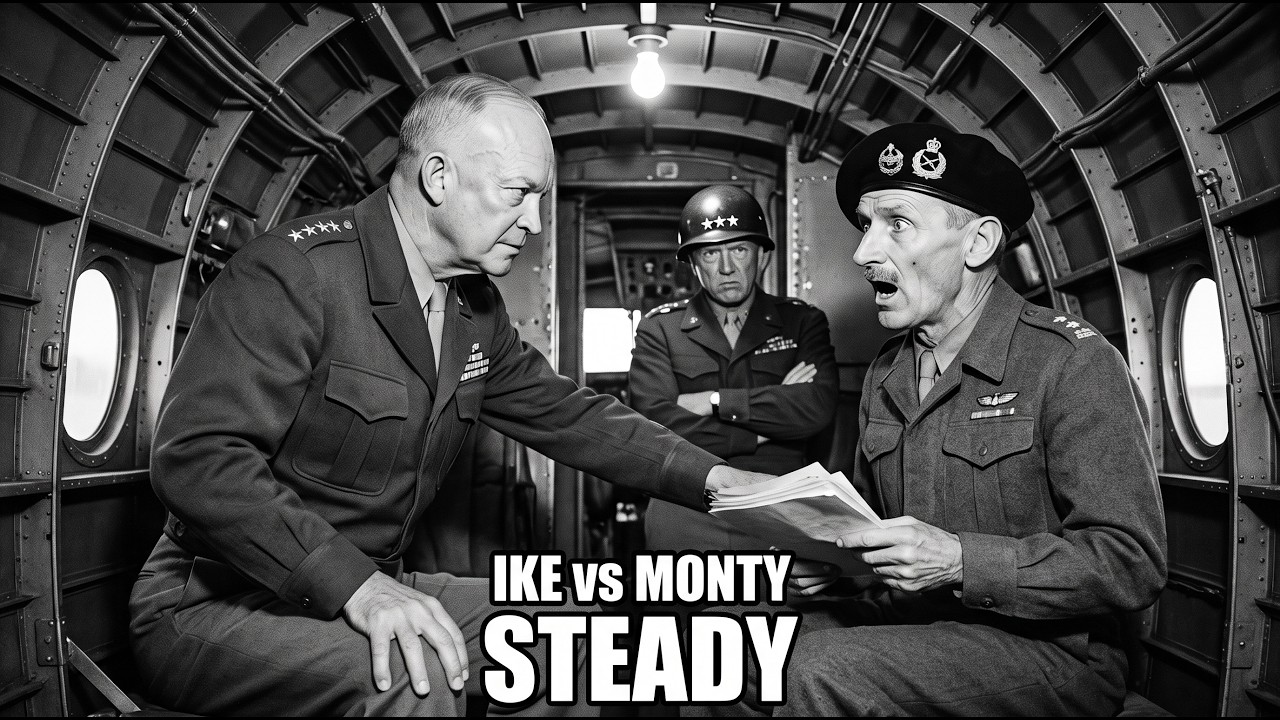
Picture the scene. Eisenhower sat in his seat, his injured leg stretched out before him. Beside him was his deputy, Air Chief Marshal Sir Arthur Tedder, a quiet, intelligent RAF officer who had little fondness for Montgomery and was thoroughly tired of him. Also present was Eisenhower’s chief administrative officer, Lieutenant General Sir Humphrey Gale, a British officer responsible for the very supply situation Montgomery had come to complain about.
Montgomery sat down, and one of the first things he did was make a request. He asked Gale to leave the plane. It was a strange request. Montgomery was a guest at a meeting called by his commander, and he was asking that commander to send one of his senior staff officers away. But Montgomery wanted Eisenhower alone, or as close to alone as possible.
Eisenhower agreed, with his usual patience. Gale left. Tedder remained. Then Montgomery reached into his pocket and pulled out a bundle of papers. They were Eisenhower’s latest directives, the messages in which the Supreme Commander had laid out his broad-front strategy. And Montgomery began to dissect them.
He did not argue as a subordinate argues with his superior. He lectured, like a headmaster addressing a student. He went through the directives line by line and condemned them. The broad-front strategy was wrong, he said. It was chaotic. Supplies were being scattered among all the armies, and as a result, no army had enough to finish the job. The Americans in the south were being allowed to wander off in their own direction. Patton’s advance toward the Saar was draining fuel that should have gone north. It had to be stopped.
As he spoke, his tone grew sharper. According to accounts later released from that meeting, retold by Allied command historians again and again, Montgomery did not merely disagree. He used words that bordered on contempt. In some accounts, he refused an order with a single word not used in polite company. He kept going, his voice rising, his finger jabbing at the papers, while the Supreme Commander of the largest Allied force in history sat and listened.
Tedder watched in silence. Eisenhower watched in silence.
Consider who was sitting in that seat. Dwight Eisenhower was the man who planned and launched the greatest amphibious invasion in human history. He was answerable to Roosevelt and Churchill. He commanded millions of men from a dozen nations. And one of his subordinates was speaking to him as if he were a junior officer who had forgotten his homework.
Eisenhower let him talk. Then, when Montgomery finally paused for breath, Eisenhower leaned forward in his seat. He reached out, placed his hand on Montgomery’s knee, and said, calmly and with firmness: “Steady, Monty. You can’t talk to me like that. I’m your boss.”
Twelve words. There was no shouting. There was no threat. There was only a hand on a knee, a steady voice, and a clear reminder of who was in charge.

Montgomery stopped. According to the same accounts, the field marshal looked at Eisenhower for a moment, then said: “I’m sorry, Ike.” For a man like Bernard Montgomery, those words were almost impossible to say. He was not a man who apologized. He did not apologize to his staff, his fellow commanders, or the politicians in London. But in that moment, face to face with the calm, steady American, he apologized.
Here is what most people do not realize about that moment. Eisenhower was famous for his temper, and his staff knew it well. When he got angry, his face turned deep red, the veins in his neck bulged, and he swore like a farm boy from Kansas. He could have exploded at Montgomery. He could have ordered him off the plane. He could have called London and demanded his replacement. But he did none of that.
Eisenhower understood something Montgomery did not. His real job was not to win the argument. It was to keep the alliance together. Montgomery was the most famous soldier in Britain, and the British public adored him. If Eisenhower humiliated him or dismissed him, the damage to the relationship between London and Washington would have been enormous. So Eisenhower chose the one response that left Montgomery no room to reply. He did not attack him. He simply reminded him of the chain of command, then waited for him to accept it.
The plan worked. The tone of the meeting changed immediately. But the argument was not over, because Montgomery had not come just to complain. He had come with a plan. Now that things had calmed down, he presented it.
He wanted to use the airborne divisions stationed in England, waiting for a mission, and drop them deep behind German lines in the Netherlands. These divisions would seize a series of bridges across the great Dutch rivers: the Meuse, the Waal, and finally the lower Rhine at the town of Arnhem. Then British tanks would push up a single corridor across those captured bridges, straight over the Rhine, and around the end of the German West Wall. From there, the road to the Ruhr, and then to Germany, would be open.
It was a bold plan, even daring. Some might say it was the least cautious plan Montgomery ever made. And it was exactly the kind of bold move Eisenhower had hoped his cautious British commander would one day attempt.
Eisenhower did not give Montgomery his single thrust to Berlin. He did not agree to stop all other armies. But he did approve the Arnhem plan, and he agreed to give it supply priority. The operation was called Market Garden.
When Omar Bradley heard about it, he could not believe it. Years later, he wrote in his memoirs that if Montgomery, a devout teetotaler, had walked into Eisenhower’s headquarters suffering from a hangover, he could not have been more stunned than he was by the audacity of Montgomery’s plan.
Bradley was astonished. Patton was angry, because giving priority to Montgomery meant one thing for the Third Army: less fuel, fewer trucks, and a slower advance. At the very moment Patton was pushing toward the Moselle River and the fortress city of Metz, the supply trucks that could have fed his tanks were being sent north to support an operation in the Netherlands.
In his diaries and letters, Patton complained that Eisenhower was giving in to all of Montgomery’s demands. He wrote about the Germans digging in on his front while his tanks waited for fuel. To Patton, it seemed the war was being handed to the British on a silver platter while the army that had been fighting its way forward was told to stay put.
Bradley shared much of Patton’s anger. Both men believed Eisenhower was too willing to bow to British pressure. And both watched with growing concern as Operation Market Garden took shape.
On September 17, 1944, one week after the confrontation on the plane, the largest airborne operation in history began. Thousands of planes and gliders filled the skies over the Netherlands. About 35,000 paratroopers and glider troops were dropped during the battle. The American 101st Airborne Division landed near Eindhoven. The American 82nd Airborne Division landed near Nijmegen. The British 1st Airborne Division landed near Arnhem at the far end of the corridor, tasked with capturing the final bridge over the Rhine.
At first, it looked as though it might succeed. The Americans captured most of their bridges. A small British force under Lieutenant Colonel John Frost reached the north end of the Arnhem bridge and held on. But the plan depended on speed, and speed did not come.
The British tanks were stuck on a single raised road over flat, muddy ground, where every German anti-tank gun could see them coming. The 82nd Airborne had to seize the Nijmegen bridge in a desperate river crossing. And at Arnhem, the British paratroopers found they had landed on top of two German SS panzer divisions that had been sent to the area to rest and refit.
For nine days, the 1st Airborne Division fought for survival. Frost’s men held the bridge longer than they were asked to, until they were overrun. The rest of the division was trapped in a shrinking perimeter around the town of Oosterbeek, waiting for the tanks that were supposed to reach them in two days but never came. On the night of September 25, the survivors were evacuated back across the Rhine in small boats under rain and darkness.
Of the roughly 10,000 men of the British 1st Airborne Division and its attached units who went into Arnhem, fewer than 2,500 returned. Operation Market Garden had failed. Total Allied casualties in the operation are usually estimated at between 15,000 and 17,000 killed, wounded, and captured.

In the aftermath, the arguments resumed. Montgomery later insisted that Market Garden was 90 percent successful, and that its failure was due to a lack of support, meaning Eisenhower had not stopped the Americans, and Patton had been allowed to keep advancing. He was never fully convinced that the plan itself, one road, one chance, one bridge too far, was the problem.
The Americans saw it very differently. For Bradley and Patton, the Battle of Arnhem was proof of everything they had been saying since August. The knockout blow had been tried. It had been given priority. And it had ended with the destruction of an entire airborne division.
But there was a heavy price paid, and it had nothing to do with Arnhem. On September 4, the same day Montgomery sent his message to Eisenhower about a full-scale thrust to Berlin, British tanks captured the great Belgian port of Antwerp. Its docks were almost intact. This was exactly what the Allied armies needed to solve their supply crisis.
But Antwerp lies inland at the end of a long estuary called the Scheldt, and the Germans still controlled the banks of that estuary. Until it was cleared, no Allied ship could reach the port. While Montgomery focused on Arnhem, the Battle of the Scheldt was postponed. The Germans used the time to fortify. It took weeks of brutal fighting, mostly by Canadian forces in flooded polder land, to clear the estuary. The first Allied supply ship did not unload its cargo at Antwerp until November 28, 1944.
The supply crisis that had stopped Patton in August, the same crisis Montgomery used to argue that everyone else should stop, was not actually solved until nearly three months later.
The dispute between Eisenhower and Montgomery was not finally settled until October. By then, Eisenhower had run out of patience. Montgomery kept pressing, with repeated messages, for a single ground commander. He made clear who he thought that commander should be. In a message in mid-October, Eisenhower finally settled the matter with complete clarity.
He wrote that the question of command was not a matter of strategy but of nationality and alliance politics. He told Montgomery that if he still believed, after all this, that Eisenhower’s decisions were endangering the success of the campaign, then they should refer the matter to a higher authority, to Churchill and Roosevelt, to the Combined Chiefs of Staff. Everyone understood what that meant. If the matter went to the highest levels, someone would have to go, and it would not be the American.
Montgomery read the message, and for the second time that autumn, he backed down. He wrote a reply saying Eisenhower would hear no more from him on the subject of command. He signed it, “Your very devoted and loyal subordinate.”
It would not be the last time the two men clashed. Just two months later, in the snows of the Ardennes during the Battle of the Bulge, Montgomery again sought command of the entire ground war and pushed Eisenhower to his limits. And again, it was Patton racing against time across the map while Montgomery planned. But that is another story.
What matters is what happened in that cabin on September 10. In that moment, the course of the war in Europe was set. There would be no single British thrust to Berlin. The Americans would not stop. The alliance would advance on a broad front, with Patton and Bradley and the American armies fighting alongside the British all the way into Germany.
And that was decided not by a battle, but by twelve quiet words from a man with a bandaged knee: “Steady, Monty. You can’t talk to me like that. I’m your boss.”
So here is the question historians still argue about today: Was Montgomery right?
Some say yes. In September 1944, the German army in the West was indeed on the verge of collapse. If the Allies had taken every drop of fuel and every truck and given it to one army, whether Montgomery’s or even Patton’s, they might have crossed the Rhine before the Germans recovered, and they might have ended the war before Christmas. Eisenhower’s broad front was a political compromise disguised as strategy, and it cost the lives of every man who died in the long winter that followed.
Others say the opposite. It was not possible to supply any single army all the way to Berlin over one road from Normandy. The Germans had far more fighting power than anyone in the Allied camp realized, as Arnhem and the Bulge proved. If Montgomery’s single thrust had been launched on the scale he wanted, it would have been Market Garden doubled, a spear pushed deep into Germany with its flanks wide open. Eisenhower’s decision was correct. He kept his cool, he held the alliance together, and he refused to put all his eggs in one basket.
And then there is Patton. Some say that if anyone deserved the fuel in August, it was the general whose tanks were already sitting at the Moselle River, and that the war could have ended months earlier if he had been given it.
What do you think? Was Eisenhower right to hold his ground against Montgomery? Or did the broad front cost the Allies their chance to end the war in 1944?