In the autumn of 1908, the Oregon Cascades were a place where the maps ran out before the trouble did. Roads thinned to deer trails, and deer trails thinned to nothing at all. It was in this high, isolated country that a widow named Mabel Thornquist disappeared under circumstances that remain unexplained to this day.
Mabel was 34 years old. Her husband, Orson Thornquist, had been a timber cruiser. In the spring of 1906, he walked into the Willamette National Forest on a survey contract for a lumber company out of Eugene. He never walked out. Searchers found his bedroll, his compass, and one of his boots set neatly on a flat rock, as if he had taken it off to soak his feet. His body was never found.
Mabel waited two years for her husband to come home. When the lumber company sent her his final wages and a letter of regret, she did what many widows in that country did. She kept the cabin, kept the goats, and kept living.
The cabin sat at the head of a place locals called Suther’s Draw, though no Suther had lived in those hills for 40 years. It was high country, thick with spruce, hemlock, and Douglas fir so dense that the noon sun came down green. The nearest neighbor was a man named Cornelius Holloway, a 61-year-old retired mule packer with a milky right eye. He lived an hour’s walk down the draw and checked on Mabel once a week out of a sense of duty he never explained.
It was Cornelius who first noticed something was wrong. He came up the draw on the morning of October 12, 1908, carrying a sack of cornmeal and news of a logging camp hiring at Blue River. When he came over the last rise, he stopped. The goats were loose in the yard, which was not unusual. But the gate to their pen was gone, pulled clean off its hinges. The hinges themselves were bent backward, as if something had taken the gate and walked away with it without bothering to lift the latch.
Cornelius set the cornmeal down on the porch step. He called her name once, then twice. The cabin door was shut. The window curtain was drawn. There was no smoke in the chimney, and it was cold enough that morning that there should have been. He knocked. He waited. He knocked again.
The door opened on its own, just enough to show him a sliver of the room inside. On the wall, he saw a long, dark mark running from the floorboards up to the ceiling beam in a single unbroken line. It looked as if someone had dragged a wet brush from the bottom of the room to the top in one motion. Cornelius would later tell deputies it was not paint. He knew the difference.
He stepped inside. Mabel was not there. The bed was made. The kettle was warm but not hot, meaning the fire had gone out an hour or two before. Her boots were beside the door. Her coat was on the hook. Her shawl was folded on the chair. The mark on the wall was the only thing that did not belong.
As Cornelius stood looking at it, he became aware of a smell. It was not wood smoke. It was not the goats. It was something deeper, like wet iron and old leaves. It was a smell he had only encountered once before, when he was 19 and helping a neighbor pull a calf that had died inside its mother.
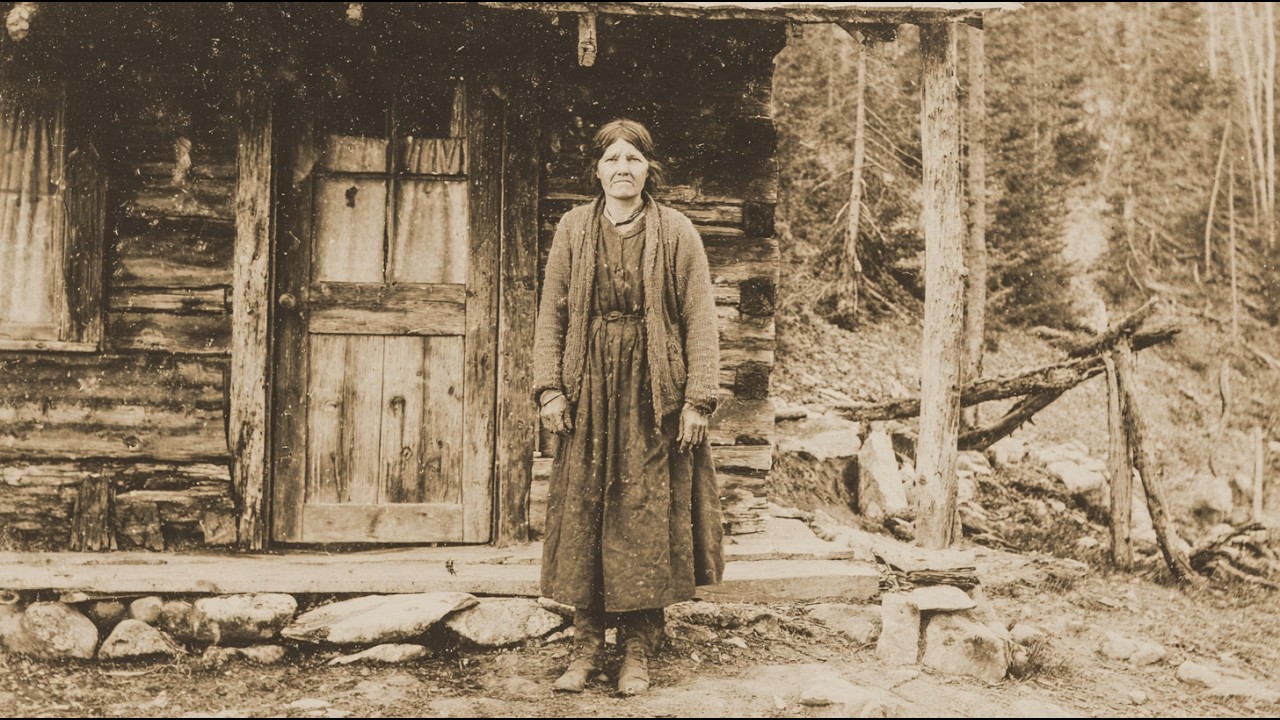
He walked out of the cabin without touching anything. He pulled the door shut behind him. He gathered the goats into the pen and propped the broken gate in place with a length of cordwood. Then he walked four miles down to the town of Detroit Crossing as fast as a 61-year-old man could walk.
The deputy who came up the next day was a man named Wendell Crisp. He was 28 and had been a deputy for three years. He came up Suther’s Draw with Cornelius and a tracker named Absalom Reeve, who was 47 and half Klamath on his mother’s side. Absalom knew the country better than any white man living.
They went through the cabin together. They found the mark on the wall, which had darkened overnight. They found Mabel’s journal under the mattress. They found the goats fed and watered. They found no sign of Mabel, no sign of struggle beyond the broken gate, and no tracks leading away from the cabin in any direction.
That last part bothered Absalom. The ground around the cabin was soft from rain three nights before. Cornelius had left tracks coming and going. Wendell had left tracks. Absalom himself had left tracks. The goats had left tracks. But there were no tracks of Mabel leaving the cabin, and no tracks of anything else coming to it. Whoever or whatever had taken her had not walked.
They searched the draw for three days. They found nothing. On the fourth day, Wendell sent a telegram to the sheriff in Salem. On the fifth day, he sat down at his kitchen table and opened Mabel Thornquist’s journal.
The early entries were what you would expect from a woman alone in the mountains. Weather, goats, the price of flour, a neighbor’s cow that calved twins. Wendell read those pages quickly. He was looking for the recent ones.
The recent entries started in the middle of August. On August 15, 1908, Mabel wrote that she had heard her husband’s voice. She had been splitting kindling on the porch when the wind came down off the ridge. Inside the wind, she heard Orson say her name. Just once. Just the way he used to say it when he came in from the woods.
On August 22, she heard it again. This time, inside the cabin. She had been sitting by the fire mending a tear in her apron when she heard him say her name from the corner where the rocking chair sat. The chair was empty. She wrote that the room got cold, and that she sat very still. She went to bed without putting out the lamp.
On September 3, she heard him knock on the door. She knew the knock. Three short, one long. It was the knock he had used their whole marriage, since they were courting in Coos Bay in 1893. She wrote that nobody else in the world knew that knock. She went to the door and put her hand on the latch, but she did not open it. Something underneath her, some animal part that lived in the bones of her, told her that whatever was on the other side was not her husband.

The knocking went on for an hour. It stopped at midnight. When she finally opened the door at dawn, there were no footprints in the dew on the porch.
After that, the entries got stranger. On September 11, she wrote that she had begun to find small things. A tin button on the window sill that had not been there the night before. A coil of wire on the table. A piece of bark with a face scratched into it, propped against the leg of the stove. She did not know who was leaving them. She wrote that the things felt familiar, the way a smell can be familiar when you cannot place it.
On September 19, she wrote that she had seen a man at the tree line. He was standing between two hemlocks at the edge of the clearing, about 80 feet from the porch. He was tall. He was wearing what looked like Orson’s coat, the brown wool one with the patched elbows. He was facing her. She could not see his face because of the angle of the light.
She stood on the porch with her hand on the rail. The man did not move. After a long time, he lifted his arm and waved at her, slowly, once, the way a man waves to his wife when he is coming home. She did not wave back. She went inside and bolted the door. When she looked through the window an hour later, the man was gone, but the two hemlocks at the edge of the clearing were leaning toward each other, the way trees lean when they have been pushed.
On September 25, she wrote about a dream. In the dream, she was standing in the cabin, and Orson was standing in front of her, and his face was wrong. She did not say how it was wrong. She wrote only that the wrongness was not damage, it was construction. Whatever was wearing her husband’s face had built the face out of pieces, and the pieces did not quite fit. She woke up screaming. The goats were screaming too, all four of them in the pen at 3:00 in the morning. They did not stop until the sun came up.
The last entry in the journal was dated October 11, 1908. The night before Cornelius found the cabin empty.
Wendell read the last entry three times. Then he closed the journal. Then he poured himself a drink, which was something he did not often do. He copied the last entry, word for word, into his deputy’s report.
That report was filed with the Marion County Sheriff’s Office in Salem on October 17, 1908. It is not in the Marion County archives today. According to a note pinned inside the empty folder where it should be, it was removed for review in 1922 and never returned. The folder is otherwise empty, except for that note and a single dried pine needle that nobody can explain.
Wendell Crisp lived to be 84. Before he died, he gave a copy of that last entry to his granddaughter. She gave it to a man who was writing a book that was never published. The man’s papers ended up in a university library in the Pacific Northwest.

This is what the last entry said. Mabel wrote that on the night of October 11, she had heard her husband’s voice again. Not at the door, not in the wind. Inside the cabin, behind her. She had been bent over the stove putting up a kettle for tea, and the voice had said her name, very close, very clear, from a place not 3 feet behind her.
She wrote that she did not turn around. She wrote that she could not turn around. She stood there with her hand on the kettle, the heat rising up through the iron, and she listened to the voice tell her, in her husband’s exact tone, in the cadence of a man she had loved for 13 years, that it was sorry. That it had been a long way back. That it was tired. That it wanted to come home.
The voice asked her, very softly, if she would open the door. She wrote that she said, “No.” The voice asked her again, and again, and again. Each time a little quieter, a little more patient, and a little less like Orson. Until the last time, when the voice that asked her was not a voice at all, but the sound a kettle makes just before it boils.
The last thing she wrote in her journal, in handwriting that ran slightly off the line, was this: “I do not know how long it has been here. I do not know if the door has ever been closed. I am going to look behind me now.”
There was nothing else on the page. Just the date in the corner, October 11, 1908, and a single small smudge of ink at the bottom of the page. When Wendell held it up to the lamp, it looked for a moment like the print of a thumb that had been pressed there from underneath the paper.
Mabel Thornquist was never found. There were searches. There was a reward of $200 posted by the lumber company that had once employed her husband. There were psychics from Portland who came up the draw and refused to spend the night. There was a Methodist minister from Salem who walked into the cabin alone, walked back out 20 minutes later, got into his buggy, and drove away without saying a single word to anyone for the remaining 6 years of his life.
The cabin stood empty for two winters. In the spring of 1911, a homesteader named Ulric Vance bought the parcel from the county for back taxes. Ulric was 46, a widower himself, an immigrant from somewhere east of the Carpathians. He moved into the cabin. He fixed the gate. He kept goats. He lasted nine days.
On the tenth morning, Cornelius Holloway, now 64, walked up the draw with a bag of cornmeal because he had heard there was a new neighbor. He found the cabin door open. He found the goats in the yard. He found the gate, again, pulled clean off its hinges and missing entirely. He did not go inside. He turned around and walked back down to Detroit Crossing. He sat down on his own front porch step and cried for the first time since he was a small boy.
Ulric Vance was never found, either. The county did not sell the parcel a third time. They let it revert to wilderness. By 1920, the trail up to Suther’s Draw was overgrown. By 1930, the cabin had collapsed. By 1940, there was nothing left but a chimney stack and a few black timbers. The locals had stopped using the name Suther’s Draw entirely. They called it, when they had to call it anything, the empty place.
The cabin is gone now. The draw has another name. The lumber company that hired Orson Thornquist went out of business in 1926. Cornelius Holloway died in 1917 of pneumonia in his own bed, with his hand on a Bible he had not opened in 50 years. Wendell Crisp lived to be 84. The Methodist minister never spoke another word.
The journal sits in a climate-controlled box in a university library behind a request form and a pair of cotton gloves. The last sentence is still the last sentence. The smudge at the bottom of the page is still there.
According to the few hunters who still go up into that part of the Cascades, and who will talk about it in the parking lot of a bar and not anywhere else, someone occasionally hears a voice in the wind near the empty place. It says a name. It says it once. It says it the way a man says the name of his wife when he is coming home from the woods. Whoever hears it, they say, has the good sense to keep walking, to not look back, and to never, under any condition, answer. Because the door, as Mabel wrote, may have never been closed. And whatever came in is still inside.