Margaret MacDonald was born in 1904 in a three-room railway cottage on the Black Isle, a farming peninsula north of Inverness. Her father was a railway worker, and her early life promised little beyond a respectable position in service. She took her first job as a chambermaid in a modest hotel, learning the discipline of domestic work: how to be present everywhere and noticed nowhere.
In 1926, at the age of 22, she was hired as an assistant nursery maid for the Duke and Duchess of York, who were expecting their first child. The baby, Elizabeth, was six weeks old when MacDonald arrived. Her younger sister, Ruby, joined royal service around the same time and eventually became dresser to Princess Margaret. Two sisters from a three-room cottage in the Highlands, drawn into the homes of two royal sisters, where both would remain for the rest of their careers.
The nursery was run by a formidable head nurse named Clara Cooper Knight, known to the family as "Alla." Under her, the young Scottish nursemaid learned the household's ways, the strict hierarchy of the royal home, and the rules of who spoke to whom and when. She was a servant among many, at the bottom of a vast machine, performing quiet, repetitive, and nearly invisible work.
When the second princess, Margaret, was born in 1930, the nursery changed. Alla turned her attention to the newborn, and Ruby MacDonald was brought in to help care for her. This left the four-year-old Elizabeth in need of someone of her own. That person was Margaret MacDonald. From that moment, she took full charge of Princess Elizabeth and made a decision that defined the course of their lives together: she moved into the child's bedroom.
The stated reason was simple and practical. A little girl, no longer the center of household attention, needed a stronger sense of security and a constant face beside her day and night. So MacDonald slept in the princess's room, close enough to answer any small cry in the dark, and continued to do so throughout Elizabeth's childhood. Sources differ on exactly when the arrangement ended, some saying age 11, others age 13, but none dispute its effect. For most of her early childhood, the first face the future queen saw each morning and the last face she saw each night was MacDonald's, before her mother, before her father, before anyone else.
Even the name "Bobo" came from this closeness. One story holds that it was simply the first word baby Elizabeth could say, attached to the face that was always there. Another says it came from a game of hide-and-seek, where MacDonald would call "Boo" and the delighted child would answer "Boo" until it gradually became "Bobo." Whatever the origin, the name stuck. She was Bobo to the royal family, Bobo to the servants, Bobo to the press, and Bobo in the pages of history.
The privilege was mutual. Little Elizabeth could not pronounce MacDonald's name properly and called her "Lilibet," a name that became hers among those who loved her most. Her father used it, her mother used it, her sister used it, and so did Bobo. Of all the people outside the immediate royal family, and throughout her long life, Margaret MacDonald was among the very few permitted to address the queen by that private childhood name.
In a childhood surrounded by nurses and attendants and endless calculated distances, the circle of people who truly belonged to Elizabeth was very small. Her father, her mother, her sister, and Bobo. The family affectionately called themselves "we four," meaning the future king, the future queen, and the two little girls. But there was a fifth presence woven through those early years, always at the edge of the family picture: Bobo, close enough to share the child's room, trusted enough to share her private name.
Elizabeth herself left a record of what that felt like. In an essay she wrote at age 11, describing the morning of her father's coronation in 1937, she wrote about waking early amid the excitement and cold. "I jumped out of bed," she wrote, "and so did Bobo." They put on dressing gowns and shoes, Bobo made her put on a jersey because it was cold, and they squatted at the window, looking out at a cold, misty morning. On the day her father became king, the future queen was not beside her parents. She was at a cold window with her nurse, wrapped against the frost by the woman who thought first of whether she was warm.
When war came in 1939, the princesses were moved to Windsor for safety, and when air raids threatened, Elizabeth and Bobo went down to the shelter beneath the castle together. The heiress to the throne and the servant from the Highlands, side by side in the dark underground while sirens wailed above. Whatever fear those nights held, the child did not face it alone.
As Elizabeth approached her teens, the nursery years ended. For most nurses, that is the end of the story. The child grows up, the nursery empties, and the woman who ran it moves on to another family, another child, another house. But Bobo's life took a different turn. The family kept her close and gave her a new title and a new role: dresser to Princess Elizabeth.
In the language of grand households, the word sounds modest. A woman who helps another woman get dressed. But the reality was far larger. The royal dresser managed everything about the princess's appearance before the world. She managed the wardrobe piece by piece. She cared for the jewels. She prepared her mistress for every public moment, every private moment, and every hour in between. Because appearance was for a royal woman a form of duty equal to any speech or ceremony, the person who controlled it held quiet, real power.
Bobo knew Elizabeth better than any professional dresser hired fresh could ever know her. She knew her body and her habits, what she liked and what she resisted, how she stood and how she tired. She had known all of it since the child was six weeks old. The promotion was not a gamble. It was the safest choice the family could make, keeping the most trusted person in the palace exactly where she had always been: beside Elizabeth from the moment she woke.
In 1947, Princess Elizabeth married Philip, the Greek and Danish prince who had become a naval officer, handsome, intelligent, ambitious for a life of his own. The wedding was a national occasion, a splash of color in a gray, austere Britain. When the couple left for their honeymoon, first to Broadlands in Hampshire, then north to Balmoral Castle in Scotland, they did not travel alone. Bobo went with them. She had helped the bride into her dress, and her presence on the honeymoon was as natural as the luggage.
By that point, Bobo's entire life had been shaped with rigidity. She was in her forties, unmarried, childless, with no home of her own beyond the rooms the palace provided. She had devoted everything she had to one person and asked in return only the right to continue doing so. There were no other claims competing with her devotion, no husband, no family of her own to distract her. Elizabeth was her work, her purpose, and in every way that mattered, her family.
There was one person in the entire palace who looked at this arrangement and did not like it at all. He had married into the system without being asked and had every intention of changing it. His name was Philip.
Biographers who have studied the early years of the marriage record that the first real friction in Philip's new life came not over politics or protocol, but over a servant named Bobo MacDonald. He was a young man of strong will and clear expectations. He had given up a promising naval career and accepted the strange, constrained life of a royal consort. In return, he reasonably wanted the ordinary privacy of any new husband. What he found instead was that his wife was not entirely his own, because the dresser who had slept in her room as a child still slept in the room next door.
Accounts describe Philip's irritation at her presence at every turn, at every hour of the day, and, most frustratingly, at night as well. He expected to close the door and be a married man in complete privacy. But behind the door, more often than not, there was Bobo. For a proud young man determined to be master of his own household, it was an intolerable discovery, and he did not hide his feelings about it.
What followed was a long, quiet struggle that biographers agree was never fully resolved. Philip wanted his wife to himself. Bobo had loved and served that woman since before Philip knew she existed, and she was not about to withdraw because a husband had arrived. Two strong wills now revolved around the same person, one holding the rights of a spouse, the other holding the rights of a lifetime.
In theory, there should have been no contest at all. Philip was a prince, a husband, and the father of the heir to the throne. Bobo was a paid servant from the Highlands. Yet the servant did not lose, and could not be made to lose, because the person they were fighting over would not give her up. A dresser could ordinarily be dismissed with a month's notice. But Bobo was untouchable, and everyone understood why. To move against Bobo was to move against Elizabeth's deepest attachments, and no one, not even her husband, had the standing to do that.
The palace staff learned to manage the tension rather than resolve it. Bobo stayed. Philip endured. Life arranged itself around the awkward, enduring fact of a servant who outranked the man who married the future queen in intimacy. It was not a comfortable arrangement, and sources suggest it never became one. But it held, year after year, because the only voice that mattered had been cast long before Philip arrived, and it had been cast for Bobo.
By the 1950s, Bobo MacDonald was running a small empire whose borders were the edges of the queen's wardrobe. Everything about Elizabeth's appearance before the world passed at some point through Bobo's hands. The clothes were her responsibility, from grand state banquet gowns to simple private morning skirts. The jewels were in her keeping, some of the most valuable historical possessions in the country, handled daily by a woman who had grown up in a home where a single brooch was a family treasure.
The designers who dressed the queen, the most famous names in British fashion, did not deal only with their royal client. They dealt with Bobo, who stood between them and the woman they clothed. Norman Hartnell designed the wedding dress and the coronation dress, the two most photographed garments of the era. Hardy Amies dressed the queen for decades. Ian Thomas worked at the same exalted level. These were men accustomed to deference, to having their word be final on taste. But where the queen was concerned, their word was not final. Bobo's was.
She would look at any piece from any of them, no matter how famous the name on the label, and if she judged it unsuitable for her mistress, she rejected it on the spot. A dress that did not fit well, a color that would photograph badly, a cut that would make the queen uncomfortable during a long engagement, all of it could be turned down by a woman with no formal training in fashion, only 60 years of knowing one body and one life better than anyone alive. The designers knew it. They might argue, they might plead the merits of a particular silk or a particular line, but the person they truly had to win over was not the queen alone. It was Bobo. A dress Bobo did not like somehow never got worn. A color she did not trust quietly faded from the schedule. She was the gate through which everything had to pass to reach the queen.
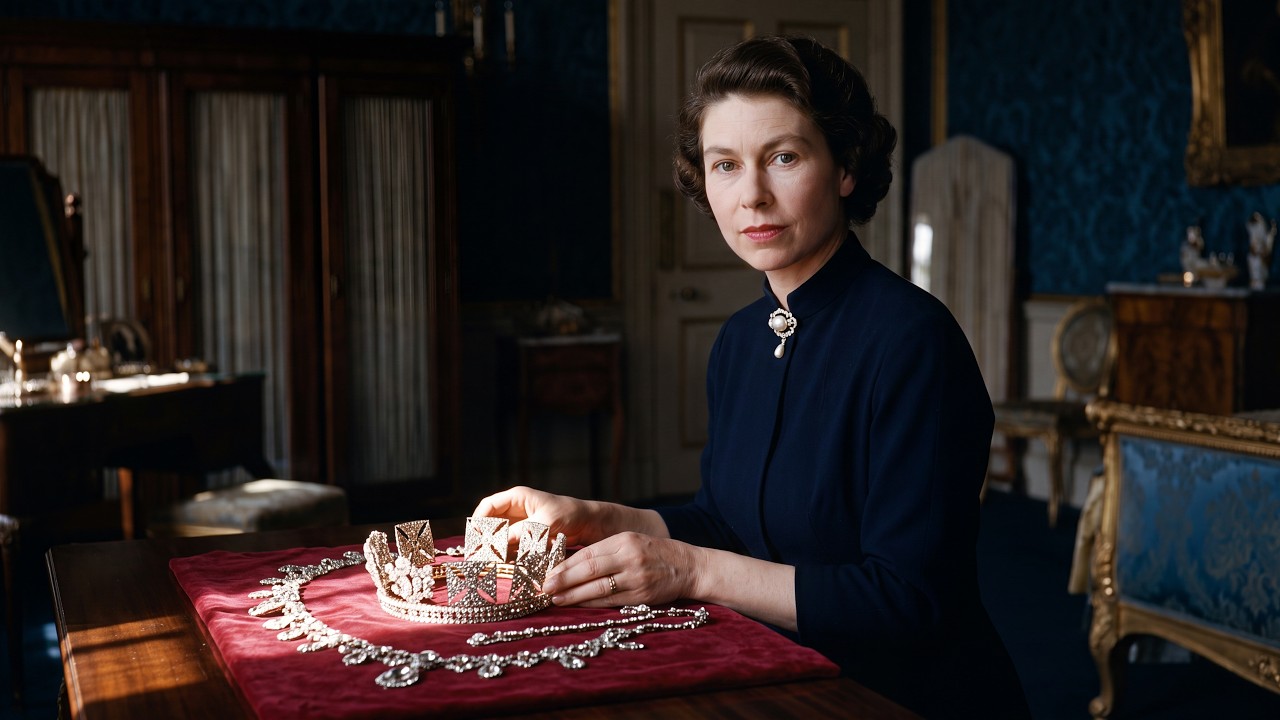
Over the course of a single reign, the queen wore thousands of outfits, each requiring selection, fitting, cleaning, pressing, coordination with the right jewels, the right gloves, the right hat, and delivery to the right place at the right time. On a major tour, the wardrobe could exceed 100 outfits, packed, shipped, and cared for across tens of thousands of miles and every kind of climate. Bobo oversaw that machine for decades, through more than half a century of state occasions, without a single public error and without a single word of complaint ever reaching the press.
The power this gave her was felt quietly by everyone who worked around the queen. New staff arriving at the palace were reportedly given one warning above all others: "Don't upset Miss MacDonald, or you'll spoil the queen's day." It was half a joke and entirely true. Bobo controlled the most private hours of the queen's routine, the waking, the dressing, the small adjustments that set the tone for everything that followed. A dresser in a bad mood could ruin the queen's morning, and a ruined morning could cast a shadow over a formal occasion. So the palace trod carefully around her.
Yet the woman who could freeze a nervous footman with a look was, to Elizabeth herself, something far warmer and far simpler. Even in old age, Bobo performed the small daily rituals with her own hands. She woke the queen every morning with a cup of tea. She drew her bath. She laid out the clothes for the day. These were tasks she had performed since the 1920s, and she would not surrender them to anyone, because they were not chores to her. They were the connective thread of their entire relationship, renewed each morning. The affection was mutual. On Bobo's birthday, the story goes, the queen carried the tea to Bobo, serving her servant one morning a year in acknowledgment of all the mornings Bobo had served her.
Only Bobo could speak to the queen with complete frankness, and only Bobo did. While courtiers weighed every word, Bobo said what was on her mind in a direct Scottish manner. If a piece of jewelry was wrong, she said so. If the queen was being difficult, she said so. It was a family frankness, the liberty of someone who had earned the right to honesty through a lifetime of loyalty. In a world built on flattery, Bobo was the one who told her the truth about the hemline, and the queen valued that more than any compliment.
The real test for a dresser comes not on a quiet morning in the palace, but in a crisis far from home when everything goes wrong at once. That test came in 1952 at a hunting lodge in the highlands of Kenya, on the worst night of Elizabeth's life, when a princess went to sleep and woke up a queen.
In early 1952, Princess Elizabeth set out on a long tour of Commonwealth nations on behalf of her father, whose health had deteriorated. King George VI was a sick man, worn down by war and worry and the cancer that was quietly consuming him. The king came to the airport to see them off on the last day of January. He stood on the tarmac, a visibly frail man, and watched the plane rise until it vanished from sight. It is one of the most poignant images of his reign, a dying father watching his daughter leave, both of them knowing without saying what that farewell might mean.
Before they left, the king reportedly turned to Bobo with a specific instruction, as if handing over a trust from one guardian to another. "Look after Lilibet for me, Bobo," he said. It was a small sentence and a vast responsibility, and it was the last significant thing he would ever ask of her. Within days, he was dead, and Bobo would spend the next 40 years keeping a promise to a man already in his grave.
On February 6, 1952, the king died in his sleep at Sandringham, the family home in Norfolk. The crown passed in that moment to a young woman thousands of miles away who did not yet know her father was dead. Elizabeth was 25 years old. Her father was 56. The responsibility the dying king had placed on Bobo days earlier, "look after Lilibet for me," had become the responsibility of caring for a queen overnight.
The party had reached Kenya and stopped at Sagana Lodge, a timbered hunting lodge given to the couple as a wedding present, set in wilderness teeming with big game. There, in the first week of February, the news came. For a few strange hours, she was the only sovereign in the world who did not yet know she reigned. When the news finally reached the lodge, the young woman who had climbed a treetop lookout as a princess came down from the hills as a queen.
What followed the grief was a practical emergency, and its weight fell directly on Bobo. The new queen, returning to a nation in mourning, had to wear black from the moment she stepped off the plane. This was not a luxury. It was the first public act of the new reign, and the whole country would be watching. But the tour had been planned for sunny days and ceremonies, for garden parties and safaris, not for the sudden death of a king. There were no mourning clothes in the luggage. In the chaos of that terrible day, the problem fell to the one person whose job it was to solve it. Bobo sent a telegram to London so that black clothes would be ready, so that the queen could return to her people dressed for the death of her father.
When the plane door opened at London airport and the small figure of the new queen appeared in black, descending the steps into the gray February afternoon, she was dressed appropriately for her father's death and the beginning of her reign, because Bobo had made sure of it. It was a small thing against the vast machinery of a royal death and succession. But it was also the kind of small thing that, left unattended, would have been remembered and criticized for a century. Bobo made sure there was nothing to comment on. That was the essence of her craft.
On June 2, 1953, Elizabeth was crowned in Westminster Abbey before the eyes of the world in a ceremony of ancient splendor and overwhelming grandeur. Millions listened on radio. Millions more, for the first time in history, watched a coronation on television, gathered around small flickering screens in living rooms across the country. At the heart of the event stood the young queen in a magnificent embroidered gown, laden with robes and regalia reaching back a thousand years of rule. Behind the scenes, far from any camera, was the woman who had prepared her for this day, who had checked the fall of the train and the placement of the jewels, to ensure that the world saw perfection when it looked at her.
The Crown acknowledged Bobo's service that year in its own quiet way. In the 1953 Coronation Honours, she was made a Member of the Royal Victorian Order, a decoration founded to reward personal service to the Sovereign, given by the monarch directly, not on the advice of any minister. For a woman who had started as an assistant nursemaid from the Black Isle, it was a remarkable proof of her standing. It announced in the language of official honor what the family had long known in private: that this servant was not ordinary and never had been.
Then came the tour that set the seal on her power. In late 1953, the young queen set out on a major Commonwealth tour, the first of her new reign, a journey that would take her around the world and keep her from Britain for nearly six months. The queen traveled some 40,000 miles across oceans and continents, through tropical heat and southern seas, meeting millions of crowds and completing hundreds of engagements. At every one of those appearances, the queen had to look her best, dressed in fresh clothes and appropriate jewels, suited to the country, the climate, and the occasion. By one account, the wardrobe for that single tour exceeded 100 outfits, and Bobo oversaw every detail of it.
More than 100 outfits, each with its matching shoes, gloves, and hat, each needing to survive shipping and packing and humidity, to emerge immaculate. Jewels worth a fortune, transported in secrecy from country to country. A schedule so tight that any delay in one city cast a shadow over the next. Bobo kept that precise machine together across 40,000 miles, so that a young queen, at the start of her reign, could appear day after day, country after country, never looking tired, disheveled, or inappropriate. The public saw a radiant queen. They did not see the woman from the Highlands who made that radiance possible.
The jewels above all were the field where her judgment became a kind of statecraft. On an official visit to Pakistan in 1961, Bobo helped coordinate one of the most striking royal looks of the era. The queen wore a gown of ivory and emerald green duchess satin, with the Vladimir Tiara and the Cambridge Emeralds, chosen to complement the state orders of Pakistan. To an untrained eye, it was just a beautiful dress on a beautiful evening. In reality, it was a message, a precise piece of visual diplomacy, blending color, jewel, and honor to compliment the host nation and dignify the queen. Decisions of that weight, seen by millions and read as messages of respect between nations, were made inside the dressing room by Bobo.
The public admired the queen's flawless appearance and assumed it came from committees and designers and the machinery of state. The truth was that most of it came from one woman with a lifetime of experience and an unerring eye, working out of sight, answerable to no one but the queen. Bobo did not design the clothes or own the jewels. But she decided how they worked together on the queen's body, and in doing so, she quietly shaped, daily, the most recognizable image of the age.
For the world, she was the faithful old retainer. But inside the palace walls, she was something else: a woman the other servants learned to fear. A great royal household runs on hierarchy and everyone knowing their exact place. Bobo MacDonald was an exception the hierarchy could not place. On paper, she was a dresser, a senior servant, but still a servant, far below the private secretaries and palace officials who managed the queen's official life. In reality, she had more private influence than almost any of them, because she possessed something none of them could acquire: the queen's absolute trust, built over a lifetime, impossible to fake.
A woman of low title and high power is an uncomfortable thing in a system built on rank, and the household felt it. The result was that Bobo inspired resentment and fear in roughly equal measure. She was, by many accounts, difficult, withdrawn, and demanding. She guarded her access to the queen jealously, brooked no rivals, and made little effort to endear herself to those around her, because she did not need to. Her power did not come from being liked. It came from being trusted by the one person at the top whose word could not be overruled. So she could afford to be brusque, even off-putting, and often was. To junior staff, she was a forbidding presence who did not smile, a woman it was wise to keep happy and dangerous to cross.
Part of what annoyed the household was that Bobo broke the one rule a great house lives by: the rule that everyone has a master. The footman answers to the butler, the maid to the housekeeper, the private secretary to the queen through a chain of command everyone understands. But Bobo answered to no one but Elizabeth herself. She could not be disciplined by palace officials, moved by the Master of the Household, or overruled by anyone short of the Sovereign, and the Sovereign would never overrule her. In a world that ran on clear lines of who commanded whom, she was a line that ran straight to the top and stopped there. That made her, in the plain practical sense, unmanageable, and an unmanageable colleague is a disturbing thing to work beside.
There was a price for this on everyone, and there was a price for it on Bobo too. The jealousy she inspired isolated her within the very house she had devoted her life to. She had no peers among the servants, no circle of friends among them, because her closeness to the queen set her permanently apart. She was above the servants and below the family, belonging fully to neither world. It was a lonely place to stand, and she stood in it for decades, unmarried, childless, her heart devoted entirely to one person, with little warmth left over for anyone else. The power that made her formidable was the same power that left her alone. She seems to have felt that isolation and borne it without complaint, because she had made her choice long before and had no intention of reversing it.
Yet when she turned that hard nature toward the queen, it became something gentle, even funny. The frankness that annoyed the staff was, to Elizabeth, a rare and precious honesty. There is a story from a tour of Canada that captures it perfectly. The queen, tired, hesitated to wear her tiara for an occasion. Bobo would not have it. "Oh, don't be so silly," she scolded. "Put it on." And so the queen submitted like a child to the woman who had raised her, put on the tiara, and went out looking, as the phrase went that night, worth millions of dollars. No courtier on earth would have spoken to the queen that way. Only Bobo could call the Queen of the United Kingdom "silly," and only Bobo would dare.
That was the paradox of her character. Frightening in the corridors, beloved in the dressing room, cold to the staff, warm to the one person who mattered. She made herself indispensable and disliked in equal measure, and she seems to have accepted that bargain without regret, because the only relationship she cared about was secure, and the rest she could do without. She chose her life narrow and complete, and she defended that choice with as much ferocity as she defended the queen.
There was a test awaiting every servant in Bobo's position, a test that grew stronger with each passing year and each passing decade. She sat at the heart of the most interesting family in the world, holding secrets the press and publishers would have paid a fortune to hear. All she had to do was talk. And the royal family had already learned, in the most painful way, exactly what happened when a trusted servant decided her memories were hers to sell.

In 1950, a governess sold her memories of the two little princesses, and the family never forgave her. Her name was Marion Crawford, and for years she had been the private governess to the young princesses, Elizabeth and Margaret. The children adored her and called her "Crawfie." She was a warm and central figure in their upbringing, trusted with the intimate facts of their small daily lives. Then, in 1950, she published a book. It was called "The Little Princesses," and it told the story of those childhood years, with all their affection and gentleness. By the standards of any later age, it was entirely harmless. It revealed no dark secret, exposed no scandal. She had simply written, with warmth and fondness, about the private childhood of royal children, for money.
The reaction was total and permanent. The family closed their doors to her. All contact was cut off, never renewed, and she was erased from the circle she had served for so long. The warmth she had described with such affection was withdrawn from her completely and forever. The sense of betrayal was so deep and so lasting that her name became synonymous with treachery inside the palace. For decades afterward, any servant who spoke or wrote about the family for money was said to be "doing a Crawfie." It was the worst accusation that could be leveled at a royal servant, and it hung over everyone in the queen's private service as a warning and a threat.
The lesson was not lost on anyone who served the family, and it was certainly not lost on Bobo. Crawfie had sold no scandals. She had written warmly, even lovingly, about two little girls she had helped raise, and her book was gentle by any measure. Yet it cost her everything, because the offense was not in what she said. The offense was in saying anything at all, in treating the family's private life as something that could be discussed for money. The family drew their line at the hardest possible place, at total silence, and made Crawfie an example for everyone who came after.
That was the fate available to anyone in Bobo's position who broke the rules. And Bobo had far more to reveal than Crawfie ever had. Crawfie had a few years of nursery memories. Bobo had 67 years at the heart of the family, spanning a queen's reign and most of the next. She had been present for the private marriage, the private grief, the private pressures, the ordinary human frailties that lay behind the polished public face. She had known the queen as no one else on earth had known her, in the unguarded hours when the crown was set aside. A single honest interview from Bobo MacDonald would have been worth a fortune and would have made headlines in every country where newspapers were printed.
The temptations grew with time. As the decades passed and the press became more voracious and more intrusive, the value of what Bobo carried rose higher and higher. The deferential coverage of the 1920s had given way by the 1980s to a ferocious popular press culture that would pay almost anything for royal secrets. Publishers would have offered sums beyond anything a Highland servant in a three-room cottage could have dreamed of. In her old age, after her working life was over, she had every reason a person could have to exploit the one asset she truly owned. And yet she never did. Not one interview, not one line written, not one detail leaked, in 67 years.
By the 1980s, newspapers were paying enormous sums, and publishers far more, for the private recollections of anyone who had stood near the throne. Bobo stood closer than almost anyone, and for longer than anyone, across two reigns and nearly seven decades. One book, or one serialized interview, would have made her a wealthy woman many times over, she who had spent her entire working life on a servant's wage, with no home of her own beyond the rooms the palace lent her. The incentive to speak was enormous, and it grew with every passing year. She never wavered for a moment.
When the two women are placed side by side, the scale of Bobo's discipline becomes clear. Crawfie wrote a modest book about a few years in the nursery and lost everything. Bobo kept the secrets of two reigns for most of a century and spent none of them. The one who had the least to say said it and was destroyed. The one who had the most to say said nothing and remained beloved to the end. Whatever secrets Bobo carried, she took them with her to the grave, intact and silent. She never loosened her grip on them, not for money, not for flattery, not for the simple human desire to be known as someone who had been there.
The reason for her stubbornness is her real mystery, and the answer seems to lie in how she viewed the secrets in the first place. To a journalist, those secrets were stories. To Bobo, they were simply Elizabeth, the private truth of a person she had loved since the child was six weeks old, and selling them would have been a betrayal, not of an employer, but of a family. She never separated her duty from her love, and so the question of speaking never really arose for her. There was nothing to decide. The secrets were a trust because the woman they belonged to was a trust. For Bobo, that was the beginning and the end of it.
That silence is the true measure of this woman, and the essence of this entire story. She knew everything, and she said nothing. In an age when everyone was learning to sell every secret they found, she sat on a treasure of secrets and kept the faith completely, for her entire life. The question that presents itself before such a choice is: what exactly was that silence protecting? And did the woman who kept it understand the price she was paying?
What lay behind that silence was what gave it its true value. She was guarding a living human being with a heart and a history and many fears. Over the decades, she saw Elizabeth in every state a person can be in: as a frightened child in a shelter, as a grieving daughter in Kenya, as an exhausted young queen at the end of a 40,000-mile tour, as a wife inside a marriage with its pressures like any other marriage. She saw that woman cry, rage, and despair. In the private hours the public was never allowed to share, she closed the door on every one of those moments and hid them.
Think of the scale of what she had to guard. She watched closely the long friction between the queen and Prince Philip in the early years, a tension she herself was partly the cause of. She was in the room during family arguments and private fears. She saw the ordinary weaknesses every person has, which must never be seen in a monarch above all people. Any one of those moments, told to the right journalist, could have damaged the image on which the entire institution depended. Bobo kept all of it, year after year, and gave none of it away.
The public was allowed to see a serene, untouchable queen precisely because the people closest to her, and Bobo most of all, refused to show them anything else. That silence was a form of love, and a form of power too, though Bobo would never have used that word. She had the power to hurt the person she loved most in the world. And she chose, every day for 67 years, not to. That is a power of a special kind, one that leaves no trace, because its only achievement is that nothing happened, no story broke, no secret surfaced. The measure of her success is silence, and silence is impossible to see.
She spent her entire life protecting a woman from the world, and the world never knew it was being kept from her. That is the strange arithmetic of a life like hers. The more successful she was, the less of it showed, because success for Bobo meant that nothing happened, that no story got out, that the private woman behind the crown stayed private to the end. History keeps precise records of the things that happen. It has almost no way of recording the things that were prevented from happening. And every one of Bobo's achievements lay in that second, invisible column, real, complete, and impossible to quantify.
For Elizabeth, the value of that was beyond description. A monarch is surrounded by people and yet utterly alone, watched by millions and truly known by almost no one. Everyone around the queen wanted something: favor, position, a moment of her attention, or a story to tell later. Bobo wanted nothing. She had no ambition for advancement, no book to sell, no agenda to pursue. She simply loved the woman and protected her, and asked in return only to be allowed to continue. In a life crowded with people who could not be entirely trusted, Bobo was the one who could be trusted without reservation, the fixed, safe point in a watchful world. That, more than the tea or the tiaras, was what she truly provided. She gave the queen a place to be herself without caution.
There is a loneliness that comes with the crown that no title reaches and no luxury heals. And Bobo was, for decades, the queen's surest remedy for that loneliness. With almost everyone else, Elizabeth had to be the queen, calm and careful and always perfect. With Bobo, she could simply be Lilibet, the girl at the cold window, tired or angry or ordinary, certain that none of it would ever travel beyond the dressing room. That freedom, small and daily and utterly private, was one of the rarest things in the queen's life, and it existed only because there was one woman who could be trusted without reserve.
People often say the queen kept her feelings to herself. They rarely stop to ask: who was she allowed to show those feelings to? The answer, more than anyone else alive, was Bobo. She knew everything, and she said nothing. It sounds like a boast, but for Bobo it was closer to a vow, made young and never broken. The child she had warmed against the cold became the most watched woman on earth, and Bobo appointed herself guardian of the one thing surveillance could not reach: the private self behind the crown. She protected it as she had once guarded a sleeping princess in a shelter under Windsor. Fiercely, quietly, and without any thought of reward. The secrets were safe with her because they were not secrets to her at all. They were simply Elizabeth, and Elizabeth was a trust in her keeping.
But even the most devoted guardian is a mortal creature bound by a mortal body. Bobo gave her strength to Elizabeth from the age of 22, and she kept giving it long past the age when most people stop working. The morning tea still came, the bath was still drawn, the clothes were still laid out by hands that had done it for more than half a century. Then, slowly, those hands began to fail. And the woman who had spent a lifetime caring for the queen faced the one enemy she could not manage for her, and could not avoid herself.
Most people in service leave their jobs long before age catches up with them. Bobo did not. Even in her eighties, she still performed the rituals she had begun as a young woman, waking the queen with a cup of tea, drawing her bath, laying out her clothes for the day. She had done these things since the 1920s, through coronation and world tour and the long years of the reign, and she kept doing them long past the age when she could have rested. They were not duties to her. They were the last living thread of the bond that had begun in the nursery, and she clung to them because letting them go meant letting go of the meaning of her entire life.
The Crown honored her long service in its quiet way as the years passed. She was made a Member of the Royal Victorian Order in the year of the queen's coronation. In 1986, now an elderly woman, she was promoted within the same order to the rank of Lieutenant, a further mark of personal esteem from the queen. These honors were not given on the advice of any minister. They were private gifts from the queen herself. It is the monarchy's way of saying "thank you" for a lifetime of service the public never saw. For a woman who had begun as an assistant nursemaid with no rank at all, these honors were an astonishing measure of how far trust alone had carried her.
The arithmetic of that devotion is stark. She entered royal service in 1926 and served the queen in various capacities until the early 1990s. That is a span of nearly 67 years devoted to a single person over most of a century. She was beside Elizabeth longer than the queen's own marriage lasted, longer than any other relationship in that long life. When historians look for the closest and most enduring bond in the private world of Queen Elizabeth II, they do not find it in a statesman or a courtier, or even in the ordinary sense of family. They find it in Bobo.
But time is the one force no devotion can stop. In her late eighties, Bobo became frail, and the small tasks she had guarded so jealously became harder and then impossible. Illness overtook her. The woman who had managed the queen's mornings for six decades could no longer manage her own body, and the great reversal of the entire story began. The one who had always given care now needed it, and the one she had cared for made sure she got it.
The queen did not do what a great royal household could easily have done: retire an old servant and quietly move her out of sight. She did the opposite. Bobo was allowed to keep her own suite of rooms inside Buckingham Palace, at the heart of the working monarchy, with no duties and every comfort provided. When Bobo became seriously ill, nurses were hired to care for her, on royal instructions, within the palace walls. The old woman from the Black Isle spent her final years not in a distant cottage, but in an apartment inside the queen's own London home, cared for at the queen's expense and by the queen's command.
The ordinary fate of a servant too old to work shows how extraordinary this was. The usual end for such a life was a modest pension, a quiet retirement far from the great house, out of sight, and soon forgotten. But Bobo got the opposite. She was kept at the heart of the queen's home, cared for like a member of the family rather than a retired employee. The queen, who could command almost anything, used that power to ensure that the woman who had raised her from infancy would want for nothing in her final days. It was gratitude paid in the only currency that mattered to them both: proximity. And it was offered by a queen who had never forgotten her origins.
It was an extraordinary arrangement, and it summed up everything Bobo had become. She was effectively a member of the family, and the palace treated her as one, even though she had not a drop of royal blood and no title to bind her to them. The relationship had come a very long way from its beginning. It started with a servant carrying a six-week-old baby, and it ended, sixty years later, with a queen quietly making sure her oldest friend was comfortable and close as the end approached. The roles had reversed completely, but the love that held them together had never changed.

There is something deeply moving in that final stage. For most of her life, Bobo was the one who noticed when Elizabeth felt cold and fetched a blanket. Now, it was Elizabeth who made sure Bobo was warm. The child at the window had grown into a queen, and the queen had not forgotten who stood beside her at that window on that cold, misty morning when the crown first came into view. For more than 60 years, the current of care had flowed in one direction, from Bobo to Elizabeth, through ten thousand small acts of loving service. At the end, it flowed the other way, and the queen allowed it because there was nothing else love could do. She could not give Bobo back her strength or add a single year to her life. She could only make her final stage warm and generous and free of need. And that is exactly what she did.
On September 22, 1993, Bobo MacDonald died in her sleep in her own room inside Buckingham Palace. She was 89 years old. She died peacefully in her bed, within the palace apartment that had been her home, surrounded by the quiet of the house she had served all her life. There was no drama in the way it happened. There was no public decline reported in the papers. The woman who had spent 67 years out of the public eye left the world exactly as she had lived in it: privately, and close to the queen.
She had entered royal service at 22, and she left it, and left life, as an old woman a few doors down from the Sovereign, never having really moved from Elizabeth's side in all those years. There was a quiet mercy in the way it happened. She did not die in a hospital ward among strangers, or alone in a rented room far from the life she had known. She died in her own bed, in her own room, inside the house she had served, with the queen she loved nearby, within the same walls. For a woman who had given everything to one family and one place, it was as gentle an end as such a life could hope for, and it was the end the queen made sure she had.
The place of her death matters because it was far beyond what her rank would have earned her. Buckingham Palace is the principal residence of the British monarchy, one of the most guarded and exclusive addresses on earth. To have a private apartment there, with no official duties, only as the queen's personal companion, was a privilege never granted to an ordinary servant. Yet that is where Bobo lived her final years, and that is where she died. The girl from the three-room railway cottage on the Black Isle breathed her last inside the palace of the Queen of the United Kingdom, in rooms kept for her because the Sovereign wished it.
When the news was announced, the palace chose its words with the usual courtly restraint, and yet the feeling showed through. A spokesman said simply that the queen was, naturally, very saddened to hear the news. In the reserved language of royal statements, where emotion is never displayed, that simple sentence carried real weight. This was not the death of a distant servant to be marked with a line of formal regret. This was the loss of the woman who had known the queen longer, and more intimately, than almost anyone else alive. The grief behind the sentence was the private grief of a woman who had just lost the last companion of her childhood.
For those who understood Bobo's standing, the simplicity of the announcement said more than any eulogy could. The world was told in one sentence that an elderly former servant had died. What had actually happened was that the queen had lost the one person who connected her, without interruption, to her beginnings. The face that had been present before the throne, before the war, before the crown was even a certainty. There was no public funeral, no flags lowered across the country, because no one outside the palace grasped the scale of the loss. It was a private grief for a private woman, felt most deeply by the one person on earth who had known her longest and needed her most.
Consider this woman's life for a moment, in its simple facts. Born in 1904 in a Highland cottage, she entered royal service in 1926 at age 22 to care for a six-week-old princess. She took full charge of that child from 1930. She became her dresser when the nursery years ended. She was present for the accession in 1952 and the coronation in 1953, and the Crown honored her in that same year and again in 1986. Finally, she died in her own apartment in the palace in 1993, at age 89, after 67 continuous years beside one woman. Very few lives in the history of the monarchy can show such a single unbroken line from nursery to deathbed, without a single deviation.
It was a life empty of the usual landmarks that mark most people's time: no marriage, no children, no house bought, no family founded. In their place was one continuous act of devotion that began in 1926 and ended only with death. Measured by the standards of ordinary people, she had little to call her own. Measured by the only standard that mattered to her, the trust of the person she loved, she had more than almost anyone, and she kept it unbroken for longer than most marriages last.
For the queen, the loss reached a place public life rarely touched. Elizabeth had lost her father, and in time she lost her sister, her mother, and her husband. But Bobo was different from all of them, because she was the only one whose roots went back further than any of them into the queen's own beginnings. She was the first face, the oldest constant, the person who was there before the crown became a distant certainty, when Elizabeth was just a little girl who needed someone to notice she was cold. To lose Bobo was to lose the last living link to that first, unguarded self. It was the closing of a door that had been open since 1926.
And so the queen did something monarchs almost never do, something that would tell the entire country, without a single word of explanation, how important this quiet Scottish servant had been to her. There is a strict, unwritten economy to public royal grief. The queen, as a rule, did not attend the funerals of her servants, no matter how devoted. The demands on her were too great, and the risk of setting a precedent was too high. Her presence at a graveside was rare and deliberate, reserved almost entirely for her family and the greatest figures of state. So when it became known that the queen would personally attend the funeral of Bobo MacDonald, everyone who understood the nature of the court understood immediately what it meant. This was not a servant being buried. This was a member of the family, by every measure except blood.
By attending in person, the queen told her household, and anyone in the world who was watching, that Bobo MacDonald had never been a servant like other servants. She had been, in the truest sense the institution allows, one of the family. The funeral was held on September 30, 1993, eight days after Bobo's death, at the Queen's Chapel beside St. James's Palace in London. It is a small, beautiful royal chapel, first built in the 17th century for Henrietta Maria, the French Catholic queen of King Charles I. It was an intimate rather than grand place, a quiet and dignified space for a quiet and dignified woman, and it suited Bobo perfectly. There was no great public display, no state farewell, no procession through crowded streets. A small service in a small chapel for a woman who had spent her entire life avoiding the attention a larger funeral would have brought.
It was fitting that the final chapters of Bobo's life should unfold in a place so tied to the history of the Crown. The chapel had stood since the 17th century, originally built for a queen of England 300 years before, and it now received the coffin of a railway worker's daughter from the Highlands, who had served the monarchy with more devotion than most who were born to it. She would not have wanted anything grander. A small, dignified service in an ancient royal chapel, with the queen among the mourners and no prying crowds, was exactly the farewell that suited a woman who had spent her entire life out of sight.
And there, among the mourners, sat the Queen of the United Kingdom. There are still photographs of Elizabeth leaving the service, and they show something the public was almost never allowed to see: the queen in private grief for a person most of her subjects had never heard of. She had come to say goodbye to the woman who had woken her with tea for most of a century, who had dressed her for her coronation, who had ordered the black dress on the worst night of her life, and who had kept every one of her secrets for 67 years. A queen who could not attend the funerals of her servants made an exception for this one, because this one had been there from the beginning.
Bobo was not quite the last of her family in that palace. She was survived by her younger sister, Ruby, who had entered royal service at the same time, around 1930, and served Princess Margaret as her dresser. The two sisters from the Highlands had devoted their entire adult lives to the two royal sisters, in a parallel devotion that ran side by side for more than 60 years. Now one of the four was gone, and the long, strange symmetry of their lives had finally begun to come apart. Two sisters from the Highlands, two royal sisters, four lives intertwined for over a century. It had begun in a nursery in the 1920s when two girls from the Black Isle came south to serve two little princesses, and it had continued through war and coronation and the long turning of the years, until age began to take them one by one. Now the first of the four was gone, and the fabric that had seemed as if it would last forever was beginning, quietly, to unravel.
What Bobo left behind was, by her own design, almost nothing. She never married and had no children. She left no memoirs, no diaries offered to a publisher, no cache of letters kept for their scandalous value, no recorded interview for posthumous release. There was no final revelation prepared to make headlines, no last word for the world. She had spent an entire life saying nothing, and she died holding to that to the very end. The only monument she wanted was the one she had already built, invisible and complete: a life of trust that was never broken.
That absence is in itself the most eloquent thing that can be said about her. In a century when palace servants turned their memories into money, Bobo turned hers into silence and carried them with her to the grave. Historians studying Queen Elizabeth II keep arriving at the same closed door. The person who knew the queen in her private life best, and for the longest, is the one person who never said a word about her. Bobo is the great absent witness to the reign, and she is absent on purpose. She took the truth of her life with her, exactly as she had always intended.
In the years since her death, Bobo has become a kind of measure, the standard against which every other royal servant is quietly judged. Where later members of the household wrote books, gave interviews, or sold their stories, commentators return to Bobo as a reference point for an older, fading loyalty. When Angela Kelly, the queen's later dresser and confidante, published her own accounts of her service with the queen's blessing, Bobo's name was invoked for comparison, as a woman from an earlier age who would never have dreamed of putting a single private word on paper. Bobo has become the very definition of discretion, the last true keeper of the old code.
Bobo herself would have found this comparison strange and probably unwelcome. She never thought of herself as a guardian of any code, or as an example to anyone at all. She thought of herself as Lilibet's, and that was all. The discretion that later generations would take as a model was, to her, simply the natural behavior of someone who loved a person and would rather have died than hurt her. There was no performance in it. She lived the only life that made sense to her, and history noticed her only later, when it came looking for her testimony and found a locked, silent door.
That code is now largely gone, and its passing is part of what makes her story linger. The world Bobo came from, the world of lifelong service and absolute discretion, has almost entirely vanished. The deferential press she began under gave way to a culture that treats proximity to celebrity as a currency to be spent as quickly as possible. Against that backdrop, a woman who held the greatest secrets of the age for 67 years and sold none of them looks less like an ordinary servant and more like something from a lost world. She is remembered because she represents the thing the modern age no longer produces. A figure whose loyalty is almost impossible to imagine now.
It would be easy to turn her into a simple lesson, the good old servant against the greedy modern one. But her truth is stranger and more affecting than any tidy moral. Her silence came from something far deeper than obedience or fear. She saw exactly what happened to Crawfie, and she understood the rules as well as anyone. And yet it was not the rules that truly bound her. What bound her was the settled constancy of a heart that had attached itself once, and completely, to a single person, and had never wavered in 67 years. That constancy in itself was a kind of love rarer than any code, and it is something that barely exists in the world anymore.
Her silence was not an emptiness. It was the loudest thing she ever said. Every year she kept her faith was a year she chose again to protect the woman she loved rather than profit from her. And the length of that choice, 67 years, turns simple discretion into something approaching devotion in its purest form. She had the power to wound the queen at any moment, and she chose not to use it on every single day of her life. The measure of that is not a monument or a memoir. It is an absence, a story never told, a treasure of secrets that simply resided and remained silent, forever.
She knew everything, and she said nothing. That was her entire achievement, and it was enough. She came from a three-room railway cottage on the Black Isle with nothing, no rank, no wealth, no name that opened doors, and she reached the heart of the monarchy on the strength of a single quality: her absolute, unbreakable trustworthiness. What she built there was never meant to be seen, because it consisted entirely of things that never happened. Secrets never revealed, stories never sold, a queen whose private life stayed private because one woman refused to speak, for her entire life. It is the rarest kind of legacy there is. A life whose greatness lies precisely in what it withheld.
And in the end, it all comes back to where it began: a cup of tea carried down a quiet corridor in the early morning. For most of a century, Bobo carried that tea to Elizabeth; first to a little girl in a cold nursery, then to a young princess, then to the most famous woman in the world, and finally, as an old woman herself, to the queen she had loved since a time neither of them could remember. On Bobo's birthday, the queen carried the tea herself in the opposite direction, once a year, in memory of all the mornings it had gone the other way. Then, one September morning, the tea was not carried, because the woman who had carried it for 67 years was gone. And there was no one else on earth who could take her place.
That is the true price of the crown. It shows itself not through scandal, but through a servant. A queen may be surrounded by thousands, but she is truly known by only a very few. And it may be that the deepest bond in her private life was with a woman the public never saw, who asked for nothing, and who guarded the one treasure she owned rather than spending it. Bobo MacDonald spent 67 years in the deepest heart of the most watched family on earth. She saw everything worth seeing, and she kept it all. She was the keeper of the door, and she never once let it open. And when she was laid to rest in a small chapel, with the queen among the mourners, the secrets of an entire reign went quietly to the grave with her, exactly where she had always intended them to go.